

The Death of Markos Botsaris 9/8/1823. The Battle of Kefalovrysos
The Death of Markos Botsaris 9/8/1823. The Battle of Kefalovrysos
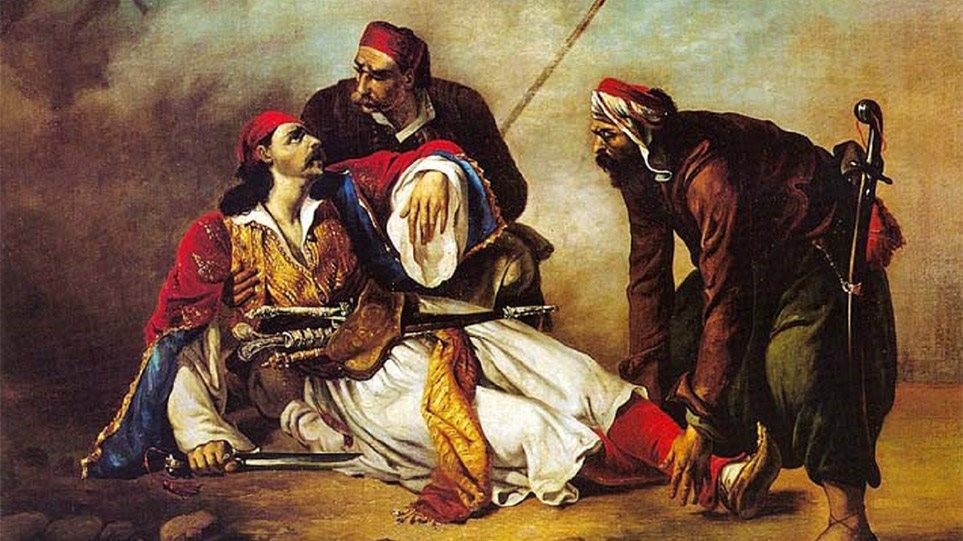
The first Siege of Messolonghi was a disastrous failure for the Turks. The Sultan had ordered Yusuf Pasha to gather an army with the aim of subjugating Central Greece. However, Omer Vryonis, out of jealousy, managed to disband Yusuf's troops. Thus, in the summer of 1823, the Sultan ordered Moustafa Pasha Iskodralitis to campaign with Vryonis.
Musta'i was then 25 years old and one of the greatest pashas of Albania. He had pashaliks in Shkodra, Vlora, Berat as well as all their provinces. In June 1823 he set out with ten thousand chosen soldiers. His uncle Jelaledin Bey, Sulca Korca and Ago Vasiari followed him.
To Moustais' 10.000 men would be added the army of Omer Vryonis and Kioutachis in Agrinio.
What was the reaction of the Greeks to these events? Absolutely nothing. The cursed discord had fallen upon the Greeks again for three reasons:
a) the appointment of Souliot Markos Botsaris as general of Western Central Greece from 1822. The Central Greek chieftains protested to Konstantinos Metaxas because he was a foreigner. Foreigner who? The one who delayed crowds of troops in Epirus for months? The one who saved their lives in Messolonghi when they were ready to surrender? b) the settlement of Souliots in Zapanti. This enraged the Greek and Turkish residents of the village. c) The hatred of the Butchers for Grivas. They attacked him and trapped him in a tower. They protested to Metaxas that if he did not leave Central Greece they would not be calm.
Upon hearing about the campaign of Moustais and Omer Vryonis, Constantine Metaxas did his utmost to reassure the Greeks: a) He appointed the protesting chieftains as generals of Central Greece for eleven days. This reassured them considerably.
b) He spread the word that the settlement of Souliotes in Zapanti was a lie to expel the Turkish residents while at the same time he rented houses in Messolonghi for the Souliotes to stay and
c) convinced Grivas to leave Central Greece.
Thanks to Metaxas, a defensive line of four thousand men was created in Makrynoros, which almost collapsed for the following reason: The Tzavelaioi (Zygouris and Kitsos) began to protest again about the appointment of Botsaris and incited the other chieftains against him. On July 14, 1823, Botsaris called the Tzavelaioi and spoke to them in such patriotic words that it moved them, causing them to forget their enmities. Later, on the same day, he called the other chieftains and announced his plan to confront Moustais. However, most of them objected to his plans, namely to go outside the city and fight Moustais there. Markos Botsaris discerned that behind all this was the general's diploma. He stood up and took out the diploma, which, adopting the customs of the people of Stereohella, he had on his belt, and spoke:
-I swear to you that I do not want or have asked for any office. The government gave me a degree, supposedly you are not worthy of receiving it? Well, I tear up my diploma in front of you!
He lifted it up and kissed it to show his respect for the Government. Then, holding it before the eyes of the chieftains, he began to tear it slowly until the diploma was split in two. He threw it on the floor, saying:
-Diplomas are given in battles and are not written on papers, but on the blades of swords! And those of you who do not want to follow me, let them sit here and turn to ashes!
No one disagreed with his plan now. They followed him and decided to stop Moustais once and for all. They managed to find 1.250 men with great difficulty. This handful of warriors had to stop the huge army of 10.000 Albanians.
On July 28, 1823, Botsaris passed by the monastery of Proussos where Karaiskakis was ill. The two warlords greeted each other like brothers and then Botsaris left the monastery forever…
On August 5, Celaleddin Bey with most of his officers and 5.000 warriors camped at Kefalovryso, twenty minutes from Karpenisi. Half of his army consisted of Mirdites, that is, Catholic Christian northern Albanians, a select body of excellent African snipers and the rest were Albanian Gekis. The rest of the army, together with Moustais, camped at Platania and other areas. On the same day, Botsaris with his one thousand two hundred and fifty men camped at Mikro and Megalo Chorio in Evrytania. Since further resistance was useless, Markos began to plan a night attack. However, he needed the appropriate information about the camp. So on the 7th of the month he sent three spies, his first cousin Thanasis-Toussa Botsaris, Ioannis Bairaktaris and his peer Thanasis Koutsonikas to enter the camp. On the evening of the same day they returned and reported the information they had gathered. Botsaris now began to prepare his young men for the attack.
Two hours before the great operation, Botsaris received a letter from Lord Byron, who wanted to meet him. Botsaris sent him this letter, which would be his last: “…Tonight I intend to undertake something against a body of Albanians of seven thousand, encamped just in this place. The day after tomorrow I will depart with my chosen men to come to meet your Excellency…”.
Shortly before they attacked, Mark went to a church to pray. There he met a priest. He ran towards him and after kissing his hand gave him a bag of gold coins. Then he said to him:
-Take it, my good man, and distribute it to the poor so that the soul of Markos Botsaris may be forgiven.
-What do you say, my child? Did Markos Botsaris die? (The priest didn't know him) -No... he's going to die, Markos replied!
At midnight on the 8th and 9th of August 1823, Markos Botsaris with 450 selected Souliotes (the other 800 would attack Platania) infiltrated the Turkish camp from the western side, which, as their spies assured them, was almost unguarded. After easily neutralizing the few targets, Botsaris gave his last instructions to his lads:
-We will attack first with the rifles and shout in Albanian to cause panic. Then we will grab the swords with the knives and if we are not distinguishable in the darkness we will ask the other person in Albanian again "who are you?". If he does not answer "steel" we will beat him.
The Souliotes, in the dark night, dug deep into the camp. Then, following the instructions of their leader, they began to shoot. The Albanians began to run back and forth, causing the others to panic. However, the officers came out of their tents and began to shout that they were not Greeks but some Albanians who had rebelled, something that happened several times. Botsaris then climbed onto a rock. A thunderous voice penetrated the entire camp, making everyone shudder:
-Wrong, they are not Albanians! You are trembling, you barbarians! It is Botsaris, my boy, and he has come to slaughter you all!
-Botsaris has come! (= Botsaris has come) they started shouting.
In the camp now a wild drama of death was being played out! The Albanians were running left and right to save themselves. From whom? Perhaps in the panic and darkness they were being separated? They were killing each other! Others, even thinking that the Souliotes were their own, ran towards them. By the time they realized their fatal mistake, they had passed into eternal sleep…
Among the lads, one stood out, the formidable Markos Botsaris, who was frantically searching the tents of the pashas. Next to him was his chief lad, Lambros. The two brave men searched the tents until at some point they entered a large one. There, Botsaris found Xafer Pasha. He caught him and gave him to his lads. He entered another and found Agios Vasiaris. Botsaris had conducted negotiations with Vasiaris in Messolonghi during the First Siege. He captured him and gave him to his lads as well. As for the guard of the tent, they didn't bother much. When he saw the giant of Soulio in front of him, he fainted!
At some point, a bullet hit Botsaris in the groin. Lambros runs to see.
-Stop, it's nothing! he tells him and, leaning on his sword, he stands up. Then he grabs an Albanian and asks him:
-Where are the pashas?
He, trembling, showed him a sheepfold for the army where Celaleddin Bey had gathered warriors, fortified it and was unleashing deadly fire against the Souliotes. Botsaris, without wasting time, ordered Lambros to call some young men together with Thanasis-Toussa and his brother, Kostas Botsaris, to gather around the sheepfold. The Souliotes gathered around it with cheers.
Botsaris raised his head a little above the fence to see how many enemies were gathered there to get an idea. He paid for this daring with his own life… A bullet whistling through the air hit his right eye and wedged his skull. “My patriots, I have been hit…” he managed to say and died!
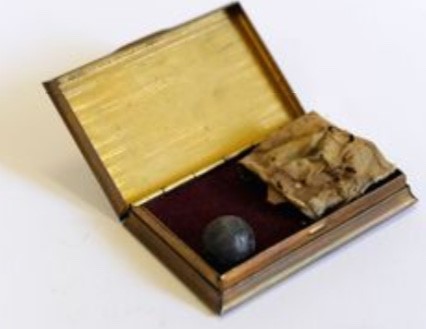
The bullet that killed M. Botsaris
Thanasis-Toussa immediately picked up his cousin's body and with thick tears in his eyes took it from the battle... The rest of the Souliotes, after being notified, fled. Celaleddin Bey then, out of joy, sent two hundred horsemen to disperse the Greeks. If this had happened, victory would have been for the Albanians. Fortunately, however, a chieftain named Giannis Tsaoussis with
With his chosen lads he captured a bridge that connected one end of Kefalovrysos to the other, and gave the Souliotes time to flee. They had only 60 dead and forty-two wounded. However, they had left behind for Moustaes to bury over twelve hundred killed.
When the Souliotes left, they gathered around their leader. They did not want to believe that he was dead! One of them slaughtered Agios Vasiaris in his despair and terrible sorrow...
A hundred young men decided to bring the dead man back to bury him in Messolonghi. And so it was, and they put him on a horse. They made him stand up like a warlord of Hades… As they passed by Prussos, Karaiskakis saw the funeral procession. Although sick, he leaned on his caryophile, limped down the steps and bowed to the remains of Markos, saying: "I wish that I, the hero Markos, would escape such a death!" Later, he sent a letter to the government:
"Mark was a genius. He had a mind like no other and had an opinion as righteous as Christ's! We couldn't even touch him!"
On the 10th of the month, his funeral took place. Thousands of men and women attended his funeral. Markos Botsaris was covered with a blue shroud. Konstantinos Metaxas allowed Botsaris' sister Maro to prepare him for burial. Souliotissa prepared the deceased and mourned him as she had done for other of her compatriots... Botsaris was buried in the church of Agios Nikolaos in Tourlida. The Archbishop was present. His coffin was supported by his young men in black fezzes. The Albanian prisoners also watched. When the funeral speech ended, his men bowed to the coffin and buried him, where he had defended almost a year before, in the Great Mound of Messolonghi. As the coffin was covered with soil, the city's sacred cannons sounded thirty-two times. As many years as...
The Messolongites were not the only ones who mourned. All of Greece mourned and Mavrokordatos managed to spread Botsaris' fame to Gaia, Italy and later throughout Europe. A square in Strasbourg still bears his name today. But even his own enemies honored him! Hasan Arsin Pasha said: "If he were a Muslim, I would think that the prophet had returned to the world!". Even Moustai, whose men Botsaris had slaughtered in one night, said of him: "I wish I had his bravery!". Finally, Karaiskakis dedicated these immortal words to the Eagle of Soulion:
"Like Marcos, a hero mother never gives birth again"
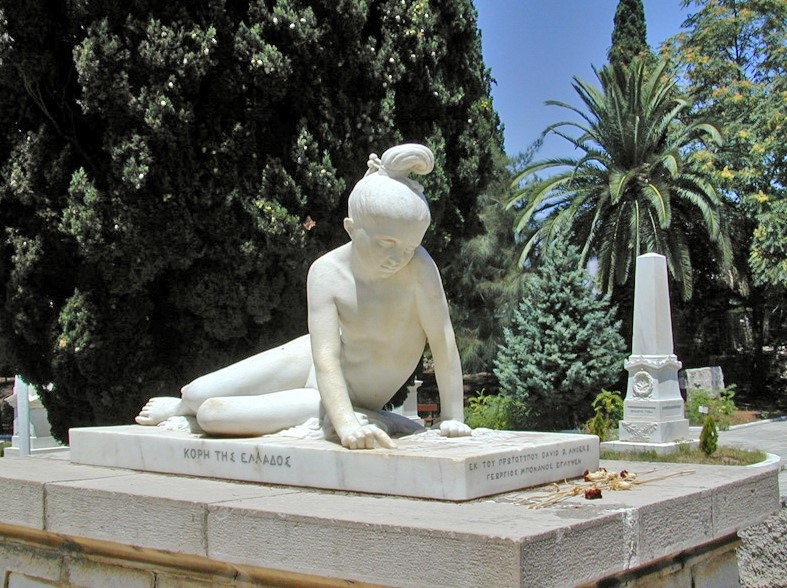
The grave of M. Botsaris in Messolonghi