

Houthi cutting-edge weapons are changing the game in the Middle East
Houthi cutting-edge weapons are changing the game in the Middle East

The latest attacks by the Ansar Allah rebels in Yemen, better known as the Houthis, in the Red Sea have caused serious problems in international shipping, resulting in many companies considering stopping using the Suez Canal, as decided by MSC Mediterranean Shipping Co, based in Switzerland.
A superficial reading of the developments might suggest that the United States, perhaps in collaboration with other countries, could use its superior military technology to “punish” the Houthis. However, this is not as easy as many might think. The Houthis are a peculiar war machine that possesses symmetric and asymmetric capabilities, utilizing both low and high technology, and as far-fetched as that may sound, they are a missile superpower.
For example, a report jointly issued by France, Germany and the United Kingdom, based on images that appeared on social media on April 22, 2019, referred to Burkan-2H missiles used by the Houthis against targets in Saudi Arabia, which featured maneuverable reentry vehicles (MaRVs), a capability previously considered the preserve of technologically advanced states. Similar MaRVs equip the famous Chinese DF21D anti-ship ballistic missiles (ASBMs) and are considered a strategic asymmetric threat to US carrier battle groups.
The Burkan-2H is referred to as a variant of the ballistic missile Qiam:, which has been modified to attack targets at distances greater than 1000 km. The Houthis used Burkan-3 missiles to strike a Saudi military installation in Dammam in eastern Saudi Arabia on August 1, 2019. But on a more tactical level, the Houthis have also developed weapons of great destructive power and high precision of strike. For example, on October 28, 2018, they presented a guided version of the Badr-1 missile, the Badr-1P, which they claimed to achieve a range of 130 km and an impressive accuracy of three meters.
The original Badr-1 is an unguided heavy artillery rocket that was unveiled in March 2018. It has a diameter of between 300 and 350 millimeters and uses fins on the rear to stabilize its trajectory, similar to those of the Badr-XNUMX family. of Iranian tactical missiles Fateh-110.
Also, on April 16, 2019, the Houthis presented a new version of the Badr missile series, the Badr-F, which has an air burst warhead. That is, it explodes in the air to maximize the lethal effects on the ground. According to a representative of the organization, the missile has a range of 160 km and explodes 20 meters above the ground, spraying an area with fragments 350 meters in diameter. Incidentally, such weapons can be critical game changers in the Greek-Turkish system.
Anti-aircraft missiles from farm trucks
Furthermore, on March 21, 2018, the Houthis shot down a Saudi F-15 fighter jet with an anti-aircraft missile. Indeed, a Royal Saudi Air Force F-15 was shot down that day, but its pilot managed to return it to base. Interestingly, as seen in the video, the Houthis used a Soviet-made R-27 air-to-air missile that had been fitted to the Yemeni Air Force’s MiG-29 fighter jets before the war, and which they had modified to be launched from modified agricultural trucks, guided by an electro-optical system.
The R-27T when launched from the air has a maximum range of 65 km, which of course is drastically reduced in the case of launching from the ground. This conversion of weapons systems by a guerrilla force of an underdeveloped country shows what a country with access to advanced technologies can do if it has the imagination and will to gain advantages over the opponent, leaving aside excuses…
Attack drones and robotic missiles
Also on March 11, 2021, the Houthis displayed 21 new high-tech weapons, including several robotic attack aircraft. Among the weapons on display were Qud cruise missiles, a delta-winged unmanned aerial vehicle (UAV) referred to as the Waeid, and new versions of the Samad family of long-range “suicide” UAVs. The original Samad versions were used for reconnaissance, but the Samad-3 has an explosive warhead and can be converted into a “loitering munition” to directly attack the target. The newer Samad-4, in addition to its explosive warhead, also carries a 25-kg bomb under each wing and the Houthis claimed it had an impressive range of 2000 km.
A new mobile munition called Khatif was also presented. The organization claimed that the aircraft has a sensor on its nose that can detect and attack a moving target with its explosive warhead, which can destroy armored vehicles. Finally, ballistic missiles of various types and performances were also presented.
Anti-ship ballistic missiles from the Houthis
Finally, during a parade in Sanaa, Yemen on September 21, 2022, the Houthis displayed a series of new missile systems, mostly of Iranian origin, most impressively the Asif anti-ship ballistic missile (ASBM), which, like the Iranian Khalij Fars, uses an electro-optical sensor for terminal guidance. The Asif is 10 meters long, 70 centimeters in diameter, and achieves a range of 400 km, carrying a payload of 550 kilograms.
Also, and perhaps even more impressively, a smaller anti-ship missile was displayed, referred to as the Al-Bahr al Ahmar (Red Sea), which does not appear to be a variant of any Iranian design. The video released by the Allah Ansar Defense Ministry from the parade states that this missile was developed from the Saeer surface-to-surface ballistic missile and uses a combination of an infrared camera and radar guidance to attack target ships. Another anti-ship ballistic missile displayed is the Falaq-1, which was also displayed in a parade in Al-Hudayadan on September 1, 2022.
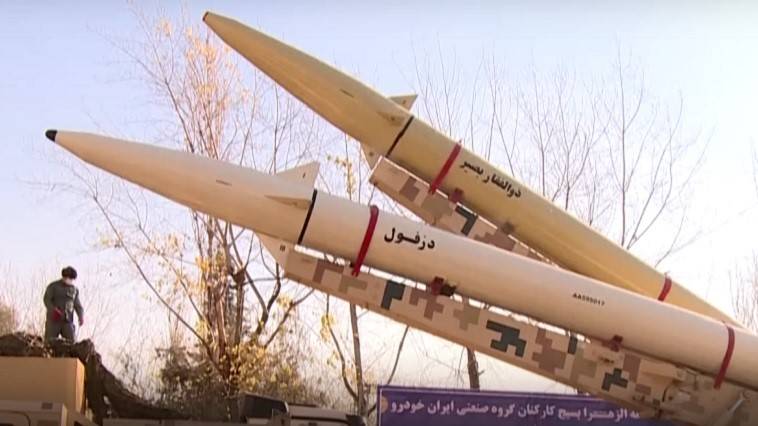
The parade also featured three ballistic missiles. One of them is reported to be the Falaq, which looks similar to a version of the Iranian Qiam. The Qiam is liquid-fueled and has a reentry vehicle with stabilizing fins. Another missile is reported by Ansar Allah as the Burkan 2H and another as the Zuliqar. These missiles appear to be Iranian Qiams that have been modified to increase range and have fins on the main rocket motor, unlike the original Qiams.
Also on display were the Karar and Hatim missiles, which appear to be modified versions of the Iranian Fateh-110. The Karar is nine meters long, 60 centimeters in diameter, has a range of 300 km, and carries a 500-kilogram warhead.
Hatim appears to be a version of Iran's Kheibar Shekan, which in turn is a new version of the Fateh-110 unveiled in February 2022. It is claimed to achieve a range of 1450 km.
This information is reported in a video of the parade released by the Ministry of Defense of Ansar Allah, i.e. the Houthis. Qud series cruise missiles were also presented. Three of them are referred to as Qud-3 but they did not have any external difference with previous models.
Cruise anti-aircraft missile
Ansar Allah also displayed a loitering SAM for the first time. This missile had previously been spotted on ships carrying Iranian weapons from Iran to Yemen. In the parade, three trucks carried a total of 39 of these missiles, referred to as Saqr-1. Perhaps the most impressive system of the Houthis, as a New York Times article of February 19, 2020 informs us, is precisely this new type of surface-to-air missile, which has the innovative feature of being able to loiter (loiter) in the target area in search of targets.
The missile appears to have an electro-optical sensor and an optical proximity fuze. It has a solid-propellant booster that it then discards and activates a jet engine with which it roams an area looking for targets. One particularly dangerous feature is that precisely because it uses a passive target acquisition system, but also has a jet engine, it is probably not detected by helicopter and fixed-wing aircraft self-protection systems to launch decoy flares.
This new weapon could be described as an anti-aircraft cruise missile, an innovative approach to air defense that is unparalleled in the world. Jane's estimates that these missiles pose a serious threat only against slow-moving airplanes and helicopters, although Ansar Allah claims that they reach a maximum speed of 200 meters per second.
The MiraJ anti-aircraft missile was also shown, which, as mentioned in the video, was developed from the Badr P1 missile and uses an infrared camera and radar guidance. The missile is equipped with an electro-optical sensor and the launcher is mounted on a trailer that has a radar that appears to be the one used by the ZSU-23-4 self-propelled air defense systems. The guns were guided by a P-19 surveillance radar and two types of mobile electro-optical detection and tracking systems.
Suicidal robotic speedboats
The parade also featured various types of small boats, one of which looked similar to the speedboat modified with an improvised explosive device (VBIED) known as the “Blowfish” that was seized by Saudi forces. This boat was referred to in the video as the Tufan-2, while there was a smaller version referred to as the Tufan-1, and a larger one referred to as the Tufan-3.
The three Tufan-3 boats that paraded were equipped with cameras, as well as marine radars on their masts, so they can be remotely guided to ships rather than relying on pre-programmed coordinates. The parade was the largest ever held by Ansar Allah since the UN-backed ceasefire in Yemen began in April 2022.
Slpress.gr