

8/5/2017. How an ''Empire'' collapses!
Logic, after the landing of Ilyushin96, wants it to land in the new reality, but . . . On a journey of several kilometers, from Sheremetyevo to the center of the capital, the associations, in an uninterrupted flow, penetrate you, disturb you until pleasantly and take you far away. Forms and stories, faces and legends, people and their fate, an entire world over time. The Rus and the Tsars in an inconceivable expansion through the centuries.
The multi-towered Kremlin as a political council and the onion-shaped Christian domes. The resourceful according to tradition, wise according to history, saint according to the church, Princess Olga of Kiev, the first apostle of Christianity in Russia. Sophia Palaeologina, marries Tsar Ivan III and receives the double-headed eagle, the symbols of the Byzantine Emperors. Moscow as the Third Rome. The Turks invade, under Ivan IV the Terrible, and reach Astrakhan. The two-faced Peter the Great builds St. Petersburg, thousands of human skeletons in its foundations, and lowers his fleet to the Sea of Azov. He will want to reach Constantinople. Let the eighteen-year-old Charles II of Sweden be seen. He will declare war on him. The Battle of Poltava – a milestone. Lomonosov, at seventeen, will walk the distance from the far north to the capital to study and later, as a professor, will found Moscow State University.
Catherine the Great baptizes her grandson, Constantine, to proclaim him Emperor of the new Greek Empire. Orloff in Oitylo. Kapodistrias in the service of Alexander I. Napoleon the Great in the Kremlin, but the "wooden" Moscow is burning. Tsar Nicholas I uses the word Hellas in diplomatic language for the first time. The Tsarevich arrives at Agios Stefanos, a suburb of Constantinople. His soldiers make out the domes of Hagia Sophia. They hang up their bells and cross themselves. They await the stentorian voice of their leader, to take the City. Take it at last! Oh, my God. . . The Grand Duchess of Russia, Olga, Queen of Greece. Tsar Nicholas II, the last of the Romanovs, will embarrass us in the unfortunate war of 1897. An insurmountable fiction with a global appeal permeates the bear country, but an unbridled superstition limits the popular horizon. And Lenin, on the train from Vienna to St. Petersburg, points towards the Winter Palace. The communist system, as a way of governing, as a way of life, and as a dictatorship of the proletariat, will last a long time. But . . .
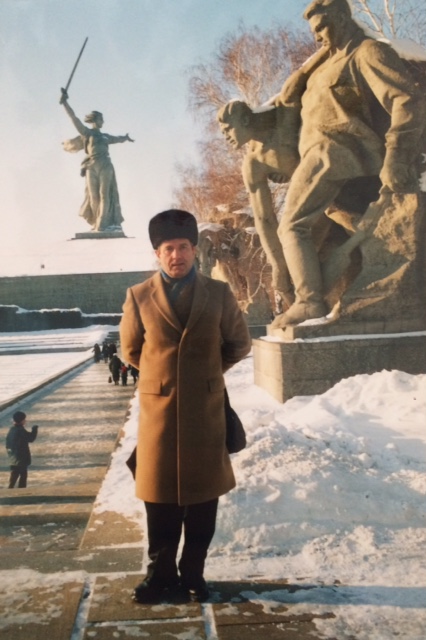
Gaspadin Grigorios, do you see that over there? The guide brings me to you. It is May 9, 1994. Perhaps I hear the bells for vespers. On the distant horizon, the twilight approaches bloodstained. I am in the center of the former capital of world Bolshevism. So he shows me a multi-story building, half-smoked, and riddled with bullets of various calibers. It is the Russian Parliament. The White Tower of Moscow. This is what all of Russia looks like, he will add. Other associations, in the foreground!
We all remember Glasnost (transparency) and Perestroika (reconstruction) of the very likeable Gorbachev. And Raisa was always by his side. Apparently, he could not stand the competition of Star Wars, Reagan, and wanted to create a social democratic regime. What is certain is that he succeeded in putting the Soviet Union into modernization processes. Elections for the parliament. Freedom of the press. Independent Constitutional Court. A radical economic reform remained. However, until the first steps are taken, the USSR begins to falter. Each former Soviet Republic is timidly following an independent, lonely path. And Russia, one of the fifteen former, its own. Domino of secessions. Wind of freedom. The situation is out of control and the side effects seem violent.
The calendar shows August 19, 1991. A group of old-guard communists send tanks against the White House in Moscow. Their goal is to stop democratization. The president of Russia is Boris Yeltsin. He is also among the anonymous crowd of Russians who rushed to defend their newly founded democracy in a peaceful way. He climbed into a tank, denounced the venture as a cynical ultra-conservative coup attempt, and the tanks withdrew. Yeltsin is now presented as the courageous defender of democracy. Something like a folk hero. And the anonymous crowd has the feeling that for the first time they can actually influence political developments in their country. Gorbachev resigns. The Soviet Union is dissolved. And Jeffrey Sachs will say, "My God, such events happen once every century!" Which Dostoevsky and which Tolstoy will describe them?
Yeltsin had invited to Russia, as an advisor for immediate reforms, the then 37-year-old American economist Jeffery Sachs, a professor at Harvard. Who would have imagined it? He assembled a group of Russian economists, devoted followers of Milton Friedman, the patriarch of the free market. What Bolshevik would have dreamed of it! And he secured absolute power for a year. Easy and usual! With this triptych, he will try to reform the economy of Russia. A lot has been done. Models of the ''Chicago School'' were applied, based on the axiom that <<in the free market, individuals acting on the basis of their selfish desires create the greatest benefits for all>>. In other words, from the Marxist workers' utopia to the business utopia, as it will be called. However, the centrally controlled economy had to be ended. The country was taken by surprise. The Russians demanded ''no more experiments''. And the deputies voted to revoke Yeltsin's emergency powers. He himself, of course, in good cooperation with Washington, will also give him financial assistance, and the IMF, present to demand strict fiscal adjustment, dissolves the parliament and sends military units to ''protect'' it. We arrive at October 3, 1993. A crowd of parliament supporters heads towards the television building and demands objective information. They will be attacked with machine guns. About a hundred protesters will lose their lives. The next day, the president will send hundreds of soldiers and tanks. The parliament will be hit by Yeltsin's order, now with weapons of various calibers. Up to five hundred people will lose their lives. The biggest explosion of violence that Moscow had experienced since 1917. The parliament will acquire the nickname "Black House". This is how I will see it seven months later.
The changes are rapid. Yeltsin's 35-year-old son-in-law, Anatoly Chubais (a loophole), takes over the privatization portfolio and declares, <<For there to be democracy in society, there must be a dictatorship in power>>. Such! Over two hundred thousand state-owned enterprises are heading towards privatization, and are attracting foreign investors. Capitalism, on the tsarist doorstep. The parenthesis of Bolshevism is closing. Lenin and Stalin are permanently erased. In particular, the "demolition" of Stalin had begun many years ago. Not a single statue of him remained standing. In school textbooks, not a single mention of the "father". What happened to the pioneer of the "Great Patriotic War"? Millions of "dissidents" he murdered.
Among the first foreign investors, was ETHEP International, owned by the sub-engineers-entrepreneurs Arfanis and Chionis. When the bosses called me for an interview, having my CV in front of them, they told me, first and foremost, we want aviation determination, the legal requirements, but they come second. Indeed, I had also presented my Law degree (1976-81), which I had obtained with great pomp, as my good colleague Theodoros would say. The matchmaking with the company had been done by another good colleague, Antonis Kozanitis.
In Moscow, the Company had an office to monitor privatization programs, and in heroic Stalingrad, renamed Volgograd in the context of de-Stalinization, 1000 km S, SE of Moscow, we had the headquarters for the development of new investments and the exploitation of those that were being completed. At a high level, the company, as a construction company, with major activities in Libya (the duo will mediate for the infamous, you remember, meeting of Mitterrand, Gaddafi and Papandreou, here you can see secret diplomacy!), will also seek to undertake the construction of two bridges over the Volga. The company's strategy was, <<from seed to spaghetti>> and <<from seed to standardized steak>>. With all intermediate and necessary assets, either in its ownership or under its full control.
Selected cereal seeds and sows from abroad. Pig farms (former collective farms) in upgraded operation. Feed production factory (managed by Giorgos Matsoukis, from Vovousa, a child of the pedomazomatoma and whose father is buried in Tashkent, 4000 km SE of Moscow). Twelve thousand acres of arable land. All the relevant machinery brought from Italy. Construction of a meat processing factory from the ground up. The most lovable pig walking in and out wrapped in cellophane. Construction of a sunflower oil production factory. The equipment came almost assembled from Italy. But it's not enough . . . !
Agricultural production in the Volgograd region, roughly the same size and shape as France, is controlled by twenty-five elevators, let's say silos. Huge buildings. The only "obstacles" that interrupt the vast flat southern Russia. After the collapse of everything, only twelve of them were operating. It was decided, therefore, to take the majority of the shares. Which shares? The Central Power, within the framework of the sell-off program, had distributed to the workers, depending on their position-rank and years of service, Vouchers, which they could sell until a certain short date. Then, they were automatically converted into shares, in whose hands they were.
With a black bag, then, bulging with dollars from the company's profits in Libya, I would visit the workplaces of these economic oases, to buy enough vouchers to secure us a majority of the shares. I had to convince them of the price we were offering them and, most importantly, that they would continue working. I would refer to the identity and prospects of the company. But what excited them was my reference to Yuri Gagarin and Leonid Milyutin, the Russian flight attendant-colleague in Bonn. To make a long story short, I became chairman of the board of directors of all twelve of these healthy Elevators. And the bosses would tell me, now we also got to know airspeeds. The day after the purchases, of course, the dollars of the proceeds were converted into televisions and stereos, of Western origin. However, in these transactions of mine, and there were many, I did not encounter a single illiterate person, even at advanced ages. One of the many impressive things about Russian society!
Now imagine what happened in heavy industry, mining and oil giants. Here the shares, with the help of foreign investors, always, and inside information secured, fell into the hands of the new Russian nomenclature. This is how the new Russian "oligarchs" were created, in good cooperation with the "Chicago kids", accumulating for themselves enormous wealth, which either remained abroad or was taken abroad.
Imagine an Abramovich emerging from a . . . Russified Old Testament! And stocks soar to stratospheric heights. But the supermarkets are emptying! And the chimneys no longer smoke. The tractor factory on the outskirts of Stalingrad stretches for twelve kilometers along the Volga. In World War II, it supplied the front with tanks. Now, it rusts. Pensioners now and then collect a meager pension. Incredible family heirlooms are being sold off. How an empire collapses!
Chionis, alone (Arfanis had to manage the internal Greek political-party front) visited us three to four times a year, each time accompanied by agronomists and veterinarians, professors of Greek Universities, in the company's aircraft, with the pilots of his colleagues, Giorgos Christakis and Panagiotis Batlakas. Sometimes I was given the position of co-pilot. And Chionis wanted to hear the airline's opinion on the choice!
Our last act, as foreign investors, was the acquisition of shares (12%) in the Taganrog shipyards in the Azov Sea. Where Peter the Great launched 300 ships from Yaroslavl, via the Don. Before I went there to participate (I participate . . . according to our own journalists!) in the auction, there was a small meeting in Rostov. If I tell you, with reservation, that Ivan Savvidis was also present, don't scold me!
But there are also leap years. Gaddafi will close the taps to foreign companies, in a counter-embargo for the reprisals that the West had established against him for the well-known plane crash. The company's investments in Russia, after five years, began to run out of cash. Arfanis will pass away and Chionis will soon follow him. May they be remembered. And their heirs will follow the well-known disastrous recipe. Investments evaporate. How an empire collapses!
This juncture will coincide with the repeated attacks by Chechens on Moscow. The war in Chechnya had preceded it. Endless trains with war material. An endless war machine on the rails towards the Caucasus. Awe! Putin, then, the prime minister of Russia, the cold and vaguely threatening Bladimir, as they called him, will take on the pursuit of the Chechen "terrorists". And the new Russian oligarchs will arrange the transfer of power, and without elections, from Yeltsin to Putin. From prime minister, president. The calendar shows December 31, 1999. Putin's first act, as president, will now be a law that will protect Yeltsin from any criminal liability. Gorky, after the first revolutionary acts of Lenin and Trotsky, will write, <<They have no idea about freedom and human rights. They are already alienated by the stinking poison of power>>. It is valid throughout time, with many nuances.
Instead of an epilogue, I will say, without any missionary spirit, woe to the people who are always victims of adventurism, obsessions and "strange ideologies", from one side to the other. And we are slaughtered over who saved us the most. I've tired you!
Thank you, Dashvidania.
Gregory Dim. Nousias.