

The upgrading of the role of the Turkish Intelligence Service MIT
1 The upgrading of the role of the Turkish Intelligence Service MIT
By Christos Minagias January 12, 2012 www.geostrategy.gr
On 11-1-2012, the head of MIT, Hakan Fidan, presented to the political leadership of Turkey the new structure and the new operational plan of the Turkish National Intelligence Service in the context of the 85th anniversary of its establishment. This presentation took place at the MIT premises, lasted 2,5 hours and was attended by the President of the Republic Abdullah Gül, Prime Minister Recep Tayyip Erdogan, the Chief of the General Staff General Necdet Özel, the Minister of Interior İdris Naim Şahin, the Minister of Foreign Affairs Ahmet Davutoğlu and the Minister of Justice Sadullah Ergin.
MIT, with its new structure, applies an aggressive doctrine to target countries and places particular emphasis on foreign intelligence, which focuses on the military, energy, economic, political, cultural, religious and demographic sectors.
The Caucasus, the Balkans, the Asia-Pacific Ocean, the Middle East, the Mediterranean Sea, Africa, the Red Sea-Gulf of Aden and the Caspian Sea were determined as areas of interest.
Additionally, according to Turkish sources, MIT, with its new operating regime, is the main manager of the country's internal and external intelligence. An illustrative example is its 12-month consultation with the Turkish National Defense General Staff that resulted in the integration of the General Staff's Electronic Systems Directorate (personnel and materials) into the Turkish intelligence service.
Thus, all electronic information will be collected by one body, the MIT, and then it will be distributed competently. In the past, each body (armed forces-police-MIT) collected information with its own means, but without fully informing the others. From now on, all information will be registered in the MIT information bank, to which all security bodies in the country will have access.
However, there will be an exception to the management of information collected by unmanned aircraft, given that the collection, evaluation and exploitation of this will be carried out by the Turkish Armed Forces, which, if they deem it appropriate, will inform the country's other security agencies.
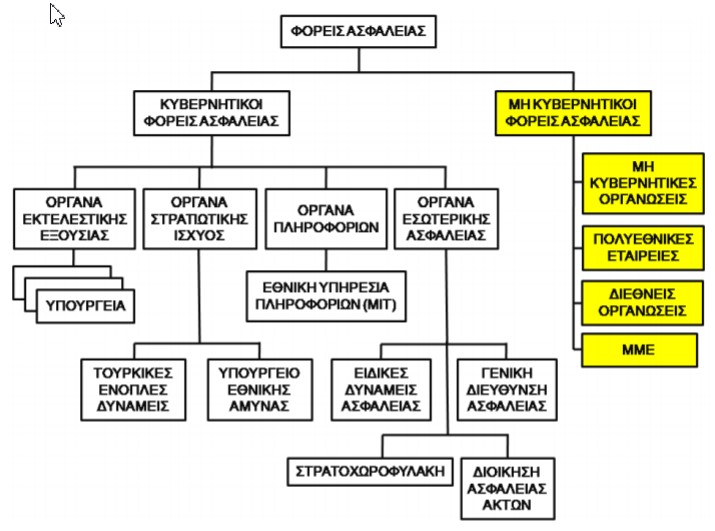
With regard to Turkey's security agencies, it is deemed appropriate to quote the following organizational chart from the book of the author of this article entitled: "The geopolitical strategy and military power of Turkey", the importance of which is obvious, because it leaves no room for questioning the optimization attempted in the field of information by all governmental and non-governmental agencies.
It is noteworthy, however, that these security actors include non-governmental organizations, multinational companies, media outlets and international organizations that are controlled and guided by Turkey.
Another key point is the fact that the new head of MIT took the following actions in order to expand the active role of the Turkish intelligence service from a regional to an international level over the next 2-3 years:
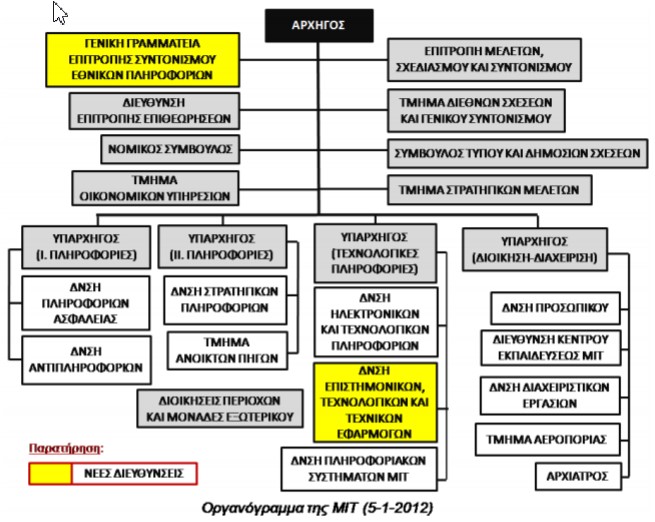
First, he appointed an ambassador to the position of Deputy Chief of Intelligence (Foreign), demonstrating the importance given to foreign information.
Secondly, it established the Scientific-Technological-Technical Applications Directorate, which reports to the Deputy Chief of Technological Information.
Third, he established the General Secretariat of the National Intelligence Coordination Committee, which reports directly to the head of MIT.
And finally, in the coming days, an information school will open in Ankara, where a large number of executives will be trained in learning foreign languages such as Chinese, 3 Greek, Bosnian, Serbian, etc.
Specifically on the issue of the necessity of learning foreign languages, Hakan Fidan emphasized that MIT's Open Source Department monitors approximately 1.000 television stations daily.
The new organizational chart of MIT is listed below.
It should be noted that the General Secretariat of the National Intelligence Coordination Committee will meet every month (the first meeting will be held at the end of this month) for information briefing-evaluation and will be attended by the head of the MIT, the intelligence directors of the National Defense General Staff, the military gendarmerie and the police, the deputy ministers of the ministries and the deputy minister of Public Order and Security.
Also, if required, this committee will meet in an extraordinary manner.
In addition to the above, a corresponding meeting will be held weekly with the participation of low-ranking executives of the country's security agencies.
Finally, MIT, as part of its work, has created a museum where various materials used by secret services are exhibited. These include eavesdropping systems installed by the intelligence services of Greece, Russia, Bulgaria, Romania, Cyprus, etc. in the buildings of Turkish diplomatic missions abroad (Milliyet newspaper/6-1-2012).
In closing, it is appropriate to quote an excerpt from Manos Eliades' book on the secret actions of the Turks in Greece and the modern MIT, where the author states the following:
"The presumed support of the new head of MIT by the President of the Republic A. Gül, Prime Minister R. T. Erdoğan and Foreign Minister A. Davutoğlu, three main poles of power in the Erdoğan system, is estimated to soon lead to a reorganization and changes in MIT, which will potentially have an impact at least on the intelligence mechanism of the General Staff, if not on the entire network of Turkish intelligence and security services in Turkey. This is because for a country like Turkey, with intense security challenges at home and ambitions for a more active and proactive role in a wider regional area, radical changes in intelligence and security services presuppose the existence of strong political support for anyone who attempts it."