

Dimitris Bakas: FEMININENESS: THE NEGLECTED VIRTUE
Preamble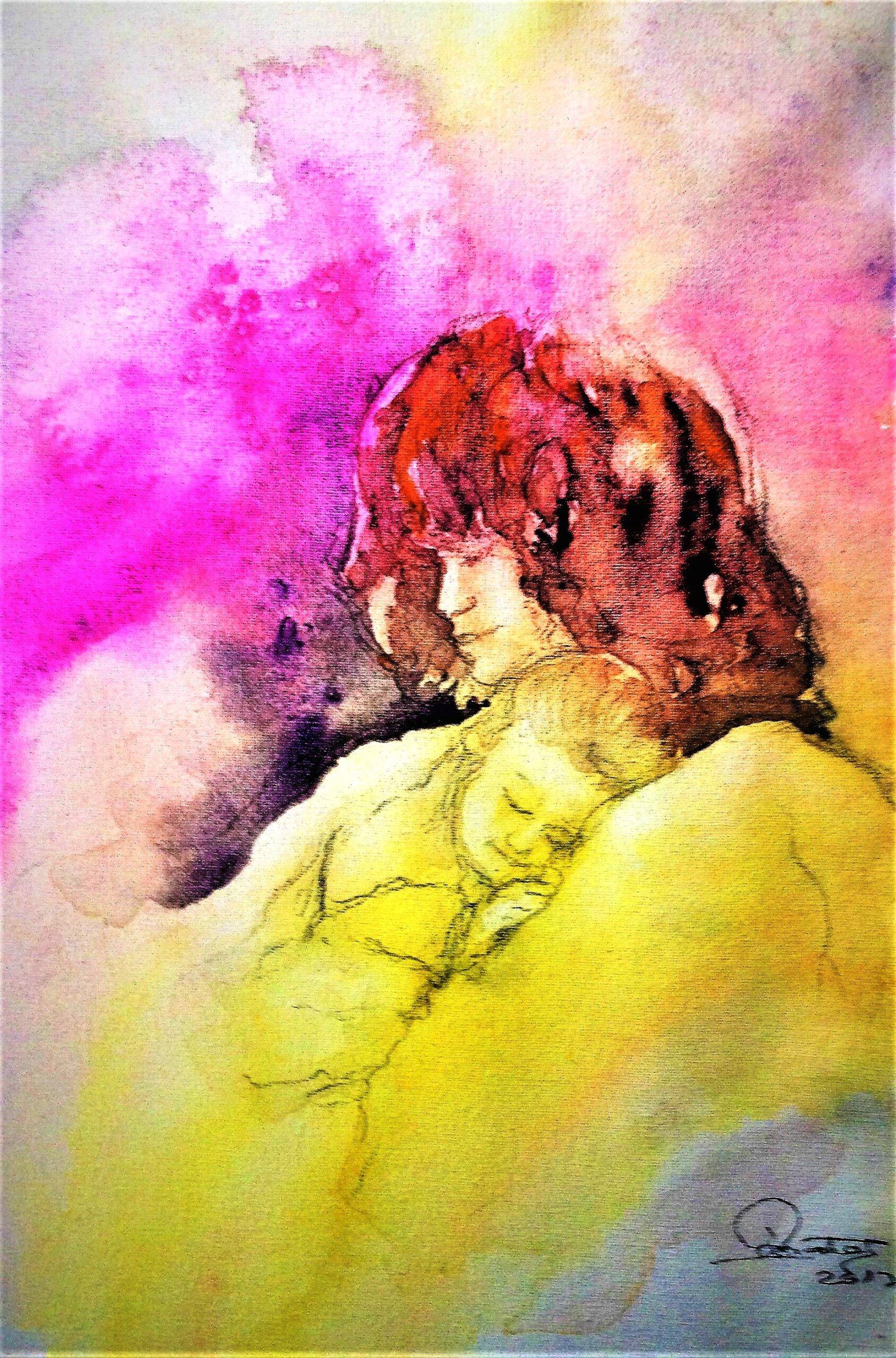 We celebrate Mother's Day every year. Quite rightly and justly! Is there a person on Earth who can question what his Mother is worth? The newborn baby seeks his mother's nipple from the first moment before he even opens his eyes. He is guided by the smell and taste of the amniotic fluid that has already brought him to life. Who can forget his Mother's first smile? The warmth of her embrace and the security he felt, forgetting all terror, fear and anxiety?
Those who have not felt their mother's caress are unhappy. They never feel complete. Those who have lost her long for her and have her image always in their mind and heart. We call upon our mother for help in every pain and anguish.
But what is this unique characteristic that elevates the mother to the highest pedestal of values in our lives? It is a special quality, a virtue different from the others that make up the humanity of the human being. The Greek language has a wonderful word to express the essence of this virtue. Femininity. A term that, unfortunately for many reasons, has disappeared from our vocabulary.
Introduction
Virtue is an acquired disposition to do good. A power of energy and humanity. It is good itself in spirit and in truth. Good is not simply to be considered, but it is something that we must be able to do. However, we cannot know it and apply it to an absolute degree.
Virtues are moral values in practice, that is, embodied, not theoretical. Always unique like each of us. There are many of them, as many as our flaws. They constitute "means" (according to Aristotle), but qualitatively they are "peaks" between two evils (excess and deficiency). That is why they are difficult to acquire. "Praiseworthy habits". However, they should not be confused with skills. Virtues are forces that always aim at the general good.
In general, virtues are not distinguished according to gender, although some are more suitable for men or women. Only truth is absolutely universal. But truth is not moral, nor emotional, nor volitional. All virtues arise from desire, and desires are usually different in people and almost always vary according to gender. However, both sexes participate in all virtues, albeit in different ways.
Softness- sweetness-femininity
The Ancient Greeks, and especially the Athenians, were proud that they had become partakers of gentleness in the world. They considered gentleness a synonym for Civilization as opposed to barbarism. Today's Western civilization is essentially Greek civilization, as humanism. Gentleness is the opposite of anger and cruelty. It is not a simple virtue but a synthesis of several virtues. The verb "calm" expresses this. Aristotle will upgrade gentleness to a separate virtue, as a mean between irritability and softness. Gentleness is identified with non-violence. "Non-violence is clearly preferable, only, when it is effective," writes Simone Weil. Let us consider Gandhi's gentleness in India.
Sweetness, synonymous with gentleness, is identified with femininity, which is recognized as a type of feminine quality. A strength without cruelty. A love without anger. The opposite of brutality, aggression, barbarity. Inner peace, without hatred or insensitivity. Aggression and anger show weakness, as does violence when uncontrolled. Only sweetness is a force that can direct us towards good and for this reason it is a virtue. A peaceful, sweet force, full of patience and kindness. It is what more than any other resembles love, more than generosity, which wants to do good to the other, and compassion, which hurts with the pain of the other. Sweetness refuses to harm him. It is courage without violence, what we call courage! A finality without any other purpose. A supreme completeness and omnipotence.
Femininity should not be confused with femininity, just as masculinity with courage and bravery. Femininity and masculinity are assets and skills. That is, powers of a different nature. They are not defects, but they are certainly not virtues in the sense that they direct action towards good. Femininity should also not be confused with effeminacy, which certainly for the above reasons is not a virtue. Nor with pathological hysteria, which is not sweetness, it is not love, but narcissism, pretense, a desire for power. That is, an art of conquest and demonstration. The opposite of the truth.
Gentleness, sweetness and femininity are at the other extreme: they are welcoming, respectful, open. Virtues that are somewhat passive, submissive and accepting, which is why they are closer to wisdom. There is no wisdom and no other virtue without a degree of submission. The wise man “behaves with humanity and gentleness” (Spinoza). Gentleness is mildness, a kind of spontaneous kindness: “do what is good for yourself while causing as little harm as possible to others” (Rousseau).
Sweetness (femininity) is subordinated to reality, to life, to becoming, to everyday life. A flexible virtue, of patience, devotion and harmony. The opposite of arrogance and impatience, of rigidity, of unyielding and stubborn strength, of impudence and impudence. Closer to self-discipline and self-imposition. Even against oneself if necessary. And love means surrender, that is why it is sweetness and gift.
Femininity does not belong to the basic virtues considered (prudence, temperance, courage, justice), but to the mild ones. But without a minimum of femininity, humanity does not emerge. Man cannot live without sweetness and gentleness. The role of sweetness in every teaching and upbringing is invaluable. The first example is that of the God-man.
Comment
Honoring the mother one day a year is not enough, because the mother is in front of us at every moment of life. She is a guardian "angel" and above all our guide and role model. The same applies to the male and female. Unfortunately, as individuals and as a society, we downgrade or neglect the unique value of our female partner. In fact, we even distort the original constitution, as Nature created it.
The way people think, feel and act has changed dramatically with technological development, the creation of megacities and especially with the prevalence of the commercialization of everything, even the human face. In the climate of excessive consumption of material goods of our time, the needs of survival have forced women to move away from the maternal role and to engage in a professional career that gives them greater limits of liberation. The trend (fashion) and above all the hunt for commercial profit have distanced them from femininity (sweetness) and pushed them towards femininity.
Hellenism discovered the specific laws of the spirit, the language of logical thought and established the term Humanism. Christianity as a peculiar sense of life discovered the “logic of the heart”. “Le Coeur a ses raisons que la raison ne connait point” (Pascal). Plato’s love for teaching and learning is upgraded to love, not out of charity and pity but for man himself, regardless of his origin and capabilities.
The educator and andragogue must have a kind of femininity-sweetness, because it constitutes an idealized kind of mother. Through a maternal filter, all aspects of the human personality are x-rayed, so that with the holistic formation, the inner powers of human nature are developed comprehensively and harmoniously. This maternal filter repays the divination gift to the educator as a reward and the ineffable fullness and omnipotence that he receives from his function emerges. Then pedagogy becomes a spiritual creation and moral energy. Only in this way is the educator's labor compensated, in a way.
Virtues, as praiseworthy habits, that is, embodied moral values, belong to both sexes regardless of whether they have a different texture, because values emerge from desires that differ from person to person.
Femininity is neither a virtue nor a defect. It is an asset, a power of another nature. Femininity is a virtue because it is a power that denies evil. It is identified with sweetness and emerges from gentleness. And despite the fact that it is expressed more strongly in the female, it is necessarily present in the male as well, because it constitutes the essence of humanity, which brings people close to the difficulties and problems of life.
Conclusions
Femininity (sweetness, gentleness) constitutes the quintessence of the virtue of coexistence. Of the psychic power for active participation, in order to create the absolutely necessary conditions, which when they come together, the mutation and transmutation of all parts into a composition with new characteristics takes place. Then the jumble turns into a group. Then the whole takes on form and its own content. Then there is and essentially the being of Society. Then we can speak of a group, family, society, nation and Homeland. It is then that we have entered the framework of moral coexistence. Then we feel "the other, as ourselves". Then our own dignity is reflected in the dignity of the other and every limitation of ours is an expression and release of our inner freedom. Then realistic love emerges. Then problems become more solvable.
The Japanese word amae, which means sweetness, I think, gives us the most beautiful expression. It is that magical moment when we feel the wonderful feeling of belonging to a whole, to which we want to belong and that whole wants us as a member. Indeed, we all agree that there is no more beautiful feeling than returning home that you want so much and feeling the love of your entire family or going to your workplace and feeling that your colleagues are waiting for you with longing to be near them or even when you are far away they would like to have you next to them and among them.
The Japanese ideogram for the word amae is truly expressive. It depicts a mother holding her baby in her arms! It is that ultimate moment, when the baby feels the greatest affection and security and the mother holds what is most precious to her in life. We believe that this ideogram is the most perfect expression of femininity (sweetness).
Epilogue
We must cultivate this archetypal human bond between people today. Today, when humanity has covered such a large area, our entire Planet, which goes beyond the limits of individual conception and power-action, only a broader participatory, but also harmonious action can bring positive results.
Then we can say that we are in the field of the current concept of ethics, that is, in the dialogical character of democratic qualitative coexistence. The dialogical way of communication and resolution of differences is our only moral path. The exercise and education of all of us for the creation of social consciousness, which unites in a complementary way competing terms: syneresis/conflict, freedom-equality-fraternity, rights/obligations, national unity/social and ideological antagonisms. The only catalyst for the above rivalries is the development of mild human-ethical forces with the basic element of weaving the archetypal bond of the family, namely the indissoluble bond of Mother and Child.
The mother's femininity, her feminine nature, her feminine sweetness and uniqueness are expressed and culminated in the upbringing of the child!
Only in a climate of "brotherhood" can the issues of equality, justice, freedom, dignity find a tolerable solution, otherwise, they will constitute utopias. In short, the brotherhood that holds the basic micro-society (the family) together must be transferred in an acceptable form to the space of the large and even planetary, we might say, society.
This is precisely where the enormous need to spread holistic medicine is fully revealed.
Education and more specifically the proper formation of young people, so that the basic cell of society, the family, is healthy and alive with cohesion and competence.
This supreme mission, as a gift, but also as a duty, by nature, has been primarily assigned to the MOTHER.
That is why we always honor her, glorify her and are grateful to her.
Dimitris K. Bakas May 2018