

Edited by: G. Doudoumis- A. Basaras: Konstantinos Manos (1869-1913): a biography
Konstantinos Manos was born in Athens in 1869. His father, Thrasyvoulos Manos, was a general and came from a Phanariot family with distant origins in Kastoria, while his mother, Roxane Mavromichali, from the Mavromichali family of Mani. Manos received a careful upbringing and later went to Leipzig for higher studies. In 1891 he was awarded a doctorate from the University of Heidelberg in law. In 1894 he went to Oxford where he attended courses in philosophy and philology, while at that time he served as professor of Greek to the Empress Elisabeth of Austria for six months.
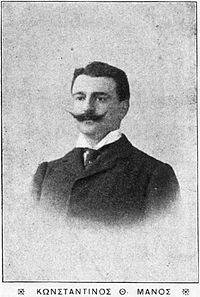 Konstantinos Manos' involvement with sports began during his years of study at universities with organized sports activities, such as Oxford. Although he lived in Europe, it seems that he participated in the processes of shaping Greek sports institutions. It is characteristic that he wrote the lyrics for the anthem of the Panhellenic Gymnastics Association (P.G.S.), which was presented for the first time at the games organized by the Panhellenic in 1893.
Thus, upon returning to Athens, he was appointed as one of the main organizers of the first Olympic Games of 1896, for which he printed a brochure as a guide to the sports. In October 1895, he founded the sports club "Athletic Club of Athens" with the aim of preparing athletes for their participation in the 1st Olympiad that was organized the following year in Athens. In the preparation sports, he did not include gymnastics, wrestling and cycling, which he did not consider noble sports, as he wrote in an article published in the press of the time
"...For me, the Olympic Games are only those held in the Stadium... The acrobatics of the single and double balance and hoop exercises and the ugliness of the cycling race do not move me at all."
 His social background and close relations with the royal family resulted in the Club attracting athletes of the aristocratic class, while the favor of the heir Constantine towards him resulted in the club dominating the qualifying matches. He was elected a member of the reorganized Olympic Games Committee [O.O.A.], a position in which he remained until 1904, when he was replaced due to his absence from the meetings.
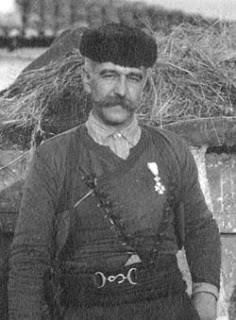
At that time he joined the “National Society”, whose members included his brother Petros and his father Thrasybulos, and prepared armed uprisings in Macedonia, Epirus and Crete. When the Cretan revolution broke out in 1897, he organized a group of armed men under the name “Holy Battalion”, landed on the island and entered Chania. Manos was disappointed with the course of the war and for this reason left on a long journey and reached Alaska. After the temporary settlement of the Cretan issue, he returned and settled in Crete and was appointed mayor of Chania by the island’s high commissioner, Prince George. After the outbreak of the Macedonian Struggle, he went to Athens where he was initiated into the Macedonian Committee. As its representative and under the pseudonym Michaelides, he went to Kastoria to help the Struggle, but was arrested by the Turks.
Manos shortly before his tragic death: When he returned to Crete, he sided with Eleftherios Venizelos during his confrontation with Prince George and supported him in the revolution of Therisos in 1905. After the “revolution in Goudi” in 1909, he was elected plenipotentiary of Crete twice, as a close associate of Venizelos.
A strong supporter of the Aviation Idea, he was the first Greek passenger on an airplane, when in 1908 he flew over Faliro as a co-passenger of the Russian aviator Utoskin, who, while touring Europe, made show flights in a privately owned airplane in Athens. Konstantinos Manos also wrote several poems, which he published in the only collection he published under the title Words of the Heart. This collection of his was honored with the first commendation at the Philadelphia competition. He also pioneered the establishment of the demotic language together with Lorenzo Mavilis, while in 1905 he published a translation of Sophocles' Antigone into demotic, a pioneering event for his time.
In the Balkan Wars, he participated with his own Corps consisting of 300 Cretan volunteers as a chieftain, liberating Nikopolis and Manoliasa. He distinguished himself for his heroism and was wounded twice in Preveza. After the liberation of the city, it was decided to disband the volunteer corps. Manos remained in Philippiada and expected to be called to fight, however, until the fall of Ioannina, he did not need to and so he returned to Athens. He then went to Thessaloniki, where the struggle for the liberation of Macedonia and the battles against the Bulgarians continued.
His death was both heroic and tragic. On April 3, 1913, he participated as a passenger in a reconnaissance flight of a Bleriot XI airplane with Argyropoulos as captain. During the flight, at 10 in the morning, they crashed due to mechanical failure, due to their involvement in severe bad weather, and met with instant death on rocks, 500 meters from Lagada.
An eyewitness who saw the accident up close told the newspaper Macedonia: "The plane stood majestically and we were proud of the daring aeronauts. The plane was only a thousand meters away from Lagada. Suddenly its normal flight stopped. It made a few turns that resembled the flight of a wounded bird and then, face down - if one can express it like that - it fell at breakneck speed"...
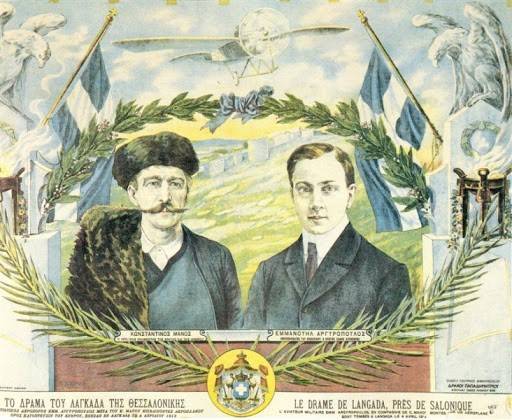
A simple monument outside Lagadas, at the point where the plane crashed, commemorates the loss of the two men who fell while on duty and opened the sad dance of Greek airmen who lose their lives in the line of duty.
Πηγές
http://www.pasoipa.org.gr/lefkoma/pilot_details/?id=36
https://argolikivivliothiki.gr/2010/04/08/manos/
https://el.metapedia.org/