

France, the victory of “Paris” showed dangerous social fragmentation. In the Greek case, we have a nation and state dimension.
France, the victory of “Paris” showed dangerous social fragmentation. In the Greek case we have a dimension of nation and state of the SPECIAL ASSOCIATE France is not burning because PSG wins. It is burning because PSG’s victory acts as a pretext for the explosion of a society that has lost a common law, a common identity and a common political center.
2
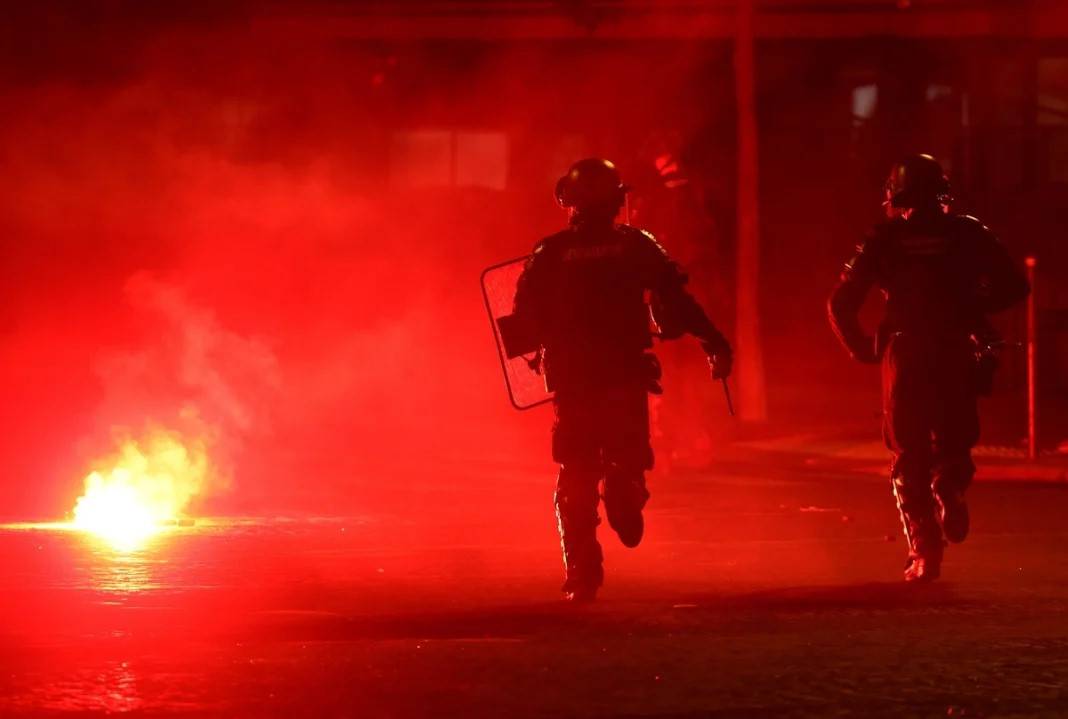
The recent riots after PSG's victory are not simply "hooliganism". Nor can they be explained by the easy formula "it's immigration's fault". What is more profound is that France has entered a state of social fragmentation, where large parts of the population no longer experience the state as a common homeland, but as a foreign power, a repressive mechanism or a rival symbol. In the events of 2026, international reports speak of hundreds of arrests after PSG's celebrations, with incidents in Paris and other cities, injuries to police officers, vandalism, fires and attacks on public order points. The numbers vary by source and time, but the order of magnitude is clear: this is not an isolated incident, but a recurring pattern of urban explosion. An article published in Detections places the event in a scheme of "society in disintegration": PSG's victory is presented as a pretext for violent demonstrations in many cities, while the analysis insists that the problem is not only public safety, but the disintegration of social cohesion, the identity crisis and the inability of the French state to impose common law without appearing either weak or authoritarian.
3
The great conflict is between two interpretations. The first, of the Merchet/de Montbrial type (the first a French journalist and the second a French lawyer), sees the riots as internal geopolitics: a clash of territories, neighborhoods, identities, “us” and “them”. The second, of the Husson type (a French historian and academic), says that the ethnocultural reading works as a poison, because it hides the deeper social reality: inequalities, deindustrialization, the crisis of education, the decline of sovereignty and the class division between city centers and the peripheries. Both see a piece of the truth, but neither alone is enough. France does indeed have an ethnocultural problem, but not because origin alone produces violence. The problem is that the French state has failed to transform massive populations into a common political body. The French democratic promise was: “I don’t care where you come from, you will become a citizen through school, language, work, the army, public space.” This mechanism of integration has broken down. On the other hand, the social reading is also true: the suburbs are not simply “foreign tribes” within France. They are places of unemployment, poverty, school failure, police distrust and spatial exclusion. Reuters, on the great riots of 2023 after the death of Nael, noted that the rioters did not only burn cars and means of transport, but also targeted town halls, police stations and schools — that is, buildings that symbolize the French state itself. So the central phenomenon is not simply “youth running away”. It is a rebellion without a political program. It is violence that does not demand anything clear. It has no manifesto, no leadership, no plan for power. But it has an enormous symbolic charge: it strikes at everything that reminds us of order, state, property, public space, normality. Here lies the most dangerous point: when social discomfort is not politically organized, it turns into a nihilistic action. It does not say “I want justice” in a structured way. It says “I do not recognize anything.” It is not a revolution. It is decomposition. PSG (Paris Saint-Germain) functions as a perfect symbol of this contradiction. It is a Parisian team, but
4
simultaneously a global brand, Arab money, post-national football, a mechanism of spectacle and identity. Its victory becomes a festival, but the festival becomes a scene of debauchery. There the new France appears: a country that can produce a global spectacle, but cannot control the social body that gathers around it. The state responds with police. And here the vicious circle begins. The more France loses its social cohesion, the more it needs repression. The more it needs repression, the more the excluded regions feel that the state is not a common institution, but a hostile force. Thus, the state becomes at the same time too strong as a police force and too weak as a homeland. This is the central political crisis of France. Macronism is the ideology of this contradiction. On the one hand, it represents the technocratic, Europeanist, globalized France of the centers, the markets, the financial flows, the metropolitan elites. On the other hand, he governs a country where large sections of society feel abandoned: the suburbs, the countryside, the workers who were lost with the
5
deindustrialization, small and medium-sized businesses that are squeezed, young people who see no upward mobility. This is why France seems to be experiencing multiple crises at the same time: the Yellow Vests were the uprising of regional and popular France. The riots of the banlieues are the explosion of excluded immigrant and post-immigrant France. Riots around football victories are the most brutal form: violence without political language, but with enormous political meaning. Not even the “right” answer is enough, if it only remains in “law and order”. Without a common political identity, the law becomes simple repression. Not even the “left” answer is enough, if it simply says “the police are to blame”. Without a state, common school, security and rules, the weakest are the first to be crushed by delinquency. The central sociological diagnosis is: France is moving from the model of integration to the model of parallel coexistence. That is, we no longer have a society that assimilates, integrates, creates a common political person. We have groups that coexist geographically, but not in terms of values. They speak the same language, but do not participate in the same symbolic world. They live in the same state, but do not feel that they belong to the same historical community. This explains why any occasion can become a fire: a death by a police officer, a football match, a political decision, a rumor on social media. The occasion changes. The underground matter remains the same. So, at a central political level, the riots show three things. First, a crisis of sovereignty. The state does not fully control the public space. It can intervene, arrest, suppress, but it does not inspire self-evident legitimacy. Second, a crisis of national narrative. France no longer knows what it means to be French without either being accused of exclusion or ending up with an empty multicultural slogan.
6
Third, a crisis of social ascension. When work, school, and neighborhood fail to function as bridges of integration, then identity is organized around anger, race, religion, region, group, gang, or simply anti-state sentiment. So the final analysis is this: The riots in France are the form a society takes when it loses its common center. It is not just an immigration issue. It is not just a class issue. It is not just a police issue. It is not just a cultural issue. It is all together, precisely because France no longer has a strong mechanism to translate differences into shared political participation. The old France said: “Become a citizen and you will belong.” The new France seems to say: “Live here, but alone, with your own group, your own anger, your own memory, your own neighborhood.” And then, when night falls, society does not celebrate. It erupts.
7
THE GREEK CASE: NATION AND STATE DIMENSION The Greek case is not the same as the French one. In France the problem is that large parts of society no longer recognize the state as a common homeland. In Greece the problem is that citizens still recognize Greece as a homeland, but do not trust the Greek state as an expression of the homeland. In France the crisis explodes in the street. In Greece the crisis accumulates in disappointment, in irony, in privatization, in flight, in the feeling that “nothing changes”. France has a crisis of common identity. Greece has a crisis of institutional trust. In France the question is: who belongs to France? In Greece the question is: who really serves Greece? The citizen can love the flag, the history, the place, the family, the church, the village, the memory, but at the same time consider that the state is a foreign body: clientelist, Athenian-centric, bureaucratic, unreliable, often indifferent or even hostile to the citizen himself. So we do not have a dissolution of national identity in the French way. We have a gap between the nation and the state. The Greek has not stopped feeling Greek. He has stopped believing that his state functions in a Greek way.
8
In France, the riots show a society that does not have a common symbolic center. In Greece, the absence of rebellion often means fatigue. Greek society does not explode like the French one, because it has other absorption mechanisms: family, small property, locality, private solutions, youth migration, clientelistic dependencies, cynicism. Where the young Frenchman of the suburbs may clash with the police, the young Greek often leaves for abroad or withdraws into a private life without expectations from the public. This is the Greek form of decomposition: not fire in the streets, but silent withdrawal from the common future. Greece does not have banlieues in the French sense. But it has regions that feel abandoned. It has villages that empty. It has islands that remember the state only when there is a crisis. It has Thrace, Macedonia, Epirus, the Aegean, Cyprus, which are often treated by the center not as organic parts of a national strategy, but as management files. Athens often functions like the Parisian centers described by Husson: as a metropolitan elite that speaks on behalf of the country, but does not live the country's anxieties. In France, failure is integration. In Greece, failure is representation. The Greek does not ask to be integrated into his state. He is already part of the nation. He asks not to feel that the state is making fun of him. That is why the Greek crisis has such an intense anti-institutional charge. It is not always anti-patriotic. Often it is exactly the opposite: it is patriotic indignation against a state that is considered inferior to the history, dangers and sacrifices of Hellenism. The citizen does not say "I do not care about Greece". He says: "those who govern are not up to Greece". Here lies the difference with France. France fears that it is losing its common body. Greece fears that it has a common body, but not a worthy head.
9
The French crisis produces a clash of identities. The Greek crisis produces distrust of every official narrative. That is why in Greece people have difficulty believing the announcements, the committees, the promises, the reforms, the "wills", the "plans", the "national strategies". The distrust is not accidental. It is a historically accumulated experience of denials. The Greek state asks for trust, but often offers management. It asks for patience, but does not provide accountability. It asks for national unity, but operates in a clientelist manner. It asks for sacrifices, but does not convince that the sacrifices are worth it. Thus, society remains patriotic deep down, but distrustful on the surface. It loves the homeland, but does not trust its administrators. This is the Greek paradox. Greece is not currently in danger of a French-style urban explosion. It is in danger of losing faith that there is a collective plan. When the citizen believes that the state cannot protect the trains, the borders, the education, the health, the justice, the public property, then he does not need to rebel. He simply withdraws his trust. And when he withdraws his trust, the state exists formally, but it does not inspire. So, the Greek crisis is not a crisis of “common identity” like in France. It is a crisis of common trust. France asks: can we still live as one people? Greece asks: is there still a state worthy of this people?
10
And this is perhaps more burdensome, because Greece still has strong reserves of identity, memory and historical cohesion. It does not lack a soul. It lacks the organized political will that will transform this soul into a state, strategy, production, education, justice and power. France burns when it loses the common law. Greece is silent when it no longer believes that the law is common. And silence, sometimes, is more dangerous than fire.