

POST-TRAINING: Makronissos – How many of us know its history?
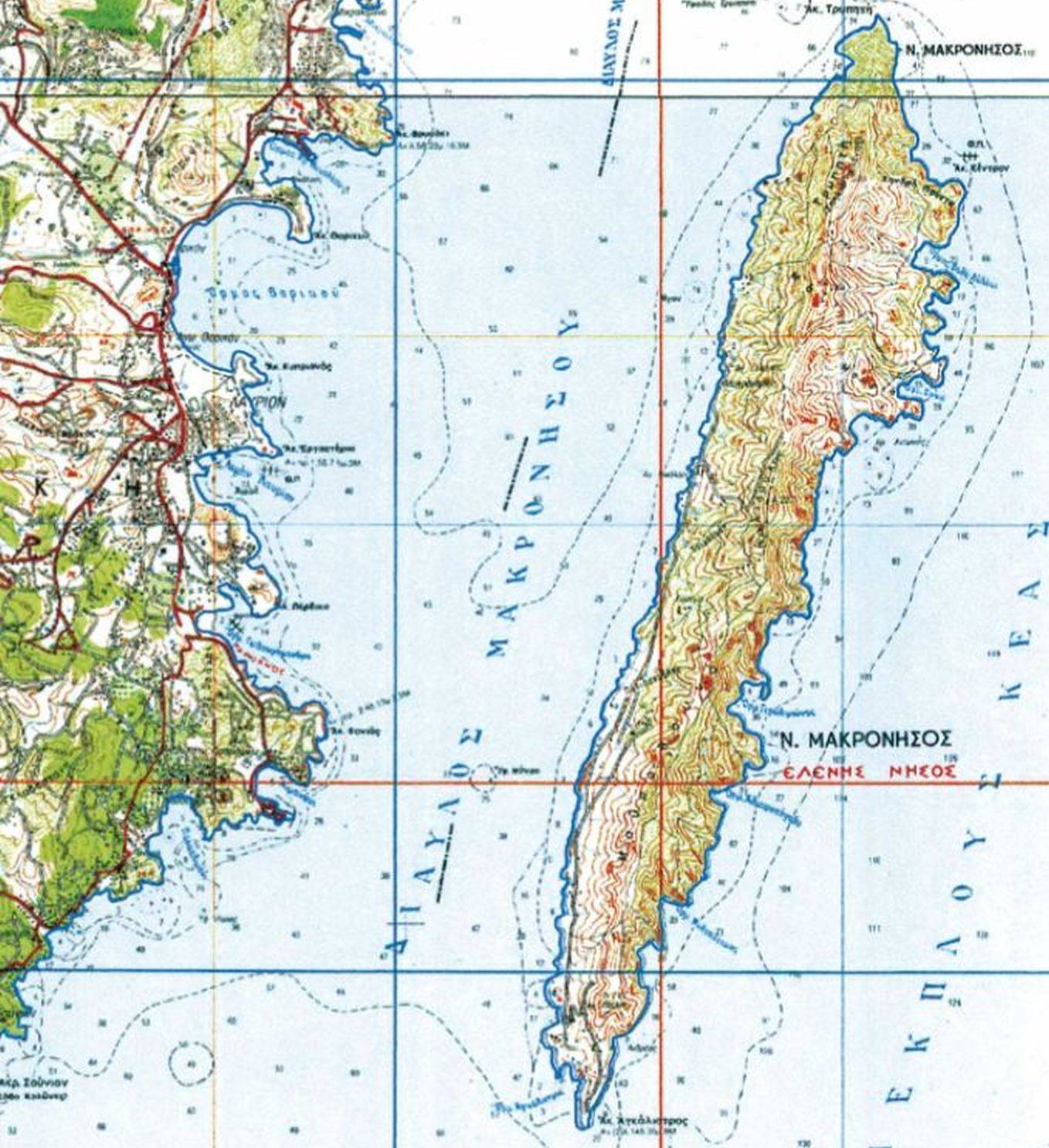
 Η Makronisos [1] or else "Makronisi" or also Makris [2], due to its shape, which in ancient times was called "Helen" ή "Eleni Island" [3] and the geographer Crooked mentions it by name "Kranai" [4] It is an island in the Aegean Sea, separated by a short distance from the coast of Attica.
  Makronissos Contents
General elements
Makronissos is administratively subordinate to the island of Kea, to which it has belonged since 1830, after maintaining historically recorded relations, but also by an irrevocable decision of the Supreme Court. According to the 2011 census, Makronissos, located at longitude 24o 07′ 24.23″ E and latitude 37o 41′ 57.87″ N, has a population of five (5) inhabitants. The island has an elongated shape, with a length of approximately 13 kilometers from North to South and a width of 1 to 2,5 kilometers. Its area is 18,427 square kilometers, its terrain is dry and rocky with small hills. Its subsoil consists of layers of marble and schist, while in some areas there are silver-bearing minerals, such as galena (PbS) . In terms of geological affinity, Makronissos belongs more to the Lavreotiki than to the Cyclades. The highest peak of Makronissos rises to 281 meters, is located at the northern tip of the island and is called "Trypiti" , due to the fact that it is a natural tunnel with a direction from East to West. Also in the northwestern part of the island there is a cave named after Helen. The ridge separates the eastern side, with the strongest slopes, reaching up to 60%, and beautiful coves, from the western side, where the slopes do not exceed 30% and the coast does not have many fluctuations. The island's coasts have a total length of 37 kilometers, which form three bays: Agaliastro, Gerolymnion and Mavria, while between them at Katazygia there is a large natural cave. In Makronissos there is a shortage of drinking water as there are few springs that often dry up.
In recent years, the island has been economically active in beekeeping, by residents of the nearby coasts of Attica, as well as in underwater amateur fishing, when weather conditions allow. On the island, habitats of metallurgists, livestock breeders, beekeepers, monks have been identified or suspected, in discontinuous periods, always in relation to the economic and other activities of the nearby areas, Kea and Lavreotiki, i.e. the southern tip of Attica. Around the island there are six ancient shipwrecks dating from the 2nd century BC. to the 4th century AD, two on the reef of Tripiti, one at Cape Kentro, one in the bay of Vathy Avlaki and two between Makronissos and Thorikos, while until recent decades the half-sunken ship "Apollonia VI" was visible after its run aground in 1980 in the area of "Tripiti" . The island phytogeographically belongs to Central Greece. The only confirmed reports of plants from the island seem to come from Sibthorp and Smith, who in the work "Flora Graeca" mention the species "Centaurea spinosa" and "Globularia alypum" . 304 species and subspecies of vascular plants have been identified in Makronissos, which belong to 193 genera and 57 families. Among them, “Aspleniun obovatum” is widely distributed in the Cyclades but is absent from Central Greece, “Silene remotiflora” is scattered in mainland Greece but very rare in the Aegean, “Silene apetala” is absent from the rest of the Cyclades, “Trigonella rotundifolia” has been reported in the Cyclades only from the Santorini complex, while “Goniolimon sartorii” is a local endemic species of the Aegean Sea.
Story
In ancient times, as sea transport was faster and more practical than land transport, the surrounding area was a busy sea route. Six ancient shipwrecks have been identified around Makronissos. There is a settlement on the island that dates back to the late 4th millennium BC, between the Neolithic period and the Bronze Age. Ancient ruins, pieces of columns and platforms of a large ancient building have been found. Obsidian blades have been found on Makronissos, while the oldest known "silver stones" of Lavreotiki have been found at the Provatsa site on the island, which document metallurgical activity. At the same time, a small settlement of 2700-2300 BC was discovered, contemporary with the operation of "Miner No. 3" of Thorikos, one of the oldest silver mines in the Mediterranean. During the period of systematic mining and metallurgical activity in the Lavreotiki region of classical times, which yielded silver for the Athenian "glafkes" , there was a corresponding operation in Makronissos.
At the end of the 12th century, Makronissos became a base for pirates, as did Aegina and Salamis, as after a decision by Emperor John II Komnenos, following a suggestion by John of Proutz, the emperor cut off funds to the navy. Michael Choniatis, a scholar of Byzantine times and metropolitan of Athens between 1182 and 1204, mentions the existence of the poor monastery of Agios Georgios in Makri and regrets that he had not evacuated it, so that the pirates would have one less reason to make the island a "habitat" . Evidence of the existence of monks on the island exists in 1675 by the French traveler Guillet, while the current church of Agios Georgios may have survived from the monastery. Another French traveler, Tournefort, who spent the night on the island on November 7, 1700, had read in his "Pliny" that the storm had cut off Makronisos from Euboea. On Makronisos there is also the church of the Virgin Mary, which was also built on the ruins of an ancient temple. In 1871, the slag from the classical period was transferred from Makronisos to Lavrio for new exploitation and ten years later, in 1881, Makronisos was granted as a mine to the "Eleni" mining company . In 1910, research was carried out for zinc on the island.
From November 1912, during the Balkan Wars, a large number of Turkish prisoners were transferred to Makronissos, where a health service hospital operated. According to the French press, most of the prisoners from Ioannina were transferred there, exhausted and many already sick with pneumonia and dysentery. The prisoners remained on the island until the signing of the Greco-Turkish Treaty on 1 November 1913, when within a fortnight about 10.000 Turkish prisoners returned to Constantinople. On 10 June 1922 and until 1925, a plague-cleansing camp for Pontian refugees operated on the island [5] , who, after being hosted for a few months, were sent to mainland Greece. The plague hospital was established by the charitable organization "American Women 's Hospital" , as the Americans took over the feeding and settlement of the refugees of Makronissos. Before World War II, geological research and mapping was carried out on Makronissos by the French Mining Company of Lavrio, while in 1948 the company "Hellenic Mining Enterprises Makronissos EMEM S.A." was founded.
Makronissos Camp

Makronissos (E.T.O. Order)
The legal status of Makronissos was based on the decision to expel bandits, which had been established for the first time by Theodoros Pangalos with the law of 1925/1926, but also with the law 4229/1929, the well-known law "on the name" of Eleftherios Venizelos . In 1931, the island was proposed as a place for the gathering of communists and in 1935 it was reported in the press that it was decided to transfer the expelled communists there. The idea for the establishment of a camp exclusively for politically suspected soldiers and reservists belonged, according to the testimony of General Dimitris Zafeiropoulos , to the then head of the General Staff. Konstantinos Ventiris , after the general mobilization in the fall of 1946 and already within the same year Disciplinary Battalions had been created, in which soldiers known for their leftist views were gathered, such as in Liopesi, Larissa and Dudoular in Thessaloniki. The introductory note of the Ministry of Military Affairs, drawn up after the elections of April 1 , 1946, states: "It is decided to confine leftist conscripts to certain camps in order to undergo detoxification. All military units must be cleared of leftists or those suspected of leftism . "
At the end of 1946, a Pioneer Company was organized per Army Corps, which evolved into Special Pioneer Units that were based, the 1st Pioneer Battalion in Liopesi, Attica and in December 1946 was transferred to Agios Nikolaos, Crete, the 2nd Pioneer Battalion initially in Loutraki, then transferred to Larissa and then to Lamia to end up in Agios Nikolaos, Crete, where they were unified with the first battalion, and the 3rd Pioneer Battalion initially in Mikra and then in Diavata, outside Thessaloniki. Communist conscripts were gathered in these Battalions, who were assigned to the execution of various military projects. On February 19, 1947, following a recommendation by the General Staff, [General Staff of the Army] to the Ministry of Military Affairs and with the aim of maintaining the combat capability of the Greek Armed Forces fighting the gangs of the so-called Democratic Army of Greece , it was decided to establish the camp of Makronisos. The island was considered to have significant advantages due to its proximity to Attica and Athens, which provided the possibility of convenient supplies, hospitalization of sick hoplites, etc., while ensuring the most comfortable stay of the hoplites, as there were no special restrictive measures to prevent and deter possible escapes. Initially, it was planned to create camps both in Gyaros - for the "dangerous and unrepentant hoplites" - and in Makronisos - for those "susceptible to conversion" . At the same time, the nationalist Lieutenant General Dimitrios Giatzis clarified [6] that the establishment of the camps aimed to "preserve the morale of the fighters and protect them from the Communist miasma".
The establishment of the Makronissos camp was implemented on 3 April 1947, when the nationalist General and then Chief of the General Staff, [Army General Staff] , and Inspector General of the Army, Konstantinos Ventiris, assigned Artillery Colonel Georgios Bairaktaris [7] the responsibility of forming Pioneer Battalions on Makronissos, with the camp's commanding authority being the B-XI Directorate [8] of the Army General Staff. The decision to operate the camp on the island was signed by Georgios Stratos , Minister of Military Affairs of the government of Demetrios Maximos , and it became operational on 26 May 1947, when the first communist soldiers were transferred there from other military units. The purpose of the camp was to re-Hellenize those suspected of being communists or underground communists and, according to its commander Georgios Bairaktaris, it wanted to "combine the affection of a mother with the severity of a father" . [9] Makronissos welcomed all conscripts for whom there were solid indications or simple suspicions of left-wing views, participation and activity in communist organizations or the possibility of similar behavior due to family history.
The following units were stationed in the camp:
- Athens Military Prisons (S.F.A.)
- A', B' and C' Special Hoplite Battalions (A' E.T.O., B' E.T.O. and C' E.T.O.),
- Disciplined Living Camp,
- Model Juvenile Education Center,
- Special Women's Reform Camp (ESAG), which operated in a special area of the 1st ETO.
In addition to the three E.T.O. [Special Infantry Battalions] , communist reserve officers and non-commissioned officers formed a separate battalion. In the S.F.A. [Athens Military Prisons] , court-martial suspects, gang-ridden officers of the communist ELAS as well as officers who participated in the communist movement against the Greek Navy in the Middle East were held. All the Camps were connected to each other by a dirt road [10] . On 7 September 1947, 1.100 permanent and reserve ELAS officers were serving in Makronissos, while by the beginning of 1948 15.000 infantrymen had been sent. The camps of Makronissos resembled any other camp where soldiers were trained and served their military service. The soldiers were not classified as prisoners, since they had not committed any crime, but were considered to be of communist beliefs or due to their participation in communist groups. Today we know that a small number of criminal prisoners were held on Makronissos, as well as a small number of Jehovah's Witnesses, due to their refusal to serve in the military.
In total, by the beginning of 1950, eight camps were established on the western side of Makronissos, that is, towards Lavrio, which were constructed in the following chronological order:
- 1947nd Special Hoplite Battalion: XNUMXnd Special Hoplite Battalion, May XNUMX.
- 14rd Special Infantry Battalion: 1947rd Special Infantry Battalion, on July XNUMX, XNUMX.
- 21st Special Infantry Battalion: 1947st Special Infantry Battalion, on July XNUMX, XNUMX. The Pioneers were transported by a tank to Makronissos and the Battalion was established in the center of the island, between the XNUMXnd and XNUMXrd Special Infantry Battalions that had already been established.
- S.F.A.: Athens Military Prisons, August 1947.
- 1947rd C.P.A.: XNUMXrd Officers' Presentation Center, September XNUMX.
- S.P.E.: Political Exiles Camp, November 1948.
- E.S.A.I.: Special Private Reform Camp, February 1949.
- E.S.A.G.: Special Women's Reform Camp, January 1950.
Schools for illiterate Pioneers, Carpenters, Blacksmiths and Shoemakers operated on the island, while there was a Health Service and a rescue team which supervised the Pioneers' swimming hours, as well as three choirs, one per Hoplite Battalion.
3rd E.T.O. of Makronissos

On 4 August 1946, then Captain Panagiotis Skaloumpakas accepted the proposal of his successor Ioannis Tsarouchis, Chief of Staff of the 3rd Army Corps in Thessaloniki, and was selected as Commander of the 4th Pioneer Company. His unit, which was decided to consist of infantrymen, either communists or sympathizers of communism, and with the addition of three additional companies, which were abolished for reasons of insufficient performance, was reorganized into the 3rd Pioneer Battalion. According to Panagiotis Skaloumpakas, "The 4th Pioneer Company, from August 1946, armed 100s of abducted children and the 1st, 2nd and 3rd Companies were subordinated to it and then the 3rd Pioneer Battalion was created under my command in the 3rd SS ." With his actions, Panagiotis Skaloumpakas managed to ensure that the 3rd Special Infantry Battalion had its own broadcast time on the Thessaloniki Radio Station, while he created a theater group that performed plays at the Royal Theater of Thessaloniki. Retired Pioneers of the 3rd Battalion, due to the success of its cadres in converting the beliefs of communist Pioneers, formed the composition of the 37th Commando Company [12] who fought in the mountains of Macedonia against the foreign communist guerrillas, paying a heavy blood toll on the battlefields.
On June 14 , 1947, the Battalion was moved to Makronissos under the name 3rd Special Infantry Battalion [3rd E.T.O.] , under the B-XI Directorate of the General Staff [General Staff of the Army] . In Makronissos, at the age of just 29, Captain Panagiotis Skaloumpakas, initially as Commander and then, with the arrival of Lieutenant Colonel Spyros Chimariotis as Commander, as Deputy Commander of the Battalion, devoted himself with zeal and respect for the personality of the infantrymen to their national education, to the extent that the vast majority of the soldiers abandoned communist ideas and joined the Greek Army as combatants. Captain Panagiotis Skaloumpakas, as Commander of the 3rd E.T.O. -which became known as the "Blue Order" - was the initiator of the publication of the magazine "Pioneer" , the first magazine of National and Moral Education of Makronissos, which was published from August 1947 to May 1950, by the Order [13].
On May 12, 1948 , Varvara Theodoropoulou-Livada , known as the "Soldier's Mother", visited Makronissos . As part of her national action, Varvara visited the 3rd E.T.O. where she met with Pioneers whom she visited in their tents, toured all parts of the Battalion, while she went to the infirmary and spent some time with the patients. On the second day of her stay in Makronissos, on May 13, Varvara Theodoropoulou-Livada spoke to the Pioneers, in the presence of the Battalion Commander, Captain Panagiotis Skaloumpakas. Finishing her speech to the Pioneers and shortly before departing for Athens, she told them: "In a short time, my children, I will come to meet you at the border." Varvara Theodoropoulou-Livada, summarizing her impressions from her visit to the 3rd E.T.O. of Makronisos, writes: "Those who want to be convinced of the ridicule of communism in our Homeland should visit Makronisos, which is not the place of loneliness and pain, but of joy and National Greatness. Every little lamp of Makronisos - a National Rock. But of the Third Battalion a Bright Lighthouse" [14] . As soon as she returned to Athens, Varvara Theodoropoulou-Livada sent a letter to Captain Panagiotis Skaloumpakas, Commander of the 3rd E.T.O. in which she stated: "My dear child, The Greek voices and promises of my beloved children, which I hope will become reality, still ring in my ears. …In this certainty I weep and consider myself very happy that I succeeded and stayed even for a while and chased away the hoarseness that was beating, that, perhaps our national living wealth would be lost… I am very happy to have known your work and even more proud of its crowning. Bravo to you, Bravo to your brilliant collaborators. And the greatest Bravo I reserve for the true Greek children who closed the 3rd Order for the power of their redemption. A thousand thanks for your affection, for the affection of my children. When I return I will come back to you with a gift for your Order. I kiss you all with adoration, your Mother, Varvara Theodoropoulou-Livada ” [15].
Panagiotis Skaloumpakas served in the 3rd Special Infantry Battalion until September 6, 1948, when he was transferred to a combat unit, and was succeeded in the Command of the 3rd Special Infantry Battalion by Infantry Major Georgios Sgouros. In the daily order issued by Colonel Georgios Bairaktaris , Commander of the 2nd-XI Directorate of the General Staff of the Army, he wrote: "We express our complete satisfaction to Infantry Major SKALOUBAKAS PANAGIOTIS because, as Commander of the 3rd Pioneer Battalion for 11 months and since its formation, he has worked with exceptional zeal, industriousness, activity and admirable method in a way that he has achieved, not only in the chapter of enlightening the hoplites who have been led to anarchist concepts, the greatest national work, but also in every aspect of his Battalion (discipline, order, organization and so on). Patris will always be grateful to the Major in question, and we are saddened because we are losing an excellent colleague, but we are also obliged to respect his career as a permanent officer, which requires continuous service in a combat unit, and we are certain that his performance there will be equally excellent." In 1949, a play written by Pioneers of the 3rd Battalion was performed at the theater of the Makronissos camp, in which their colleagues from the same Battalion starred, while in the same year the Battalion's theater group performed the tragedy "Antigone" by Sophocles with exceptional success.
Stop A' E.T.O.
In the first days of January 1948, the Command of the Makronissos camp received information about an imminent uprising of pioneers, followers of the Left or members of the Communist Party and Christos Konstantopoulos, the then Commander of the 1st E.T.O. after consultation with the General Staff, called the Battalion to a meeting and announced to the pioneers that, “…The Command has information that you intend to disarm the Unit Police and the Command Company and to beat us… The hills, however, and the surrounding outposts and the forces guarding them, are commanded by brave officers and will not surrender. But finally, will there not be a few sane people among you to restrain these madmen? …{…}… The state is strong and any attempt will crush it….” . On the morning of Sunday, February 29, 1948, after the invitation of the Battalion, it was announced by the officers that their unit was hosting the archimandrite of Agios Sostis, Stylianos Kornaros, who had come to officiate and the pioneers were ordered to move towards the theater to watch it. The time of the transition to the place of the speech was used as an opportunity for a stand-off by communist recruits, which soon developed into a rebellion. The stand-off began when organized communist pioneers of the 1st E.T.O. violently attacked the Police Unit of the Battalion, whose members reprimanded the Pioneers for their -premeditated as it turned out- lateness. The rebels attacked and attempted to disarm the military guard when it intervened to restore order and at the same time attempted to abuse Lieutenant Kardaras. The guard, which consisted of men of the 3rd E.T.O., although it tried to avoid the conflict, was forced to use its weapons in the face of the obvious danger of being disarmed, resulting in the deaths of 5 Pioneers, Thomas Zachos, Sivris Vergos, Vasilis Landouris, Vangelis Sakayiannis and Thanasis Lambrou, as well as 10 wounded.
The rebels were pinned down with the help of reinforcements that arrived from the 5nd and 15rd Pioneer Battalions and retreated to their adjacent camp, taking with them the 1 dead from the previous clash, while they handed over the approximately 7 wounded to the Battalion's Medical Service. On the morning of Monday, March 7, the Pioneers who had rebelled were forced to hand over the bodies of the five dead as their attempt to bury them in the Battalion's square was in vain. Then the Pioneers were called by loudspeaker by Colonel Georgios Bairaktaris to abandon the leaders of the standoff and gather in the 31th Company, but many not only did not comply and prevented those who wanted to do so by using force, but also attacked with every suitable means at their disposal against a platoon of the 12rd E.T.O. that tried to facilitate the departure and transition to the XNUMXth Company of those who disagreed. Their attack caused the injury of the platoon leader and XNUMX Pioneer guards, which forced the Unit's guard to use its weapons, causing the death of XNUMX additional rebel Pioneers, most of whom were not among the leaders, who took care to avoid danger.
On the afternoon of Sunday, February 29, 1948, the accredited editors at the then Ministry of Military Affairs were informed that incidents had broken out at the Makronissos camp, with dead and wounded. On Tuesday, March 2, late in the afternoon, the Commander of the Makronissos camp, Colonel Georgios Bairaktaris , arrived in Athens, who presented himself to the Minister of Military Affairs and reported to him about the events on Makronissos. That same evening, a statement was issued by the Ministry of Military Affairs confirming the events on Makronissos and stating: “On February 29, men from the Makronissos Camp, where dangerous communists serve, attacked the Camp guard during a religious ceremony in order to disarm them. The last defender made use of weapons and order was restored. Rebel losses 17 dead and 61 wounded. Of our number, 4 were wounded by stoning. The wounded are being transferred to the Military Hospital”. Indicative of the climate of the days are the front pages of the Athenian newspapers: “Nea” wrote: “The communists caused riots in Makronissos” . “Vradini” : “…the communists of the 1st Battalion attempted to create riots. The island’s garrison intervened and restored order, forcing the communists to withdraw to their positions with weapons” . " Acropolis" : "...not yet "detoxified" communist soldiers staged a mutiny ." "Kathimerini" : "..Some infected with the communist germ and incurably ill individuals staged a mutiny before the treatment, which is carried out there, with great patience and all care, could be carried out. They staged a mutiny and were requisitioned . "
In an interview in April 1988, the then Captain Commander of the 3rd ETO, General Panagiotis Skaloumpakas, in the newspaper "Ta Nea" reported characteristically about the Uprising: "...A deadline was set for the mutineers of the 1st ETO, which they did not obey! At some point I see 2 companies of gendarmes from Lavrio coming to the port! I get Bairaktaris on the radio and say to him "for God's sake, Colonel, are you going to have the gendarmes suppress the Uprising? We will have victims and they will be hated forever. My people want everyone to go and suppress it, but in any case without victims". “You are right, Skaloumbakas,” Bayraktaris told me, and so I sent some 200 of the repentant members, the unarmed members of my own Battalion (of the 3rd E.T.O.), with helmets and bamboo canes (under the Command of the Director of the 1st E.T.O. Vasilopoulos), to be formed in the 1st Battalion, but all of my people wanted to go put out the fire, to go suppress it! It was preferable to having the gendarmes go and kill the children! However, there were wounded and dead from the rebels who were unrestrained and undisciplined and from our own wounded, but to the minimum possible extent! It was an ordeal that should not have happened, and this was due to the tolerance that existed in the 1st Battalion until then!”
Despite the legends to the contrary, the conflicting information and the cataclysmic publications about the existence of hundreds of dead, some of whom alleged witnesses report that their bodies were thrown into the sea in sacks or others that they were buried somewhere in Lavrio, the absolutely verified dead, that is, the dead with a name and surname, are the 17 that the Army General Staff mentioned in its initial announcement. Ridiculously unsubstantiated, completely false and at the same time comical, as it is not accompanied by any evidence and is not confirmed by any other source, is the “testimony” of the communist Mimis Vrontamitis, “captain” of the boat “Agios Nikolaos” , who allegedly narrated (after his death! [16] ) the following comical, which are also “undocumented” for a captain: “…In the terrible gunfight of March 1948, Skaloumbakas stuck his pistol to my head and with threats ordered me to carry dead soldiers far away to Cape Doro, on the islet of San Giorgio. In the 3rd Battalion, I was loading the dead soldiers, who were examined by Doctor Malamis, and he wrote the word "dead" on the death certificate. Two other doctors were next to Doctor Malamis. The killed soldiers were being arranged in a cramped manner in the hold by the Alphamites Choumis and Dimitras Lagos. In a single trip, we loaded 185 dead soldiers. I said to Skaloumbakas: "The boat can't lift that much stuff, it's too much stuff, the boat will fill up." He wouldn't talk, he ordered me with the pistol. What should I do? The pistol freezes you... We were setting sail at night to Cape Doro. There, in San Giorgio, a warship was waiting. The sailors took the killed soldiers and put them in wire nets with weights and sank them to the bottom of the sea. The dead were all around 350, I counted them one by one and there were 350 dead soldiers….” It is characteristic that even historians of the Left, such as Giorgos Margaritis, speak simply of “…many dead and more wounded” [17]
After the suppression of the uprising, a total of 260 communist Pioneers of the 1st Battalion were arrested, 155 as leaders or ringleaders, while 700 were transferred to the 3rd Special Hoplite Battalion. As a result of the uprising and the uprising, twelve Pioneers were taken to military prisons as "leaders of the uprising that caused the events" and another 142 were judged as ringleaders. After the investigation process, the Royal Commissioner referred 114 soldiers of the 1st E.T.O. to the Extraordinary Military Court for the establishment of a militant armed group, the seizure of military power, acts of violence against officers and other charges. The Extraordinary Military Court that met in Lavrio on May 14, 1948 imposed the death penalty on: Nikos Ambatielos, Nikos Vosnidis, Nikos Baltas, Parisis Katsaros and the medical student Aristides Arsenis, a sentence that was not carried out for any of the defendants, while imposing sentences of up to life in prison in some cases.
From Makronissos to the Front
Through the process of military training, units of hoplites from Makronissos were formed, which were organized into military units such as the 596th Infantry Battalion that in 1948-49, fought heroically in the Peloponnese and Grammos, so that “…many of the cadres of the Democratic Army state in their testimonies that “the Right won with our own children, with the survivors of the Occupation and the Resistance”. This observation owes much to the operation and effectiveness of the camp, direct or indirect.” [18] According to Margaritis “…the success of the method of “confirmation through purgatory” worked effectively. In fact, it worked so well that …{…}… the vast majority of the displaced soldiers signed a “declaration of repentance and renunciation of communism” with relative ease, without the need or the opportunity to exert any particular pressure. The constants of these declarations, the renunciation of communism and the denunciation of the communists as traitors and instruments of foreign powers with the aim of detaching parts of the Greek territory - led by Macedonia and Thrace, the repentance for any left-wing activity, the projection of the request for weapons and for sending to the front, where the homeland was in danger, constituted links in a process that ended with the ceremonial departure of the soldiers to the front. The latter, always of a ceremonial nature, was not a rare or unusual ceremony…” [19] . The first departures of Makronissos fighters for the front took place as early as November 1947 and consisted of 800 men. In May 1948, out of 16.000 Pioneers serving on Makronissos, 15.000 had already fully signed statements of repentance, 80% of which were considered sincere, and 12.000 Pioneers were available for the war front in Mountainous Greece. At that time, the total number of Greek armed forces reached approximately 120.000 men, and its numerical reinforcement with the recovered Pioneers allows us to calculate the importance of the work of Makronissos as a field of the Greek Army.
Makronissos Exhibition

Photographic exhibition "Makronisos"
In March 1949 , King Paul I and Queen Frederica visited Makronissos . The King addressed the Pioneers to whom he said: "My children, this is the first time I have come to Makronissos, but it is not the first time I have seen children like you. Even today, our land is fighting against a treacherous and terrible enemy, who does not hesitate to kill and crucify even priests and civilians. They are the denial. Today you are in Makronissos, tomorrow the Homeland will need you to work to set an example for the whole world to feel. Our farmers, our workers must be happy and we must all feel that, when we all work together for the Greek People, we are moving forward. When everyone thinks of themselves, we are not going anywhere. Well, soon we will begin the creative work and become a center of civilization. We have one more stage, but it will pass quickly. I will follow your progress. I, always with love, speak to you. I hope that one day in the future we will have the happiness to meet under good circumstances and then we will remember that we met in Makronissos. I wish you that it is better for your future. Happy reunion.” [20] . In every mission of the convalescents to the front, a similar ceremony took place in Athens, and the Pioneers paraded to the applause of the crowd, while it is worth noting that these units had as their banner the skull and crossbones, which symbolized their great determination and fighting spirit. Of the special ceremonies organized outside Makronissos, the ceremonies of the handover of arms and the flag by the king to the battalions of reformed Makronissos sent to the front stand out. In the summer and autumn of 1948, ceremonies were organized at the Kallimarmaro Stadium and at the columns of Olympian Zeus, in the presence of a multitude of dignitaries, in which King Paul handed over the Greek flag to the battalions of reformed Makronissians, before they departed for the front, while a parade followed in the central streets of Athens, culminating in the great celebration and parade at the Kallimarmaro Stadium on September 10, 1948, upon the departure of the E.T.A.X. [Special Officers' Battalion].
On April 14, 1949, just four months before the complete victory of the Greek Army in Grammos and Vitsi and the elimination of every center of resistance of the communist guerrillas , the Photographic Exhibition [21] of Makronissos was inaugurated by King Paul I on the grounds of the Zappeion Palace. The exhibition, organized by the 2nd-11th Directorate of the General Staff of the Army, was inaugurated by King Paul I on April 14, 1949, in the presence of a large crowd of citizens. The list of financial supporters of the Zappeion exhibition included the Bank of Greece, the Chemical Products and Fertilizers Company, the Athens Timber Merchants' Cooperative, the Piraeus Timber Merchants' Cooperative, the Members of the Athens-Piraeus Timber Merchants' Association, the Industrialists' Association, the Piraeus nationalist businessman Kriton Delaveris and others.
In its spaces, works and letters of former communist hoplites were presented, who speak with admiration and gratitude about the “great school” , as they call it, which transformed them from unrepentant “Slavo-communists” into Greek nationalists and sworn enemies of communism. Soldiers, at their Battalion gatherings, refer to the “magnificent work of moral and national reconstruction that is taking place” and to the “red Satan” that they defeated, while a “fanatical former communist dismissed from Makronissos” , speaks “in front of…the people of the city and its surroundings” of Igoumenitsa, in July 1948, on the topic “The traitors of the Nation and the National University of Makronissos” . Greeks and foreigners, “…those who visited Makronissos were amazed at the miracle of the complete national rebirth of Greeks who were nationally dead or injured” . As the British educator and publicist F. A. Voight writes “…I was ecstatic by the genuine pedagogy that is being applied….” , while the Deputy Speaker of the House of Lords Teignham speaks of “…this wonderful experiment…. which many countries could imitate” . According to the Athenian Press of the time, the exhibition “…Gives the public an idea of the feat accomplished, introduces us to the labyrinth of efforts, events, results, successive phases of the recovery, reconstruction and action of the Makronissians, […] Gymnastic exercises, outdoor lessons, entertainment for the men, loading and unloading of supplies, athletic games, church services, blessing of meals, enlightening speeches, radio broadcasts, receptions of dignitaries, parades, jousting, theatrical performances, teaching of programs, military operations with scenes taken from the fire, delivery of flags, oaths […]. Thus one forms a complete impression of the national work that was accomplished and is being accomplished in this new pool of Siloam [….].” [22].
Ο "Decalogue of the Makronissian" [23] It summarizes the basic beliefs of the reformed hoplite and includes the following declarations, whose acronyms vertically form the word Makronisos:
«ΜI belong only to Greece and I fight for it, I hate communism because it works to destroy me.
ΑMy drive is seized in the struggle to save the sacred and holy things of the Tribe.
ΚHolding high the torch of freedom, I walk steadily towards the future that expects much from me.
ΡUnblemished in body and soul, I will meet the expectations of my great homeland.
ΟMy actions are guided by the experience of the past and the lessons of Makronissos.
ΝI conquered doubt and hesitation. The clouds of my delusion dispersed.
Η My life is connected to the sacred concepts of Homeland, Religion and Family.
ΣOn Makronissos I experienced the affection of the Homeland, I steeled my faith in national ideals and became a perfect Greek.
ΟI swear to be worthy of the Fatherland and to stand as a vigilant guardian of peace and a pioneer of Reconstruction.
Σ"Reliable to friends and terrible to enemies. Thus I promise our Greece."
Makronissos Reformatory Organization
On 14 October 1949, with Resolution OG' "On National Reform Measures" , the O.A.M. [ Organization of Reformatory Institutions of Makronissos] [24] was created , with the mission of managing the camp in Makronissos. According to the resolution, the objective goal of the camp was "the reformation through enlightenment and education" of the prisoners. The camp, the management and the personnel were subject to the jurisdiction of the General Staff of the Army. The jurisdiction of the Organization included a series of prisoners such as: soldiers, political exiles, those arrested by the military authorities, political prisoners and "partisans" . Until March 1950, the camp was commanded by Brigadier General Georgios Bairaktaris , who, before his replacement, was decorated along with five other Makronissian officers for his action against communist gangs . In March 1950, the government of Nikolaos Plastiras appointed Major General Vrasidas Papagiannopoulos as commander and in April of the same year discussions began on the future of Makronissos, while in May the Council of Ministers decided to close the camps. In June, an order was issued prohibiting political discussions, discriminatory treatment of soldiers based on their political beliefs, and visits by officials. The Pioneer Battalions were maintained until 1955, while the camp was then renamed the Military Prisons of Makronissos . The Organization operated until 1955, while in 1957 the camp was completely abolished and in February 1961 the last soldiers guarding the facilities abandoned the island.
Modern times
In 1989, during the government of Andreas Papandreou, the Ministry of Culture, under the ministry of Melina Mercouri , declared "the entire island of Makronissos a historical site and all the buildings of the island's camps historically preserved monuments" , while construction and other types of interventions were prohibited. Today, after the port pier, the statue of the "Fighter-Bonded" dominates , who lifts a rock with one hand, with his fist raised in the other as the barbed wire is wrapped around his leg. Next is the outdoor camping area of the E.T.O. (Special Infantry Battalion), scattered concrete watchtowers/outposts in places with good visibility, the bread ovens in which the Pioneers kneaded and baked the day's bread, the reference area of the 1st E.T.O. with the black and white pebble floor, the multi-chambered open church of Agios Antonios and finally the theater of the 1st Battalion. The novel "Plague" by Andreas Fragkias, written in 1972, and its cinematic adaptation by Pantelis Voulgaris in 1976, with the award-winning film "Happy Day", capture one-sidedly and completely subjectively the time when Makronissos operated as a Pioneer camp. In August 2003, the communist composer Mikis Theodorakis gave a concert on the island.
National project
The creation and operation of the Makronissos camp was a prudent, absolutely necessary and indispensable decision which proved to be of key importance in the effort of Hellenism to successfully confront the armed communist rebellion and the violent attempt to impose communism on Greek territory, to serve the plans of Pan-Slavism , to dismember the national core and to cede Northern Greece as booty and spoils to the neighboring communist states, for the assistance they offered to the Communist Party. An important element in the operation of Makronissos was the fact that the vast majority of the prisoners were essentially and formally hoplites of the Greek Army and Makronissos was in the literal sense a camp, which was subordinate to the General Staff of the Army and created combat units in its history, which played a leading role in important fronts of the Guerrilla War . The planning and implementation of the camp's operating regime was a unanimous decision of the entire political spectrum of Greece, while factors of Letters, Arts and Sciences stood as assistants, and the help offered by the entire official Church of Greece was undivided, senior executives of which - as well as ordinary priests, paid for this decision with their lives. Nowadays, large ruined buildings are still visible at the camp sites, in some of which only their floors are preserved and it is almost impossible to recognize their original volume and use.

596th Battalion (in Grammos)
The creation of Makronisos aimed, basically and primarily, at solving the problem of managing communist hoplites and future conscripts, as the Pioneer Battalions that had been established in various regions of the country until then consisted of unstable and uncertain units, while cases of individual and group defections to the so-called Democratic Army of Greece or even murders in the ranks of the Army by communist hoplites had been observed. On the contrary, their isolation in Makronisos prevented this danger, while at the same time giving them the comfort to achieve their methodical conversion into fighters of the National Army. In Makronissos the Communist Party of Greece tried, but fortunately did not succeed, to maintain small or large illegal political nuclei, but there was a continuous effort by its enlisted members to discuss current news that they drew from newspaper clippings and their attempt to prevent the Pioneers from signing statements renouncing communism. This was also the reason why the Greek Army gave great prominence to the missions of rehabilitated hoplites to the front, which began as early as November 1947 and continued on a regular basis until the winter of 1948-49, when those arrested in the purges of the Greek Army began to be deported to Makronissos. Similar prominence was given to declarations of repentance, which were communicated in the hoplite's place of origin, work and association.
Many of the repentant communist hoplites of Makronissos were the main speakers and popular enlighteners in a series of lectures held in Makronissos itself as well as in other areas of Greece on topics such as:
- "The economic and social significance of international and Greek realities",
- "Communism from an economic point of view",
- "The soldiers of Makronissos and the battle of Grammos",
- "Religion and Communism",
- "Our race and the Slavic attack",
- "Greece, bastion of freedom",
- "The Marxist Error",
- "What I saw in Russia",
- "The ancient spirit in a new struggle" and more [25].
The catalogue of the Zappeion exhibition states that “…more than three thousand lectures of national social, moral and religious content and more than three thousand parodies and poems of national and anti-gang nature have been delivered by soldiers and officers. Many tens of thousands of letters of national content have been sent from there…” In a telegram to the General Staff of the Army, on July 5, 1948, the prefect of Igoumenitsa writes: “…Yesterday afternoon, in front of thousands of people from the city and surrounding areas, a fanatic former Communist AK, who was dismissed from Makronissos, spoke on the topic “The traitors of the Nation and the National University of Makronissos”. The aforementioned, interrupted for a long time, under lively applause and cheers, recounted the betrayals and crimes of the traitors of the K.K.E., who are paid by the enemies of the Greek Race, praised the life of the Greek soldiers in Makronissos, which he characterized as a National University and finally appealed to the misguided to come into the arms of mother Greece, which will accept [into] her bosom as sons, when they wholeheartedly and with a national pulse denounce the traitors of the Nation paid by the Slavs. STOP. A speech by a recovering communist, which ended amidst lively cheers and applause in favor of Anaktos, the Government and the National Army, was attended by the following: heads of public services. Mayor and Municipal Council, Presidents of organizations and associations, workers, students of schools and institutions, Army, Gendarmerie officers and others” [26].
George Papandreou , as Minister of Public Order, had said about the importance of statements of repentance: “Anyone released due to the submission of such statements seems to be surrounded with affection and trust by the Security Authorities, skillfully incited to acts that are openly hostile to the Communist Party, so as to irreparably expose himself to the conscience of his former like-minded people .” Panagiotis Kanellopoulos argues that “in Makronissos, Greece is reborn more beautifully in the soul of the Greeks” and called it the “School of National Reformation ,” while he states [27] that “…History will write that the turn of the world situation began here, in Makronissos. On this dry island, Greece has sprouted today more beautifully than ever . ” Konstantinos Tsatsos argues [28] that “…All of us in our lives must pass through a Makronissos” which he characterized as a “sanatorium of souls” , “continuation of ancient Greek civilization” , “national swimming pool” and “new Eden in the eyes of Greek History” . Professor of the Higher School of Agriculture of Thessaloniki P. Anagnostopoulos states [29] that in Makronissos “…the democracy of Pericles is in real operation” and lawyer Rikos Agathoklis states [30] that in Makronissos “…1821 is reliving with its new friends, the Bayraktarides and Tzannetatos” . Finally, Admiral Alexandros Sakellariou , former Minister of the Navy, will wish "I wish our entire country could become Makronissos...".
In Athens, a series of events were organized, such as the laying of a wreath by survivors at the monument to the Unknown Soldier , ceremonies at Kallimarmaro and the columns of Olympian Zeus, in the summer and autumn of 1948, when King Paul I handed over the Greek flag to the battalions upon their departure for the front, while in the provinces, these letters denouncing communism were read from the pulpit and gatherings were held at which the repentant spoke about the Makronissos mission. Also, postcards with English subtitles were created for sending abroad, diaries with photographs from the life of the Battalions, the camp was filmed by a BBC television crew in April 1949, while in the same year the Makronissos radio station began its operation, with a nationwide reach. At the same time, newspapers and magazines were published, under the responsibility of the Moral Education Offices of the Battalions, such as "Skapanefs" [31] , "Anamorfosis" , "Makronissos" , "Foni tis Patridos" , as well as English-language publications, such as "The Makronisso Seminary" and "The patriotic university of Makronissos".
Slanderous attacks
General Panagiotis Skaloumpakas , creator, initially Commander and then Deputy Commander of the 3rd E.T.O. Makronissos, in an interview he gave in 2008, in the context of a film about Makronissos [32] , stated characteristically that “… torture is not practiced in military units because discipline and submission are things that are given. And if some excesses were committed by fanatical reservists and lower cadres, they were not on orders, but were due to the abnormal times of the gang war at that time …” , while explaining that in order to deal with the existing communist threat, the repressive measures applied to the minimum percentage of non-reservist hoplites were necessary, saying: “… they couldn’t bear to create a K.O.S.S.A. {…} and we did not even caress people who wanted to put us on the sidelines…” , as otherwise Greece would have followed the path of the rest of the Balkan countries and the “Eastern bloc” that made up the “Warsaw Pact, under the influence of the Soviet Union…” Supporting Panagiotis Skaloumpakas ’ position that torture was not carried out is the post-coup confession of Leonidas Kyrkos, a leading figure of the communist left, who said in an interview: “….On the fourth day they came and told me that the commander, Panagiotis Skaloumpakas, wanted me . He welcomed me kindly, offered me a seat to sit on, ordered a costume to be brought to me because the one I was wearing was torn and bloodstained, and kept me in his tent where I spent the night….” [33] . The sources from which the alleged evidence of torture is drawn are all publications in periodicals of the time, which were under the absolute control or are official printed organs of the Communist Party of Greece [34] , while the testimonies on which the alleged evidence is based are from members and cadres of the Communist Party, many of which are blatantly false. The left-wing perspective of Makronissos in literature and cinema has been attributed - among others - through two works, Andreas Fragkias' "Plague" and its cinematic adaptation by Pantelis Voulgaris in "Happy Day".
An illustrative example of a vile personal slanderous attack is the case of the well-known communist composer Mikis Theodorakis, who refers to the alleged torture of Captain Panagiotis Skaloumpakas, then Commander of the 3rd E.T.O., although Theodorakis served in the 1st E.T.O. in 1949, when Panagiotis Skaloumpakas [35] had already been transferred from Makronissos to another combat military unit since September 1948. Indicative of the communist leadership's hostility towards the Commanders of the Special Hoplite Battalions is the frequent mention of Skaloumbakas' name by the radio of the so-called "Free Greece" , as well as the content of a series of propaganda leaflets that were circulated during the time of the guerrilla war, where the name of the then Major Skaloumbakas was included, along with the names of King Paul I , Prime Minister Themistokles Sofoulis , and Marshal Alexandros Papagos , among those whom the Communist Party had issued a bounty on, requesting their execution, by the gangs of the OPLA of the murderers of the so-called People's Self-Defense . The reason for the anger of those who insult the memory of the Greek officers who commanded the three Special Infantry Battalions is the formation of the 596th Infantry Battalion, whose composition was composed of former communist Pioneers and which was equipped by the 3rd Battalion of Makronissos in 1948, under the command of Panagiotis Skaloumpakas . The 596th Battalion participated triumphantly in the "Torch" operations until the end of the guerrilla war and the suppression of the armed communist rebellion, and many recovered infantrymen who participated in the front-line operations expressed in their letters [36] their gratitude to the Commander of the 3rd E.T.O. of Makronissos, Captain Panagiotis Skaloumpakas [37] . According to later testimonies of permanent residents of Makronissos, the hoplites there: “…They had their football teams, a theater, gambling clubs that everyone went to, etc. …{…}… Everything worked perfectly, we had never heard of torture..” [38].
They wrote & said about Makronissos

King Paul I & Frederick (Macronissos)
General Dimitrios Zafeiropoulos
“…The conscription for the reconstruction of the Army until the summer of 1946 was not universal, but partial, through the conscription of the most ardent nationalists. This had caused discomfort in the nationalist faction, because it was the only one that offered sacrifices in blood, while the communists remained in their homes, engaged on the one hand in their work, and on the other in distorting the people's opinions and strengthening the KKE. In order to eliminate this complaint, universal conscription was decided from the autumn of 1946. However, this had the consequence of not ensuring the unity of the Army, due to its internal erosion. The conspiracy discovered in the units of the 1946nd Army Corps in July XNUMX had alerted the Army Command and the responsible Government. At that time, it was decided to confine the left-wing conscripts to certain camps, to undergo detoxification, because during the Occupation these were teenagers and due to their young age they were being seduced by the deceptive and tempting sermons of the communists.
On February 19, 1947, the Chief of the General Staff, General Ant/gos Ventiris , upon assuming office, proposed to the Minister of Military Affairs, George Straton, the organization of three camps: Makronisos for conscripts, Trikeri for suspected men and women from the areas being cleared, and Yuuri for prisoners. The establishment of the Makronisos camp was necessary because a small percentage of the conscripts invited did not provide confidence that they would carry out the orders imposed by duty to the Nation. Thus was founded Makronissos, the great school of national reformation, which was immediately characterized by the communists as "a new Dachau, where beliefs were forcibly converted and organized crime was systematically practiced." In order to refute the slanders of Communism, representatives of England, America, Sweden and the Netherlands visited Makronissos, and all of them confirmed that it was a model National Reformatory, worthy of imitation. The University professor, Mr. Vas. Fabis, duly stated that the National Academy of Makronissos honors the Greek intellect and patriotism and symbolically characterized the ongoing effort as follows: "Just as Hera, according to ancient myth, bathing in the waters of Kanathos, regained her virginal bloom and beauty, so those who enter the National Academy of Makronissos are cleansed of all spiritual dirt and mental dross and regain new strength and courage..." The transfer of conscripts was carried out based on certain elements and proposals from the local police authorities, as to whether the conscript provided guarantees of trust.
The Makronissos movement from 1947 to 1950 amounted to: 1.100 reserve officers and 27.770 reserve infantrymen. Of the reserve officers: 800 were returned to the Army. 200 remained in Makronissos as commanders of companies and platoons. They suffered a reduction in rank of 100 as unrepentant communists. Of the reserve hoplites with an appropriate national orientation: 15.400 were returned to the Army, who fought on the side of the nationalist Greeks, such as the 596th Infantry Battalion, which at Grammos in July 1948 demonstrated heroism and self-sacrifice due to their courage and determination. They were not sent to their front lines, but were discharged and returned to their homes. 6.600 They remained unrepentant believers in communism 300. Through the three camps, and Makronissos in particular, the Army was saved, the deserters, the deserters, and the murderers of the officers and hoplites of Pontokerasia, Karditsa, Edessa, etc. disappeared…...” [39]
Theophylactos Papakonstantinou
The journalist Theophylactos Papakonstantinou mentions [40] the creation of Makronissos as the third reason for the victory of the Greek Army against the guerrillas: “…The third basic fact that ensured the victory is the fundamental but gradual progress made in the field of the purely military confrontation of the revolution, which was at the same time the most difficult and the most decisive. Here a real cosmogony took place. For for the first time in history a regular army managed to successfully confront a new type of war, guerrilla warfare, for which it was neither destined nor prepared and against which it presented an infinity of disadvantages. First, the national refinement of the army was established. The system of the selective army was abandoned. All those subject to military service were kept under arms, as long as they were healthy. However, not all were included in the fighting units, but only those who, according to the information of the competent authorities, were nationally undefended. The others were sent to the camp of Makronissos. Thus, progress was made. But it was not complete. Because the gathered communists, within a short time, managed to impose themselves on the entire mass of the conscripts and to transform Makronissos into a vast Soviet, over which the initially small garrison could exercise no control. They published their own newspaper, "Almyra", organized lectures and festivals, had their own discipline independent of the formal hierarchy and were guided by various committees. In order to paralyze the communist imposition and to morally weaken its carriers, the state was forced to resort to harsh disciplinary methods which were often morally equated with communist methods. The result, however, was fourfold. The communists ceased to enjoy the goods and security of the citizens while the nationalists fought. The selection of men for the fighting units was done with great care and rigor, so that communists would not infiltrate them. Makronissos ceased to be a place of recreation and an institute of communist education. And from this camp came companies and battalions of "reformed" who fought heroically against ganglandism ..."
Panagiotis Kanellopoulos
Panagiotis Kanellopoulos : "I consider it my duty to praise the inspired initiative of my predecessor, Minister Mr. Stratos, and the then Chief of Staff, Lieutenant General Georgios Ventiris, who, in defiance of all slanderers and reactions, organized this wonderful school of national repentance and rebaptism of the prodigal sons of Greece, as well as the administrative and educational ability of Lieutenant Colonel Mr. Bayraktaris and his immediate assistants. The work of Makronissos, recognized internationally as an example and model worthy of imitation in all free countries of the world, is a title of honor for those who contributed and are contributing to its realization. I am happy as a representative of the Army and the misled individuals because the national reform is entrusted to the military authorities who have been so successful in the task. I believe that the results that the Makronissos School will have on the consciences of individuals will be happy” [41] . Speaking in the Greek Parliament on 14 July 1950, he referred to the “so-called Makronissos camp” , explaining: “I say the “so-called” Makronissos camp, because in essence Makronissos should not be called a camp. Makronissos was and is a national school”.
It is worth mentioning that Kanellopoulos never compared Makronissos with the Parthenon, as claimed by leftists who want to libel the conservative faction of the post-war period. Kanellopoulos, in a statement to foreign journalists, said verbatim: “… Greece, which once gave humanity the Parthenon and the Hagia Sophia, philosophers and poets of global renown, now found itself in the tragic position of having its children take up arms against it. In order to deal with this difficult situation, the camp functioned…” . The Left's propaganda apparatus then took action and, through its daily and periodical press, identified Makronissos with the Parthenon, although the alleged statement by Kanellopoulos has never been found in the press of the time or anywhere else, but in almost all written or oral testimonies, the statement is considered absolutely given, but without specifying where and when it was said. The issue of Panagiotis Kanellopoulos' alleged statement returned to the fore after the political crisis and Kanellopoulos, after taking the stage of the Greek Parliament, addressed the K.K.E. members of parliament, most of whom had served in Makronissos, whom he asked when they had heard him compare the Parthenon and Makronissos, without receiving an answer as they knew the enormous lie they had cultivated for decades. Kanellopoulos, in the 1980s, anticipating a possible candidacy for the Presidency of the Hellenic Republic and seeking the support of the Left, will request the recognition of the so-called National Resistance , in a more general spirit of reconciliation with the Left. Kanellopoulos' actions forced his old friend Konstantinos Tsatsos to write: "Panagiotis, the most genuine nationalist, has slipped to the left. He has not become leftist, but ultra-partisan..." [42].
Konstantinos Tsatsos
Konstantinos Tsatsos : “..If Makronissos were a hell of violence, everyone would return to their old beliefs, more fanatical than before. However, the opposite happens. They maintain the beliefs they acquired in Makronissos and become models for Greek soldiers and citizens. This constitutes the justification of the educational method used” [43] . While later Tsatsos added that: “The work that is being done there, however much it has been praised, we do not think that it has been understood to its full extent and we do not think that it has been helped as much as it should be in order to yield more than it yields. It needs both material help and moral help, especially from the spiritual leadership of the place. Makronissos is above all a great educational institution and seeks to be based on sound reason. It calls for a breath of human affection and friendship, which those who deeply feel for the misguided children of Greece are called to give . "
Christodoulos Tsigantes
Ο Christodoulos Tsigantes, brother of the hero John Tsigantes, an officer of Venizelian beliefs who visited Makronissos: "It is at least unpleasant to think that young people who are meant to enjoy life are confined somewhere. The sight of prison is melancholy, even when you know that common criminals are locked up there. When you think that the state is in need of locking up 15.000 young conscripts because they "do not inspire confidence", you are overcome with true sadness. You measure the psychological effect of confinement on every free person and your heart tightens. Then the concentration camp reminds you a little of the Gestapo and a little of the Geppetto. And the propaganda of the communists with its tried and tested slogans, which they have formulated on purpose to influence sensitive souls, so that there will be supporters of the outcry and honest people, always leaves you in doubt. With these thoughts I went to Makronissos, even though I had known the commander of the Baraiktari regiment for 32 years, a civilized and very modest warrior, anything but a prison guard.
In Makronissos, all my doubts were dispelled. I saw officers there whom I knew from before and whom I even happened to command. I spoke with hundreds of soldiers, with dozens of Eamites, with liaisons and guides of the Sacred Company and who belonged to the EAM during the occupation. Even with people who tried to resist the imposition of the state on the Aegean islands in 1944. And others who came forward on their own and told me that those at the time called me a "pandemic rally". And all my doubts have been dispelled: Makronissos, as far as conditions allow, is a useful, well-managed and efficient organization. I happened to see firsthand the technique of the communists, in prisons, in military units, in camps and in factories. In the prisons of Aegina, they forcibly forbade their imprisoned followers from speaking to me privately.

Pioneer Entertainment
In factories in Thessaloniki, communist minorities forced other workers to go on strike. In prisons, they ordered hunger strikes. In a military unit, they terrorized young villagers with sticks, and where they had no initiated non-commissioned officers, they acted as disciplinarians and denounced as communists those who did not want to follow them.
In the Middle East, a communist major, later convicted, removed from the unit, as suspects, a nationalist and wrote about it in a letter that fell into my hands. In the Alma camp where the soldiers of two battalions that had mutinied had gathered, soldiers I knew did not dare to speak to me, despite the entire guard, until the moment I showed my face from inside - a "group" of terrorists who beat mercilessly. Defendant in a military court, he was publicly threatened during the session by the "professor" of the defendants, when he dared to tell a detailed truth, with retaliation on behalf of the party "when we go to Greece".
I mention these personal observations to show the way in which communist riot cells work and consequently the difficulties of those responsible in any case of group coexistence. Against this continuous conspiracy, military regulations are powerless. I considered and still consider the officer who beats soldiers to be cowardly and incompetent. It did not happen to me in Makronissos to see that beatings were taking place in the battalions where I went. However, I think and believe that when there is an organization of terrorists and a blind adherence to the letter and spirit of the regulations, which absolutely prohibit corporal punishment, it is as if you were asking to be imposed on a madhouse without guards and without a straitjacket. You cannot oppose the gospel to deliberate terrorism.
I saw three battalions and the reserve officers in Makronissos. I did not see the prisons. However, they invited me to go there and stay as long as I wanted. In these battalions and the reserve officers, I found that there are three categories of people:
- 1st the communists,
- 2nd, the former Elasites and Eamites - those drawn to the mountain by patriotism (and who were kept in their idea by persecution, Hafidism and the Dosilogocracy, in a word, the fanatical reaction that followed the terrible December),
- 3rd, the leftists, many liberals and simply anti-Metaxists, who remained in the archives as dangerous to the regime since the time of Maniadaki.
All of them, except for a few unrepentant ones, are being brought back into the National family by the work being done on Makronissos. I did not have time to go into the details of the enlightenment. But I saw the results, the 10.000rd battalion and the XNUMXnd, approximately XNUMX people, impressed me, they convinced me that they could join the regular army from today. The first, of course, requires selection and enlightenment. It takes some time for the officers to gain the trust of the newcomers, especially those who arrived on Makronissos for the issues of the occupation. Because their bitterness is natural, when they were separated from their peers to be taken to the desert. I was very impressed by the order, the cleanliness, the familiarity of the officers with the soldiers, the cheerfulness and liveliness of the soldiers. A team spirit has been created in the XNUMXrd Battalion. The pride of repentance. And it is evident and moving.
There is another, less sympathetic category in Makronissos. Those who want to stay in Makronissos to avoid the campaign, without being communists. They have created the theory that they do not sign a statement because their dignity does not allow them to! I spoke with some of them and became convinced that they nevertheless prefer Makronissos to hardship and danger.
It would be a wish that Makronissos did not exist. That we still lived in the era when we could trust our fellow citizens, without communist conspiracies, without betrayals and murders, without treason and without patriotism. However, the state is waging war for the existence and integrity of Greece and cannot accept without choice, in the army that is fighting, neither traitors, nor future defectors, nor Fifth Phalanx members.
I have seen similar organizations in other armies and I can confirm that Makronissos is much more civilized, much calmer than similar camps of Western nations. And it certainly has no connection with the salt mines of Siberia. For this, the people responsible for Makronissos deserve praise and for the civilized way in which they carry out the thankless task, but also because, beyond any theoretical doubt, the practical result is that the largest percentage of suspects is attributed to the country in a relatively short period of time.. [44].
Various prominent people
- On October 21, 1948, the archaeologist professor at the University of Athens Spyridon Marinatos, professor at the University of Athens, writes: "There is no more didactic school than the great National School of Makronissos. We came here to tell the former deviant Greeks to come with us and we did not dare to say it because we saw that they were leading the national pulse."
- On the same day, October 21, 1948, the University Professor George Zoras writes: "We came to see our betrayed children and we leave with pride and joy for all the progress we see. Those who only call themselves Greeks, without being, should come here, to see the Greek pulse, but also to breathe the air of a Greek soldier."
- An American official who visited Makronissos described it as "enlightenment camp", an institution "education, not detention", where the main means of enlightenment were lessons and speeches.
- The recovered soldiers of the 2nd Special Battalion, Zoannos and Sarris, close their brochure "The truth about Makronissos" speaking of new Thermopylae and Marathons: "Makronisos passed into the History of Greece as Marathon, Salamis, Thermopylae passed, and with the new Thermopylae, Marathon and Makronisos, Greece will live and do great things".
- L. Sakalis, correspondent for the Australian newspaper Daily News writes [45]: "...According to neutral observers, while 2 years ago (ed.: that is, before the establishment of the Makronissos Pioneer Battalions), hundreds of conscripted hoplites in the guerrilla war, (leftists or sympathizers), abandoned their mountain units as soon as they took up arms and joined the ranks of the guerrillas, after that, the flow reversed dramatically and permanently!"
- One of the leading Greek journalists and writers Stratis Myrivilis writes in the report of his visit to Makronissos, on behalf of the Athenian newspaper "Citadel": "...A Major is at the head of the 2nd Battalion that hosted us. He did not know psychoanalysis, nor did he read Freud, nor did he ever do any pedagogical studies. Like Bayraktaris, the Commander of the 2nd discovered within his Greek-Christian soul his method and system. Foreign journalists go and are amazed. We Greeks go too, who know the unlimited possibilities of the race and simply boast...".
- The physician and authoritative historical writer Alexandros Zaousis says: "… Today, thanks to the systematic "enlightenment" of Greeks from a leftist perspective, the idea of hell has taken root. So much so that even serious writers write that "the Makronissos reformatory was a torture camp that exceeded the precedent of the German interrogation services during the occupation".
External links
- Makronissos: Oath-taking of recovered hoplites Historical archive of E.R.T.
- Truths about Makronissos (PDF file for reading or downloading): (Link 1st – HERE) ή (Link 2st – HERE) [Introduction, History, Foundation and Goals of Makronissos. Report (excerpt) by Georgios Bairaktaris. Political and Spiritual Leadership in favor of the "Battalions". The alleged tortures & the lies of the "Rizospastis". We do not hide the History-Letter of Lazaridis. Photographic Documents, Newspapers of the time. Visits - Enthusiasm - Weapons to the Revived. Pages from the magazine of the 3rd E.T.O. "Skapaneus". Photographic exhibition for Makronissos at Zappeion. Foundation of the Organization for the Reformation of Makronissos (O.A.M.). The Officer who gave meaning to the word "Revival". The Political Climate before the Uprising. The KKE outside the Law. Report (excerpt) by Georgios Bairaktaris on the Uprising. Before and after the Uprising (photographs). Documents–Testimonies of the Director of the 3rd ETO. Extraordinary Court-Martial & Punishments. Images from Makronissos & Epilogue.)
- "The 11 pages of the magazine "Pioneer" of Makronissos with the Panagiotis Skaloumpakas Commander of the 3rd E.T.O. Makronissos" (pdf file for reading or downloading): Link 1st-HERE ή Link 2nd-HERE)
- "Photographic exhibition at Zappeion for Makronissos-April 1949" (pdf file for reading or downloading): (Link 1st-HERE) ή (Link 2st-HERE)
- "The 15 pages of the "Pioneer" of the 1948rd E.T.O. Makronissos, (October 1950-June XNUMX), after the transfer of Pan. Skaloumpakas" (pdf file for reading or downloading) (Link 1st-HERE) ή (Link 2st-HERE)
- Makronissos Digital Museum
Πηγές
- "I wandered in the attics of communism, but I was saved," Zoannos-Sarris, survivors and executives of the Moral Education Office of the 2nd Special Infantry Battalion.
Internal article writing
- Konstantinos Ventiris
- Panagiotis Skaloumpakas
- Dimitrios Zafeiropoulos
- Calliope Lyka
- Varvara Theodoropoulou-Livada
References
- ↑ [The name Makronissos Piraeus or Troupika, as it was its older name, refers to an uninhabited islet in the Saronic Gulf, located west of Salamis, in the Salamis-Megaridos strait. After 2005, the islet is administratively under the Municipality of Megara and for this reason it is also referred to as Makronissos Megara. Until 2005, it was under the Municipal District of Salaminos, which is why it can also be found as Makronissos Salaminos.]
- ↑ [Makronisos is the name of a beach in Cyprus, in the Ayia Napa area, while the name Makronisos or Makronisi is also used to refer to an islet near Kythira.]
- ↑ [Makronisos was given the name "Helen" or "Helen Island" because, according to Greek Mythology, when Paris abducted the beautiful Helen and brought her to Troy or on her return from there with Menelaus, she landed on the island.]
- ↑ [Strabo mentions Makronissos as "Kranae" and claims that it took its name from the daughter of Kranaos, king of Athens.]
- ↑ [On September 13, 1922, the newspaper "Empros" reported the departure of 5.500 refugees from Makronissos, while on March 26, 1923, the newspaper "Rizospastis" reported the arrival of 3.750 Pontian refugees. The existence of Pontian refugees on Makronissos was reported by the magazine "National Geographic" in its November 1925 issue, where it referred to 6.000 refugees from Trebizond who had just arrived on the island.]
- ↑ [1st Army to Commanders of the 22nd and 1947rd SS, Organization of camps for suspected civilians, June 5, 406, in GES/DIS, Guerrilla Warfare Archives, volume XNUMX, page XNUMX.]
- ↑ [The then Colonel Georgios Bairaktaris was discharged with the rank of Lieutenant General of Artillery. During the revolutionary regime of April 21 He assumed the position of General Secretary of the Hellenic Automobile Touring Club and was President of the Hellenic Bridge Federation.]
- ↑ [In 2001, when Akis Tsochatzopoulos was Minister of National Defense, the military services were unable to certify the operation of the B-XI Directorate of the General Staff of the Army. Specifically, on June 19, 2001, T. Tsigas, editor-in-chief of the communist newspaper "Rizospastis", addressed the General Staff of the Army, requesting information on the fate of the Directorate's archives. On August 23 of the same year, the General Staff Press Secretary, Lieutenant Colonel of the Infantry Nikolaos Zachariadis, stated in a letter: "The Service estimates that the General Staff/B-XI archive, if the mentioned address was ever created, a fact that does not appear from the official documents of the Service, may have been destroyed with the closure of the Camp without the prescribed procedures (destruction protocols, etc.)". The existence of B-XI is certified by the columns of the magazine "Pioneer of Makronissos" issued by the Camp authorities. Specifically, in the May 1949 issue on page 28 of the magazine, a daily order of the head of the camp, artillery colonel Georgios Bairaktaris, is published, which states that the B-XI/GES was created on April 3, 1947, following an order from the then head of the GES, general Konstantinos Ventiris”.]
- ↑ ["…The Makronissos camp was essentially established in early 1947, following a suggestion by the then Chief of Staff, General Ventiri. But its existence became more widely known in 1948, probably because the number of prisoners increased at that time and information about the abuse of prisoners began to leak out. There is a version that the establishment of the camp began with a strange phenomenon. That is, that strong complaints were created by conscripts, because until the summer of 1946 a kind of selective conscription was being carried out. Mainly Nationalist draftees and not leftists were called up for enlistment. So the Nationalists began to protest, because in this way the communists and leftists remained in the cities and villages unconscripted. And finally, the nationalists dressed in khaki and left behind their families and jobs, while the leftists avoided conscription and enjoyed the benefits of civilian life, with the exception of the leftists, who had been arrested or exiled. Close to these complaints of the nationalists, there was also the concern that many of the non-conscript communists were helping the illegal activities of their party in the cities and villages. According to this version, the phenomenon of selective conscription, only of the nationalists, led from the autumn of 1946 to a modification of the method of conscription, which now became universal for all citizens. So the need to separate the sheep from the goats inevitably arose. And the establishment of the Makronissos camp was chosen as a solution in 1947. …{…}… Units of Makronissians were formed from the recovered soldiers, such as the 596th Infantry Battalion, which, to the great pain of the guerrillas, fought bravely in the Peloponnese and Grammos in 1948.”] Alexandros Zaousis, “Tragic Confrontation. The Myth and the Truth”. volume 2, “Okeanis” Publications, pages 16th & 17th.
- ↑ [The dirt road that connected the camps was repaired in the first decade of the 1st century, without changing its original appearance.]
- ↑ [Photo from the visit of Varvara Theodoropoulou-Livada, of the "Mother of the Army", in Makronissos. "Pioneer" magazine of Makronissos, June 1948.]
- ↑ New Greek Army Battalion From Ex-Communists
- ↑ [The 11 pages of the magazine "Pioneer" of Makronissos with Panagiotis Skaloumpakas, Commander of the XNUMXrd E.T.O., (pdf file for reading or downloading): (Link 1st-HERE) ή (Link 2st-HERE)
- ↑ [Magazine "Pioneer" of Makronissos, issue 6, June 1, 1948, page 13.]
- ↑ [Magazine "Pioneer" of Makronissos, issue 6, June 1, 1948, pages 12, 13 & 24.]
- ↑ [The alleged testimony of Mimis Vrontamitis first appeared in the newspaper "Kyriakatikos Rizospastis", issue of March 4, 2001, at the time when Vrontamitis had died.]
- ↑ [George Margaritis, "History of the Greek Civil War", Athens 1981, volume 2, page 628.]
- ↑ [George Margaritis, "History of the Greek Civil War", Athens 1981, volume 2, page 629.]
- ↑ [George Margaritis, "History of the Greek Civil War", Athens 1981, volume 2, page 630.]
- ↑ [Pioneer Magazine “Reformation” March 25, 1949.]
- ↑ ["Photographic Exhibition at Zappeion for Makronissos-April 1949" (pdf file for reading or downloading): (Link 1st-HERE) ή (Link 2st-HERE).]
- ↑ [ Konstantinos Kallonas, "The Makronissos Report", newspaper "I Vradini", April 18, 1949.]
- ↑ [Magazine "Pioneer" of Makronissos, issue 10, February 1950.]
- ↑ [The Makronissos Reformatory Organization was established based on the 14th resolution of 1949 October 262 "On National Reformation Measures", which was published in the Official Gazette 16 and from 1949 November XNUMX the Makronissos unit was renamed "Makronissos Reformatory Organization" (O.A.M.).]
- ↑ [C. P. Rodocanachi, "A great work of civic readaptation in Greece", Athens 1949, pages 10-11]
- ↑ [C. P. Rodocanachi, "A great work of civic readaptation in Greece", Athens 1949, pages 13-14.]
- ↑ ["Pioneer" magazine, issue 1, May 1949, Criticisms of "distinguished visitors to Makronisson".]
- ↑ ["Pioneer" magazine, issue 4, August 1949, Criticisms of "distinguished visitors to Makronisson".]
- ↑ ["Pioneer" magazine, issue 10, February 1950, Criticisms of "distinguished visitors to Makronisson".]
- ↑ ["The truth about Makronissos", Zoannos-Sarris, Athens 1950, page 68]
- ↑ [The magazine "Pioneer" in 1949 was circulated in 15.000 issues throughout Greece, while the diary of the 25.000nd Special Infantry Battalion, in the same year, in 1.000 pocket copies and 14 wall copies, which were distributed almost exclusively outside Makronissos, with most of them to services and organizations outside the army. Among the recipients are ministries, embassies, military units, the Academy of Athens, the Universities of Athens and Thessaloniki as well as "the 72 Higher Intellectual Institutions", the chambers of commerce and professions, the newspapers and magazines of Athens and the provinces, the "XNUMX confederations and workers' centers of the country", the high schools and pedagogical Academies of the provinces and the local scout offices.]
- ↑ [According to Elias Giannakakis, one of the two creators of the documentary "Makronisos": "... Despite the fact that the right-wing faction won the civil war, history was written by the leftists. The rest were marginalized."]
- ↑ [Leonidas Kyrkos: "Skaloumpakas saved me". According to the testimony of Leonidas Kyrkos, in the film "Makronisos", he was abused by the Guard and the recovering Pioneers, because he did not want "Greater Greece", describing the song that they sang "what do the Bulgarians want in Macedonia" as "nightmarish". Furthermore, the Commander Captain Skaloumbakas allowed Kyrkos to welcome his wife Kali Sbarouni, who visited him in August in Makronisos, in his tent where they spent the night.]
- ↑ [One of the sources for the activities of the then Captain Panagiotis Skaloumpakas is the "Archives of Contemporary Social History", "A.S.K.I.", an institution directly linked to the Syriza party. This connection has the consequence that the archives function as a controlled party source in terms of evaluative judgments and opinions. At the same time, however, thanks to them, almost all of the printed material was saved. See the subcategories in the "External links" section:
- "Pioneer" Magazine - Archival Documents,
- "Renaissance" Magazine -Archival Documents and
- Archival Documents & Photographic Exhibition of Makronissos, April 1949, of the Special Military Hoplite Battalions of Makronissos, publications through which the mission of the National Enlightenment of the hoplites in Makronissos is highlighted and the communist allegations of torture by Officers or hoplites of the Battalions are refuted.]
- ↑ [Mikis Theodorakis, for his false references to General Panagiotis Skaloumpakas, became the subject of criticism by the communist writer Nikos Margaris, who served as a hoplite in Makronissos from 1947 to 1949, and refers to the events in his two-volume book "The History of Makronissos". Margaris writes about Theodorakis: "Why do you lie, Mr. Theodorakis? You went in '49, Skaloumpakas left in '48. Of course, in periods of acuteness, extremes were also present, but why do you lie?" At the same time, details about the false involvement of his name by Mikis Theodorakis are mentioned by General Skaloumbakas himself in an interview, in five installments, in the Athenian newspaper "Ta Nea", in April 1988. It is worth noting that Mikis Theodorakis, on April 18, 1949, signed a "Declaration of Renunciation" of communism in the Battalion he served in, known as the "Declaration of Repentance".]
- ↑ [Letters of gratitude from rehabilitated hoplites, (from their new advanced Military Units), to their former Commander Panagiotis Skaloumpakas. (PDF file for simple reading or download.): (Link 1st – HERE) ή (Link 2st – HERE) ]
- ↑ [Dozens of letters from recovered hoplites of the 3rd E.T.O. Makronisos are preserved and exist in the General's archive kept by his son Christos Skaloumpakas, (Christos Skaloumpakas@facebook.com).]
- ↑ Testimony of locals, residents of Makronissos Video, excerpt from a television interview.
- ↑ ["The Anti-Gang Struggle 1945-1949", Athens 1948, pages 211-212, Dimitrios Zafeiropoulos]
- ↑ [ Theophylactos Papakonstantinou, “The Anatomy of Revolution”, pages 230-231.]
- ↑ ["Pioneer" magazine, issue 9, September 1949.]
- ↑ [(Konstantinos Tsatsos, "Accountability of a Life", "The Publications of Friends", Athens 2000, volume B, page 377.]
- ↑ ["Pioneer" magazine, issue 10th October 1949]
- ↑ Christodoulos Tsigantes, "Makronisos a disputed issue", newspaper "Eleftheria", May 29, 1948.]
- ↑ ["Daily News", Perth, Australia, Tuesday 28 June 1949, page 5.]
METAPIDEIA: the GREEK alternative encyclopedia
Metapedia.org edition