

When Kondylis wrote about Greek-Turkish
When Kondylis wrote about Greek-Turkish
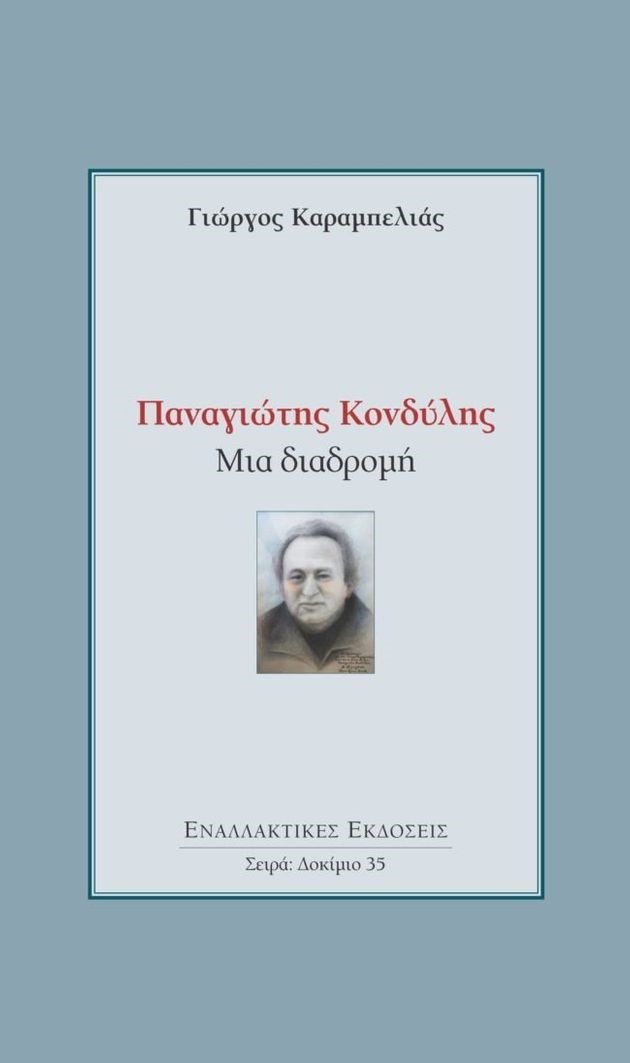
By George Karabelias
A pivotal role in this new period of his writing activity and personal development Panagiotis Kondylis will play his text, "Greco-Turkish War", which he publishes as an epigraph to The Theory of War, text written immediately after the national humiliation of Imia, in 1996, which will make him more widely known and will cause fierce public disputes and confrontations. It records without a shred of irony the gradual subordination of the shrinking Greek world to Turkish domination – what we already called "Islamo-Kemalist" and which would later become known as neo-OttomanismAfter having unprejudicedly recorded the gradual and rapid deterioration of the relationship of forces between Turkey and Greece at the demographic, economic and military levels, he returns without blinking to the fatal relationship between the Greek nation and the Greek state:
In this sense, the geopolitical potential of the Greek side was reflected in the 19th century, and up until the landmark year of 1922, much more in the nation than in the state. The nation was much broader than the state, extending from Ukraine to Egypt and from the Transcaucasian countries to the prosperous colonies of the Balkans and central and western Europe... The nation ultimately coincided with the state not because the state expanded, but because the nation was amputated and shrunk, because the Hellenism of Russia (after 1919), Asia Minor (after 1922), the Balkans and the Middle East (especially after 1945) was annihilated or displaced. This was followed by the expulsion of Hellenism from Constantinople (1955) and Northern Cyprus (1974), while today we are witnessing the disintegration and mass exodus of Hellenism from Northern Epirus. (1).
...Indeed, the core of the Greek issue should be sought in the very pathologies of the Greek state. which “was at no stage capable of effectively protecting the wider Hellenism and of halting its shrinkage or annihilation. […] The proven inability of the Greek state to defend the Greek nation – that is, to carry out its mission par excellence – constitutes the most worrying omen for the future” (2). And from the moment the cycle of external contraction has closed, contraction in the very interior of the Greek state inevitably follows, due to the demographic and economic pathologies of the parasitic consumer model, "because the Greek state is already gradually revealing itself to be unable to protect even the nation within its borders" (3). Parasitic consumerism has eroded not only the country's elites but the popular body itself in increasing depth and scope:
The main opponent of a national strategy is none other than parasitic consumerism, which in a "declining nation" like Greece's, inevitably leads to over-indebtedness. The term "parasitic consumerism" is used here in its literal sense to state that today's Greece, being incapable of producing itself what it consumes […] is parasitic, and indeed in a double direction: It is parasitic on the inside, which mortgages the resources of the future by converting them into current interest payments, and it is parasitic on the outside, which has also borrowed excessive amounts not to make future fruitful investments but mainly to pay with them enormous quantities of consumer goods, which it has again imported from abroad (4).
The only way to avoid, even in extremis, collapse is to change the productive, educational and social/demographic model, that is, an endogenous modernization, otherwise the inexorable nemesis of collapse will follow:
If Hellenism wants to survive as a distinct identity, the first thing it should do would be to produce what it eats. I do not mean at all an economic “self-sufficiency” in the old sense, but liberation from the politics and practice of parasitic consumerism. […] Otherwise, a fall to the lower rungs of the international division of labor, compulsion and political-military dependence is inevitable. … Its reversal requires a brave productive effort, advanced know-how and radical institutional reform, as well as an educational system of a completely different level (5).
… His theoretical detachment from dominant ideologies served as a vehicle for a “cold”, detached and more objective view of international relations and the position of the Greek nation-state in the world. Anyone who does not possess sufficient internal dynamics will not be saved by “European unification”:
Thus, the classic problem of national survival is posed again, through other paths and with other coordinates, which many believed they would solve easily and happily with the "European unification".... Anyone who does not want to confuse their wishes with reality must realize that… the nation, as a basic unit of political grouping and consequently its survival as a guarantee of the physical and political-social survival of specific people, has not been practically surpassed either at the European or global level (6).
And obviously no internal reconstruction can succeed as long as the mechanisms of demographic contraction persist:
...There is no doubt that for decades Hellenism has been in a process of geopolitical contraction and we now know with certainty that at least one component of this contraction will be extended approximately in a straight line: demographic. This cannot but have certain consequences, when… Turkey will have ten times more inhabitants than Greece… (7)
Based on the objective, as far as possible, view of the mechanisms of the decline of the Greek state, comes to the obvious conclusion that even if, in the future, nation-states cease to be the privileged vehicle for uniting people, Greece is at risk of national decline, long before other nation-states, and is therefore threatened with national amputation:
I am not a "nationalist," and I would not be at all upset if, by consensus, national borders and national armies were abolished. But the abolition of a nation-state along with everything else is two very different things from its dissolution or mutilation because a neighboring state is stronger and more aggressive (8).
Regarding the issue of the European Union, membership in it is not capable of preventing our national decline and the dangers it entails; on the contrary, as demonstrated by our recent adventures, the E.U. is capable of the most callous speculative behavior towards Greece – which it had largely predicted with astonishing accuracy,having in mind the stance of the European partners towards Greece, in the Yugoslav crisis, the Macedonian crisis and of course in the Greek-Turkish conflicts.
The consequences would be particularly grave if this time some of the most important partners within the European Community were to turn into… adversaries, who would do (as they are very likely to do) two things: on the one hand, they would ignore what the Greeks consider to be their national rights, adopting on the relevant issues either the position of Greece's adversaries or, in any case, a position in line with their own regional interests; and on the other hand, they would refuse to further finance Greek parasitic consumerism, imposing a strict austerity diet on the Greek economy and restoring the Greek standard of living to the level that its capabilities allow (9). […]
Of course, such a sober assessment should not lead to a – not at all sober – disposition to cut off from any alliance and any kind of membership in supranational organizations. But…, only a strong (and in need of self-sufficiency) Greece will give political weight to European integration, while being respectful of its partners... It may seem paradoxical, but, within the framework of a successful and long-term national policy, Europeanization, and modernization in general, must proceed precisely so that a strengthened Greece cannot be an accessory or puppet of "Europe", so that it can be in a position, if necessary, to take the path dictated by its own interests, when these conflict with those of its European partners (10).
References
- P. Kondylis, "Geopolitical and strategic parameters of a Greco-Turkish war", epigraph to the Greek edition of Theory of War, Themelio, 1997, p. 384.
- P. Kondylis, "Geopolitical and strategic parameters...", ibid., p. 385.
- P. Kondylis, "Geopolitical and strategic parameters...", ibid., p. 385.
- P. Kondylis, "Geopolitical and strategic parameters...", ibid., p. 385.
- P. Kondylis, Planetary…, ibid., p. 165.
- P. Kondylis, Planetary…, ibid., p. 165.
- Answers to ten questions by Spyros Koutroulis, in P. Kondylis, The invisible chronology of thought, Nefeli publications, Athens 1998, p. 142.
- Answers to ten questions by Spyros Koutroulis, ibid., pp. 143-144.
- P. Kondylis, Planetary…, ibid., pp. 163-164.
- P. Kondylis, Planetary…, ibid., pp. 174-175.
Read more in his bookGeorge Karabelias,Panagiotis Kondylis:A route.