

When you get slapped, even from Kiev, how can they respect you!
When you get slapped, even from Kiev, how can they respect you!
slpress
EPA/HOUTHIS MILITARY MEDIA CENTER / HANDOUT BEST QUALITY AVAILABLE HANDOUT EDITORIAL USE ONLY/NO SALES
 MICHAS ZACHARIAS
Greece and Israel. Two allied countries with a common adversary. But two different international behaviors. At the end of the day, however, the possibility of building a common deterrent strategy that would maximize the possibilities of effectively neutralizing the greatest threat to Greek national security is undermined. Also changing the balance in the wider region…
A few days ago, US President Donald Trump boasted that he had intervened and prevented strikes by the Israeli armed forces in Syria, while fighter jets were "warming up their engines"! Yesterday morning, we woke up to learn that such an attack had finally taken place, without specifying by whom, while the targets included an air base on the Syrian-Turkish border...
The statements and comments that followed left no doubt as to who was behind this attack. Israel was several hours late in officially admitting its involvement. However, “a village in sight”… Obviously, however, the subject of today’s commentary is not to decide who did what!
Besides, we have pointed out in a timely manner that one of the most dangerous potential fronts in the near future is the one between Israel and Turkey . A front that could change everything in the wider region, directly involving Greek (Hellenic and Cypriot) national interests. Not necessarily in a negative way, although risks by definition exist.
The Turkey-Israel front
Such a front would change the data for Turkish defense planning. No special explanation is needed as to why the real threat to the Turks does not come from the west. Any “fuss” in our region is the product of Ankara’s exclusive initiative and has as its starting point its constant revisionism. A look at the recent data on air activity in the Aegean area is enough to document that the “temperature” is determined at will from the eastern side of its coasts.
The most basic observation that must be made is the decision of the Jewish state not to make concessions on national security issues, even if the American president himself is the one objecting, with whom the current Israeli prime minister has maintained warm personal relations for decades.
The Israelis have set a red line for Turkish involvement in Syria and are systematically building an image of credibility about what will happen if... someone violates it. Without exceptions. They have also visibly moved an entire squadron of Apache attack helicopters closer to the northern front, i.e. oriented towards Lebanon and Syria...
This is the image of a country that is fully aware of what is happening in its geopolitical surroundings. It understands that everyone is playing their last, as they have understood in time the transitional phase that the international system is going through. At the local, regional and global level. Everyone is jostling for the best possible position for the next day, where there will be winners and losers.
Winners and losers. And with all due respect to themselves, the Israelis do not intend to be in the latter category. Moreover, as their strategic culture reveals , they understand that hiding in their shell is a defeatist strategy, which radiates weakness in the geopolitical environment. But above all, they actively try to shape developments.
The "loyal" Greeks...
Greece seems to be at the opposite end of this perspective. Its rhetoric continues to naively overemphasize international law, at a time when even the “law-abiding” realize that it is no longer used, not even as a fig leaf to cover up real motives and goals! Only what you have the power to secure will belong to you the next day. This is also the belief of revisionist Turkey.
Without expanding on the entire spectrum of Athens' international behavior, let us only point out that it is betting everything on the policy of alliances. On the "right side of History", with the expectation of finding support at the critical moment. At the same time, however, with the absolute adaptation of Greek interests to those of the alliance, it is sending the message that it is hesitating. The same attitude is reflected on all fronts! Existing and potential!
It advertises an alliance with Israel, but is clearly afraid of making moves that would give the impression of unifying, in a way, the Greek-Turkish front with the Turkish-Israeli front, building a strong and distinct deterrence system... It advertises a strategic relationship with Saudi Arabia and seems to be surprised by the Mecca Agreement.
The same with the Ukraine front! At first, he approached it in “ideological” terms and sermons about international law and legitimacy. Nowhere was there any reference to specific Greek national interests. From the beginning, he sent out the message of a policy that is a follow-up to that of the “allies”. Any deviation from the allied policy and reference to specific Greek national interests is considered a crime of sanctification!
Here's a "thank you" from Kiev!
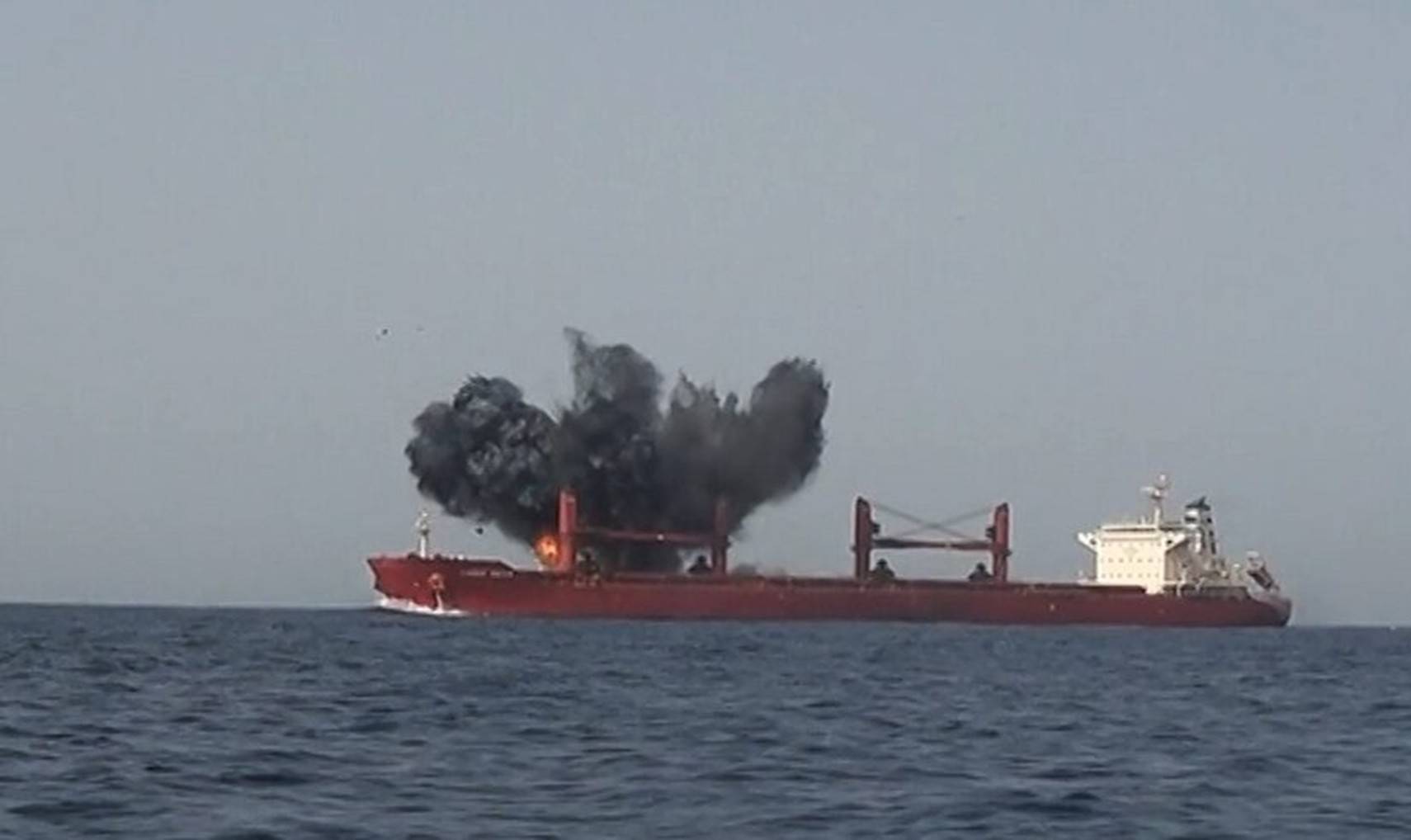
Finally, it “managed” to receive drone strikes against ships of Greek interests in the Black Sea from the Ukrainians who have benefited! In some cases, the oil was from Kazakhstan! Kiev feels comfortable… punishing its benefactor, who went against its traditional policy of balancing relations with Russia for its sake! Sacrificing Moscow’s role in the Greek-Turkish and of course in the Cyprus problem! This is the “thank you”!
Although rightly, together with Malta, strong reservations were expressed blocking a proposal by the European Commission for a complete ban on shipping services transporting Russian oil. The horizontal ban would harm the competitiveness of Greek, and therefore European, shipping companies. It would also cause further turbulence in international energy prices, harming the Greek consumer.
But is this sufficient justification for Kiev targeting ships of Greek interests? In other words, what they expected was that Ukrainian interests would be prioritized over Greek interests? We must defend these. If the country defends them, it is as if they did not exist! And since Kiev is turning against Athens, what is the reaction?
Has Greece threatened serious countermeasures if this practice continues? And certainly means it. Beyond the typical diplomatic representations, which in practice prove that in times of war it is for the eyes of the world. Inside and outside Greece… There is also the veto in the European Union if they insist on demanding complete subordination of Greek national security interests to Ukrainian ones.
Israel-Ukraine: “Lord, have mercy on us…”
That said, does anyone in Athens wonder what is the cause of the disrespect that Greece's geopolitical status has fallen into, judging by the ease with which Ukraine "forgets" Greek aid and harms Greek interests due to not being fully aligned with its decisions?
Perhaps, by analogy, the equivalent of the proverb "the most, Lord have mercy, even the priest gets bored of it" is finally true! Where "Lord have mercy" is equated with sermons on international legality, which sound so out of place in the generalized jungle situation we are going through.
Sometimes, the country seems to become a convenient target for everyone. A punching bag! Why? But because if retaliation is not expected, which would objectively erect a wall of deterrence, everything else ends up being mere details. Because the Ukrainians prioritize their own interests. The only way to deter is to cultivate the belief in credible retaliation. These would weigh heavily on anyone's calculations.
Did we hear anything substantial from the otherwise talkative ministers Kikilias, Dendias and Gerapetritis? The problem is that reputation and credibility are not built overnight. They are cultivated over time. Not with words, but with deeds. Not with “savages” and the usual style of some for communication reasons, as the priority here is the image of a cooperative politician in… selected foreign capitals. So how is it possible that you have played a leading role in favor of Ukraine, have armed it, have forgotten every trace of the usual appeal in favor of the path of diplomacy over that of weapons and are being hit by Ukrainian drones?
At the same time, you, as Greece, have not dared to connect the country's position with that of your allies on the Cyprus issue, which is also a matter of invasion and occupation! Why should we shout about Donbass, if the allies and Zelkenski do not see "occupied" areas in northern Cyprus? If they urge us to "come to terms" with the occupier, why should we differentiate our position, having taken a position of principle from day one to condemn the Russian invasion? Are there... two types of occupiers?
Berlin, Kyiv and Nord Stream
Germany has also supported Ukraine. But when the Nord Stream pipeline was sabotaged, which was attempted with a massive communications attack to pin the blame on Moscow, Berlin was not convinced. The German investigation pointed to others as responsible. Eventually, two Ukrainians were arrested who were working “on behalf of Ukrainian state entities,” and the German federal prosecutor’s office is now doing its job.
Kiev claims that it “did not organize” the sabotage, but does not hide its satisfaction, implicitly considering any attack that limits Moscow’s ability to finance the war against Ukraine as legitimate. This seems to be the case with the ships of Greek interests as well.
Kiev's stance is understandable since the priority is "the aggressor Russians". But in the Cyprus issue, we don't have "aggressors" like Greece that we should give priority to in turn? In other words, shouldn't we pretend we don't see so as not to disrupt... the unity of the alliance? Or should we justify the actions against us on the Ukraine front, putting the problems with Turkey and the Cyprus issue in second place?
Ultimately, what conclusion do the strategic planners, the political and military leadership in Israel draw from this stance of ours? It is recalled that the Israelis have proven in practice that they do not hesitate to bypass the objections of a country that has provided them with $38 billion in armaments over the last decade. Nor the special interests of the “greatest friend it has ever had in Washington” , in the words of Prime Minister Netanyahu. How is Athens’ “excessive tolerance” interpreted in Jerusalem? The comparisons and conclusions are up to each individual…
In collaboration with defencepoint
When you get slapped, even from Kiev, how can they respect you!