

Why do cities in Ukraine and Crimea have Greek names?
Why cities in Ukraine and Crimea
Do they have Greek names?
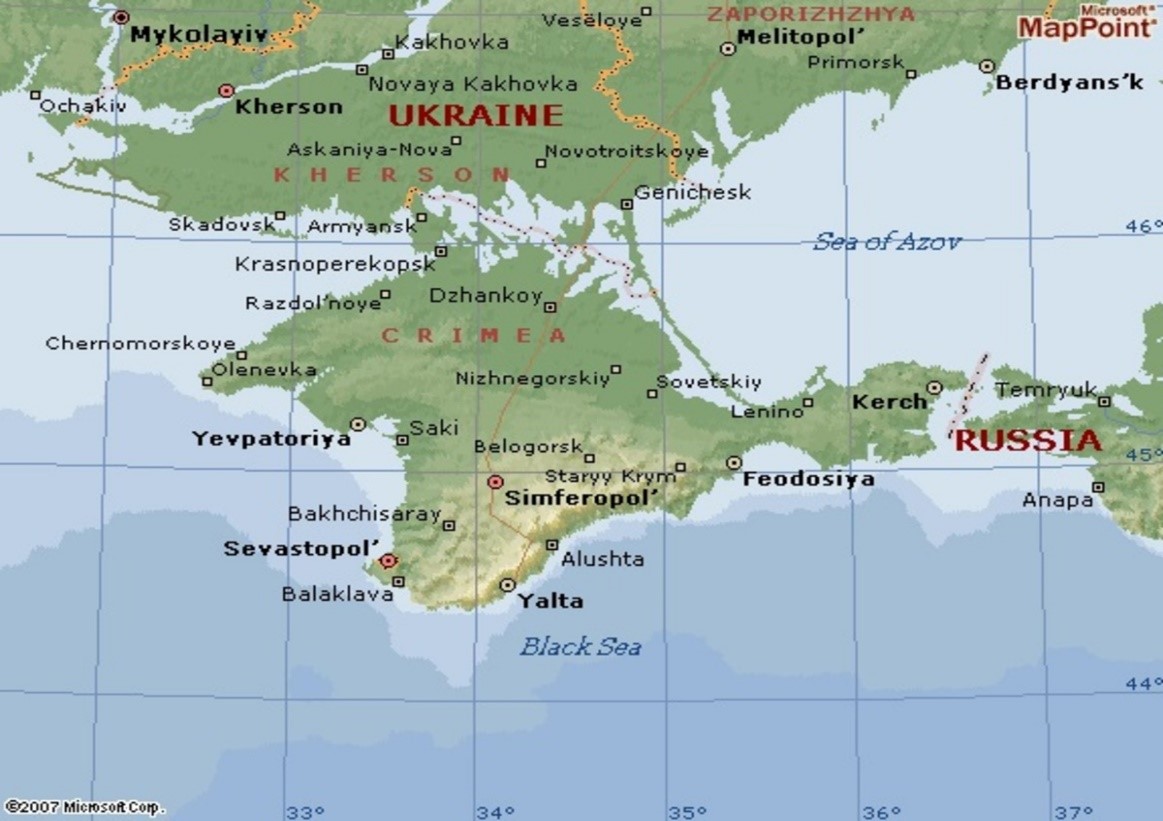
For many millennia, Greeks traveled to Ukrainian and Russian lands to establish colonies, spread Orthodoxy and Byzantine culture, engage in trade, defend the Orthodox faith from foreign invaders, and seek the long-awaited freedom. These lands have always been hospitable to the Greeks, whom the Ukrainian and Russian people considered their brothers. From the mythological Colchis, the four labors of Hercules in the Black Sea, the journeys of Odysseus, to the land of the Laistrygonians, today's Balaklava in Crimea (the ancient Tauris where Iphigenia lived), to ancient Olbia, near Odessa on the island of Lefki where the soul of Achilles lives eternally, which was transported by his mother Thetis, according to legend. The white migratory birds that stop there today, sailors call them "Companions of Achilles". The ancient myths are so old that they prove that for millennia the Ukrainian land was the homeland of the Greeks.
The numerous ancient Greek colonies on the Black Sea, grafted Greek culture on all the Black Sea peoples. In the Hellenistic years, many remained prosperous and constituted the frontiers of Byzantium. In 988 AD near Sevastopol, Prince Vladimir was baptized an Orthodox Christian, after he had previously been crowned with the Byzantine Princess Anna, and then in Kiev thousands of Slavs embraced Orthodoxy. But also Greek letters through the Cyrillic alphabet and Greek culture, since together with Anna, thousands of Byzantines of all arts and sciences undertook the organization of the new Russian state, which began in Kiev. After the fall of Constantinople, thousands of Greeks settled in Odessa, Crimea, Kiev, Lviv, etc. They were the yeast on which the Greek revolution and the financial support of the new Greek state were later based. The beautiful buildings of Panepistimiou Street, the Archaeological Museum, etc., in Athens, are all donations from the Greek Eupatrids of Ukraine. (Instead of smearing them... the comrades should have kissed them).
In the city of Nizna, 100 kilometers north of Kiev, there was during the 19th century the richest Greek community in the world, with privileges and independent taxation. There lived the Zosimades brothers who did not marry, so as to offer everything to the rebellious Greece "..keeping for themselves the absolutely necessary.." as the historian writes. In Kiev lived the family of Ypsilantis, where he organized the uprising in Moldavia. There the traveler will also see his monument in the Lavra, the metropolis of the Russian church, which was a refuge for many Greek fighters and hierarchs. Further down in Poltava, lived E. Voulgaris and N. Theotokis. In Kharkov, lived I. Karatzis from Crete where the university there also bears his name. Further down in Donetsk, a very strong Greek community flourished and flourishes, and about 600 children are learning Greek. Further down, Mariupol, where it was founded by 30000 Greeks, who, under pressure from the Crimean Tatars, in search of a new homeland, Catherine II granted them the area of present-day Mariupol. Leaving the ancient graves of their ancestors in Crimea, and after an epic march in 1788, leaving 3000 dead along the way, they settled present-day Mariupol and the 24 Greek villages that still exist.
Further down in Odessa, which every Greek had to visit once in his life, the Greek element was prosperous and dominant for almost 2 centuries. Thousands fled there to escape the massacres after the declaration of revolution in 1821. The body of the hanged Patriarch Gregory V was also buried in Odessa, when he was thrown into the sea by the Jewish mob in Constantinople. The Friendly Society was founded and organized in Odessa, where the wax figures of the friendly people still exist today. Many Cossacks from Zaporozhye, volunteers, came and fought in Greece during the revolution. But traveling from Odessa to Kherson, one cannot help but remember the 400 Greek fighters who fell against the Bolsheviks in 1919 as part of the campaign sent by the allies and Venizelos in the Russian Civil War. Descending to Crimea, ancient Tauris, everything here reminds one of Greece.
The museums full of Greek exhibits, the place names, the village of Livadia near Yalta, founded by Lambros Katsonis when he retired from the fighting. In this village, the Yalta conference took place in 1945. In today's Kerch, one will see the ruins of Panticapaeum, further on Phanagoria and the many Greek monuments. In Chersonissos, near Sevastopol, one will see ancient temples, theaters and countless Greek monuments... But also the monument of the bathhouse of Prince Vladimir. Further on in Balaklava, where it was also called Russian Sparta, the "Spartan Legion" was founded under Captain S. Mavromichalis...
There was also the organization "Greek Army" which was based in Kerch, Crimea. The service of hundreds of Greek officers and soldiers in the Russian army and navy highlighted the value of the Greek race, their hard work and their dedication. They would later constitute the "yeast" in the Greek revolution.
It is no exaggeration to say that there, in these places, is “Upper Northern Greece”. That there I encountered the Greek LIGHT. This light comes from the distant past. It still exists, as an aura wrapped in the ancient Greek monuments and in the Greeks of these regions. It is visible in their faces and in their movements when they talk about Greece. It is visible in their eyes that look at you through a continuity of three millennia. It is visible in their speech that still has the ancient tinge. It is visible in their hospitality and kindness. It is visible in the beautiful faces of the women who still have the lines of the Greek archetype. It is visible in the Greek architecture that I encountered everywhere. It is an experience that only if someone lives it will perceive, with the eye of the soul, this light, the Greek. As Emmy Dostoevsky writes, “Ukraine has always had close relations with the Greek colonies on the shores of the Black Sea. "Greek blood flows in the veins of Ukrainians, it is visible in their beautiful sunburnt faces, in their graceful movements. It is not excluded that the Ukrainian theater is a distant echo of that ancient Greek theater, which was so loved by the Greek peoples."
Knowing the signs of the history of the Greeks in the villages of Crimea, Mariupol, monuments, people who are much more Greek than us in metropolitan Greece, I gained the feeling that the Greek element in Ukraine and Russia is strong, because it has roots in Greek spirit and marble and must continue to exist there to represent Hellenism worthily. For them, the Greek flag, the language, the cultural heritage are passion and love together. But our own responsibility is also heavy for the continued presence of the Greek element, which has taken root there for three millennia.
Today, on Sundays, if someone goes to the Russian church in the center of Athens, on Filellinon Street, they will see Russian immigrants and Russian women wrapped in their scarves, humbly seeking solace and hope far from their homes, since the bad economic situation forced them to leave their country. Just like that, a little earlier, in the churches of Ukraine, in the other Holy Trinity of Odessa, the immigrants-hunted Greeks during the years of slavery would nestle on Sundays and make vows and prayers for the Resurrection of Greece. Chalices, Gospels, books were sent from Russia and Ukraine to Greece. In the churches of Ukraine there were special amphorae for the redemption of Greek prisoners from the Turks.
Today, when Ukraine is being broken and tested, since the hungry, hypocritical and always anti-Greek West has put its plans into practice, we must know the reality. To know how much we owe to the Ukrainian land where the Greeks lived and worked for millennia. And to take the corresponding position.
As an epilogue, I will quote an excerpt from the speech of an expatriate professor at the University of Mariupol: "Here in Mariupol, the Kalmius River flows into the Sea of Azov in a narrow passage. The first Greeks called it Thermopylae. It is their own Thermopylae. The Thermopylae of the Sea of Azov are guarded by Greeks, too. Not the Spartans but the Thespians, the forgotten ones. If the Thermopylae of Kallidromos symbolizes the will of man to remain free, the Thermopylae of the Sea of Azov symbolizes the will of the Greek to remain Greek and Christian Orthodox. This Hellenism, which, rooted on the shores of the Sea of Azov, acts and creates and keeps the flame and love for the Greek homeland unextinguished, awaits the affection and care of mother Greece and of each of us individually. "In Mariupol, the heart of Greece beats strongly."
MR. DAMIANAKOS