

What do Turks think about Greek-Turkish relations and Cyprus - Do they agree with Erdogan's policy?
What do Turks think about Greek-Turkish relations and Cyprus - Do they agree with Erdogan's policy?
What does a survey by Kadir Has University in Istanbul show – Does Turkish public opinion converge with the government's policy?
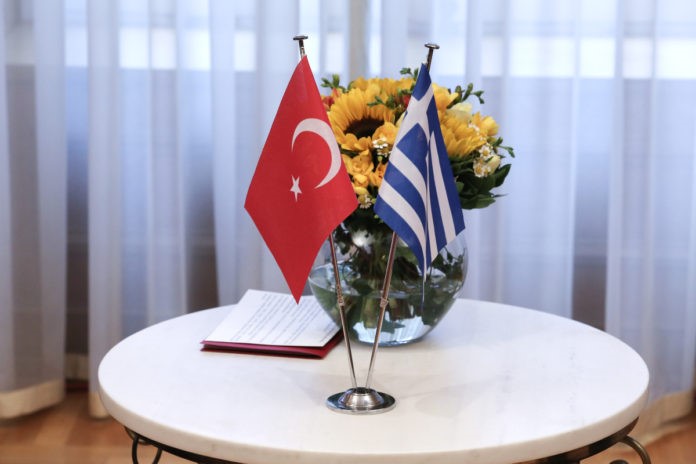
The militarization of the Aegean islands was singled out as the biggest “thorn” in Greek-Turkish relations by Turkish citizens who participated in a survey by Kadir Has University in Istanbul on public perceptions of Turkish foreign policy. More than 1.000 people, over the age of 18 from 26 cities in Turkey, participated in the survey, which yielded interesting findings on the points of convergence and divergence between Turkish public opinion and the Turkish government on foreign policy.
Greek-Turkish
The respondents characterize the relations between Athens and Ankara as problematic, at a rate of 30,2%, while for 14,9% the bilateral relations are hostile. The militarization of the Aegean islands (50,9%) is considered the most crucial problem in the Greek-Turkish debate, followed by the delimitation of maritime zones in the Aegean (45%) and Greece's stance towards the organization of the Fethullah Gulen (37,3%).
The Cyprus issue is ranked fourth (37%), followed by responsibilities and jurisdiction in the airspace (30,8%) and maritime jurisdiction areas in the Eastern Mediterranean (27,7%). It is emphasized that the issue of the Muslim minority in Western Thrace, which Ankara is attempting to raise high on the bilateral agenda, is in last place among the problems.
Cypriot
Regarding the Cyprus issue, the overwhelming majority proposes the union of the Occupied Territories with Turkey (48%). The establishment of a state with a bizonal bicommunal federation (31%) comes second, while the two-state solution recently proposed by Turkey and the Turkish Cypriots is ranked third (27,9%).
Regarding the conditions under which Ankara should recognize Cyprus, the first is the resolution of the Cyprus problem (37,3%), while a large percentage (28,2%) proposes immediate recognition of the island and without conditions. A further 23,5% believe that Cyprus should be recognized after the resolution of the Greek-Turkish problems.
Priority and ignorance
Combating cross-border terrorism (23,5%) emerged as the most important issue in Turkish foreign policy. Relations with the US (12,3%) were in second place, followed by tensions in the Eastern Mediterranean (9,6%) and relations with the EU (8,3%).
Great ignorance or misconception was recorded on key issues of Turkish foreign policy. 62,9% do not know what the S-400s are, 63,4% have no idea about the F-35, while 76,1% do not know what the "Blue Homeland" doctrine is that the Turkish government systematically seeks to promote.
At the same time, the European orientation of Turkish society was highlighted, with 60% supporting Turkey's accession to the European Union, while 40,6% described it as a European country. However, 90,6% do not know what the Customs Union is, which Ankara ardently desires.
Friends and enemies
The countries most friendly to Turkey were Azerbaijan, the pseudo-state in Northern Cyprus, Georgia, Uzbekistan and Pakistan. On the other hand, the US (54%) is estimated to pose the greatest threat to Turkey, followed by Israel (41,8%), Armenia (39,4%), Greece (38,7%) and France (37,3%).