

Ioannis Metaxas' plan for a preemptive strategic strike in the eastern Aegean without a declaration of war (March – June 1914)
Ioannis Metaxas' plan for a preemptive strategic strike in the eastern Aegean without a declaration of war (March – June 1914)
writes Ioannis V. Daskarolis (first published in historythemes.com)
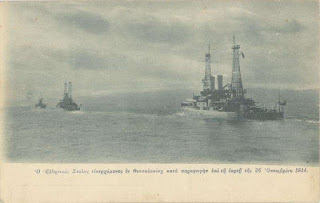
Prologue – the Treaty of Athens and the Turkish claims to the islands of the eastern Aegean (November 1913-January 1914)
In the First Balkan War, Greece, thanks to the famous armored cruiser Averof, had not only completely dominated the entire eastern Aegean, liberating its islands from the Ottoman yoke, but had also trapped the Turkish fleet in the Dardanelles, from where it was crushed every time it tried to sail.
The resumption of Greek-Turkish relations was sealed with the signing of the Treaty of Athens between the Ottoman Empire and the Kingdom of Greece. The treaty, signed on 14/27 November 1913, officially ceased hostilities between them, ceding Macedonia, Epirus, Crete and some Aegean islands to Greece. However, the treaty left the status of the eastern Aegean islands in limbo, which it envisaged would be regulated by the Great Powers.
By a collective diplomatic communiqué of 31 January/13 February 1914, the Great Powers notified the Greek government and the Sublime Porte of their decision on the Aegean islands: The islands of the Northeastern Aegean, except Imbros and Tenedos, were to be ceded to Greece on the condition that they would remain unfortified, would not be used for naval or military purposes, that smuggling between the islands and Asia Minor would be combated, and that guarantees of protection for Muslim minorities would be given. The communiqué provided that the islands would be definitively incorporated into Greece when the Greek army evacuated Northern Epirus, which would form part of the new Albanian state.
The proposed solution, however, essentially left the issue unresolved, as it did not foresee any pressure being exerted on the Ottoman Empire to comply with the decision of the Great Powers, but Venizelos, however, hastened to comply with its content, evacuating Northern Epirus. The defeat of the Ottoman Empire in the First Balkan War and the final loss of its Balkan territories had inflamed nationalism both in its leadership and in public opinion. On 3/16 February 1914, the Grand Vizier, Said Halim Pasha, rejected the diplomatic communication of the Great Powers, considering the islands an integral part of the Empire's Asian possessions.
The Sublime Porte did not accept the cession to Greece of the islands near the Dardanelles, but also more generally the cession of the large islands in the northeastern Aegean, such as Chios and Mytilene. Already the Turkish ambassador in Athens, in a discussion with his English counterpart in January 1914, underlined the legitimacy of the Turkish claims to the islands of the eastern Aegean, stating that if Greece did not voluntarily cede Chios and Mytilene, Turkey would seize them by force. But the International factor not only did not decisively support Greece in the looming conflict, but both England and France urged Venizelos to make concessions, excluding any possibility of an alliance and naval assistance.
The naval arms race in the Aegean and the Greek stalemate (January – June 1914)
In order to change the balance in the Aegean and to effectively challenge Greek sovereignty, the Ottoman Empire ordered a large battleship of the super-dreadnought type in England, which was launched on August 21, 1913, as well as another (Rio de Janeiro) on 10 December 1913 (named sultan Osman I), acquiring serious naval superiority in the Aegean. Despite the persistent warnings of the General Staff about the undesirable development, the government underestimated the danger and did not react immediately, at least having time to purchase the Rio de Janeiro.
The problem for Greece was not limited to the islands of the eastern Aegean but also concerned Macedonia as Turkey's naval superiority would prevent the transfer of a Greek army from the South to the North to confront the encroaching Bulgaria, leading any Greek defensive effort to certain failure. Similarly, all the major ports of the country such as Piraeus and Thessaloniki would remain at the mercy of the Turkish navy. The real possibility of an unholy alliance between Bulgaria and Turkey and Serbia's refusal to honor its obligations arising from the Defense Alliance Pact between the two countries created a nightmarish scenario and threatened Greece with total military devastation.
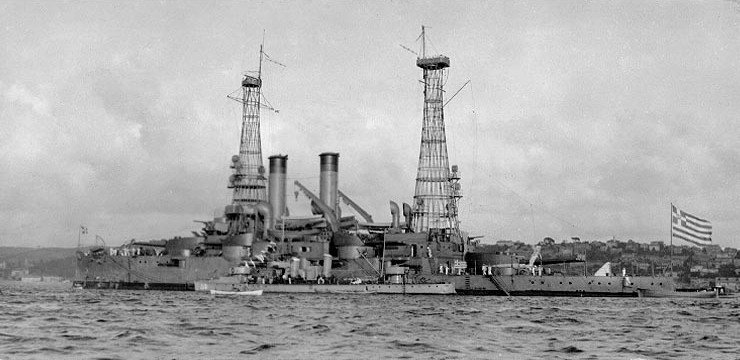
| The battleship Lemnos |
Relations between the two countries remained particularly tense as in February 1914 the first harsh persecutions were launched against the Greeks of Asia Minor, systematically organized by the Young Turk government and aided by the arrival of thousands of Muslim refugees from Macedonia. The execution of the persecutions was undertaken by the secret service. "Special Organization" [Teskilati Mashousa] acting with armed groups/gangs that were under the guidance of officers of the Ottoman Army and were also staffed by Muslim refugees from the Caucasus and the Balkans. The persecutions, which took the form of ethnic cleansing, continued with breaks until July 1915 and led to the flight of approximately 150.000 Greeks from their homes, while Muslim refugees from the Balkans settled in their abandoned properties.
As the August delivery date of the two ships to Turkey approached, Greece made a last-minute attempt to balance the situation in the Aegean by purchasing two battleships from America, which were renamed Kilkis and Lemnos. However, these two battleships were of old technology, had little firepower, and could not develop high cruising speeds, and the Greek leaders described them as “floating turtles”The two ships were completely unsuitable for maintaining the balance of power in the Aegean, while they cost more than the Rio de Janeiro to the Turks.
Thus, in the second quarter of 1914, Greece found itself in a real dilemma as to how to react to Turkish provocations in the Aegean. Desperate thoughts were expressed, such as that of Admiral Kountouriotis, to ambush the two battleships sailing to Constantinople in Malta with a submarine and to sink them by surprise, taking personal responsibility. The problem, however, was complicated by the rumor that among the crews of the two vessels there would be English officers and sailors.
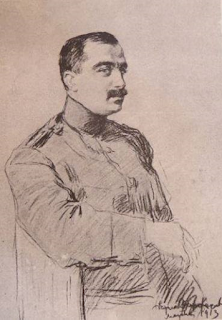
Ioannis Metaxas' plan for a preemptive strategic strike against Turkey
In that difficult juncture, Metaxas studied and drafted from March to June 1914 the famous top-secret plan to seize the Dardanelles without a prior declaration of war on the Ottoman Empire. The plan envisaged a rapid Greek preemptive crushing strike against the enemy by the surprise transfer of three divisions from mainland Greece to the Dardanelles Straits.
More specifically, the 27.000st, XNUMXnd and XNUMXrd Army Corps would prepare a full-fledged division, properly supplied and equipped without resorting to local mobilization so as not to arouse the enemy's suspicions. The entire expeditionary Corps would be XNUMX hoplites who would embark on steamships assigned to Piraeus and Thessaloniki. The steamships would transport the Expeditionary Corps to Lemnos, where the two flotillas would be unified and then the Greek forces would be landed by surprise in the Dardanelles in the inlet of the Gulf of Xiros, where they would have a great numerical superiority over the small forces of the enemy who would not have had time to mobilize.
A necessary condition for a successful landing would be that the Greek fleet would have attacked and sunk the entire Turkish fleet deployed in the area, which would have been very likely since the Greek fleet would have struck first, overwhelmingly, without a prior declaration of war.
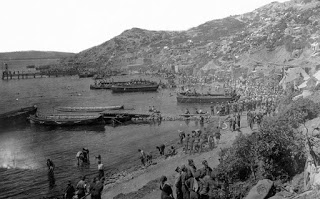
| The landing at Gallipoli in 1915 |
The plan essentially violated all international legality since it did not foresee a declaration of war or the severance of diplomatic relations, but it made a Greek victory and the securing of Greek gains very likely. The international outcry against Greece would be silenced, since Greece was essentially in self-defense, facing the constant threat of war from the Turks in words and deeds.
The King (although he had not yet reached his final approval of the plan), the Chief of the General Staff V. Dousmanis, the Minister of the Navy K. Demertzis, but Venizelos had all expressed their support for the preemptive crushing strike in the Dardanelles.
He hesitated as he considered that it had little chance of success. However, as the situation with Turkey was constantly deteriorating and public opinion was openly expressed in favor of a new armed confrontation with its neighbor, Venizelos urged Metaxas to complete his study.
Epilogue – The unexpected solution to the problem
On June 28, 1914, Archduke Franz Ferdinand, heir to the Habsburg throne, was assassinated by Serbian nationalist Gavrilo Princip in Sarajevo, Bosnia.
This murder led to the outbreak of war throughout Europe and consequently England seized the two docked Turkish battleships, unexpectedly saving Greece at the very last moment.
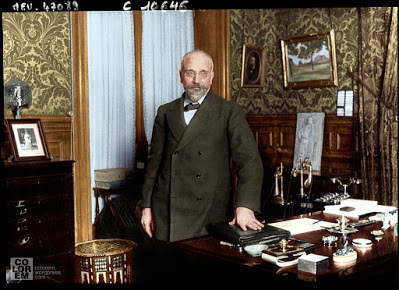
Venizelos was already in Brussels to meet with Grand Vizier Halim Pasha with the intention of making concessions to the status of the Eastern Aegean islands and a mutual population exchange agreement. The outbreak of World War I made these concessions unnecessary.
The Dardanelles campaign, however, was to come to the fore again just a year later...
Πηγές
Metaxas Ioannis, His personal diary (volume B1), Govosti publications.
Studies and memoranda of the Deputy Chief of the General Staff Ioannis Metaxas (September 1913-July 1914)
I. Study on the possible military operations between Greece and Turkey.
II.Defense of the islands of Lesbos, Chios and Samos against Turkish attack
III. Campaign plan based on the situation of June 10, 1914
The History of National Division According to the Articles of Eleftherios Venizelos and Ioannis Metaxas, Kyromanos publications, Thessaloniki 1994.
General Xenophon, Greece in Asia Minor, Creation publications, Athens 1999.
Ventiris George, Greece of 1910-1920 (volume 1), Ikaros publications,
Ploumidis Spyridon, The Mysteries of Aegis (The Asia Minor Question in Greek Politics (1891-1922)), published by Estia Bookstore, Athens 2016.
Syrigos Angelos, Minority and other provisions in the Athens Convention (1913) https://www.academia.edu/Minority and other provisions in the Athens Convention (1913)_
Joachim G. Joachim, Ioannis Metaxas (His upward trajectory from military to political action (1871-1922), Papadimas Publications, Athens 2005.
Sfetas Spyridon, The issue of the islands of the Northeast Aegean in the context of Greek-Turkish rivalry and German policy (1914/1915), https://infognomonpolitics.gr/2014/06/19141915/
Papafloratos Ioannis, Plans for the passage of the Dardanelles Straits 1914-15, Nautical Review magazine (vol. 552), March 2015.