


1/2/2017. “Turkish Armed Forces: The consequences of the purges at the operational level.”
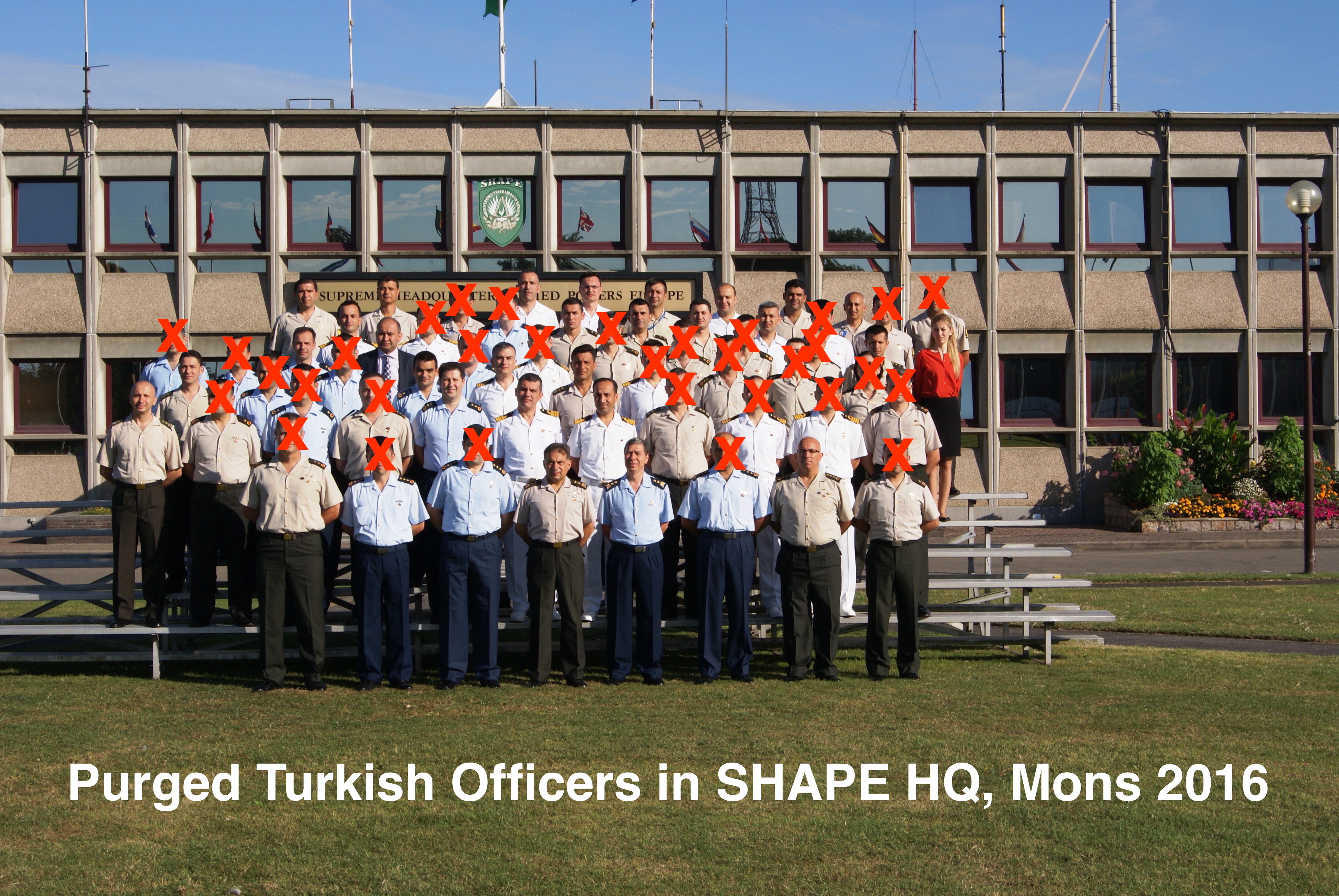
The disgraced Turkish officers who served at NATO's Supreme Headquarters Allied Powers Europe (SHAPE) in Mons, Belgium.
The first hearing in an Istanbul court for the failed July 15 coup began the day before yesterday. Of the 62 officers and non-commissioned officers of the Turkish Armed Forces who are accused of the attempted takeover of Sabiha Gökçen Airport and face life sentences, 34 did not appear in the courtroom as they are participating in Operation Euphrates Shield in Syria! [1] This news eloquently reflects the situation in which the Turkish military has found itself six months after the ongoing mass purges of experienced officers.
Accordingly, a forwarded case file for 72 Turkish Navy officers reveals that 29 warships were involved in the failed coup, which were mobilized at 21:00 on July 15, that is, 20 minutes before the coup plotters' first movements, at the Gölcük, Aksaz, Mersin, Tuzla, Istanbul, Ereğlisi and Phocaea naval bases, and the YAVUZ and KEMALREIS frigates used their weapons! It is recalled that the Turkish General Staff had claimed in a statement on July 27 that only 3 Turkish Navy ships participated in the coup, apparently in an effort to mitigate negative impressions and limit the reaction of the Islamic regime, which, however, was not avoided.
According to the latest official data, so far the following have been discharged:
150 Senior Officers (46%)
3.724 Officers
1.633 Permanent Non-Commissioned Officers
849 Professional/Contract Hoplites
157 civil servants
16.409 students and cadets of military schools and colleges
The situation in the Turkish Air Force (THK) and in filling critical positions abroad is considered particularly problematic. The fact that Ankara persistently requests air support from the US and Russia for Operation Euphrates Shield highlights, to a large extent, the limitations of the Turkish Air Force in prolonged military operations. After months of intensive air bombing in Syria and Iraq, Ankara is finding a shortage in the stock of guided bombs and trained pilots. [2] It is also characteristic that 9 pilots who are suspected of involvement in the coup are participating in bombing missions from the Diyarbakir Air Base, with the obligation to report daily to their local police station. As a former THK pilot claims in the German magazine Der Spiegel, Turkish losses in personnel and inside Syrian territory are "greater than expected" as the Turkish Air Force is no longer able to provide effective air support. [3]
The Turkish Ministry of Defense is desperately trying to fill the gap in pilots in three main ways:
A. With the return of retired pilots. As e-Amyna [4] has already pointed out, on November 9, 2016, 12 officers returned to service and according to pro-government sources, 79 more retired pilots, including 6 women, have expressed similar interest. The relevant application deadline expires on January 27 and the relevant interest remains to be confirmed.
B. By accelerating the training of new pilots. Specifically, the Ministry of Defense identified 1.040 THK executives who had been excluded in the past from the Pilot selection process and were currently performing ground service. Of these, 976 accepted to be re-evaluated, 831 passed the medical examinations, 295 were selected for training, 225 were registered for training and finally 120 began training.
C. By establishing a reserve pool of pilots, which will be utilized in case of emergency needs. The program is aimed at former THK executives who are currently employed in civil aviation and who will be retrained for at least 60 days per year.
Burcu Şahinkaya, the first female squadron leader of the Turkish Air Force who, according to her statement, christened her son “Aegea”, recently retired to work in civil aviation. A total of 6 women have reportedly expressed interest in rejoining the Turkish Air Force.
The mass purge of experienced officers serving abroad has disrupted the functioning of military diplomacy and intelligence gathering channels. According to a report by the NATO-focused website Bruxelles2, 232 of the 400 officers and non-commissioned officers serving in NATO institutions are being purged. Of these, 84 served in Belgium, 45 in Germany, 28 in the US, 28 in Italy, 17 in the Netherlands, 13 in the UK, 10 in Spain, 4 in Norway and 3 in Austria. [5]
To the above should be added 165 Defense Attachés (AKAM) out of the total 264 serving in Turkish embassies and other military delegations around the world and who were called to return to Turkey. In total, 397 out of the 664 officers and non-commissioned officers in positions abroad are being cut off, who, in addition to the cream of the Turkish Armed Forces, are also considered executives with experience in NATO issues and a pro-Western orientation. This fact causes serious concern to Greek staffs who estimate that communication with the Turkish side and the prevention of crises are becoming more difficult.
Notes
[1] This was preceded by the first conviction for the coup by an Erzurum court, which found Colonel Murat Koçak (Erzurum Regional Gendarmerie Director) and Major Murat Yılmaz (Erzurum Gendarmerie Operations Director) guilty of violating the Constitution and sentenced them to life imprisonment on 5 January.
[2] A similar problem arose for NATO member states participating in Operation Unified Protector in Libya. After 100 days of operation, NATO asked its non-combatant member states to contribute guided bombs from their own stockpiles. The leak of a classified report in November 2011 titled “Libya Mission” by the Danish Air Force’s Tactical Air Command (FTK) caused a political uproar as it was revealed that Denmark had used up its entire stockpile and had purchased guided bombs from Israel, after all attempts to procure them from allied countries had failed. As for Turkey, the Chief of the Turkish Armed Forces stated on October 5, 2015 that over 2.000 "smart munitions" were used to attack 1.200 targets in Iraq since July 23, 2015, while between August 24, 2016 and January 13, 2017, 1.233 bombs were dropped on 1.141 targets in Syria.
[3] Purges Have Weakened Once Mighty Turkish Military, http://www.spiegel.de/international/world/purges-have-weakened-once-mighty-turkish-military-a-1130494.html
[4] See Restructuring of Turkish Air Force Squadrons
[5] https://www.bruxelles2.eu/2017/01/11/plusieurs-centaines-dofficiers-turcs-refugies-a-louest-nous-ne-sommes-pas-des-terroristes/
http://e-amyna.com/τουρκικές-ένοπλες-δυνάμεις-οι-συνέπε/