

Cyprus 1974: The war that Greece did not want to fight
Cyprus 1974: The war that Greece did not want to fight

31 July 2020
The tragic events of Cyprus in 1974, when the Turks occupied 36% of the island, have left an indelible mark on Hellenism, for two main reasons. First, for the first time since 1922, Hellenism suffered a military defeat and lost national territory (what is won on the battlefield is difficult to return through negotiations).
Secondly, the Greeks felt that they had lost, without in fact having fought as they should have and as they would have liked. This, together with what followed after 1974, has led to a sense of weakness towards Turkey. However, the causes that caused the defeat in 1974 have not been sufficiently studied to date.
On the one hand, because the past is not sufficient time for serious in-depth historical research, and on the other hand, because in public discourse the events of 1974 were covered with a fog of conspiracy theories. Greece did not seek the perpetrators of the tragedy and we reached the point of blaming our defeat solely on Henry Kissinger. In the limited space of this article, we will refer to only certain aspects of the defeat.
Cyprus is an important part of Hellenism, something that George Seferis put in the most apt and lyrical way: ""There are 400 thousand souls of the best, most genuine Greekness in one corner of the earth, who are trying to cut them off from their true roots and turn them into hothouse flowers."That is, Greece did not defend Cyprus, even though it was in the interest of the survival of Hellenism and not a charitable act, in the Christian sense.
Cyprus and the national interest
In contrast, Britain undertook the campaign to liberate the Falklands, inhabited by 1813 British people and a few thousand sheep, risking its entire fleet 13.000 kilometers across the South Atlantic. That it won is a wise move in hindsight, because the conflict was ultimately decided by a single thread. Argentina occupied the Falklands and then defended them, without even having sheep on the islands.
In addition, Greece had a vital strategic interest in defending Cyprus, for two reasons. The first was due to its location and proximity to Turkey, which is what the neighboring country fears: if Greece controlled Cyprus, it would be able to attack Turkey’s “soft underbelly” and put almost all of Turkish territory within range of its aircraft or missiles. This would give Greece a significant advantage, a situation that Turkey has so far managed to prevent.
The second reason is linked to the broader geostrategic value of Cyprus. Any control of the island by Greece would allow it to increase not only its prestige but also its negotiating power in the international community. Its decision not to defend Cyprus has since seriously damaged its self-confidence and deterrent reputation.
The situation today in the Aegean and the Eastern Mediterranean would have been very different if Greece had intervened in Cyprus. However, the two above reasons, those related to the strategic value of Cyprus, are usually absent from public discourse in Greece and were not part of the national strategy. Greece, since the beginning of the armed struggle of EOKA, had not developed any specific military strategy for Cyprus, nor did it later.
The absence of a Greek strategy
The issue of the Union of Cyprus was not considered a military problem for Greece and its military aspect was not examined. In 1964 and 1967 Greece and Turkey came to the brink of war over Cyprus. Turkey, despite threats of a landing, did not have landing or airborne capabilities at the time. In the intervening decade it invested in these capabilities and by 1974 it was ready.
On the contrary, the Greek side in 1974 appeared to use fewer capabilities than in 1964. The division-level force sent in 1964 was withdrawn in 1967, while the F-84F, Harvard (T-6G) and RF-84F aircraft sent in 1964 were absent in 1974 (as was any air support). However, Greece, succumbing to the blackmail of the time in 1967, convinced the Turkish political and military leadership that it had no intention of fighting for Cyprus.
Until the Turkish invasion, there was no strategy, only a list of reinforcements from 1968, which was not even part of any campaign plan. After 1974, the doctrine of the Unified Defense Area was announced with great fanfare, which was essentially a political statement and not a military strategy, although some fragmentary actions were implemented based on the doctrine.
The Turkish invasion
In 1974, and over a period of 28 days, from July 20 to August 16, the Turks conducted operations in Cyprus and Greece did not take any substantial action to prevent them. The Chiefs of Staff, responding to a relevant question from Evangelos Averoff, claimed on August 2 that the (political) aim was to avoid war between Greece and Turkey.
Therefore, reinforcements should not have been sent to Cyprus (military purpose), so as not to get involved in the struggle. However, such an argument, in addition to being immoral, also lacks logic. Greece, with the coup against Makarios on July 15, provokes the Turkish invasion, does not send reinforcements to repel the invasion, so as not to provoke a Greek-Turkish war, even though Greek forces were being attacked by the Turks!
The same logic prevailed with the National Unity Government, although it is a fact that the military situation was now more unfavorable for Greece. The argument is summarized as follows: We are not defending Cyprus because Turkey has “geographical advantages” and confronting the Turks was impossible, due to distance and fait accomplis.
In other words, we observe in this case a reversal of the conditions under which war is waged. A country engages in war to defend survival or vital interests. If Cyprus, a major part of Hellenism, is not subject to the survival or vital interests of Greece, then one wonders why the country would use its military power.
The geographical argument
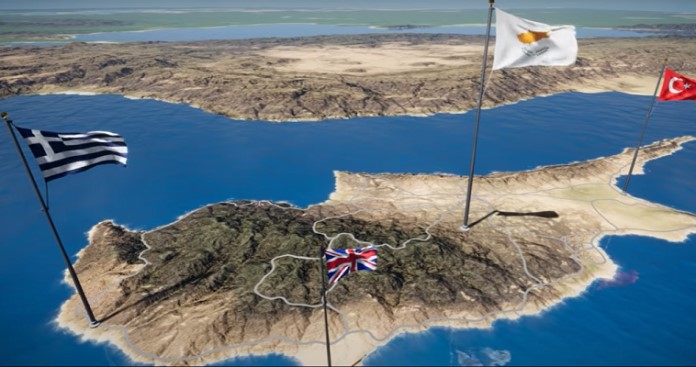
Cyprus' distance from Greece has been used as the main argument for Greek inaction. But apart from the fact that there is no geographical determinism, geography does not only offer advantages on one side and disadvantages on the other. Cyprus, it is true, is much closer to Turkey than to Greece, being 70 kilometers from the nearest Turkish coast and 400 from Rhodes.
Therefore, the Turkish air force had the advantage of the shorter distance, because Incirlik is 270 kilometers from Kyrenia and Antalya is 280, while Rhodes airport is 470 kilometers from Kyrenia, Kastelli 740 and Souda 870. However, the famous geographical advantage is only one factor in the confrontation.
When we refer to distances for aviation, and to put the issue in a comparative perspective, let us bear in mind that the Argentine air force fought the Falklands war in 1982, operating from four airfields, which were more than 700 kilometers from the islands. In other words, the Argentines defended the Falklands, despite the fact that they were further away from them than Cyprus is from Greece.
Those who do not consider the 5 to 10 minutes of aircraft time over targets as too short should bear in mind that the Argentines waged war in the Falklands for 45 days, with their aircraft time over targets of less than 10 minutes. Greece did not take any substantial measures from 1964 to 1974 to compensate for its geographical disadvantage. However, since 1974, it has not made significant progress in increasing its operational range, although we have interests in the Eastern Mediterranean and various opinions are heard in the public debate.
The most serious conclusion is considered to be Greece's phobia towards Turkey. It is its inability to evaluate and manage, mainly politically but also militarily, its military power and not the fact that it did not actually have the necessary military capabilities to prevent the invasion. This issue has existed since 1967 and continued to exist, and even with increasing intensity, in 1974. In many ways, in 1974 the balance of power was favorable, much more favorable than it is today, but Greece did not have the will to confront Turkey, citing various excuses.