

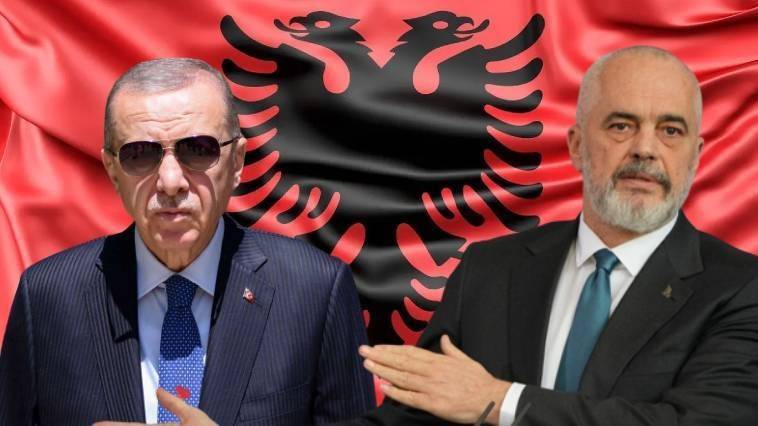
How Rama made Albania a satellite of Erdogan
How Rama made Albania a satellite of Erdogan
Ως "conspiracy theory" Albanian Prime Minister Edi Rama had characterized the allegation of Turkish involvement, which led to the cancellation of the agreement on the delimitation of the EEZ between Greece and Albania, as denounced by the country's former Prime Minister, Sali Berisha, who had signed the relevant agreement with former Prime Minister Costas Karamanlis.
On the other side, in the recent interview which he gave to a Greek media outlet, (the relevant excerpt has been posted on Rama's page, but is absent from the printed edition of the newspaper) he stated that his country does not choose between Erdogan and Mitsotakis, as it "loves both"! A claim that is difficult to believe when Albania has been an easy prey for Turkish diplomacy, especially during Rama's premiership.
Turkey has consistently targeted the Balkan countries with Muslim populations. Under the guise of cultural cooperation, it has managed to bring Albania into the Turkish sphere of influence, while also spreading its Islamic agenda. To this end, Turkey has invested in infrastructure and religious institutions, while of course not forgetting to “sell” military cooperation and protection.
Erdogan had previously proudly stated in an interview: on the Albanian channel “Top Channel” that Turkey has invested three billion euros in Albania. I don’t know how much investment has arrived from the EU, but ours will not stop", he had said characteristically. Turkey's investments in Albania are targeted and strategic in nature.
Albania's second largest bank, hydroelectric power plants, a steel mill, the former state-owned telecommunications operator Albtelecom and mobile operator Eagle Mobile have come under Turkish control. Erdogan is offering Albania economic penetration in order to consolidate political control over our neighboring country. It should be noted that Turkey is the fifth largest trading partner and the sixth largest foreign investor in Albania.
But there are also setbacks. For example, the Turkish-Albanian plan to build the Vlora airport has met with resistance not only from environmental organizations (it is planned to be built in an area rich in biodiversity) but has also come under the microscope of the European Commission. The Turkish partner in the project was forced to withdraw.
Investments and political influence
At the same time, just as Erdogan was perceived as an "Islamo-modernizer", something similar happened with Rama, where the expectations of the Greek elites for a new era in relations with Albania (at the same time as the government's unwavering support for its European perspective) fall against the "wall" of the Albanian prime minister's authoritarianism, which culminated in the imprisonment of the elected mayor of Himara, Fredi Beleris.
At the same time, Turkey is strengthening its efforts to satellite Albania, Kosovo, and North Macedonia in particular. As mentioned above, in addition to economics, it is “selling them protection,” but it is also playing the Islam card strongly. In addition, it is attempting to use the Albanian community living in Turkey.
While Turkish investments in Albania are made on economic grounds, they are also used to cultivate personal relationships and as a tool to gain political influence through a clientelistic system. The Erdogan regime, moreover, has the ability to influence the decisions of large Turkish companies. In fact, to inject their investment and other choices with its own political and geopolitical expediencies.
The Rama-Erdogan embrace
The osmosis of the Turkish business world with the Erdogan regime is mutually beneficial and has taken on such a dimension that some speak of a “new kind of political business class.” The interpenetration of entrepreneurship and politics has allowed Erdogan to shift from investments through transnational institutional relations to investments through personal relationships with leaders of other countries.
This type of relationship in the case of Albania actually hinders the prospect of democratization, the imposition of the Rule of Law and the prevalence of a Western-style normality. Thus, indirectly but clearly, any reform efforts are undermined, fueling ad hoc practices in public contracts that facilitate corruption. The political system in Albania, moreover, is characterized by weak democratic functioning and acute polarization.
In fact, Albania is experiencing a regression in democratic standards. The Erdogan-Rama ties are further eroding them, strengthening Turkish influence. The Albanian prime minister has turned to Ankara for years, believing that he draws strength from there both in his relations with Greece and Serbia (despite his rhetoric, he sees them as competitors) and at home. It is no coincidence that he was the only leader from Europe who attended the wedding of the “sultan’s” daughter.
Turkish military presence
On 29 July 1992, an Albania-Turkey agreement on military cooperation was signed. The agreement included education and training of personnel, cooperation in arms production, joint military exercises, exchange of delegations and joint committees for the expansion of military ties. A month after the agreement was signed, a Turkish warship sailed to Durres to signal Turkey's commitment to "protect" Albania. The two countries have held joint naval exercises in the Adriatic, off the Greek coast.
Turkey has played a role in the restructuring of the Albanian army and by providing military assistance. It has also trained Albanian officers and commandos. The bilateral agreement also included the reconstruction by the Turks of the Pasha Liman naval base in Vlora, in exchange for granting access and use by the Turkish Navy. At times, two Turkish frigates have been docked at the base simultaneously. In June 2021, Albania agreed to purchase Turkish Bayraktar drones, which are known to be manufactured by a company owned by Erdogan's son-in-law.
In addition to military deals, Turkey financed the construction of a 522-unit apartment complex at a cost of 42 million euros for Albanians left homeless by a 6,4-magnitude earthquake in 2019. Erdogan and Rama attended a handover ceremony for the apartments in the northwestern town of Latsi. In the face of the pandemic, Rama, after having fired shots at the EU over the distribution of vaccines, ordered vaccines from Turkey.
The fall of secularism
Historically, Islam is a relatively recent addition to Albanian culture. The majority of the population is Muslim, but despite political changes, Albania has been a secular state since its founding in 1912. All regimes have pursued a policy of systematic secularization, given that over 35% of the population is Christian.
Erdogan has been trying to promote Islam in Albania for many years. In 2015, he inaugurated the Namazgja Grand Mosque, which was funded by the Turkish Diyanet. Albania's foreign minister had claimed that "It is not true that Turkey has built the largest mosque in Albania, but that the mosque was built for the needs of Muslims".
But Hemal Ahmeti, a historian and philosopher who wrote the treatise “Saving Albanian Culture from Turkish Tendencies,” has argued that, right after the Albanian government, the most powerful role in Albania is played by Erdogan. He is also concerned about the lack of criticism of Turkey in the Albanian media. As he has characteristically written "with this policy, Albania closes every gate to the West"He has even proposed that specific measures be taken to protect Albania from Salafism and Erdoganism.
Erdogan's emissaries (imams, educators, etc.) are infiltrating political parties, academic associations, and mosques in Albania, Kosovo, North Macedonia, and other Balkan states. In fact, servility has reached levels that recall vassals of the Sublime Porte during the Ottoman Empire.
Turkish citizens have been handed over to MIT in operations reminiscent of CIA-backed jihadist kidnappings. Schools built and funded by the Gülen movement have been closed and handed over to the Turkish state agency Diyanet. Rama even closed the first private college in post-communist Albania (the non-public “Mehmet Akif” Lyceum, which provided high-quality education) at Erdogan’s request, as the school is linked to the Gülen Foundation.
At the same time, Albania is crying foul over the involvement of dozens of Rama government officials in scandals and corruption cases. Rama claims that he is taking measures to combat corruption, including the… prosecution of Beleris, which he characterizes as a decision of the “independent Albanian judiciary”. It seems funny that Beleris has been arrested on a flimsy charge of buying a handful of votes, when it is an open secret that this is a common practice in Rama’s party, apart from the close ties with organized crime.