

Greenland on the Global Geoeconomic Chessboard
Dr. MAGDALINI N. CHARDA
Economist-Researcher-Student
University of Patras
Greenland on the Global Geoeconomic Chessboard: US-EU Strategic Competitions and the Logic of “Heads I Win, Tails I Win” in the Arctic
The geopolitical value of a region is not a fixed quantity, but changes according to technological, economic and strategic developments. The Arctic is a typical example of this dynamic. While during the Cold War its importance was primarily associated with the logic of nuclear deterrence, in the 21ο In the 21st century, the retreat of the ice sheets is reshaping the world map, shifting the focus towards Geoeconomics. The emergence of new shipping lanes and the increasing demand for critical raw materials are transforming the region into a field of intense systemic competition.
Greenland occupies a unique position in Arctic geography. In addition to being a geostrategic hub between North America and Europe, the island has colossal reserves of rare earths, which directly links it to the future of the global supply chain. The existing literature focuses mainly on the West’s competition with Russia and China. In contrast, the present analysis introduces a second layer by focusing on the divergence of interests between the United States and the European Union in the light of complex interdependence.
The European Union’s attempt to assert its strategic autonomy is being challenged by the structural power of Washington, which, by leveraging existing defense agreements, is exemplarily implementing the “Heads I Win, Tails I Win” logic. In this light, whether Greenland is led to full independence or maintains its autonomy status within the Kingdom of Denmark, the geostrategic and geoeconomic advantages of the US remain secured, consolidating an asymmetric strategic dependence in the region.
The traditional geopolitical view perceived state competition primarily as a struggle for control of territory and strategic geographical points. In the modern international arena, however, the energy transition and the Fourth Industrial Revolution are shifting the focus to Geoeconomics, where economic power, securing critical raw materials and control of technological value chains are becoming crucial. Mineral resources such as rare earths, lithium, nickel, cobalt and graphite are now essential building blocks for the production of electric vehicles, microchips and advanced defense systems. In this context, China’s dominant position at critical stages of these supply chains gives it an asymmetric ability to instrumentalize its exports, causing intense systemic concern in the West.
Greenland is organically integrated into this new geo-economic logic. Its strategic importance no longer derives solely from its geographical location, but is directly linked to its colossal reserves of rare earths, such as the iconic but politically sensitive Kvanefjeld and Tanbreez deposits, which could overturn the existing Chinese monopoly. For the United States, the exploitation of Greenland's mineral resources is an organic part of its strategic disengagement. (decoupling) and risk detoxification (de-risking) against Beijing, through the creation of closed and secure supply chains between allies (friend-shoring).
The analysis of this dynamic is adequately illuminated by the theoretical framework of complex interdependence, according to which modern interstate relations are characterized by the dynamic coexistence of cooperation and competition. The interaction between the US and the European Union in the Arctic accurately reflects this dual reality. While the two sides share the need to limit exposure to feared suppliers, their aspirations are not identical.
Brussels, through initiatives such as the “Critical Raw Materials Act”, seek to secure the resources that will feed their own, autonomous European industrial base, defending the Union’s strategic autonomy and technological competitiveness. Here the central geo-economic divergence emerges; while Washington seeks to build a broader Western supply system under American leadership, the EU fights for its own autonomous access. This difference is not theoretical, but is already translated into tangible issues of investment control, mining licensing and preferential access to Greenland’s potential.
Greenland's uniqueness lies in the fact that it is not an independent state but an autonomous part of the Kingdom of Denmark. This creates a unique, multi-layered geopolitical equation. For Copenhagen, Greenland is a key element of its international prestige and geopolitical weight. Denmark's institutional participation in Arctic affairs, its presence in the Arctic Council and its strategic importance within NATO are directly linked to its sovereignty over Greenland. Denmark therefore seeks to maintain political control and cohesion of the Kingdom, while supporting the island's controlled economic development.
However, these two goals are inherently contradictory. The development of large-scale mining activities and the self-reliance of natural resources could provide Greenland with the economic self-sufficiency needed to cut itself off from the annual Danish subsidy. (block contribution), fueling domestic separatist tendencies for full independence. This possibility creates dilemmas not only for Denmark but also for the European Union as a whole. Greenland withdrew from the then EEC in 1985 and today maintains a special status of Overseas Countries and Territories (OCT) with the EU. A fully independent Greenland would gain the ability to negotiate directly with the United States or major Asian powers, bypassing the European regulatory framework and limiting European influence and access to the region in the long term.
European Arctic policy is often presented as unified and committed to sustainability. However, beneath the surface, the priorities of the member states diverge significantly. Germany approaches Greenland, mainly through a utilitarian industrial lens, as a vital source of raw materials to maintain the competitiveness of its heavy industry. France has traditionally focused on the geopolitical dimension, considering the Arctic as a “testing ground” for Europe’s strategic autonomy and reducing structural dependence on extra-European powers.
The Nordic states (Denmark, Finland and Sweden) perceive the region primarily through the prism of deterrence, regional security and territorial integrity, especially after the recent NATO enlargement and the escalation of tensions with Russia. The existence of these different national approaches makes it difficult to formulate a coherent and aggressive European infrastructure financing strategy in Greenland, leaving the field open for strategic American initiatives.
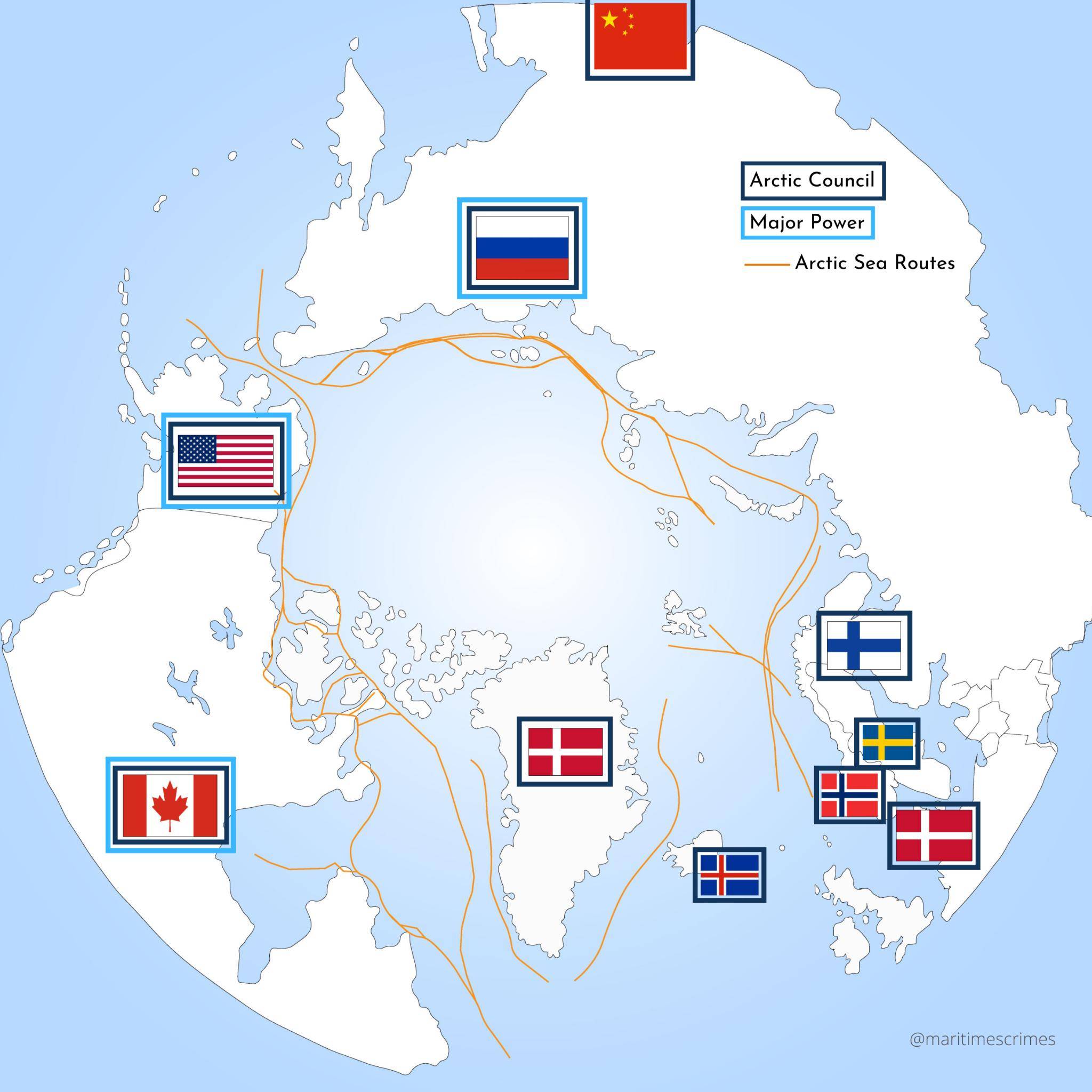
Greenland’s growing geopolitical importance is not solely due to its mineral wealth, but is inextricably linked to its central geographical position, at the epicenter of an ongoing radical reconfiguration of global trade networks. Climate change and the accelerating melting of Arctic ice are altering the security and navigation environments, creating the conditions for the commercial exploitation of sea routes that were previously considered inaccessible or economically unviable. Analysis of this emerging maritime map reveals a complex web of geographical, legal and economic parameters, which does not constitute a single high seas, but is intersected by three distinct axes, each of which is characterized by particular geoeconomic stakes and competing regimes of sovereignty.
The first and most developed operational axis is the Northern Sea Route, which runs along the Russian Arctic coast. Moscow structurally treats this corridor as its internal waterway, imposing a strict, monopolistic regulatory framework that includes the mandatory use of Russian icebreakers and the payment of high transit fees. The main geoeconomic advantage of this route lies in the drastic shortening of maritime transport between the markets of East Asia and Western Europe, offering a strategic alternative that bypasses the traditional but geopolitically vulnerable arteries of the Suez Canal and the Straits of Malacca.
The second axis, the Northwest Passage, passes through the complex island complex of the Canadian Arctic archipelago and is the subject of intense international legal controversy. While Canada claims the straits as its internal waters, exercising full sovereignty, the United States and the European Union dispute this claim, arguing that they are straits of international navigation. In addition to the legal issues, the route presents serious operational challenges as shallow waters and changing ice dynamics limit its usefulness, making it suitable mainly for regional transport and for connecting North America with the Atlantic.
The third and most “disruptive” axis is the future Transpolar Route, which is planned to cross the central Arctic Ocean and the North Pole. The specific geoeconomic advantage of this corridor lies in the fact that it extends entirely in international waters, thus eliminating political risk, controls and transit fees. Although the full functionality of the Transpolar Route is postponed, based on climate forecasts, to the middle of the 21th century when the summer melting of the central ice caps will be complete, it represents in the long term the shortest, most economical and safest route for large container ships.
In this context, the different approaches of the US and the EU reveal their significantly divergent strategic logics, often disguised behind the rhetoric of a common Western Arctic policy. On the one hand, the US perceives the Arctic corridors mainly through the prism of strategic access, power projection and hard military control, given that defending freedom of navigation is a timeless component of American grand strategy that is inextricably linked to the global position of the US as a dominant naval power. In contrast, the EU adopts an approach focused on economic connectivity, regulatory governance and sustainability. For Brussels, the prospect of shortening trade routes to Asia is analyzed as a tool to enhance the competitiveness of European ports and the Union’s industrial base.
Greenland’s geographical location makes it a natural “gatekeeper” controlling the passage from the Arctic Ocean to the North Atlantic, through the critical GIUK gap. As new shipping lanes gradually become accessible, Greenland is transforming from an isolated frozen expanse into a strategic hub, capable of providing deep-sea ports, telecommunications stations and bases for search and rescue operations. However, the island’s integration into global planning highlights a clear divergence of strategic priorities between the US and the EU.
For Washington, Greenland is traditionally and primarily approached through the prism of “hard security” and geostrategic deterrence. The US strategy for the Arctic focuses on containing Russian military activity and limiting Chinese economic penetration of the island. The US perceives the Arctic sea lanes as issues of freedom of navigation and military mobility. Its presence in Greenland, centered on the Pituffik Aerospace Base, is not so much aimed at commercial exploitation of the sea lanes as at ensuring an advanced surveillance “outpost”. Any economic or investment move by a third power in Greenland, such as the attempt by Chinese state-owned companies to finance the expansion of airports in Nuuk and Ilulissat in 2018, is viewed by the US as a direct threat to its national security, provoking its immediate diplomatic and economic intervention with the aim of canceling trade agreements and technical projects.
In contrast, the European Union approaches Greenland through the prism of soft power, environmental governance and geo-economic connectivity. The EU’s main geo-economic interest is focused on Greenland’s subsoil, which is rich in critical raw materials and rare earths (such as neodymium and praseodymium), essential for the green and digital transition of European industry. The EU is seeking to secure exclusive mining partnerships with Nuuk to reduce its dependence on China’s monopoly.
This divergence creates a structural asymmetry within the Western alliance. While the European Union offers Greenland development funds and access to the European market with the aim of institutional and economic strengthening, the United States guarantees the security framework within which the island operates. Washington exploits this asymmetry, setting up a diplomatic and military framework that allows it to maintain ultimate control over developments, regardless of the economic aspirations of its European partners or the independence tendencies of Nuuk.
An inherent weakness of traditional geopolitical analyses is the tendency to treat smaller or non-sovereign political entities as passive arenas of competition between great powers. In the case of Greenland, such a view is at least incomplete. The gradual path towards institutional autonomy of the island, culminating in Self-Government Act of 2009, has allowed the formation of a domestic political elite that seeks to exploit the geostrategic and geoeconomic importance of the region for the benefit of the local community. The prospect of full independence for Greenland is the central axis of the domestic political dialogue and is directly linked to the economic viability of the island. The rational development of large-scale mining activities and the exploitation of natural resources are not approached by Nuuk simply as economic activities, but as the necessary material conditions for independence from the annual Danish financial subsidy. (block contribution), which currently covers approximately half of the island's public budget.
This internal political dynamic creates an extremely complex equation in the network of relations with external actors. Denmark seeks to maintain the cohesion of the Kingdom, the European Union seeks to strengthen cooperation with Greenland in all areas, without undermining its relationship with Copenhagen, while the United States is primarily interested in ensuring strategic control of the region and access to the island's rare earth deposits. Within this emerging geopolitical landscape of intense contrasts, Greenland's political leadership demonstrates a remarkable ability to pursue an autonomous foreign policy. (paradiplomacy)Realizing that the interest of Washington, Brussels, and Asian powers offers it expanded room for maneuver, Nuuk is instrumentalizing systemic competition in order to attract diversified investments in critical infrastructure, increase its negotiating power against Copenhagen, and consolidate its international presence as an autonomous, dominant actor and not as a passive spectator of developments in the Arctic.
Despite the rapid emergence of geoeconomic parameters, the military dimension remains the unshakable cornerstone of Greenland's strategic value. Since the Cold War, the US military presence on the island has served vital functions of the West's deterrent architecture, including nuclear early warning systems, space surveillance infrastructure, and air traffic monitoring stations in the North Atlantic. Greenland's geographical location makes it an organic and irreplaceable link for US security.
The intensification of competition between great powers has brought this harsh geostrategic reality back to the fore. The development of hypersonic missile systems, the militarization of space, and the systematic strengthening of Russian A2/AD infrastructure in the Arctic, give Greenland an even more critical role in the Pentagon's defense planning.
This security environment highlights in the most striking way the inherent contradictions of the European pursuit of “strategic autonomy.” While Paris and Brussels systematically promote the rhetoric of building an autonomous European defense identity and reducing dependence on extra-European forces, hard security in the Arctic remains entirely dependent on the strategic capabilities that only the United States possesses and can deploy on a sufficient scale.
This contradiction is exacerbated by deep divergences within the EU itself, where peripheral member states, such as Poland, Finland and the Baltic States, prioritize the American military presence and the NATO framework as the only reliable guarantee of deterrence, viewing the Union’s defensive emancipation projects with skepticism. The case of Greenland, therefore, strips the European narrative bare, demonstrating that Europe seeks to appear as an autonomous geo-economic regulator, at the same time that its regional security in the crucial Arctic circle remains structurally encased and dependent on the American military umbrella.
Washington's approach to Greenland is governed by a peculiar geopolitical condition, where the US wins under any scenario of the island's status quo. This zero-sum game for its competitors develops along two different trajectories: On the one hand, in the Scenario of Full Independence of Greenland (Heads I Win), Washington gains the opportunity to completely bypass Copenhagen and exert direct influence in Nuuk. A newly formed, economically vulnerable state will be in immediate need of security guarantees and infrastructure investments. The US can provide this protection by “locking” Greenland into its exclusive sphere of influence, securing the Pituffik Aerospace Base in the long term, and gaining privileged access to the region’s rare earths. On the other hand, in the Status Quo Scenario (Tails I Win) where Greenland remains within the Kingdom of Denmark, the United States enjoys the same strategic benefits without the political or economic cost. The island's defense remains integrated into NATO, while Copenhagen, a traditional and predictable US ally, continues to shoulder the burden of annual financial subsidies to Nuuk. Washington maintains its strategic presence in Greenland and its deterrent power against Russia and China, having established an exemplary double-win strategy (Heads I Win, Tails I Win), which is based on the solid legal foundation of the 1951 Defense Agreement and the 2004 Igaliko Agreement. At the same time, any local concerns are balanced through the Igaliko Agreement itself, which imposes institutional consultations with Nuuk within the framework of a tripartite Joint Commission (Washington – Copenhagen – Nuuk), regulating the environmental and economic parameters of the American presence on the island.
Whether Greenland chooses the path of full independence from Copenhagen or remains within the Kingdom of Denmark, the institutional and operational framework that the US has established fully safeguards its vital interests. Granting Nuuk a political foothold through the Joint Commission absorbs local shocks and diminishes anti-American tendencies, without affecting the operational freedom of the Pituffik base, while existing defense agreements can contribute to the long-term attachment of the island to the American sphere of influence.
Ultimately, Greenland is not only the new geopolitical frontier of the Arctic. It is also a laboratory for understanding the new forms of competition and cooperation that characterize the modern international system, where geo-economics, critical raw materials, supply chains, and strategic interdependence increasingly shape the nature of power in international relations.
In the contemporary geopolitical arena, the case of Greenland demonstrates that sovereignty is not only achieved through territorial possession, but also through dynamic institutional control and the ability to adapt to political changes in the status quo. In this case, the US has managed to turn international law and bilateral defense commitments into a strategic advantage, ensuring that control of the Arctic’s most crucial gateway will remain an exclusively American affair, regardless of which flag ultimately flies in Nuuk.
Bibliography
Blackwill, RD and Harris, JM (2016) War by Other Means: Geoeconomics and StatecraftCambridge, MA: Harvard University Press.
Brigham, LW (2011) 'The Fast-Changing Maritime Arctic', Proceedings of the Marine Safety & Security Council, 68(1), pp. 12–17.
Biscop, S. (2021) Strategic Autonomy and European Defence: On the Road to a European Army? Brussels: Egmont Institute.
Byers, M. (2013) International Law and the Arctic... Cambridge: Cambridge University Press.
Conley, HA and Melino, M. (2016) An Arctic Redesign: Recommendations to Rebuild US Arctic Leadership. Washington DC: Center for Strategic and International Studies.
Department of Defense (2024) 2024 Arctic Strategy. Washington DC: US Department of Defense.
Dodds, K. and Nuttall, M. (2016) The Scramble for the Poles: The Geopolitics of the Arctic and AntarcticCambridge: Polity Press.
European Commission (2021) A Stronger EU Engagement for a Peaceful, Sustainable and Prosperous Arctic. Brussels: European Commission.
European Commission (2023) Critical Raw Materials Act. Brussels: European Commission.
European External Action Service (2023) EU Strategic Compass Implementation ReportBrussels: EEAS.
Fiott, D. (2023) In Every Crisis an Opportunity: European Strategic Autonomy Revisited. Paris: EU Institute for Security Studies.
Gad, U.P. (2016) National Identity Politics and Postcolonial Sovereignty Games: Greenland, Denmark and the European Union. Copenhagen: Museum Tusculanum Press.
Graczyk, P. and Koivurova, T. (2014) 'A New Era in the Arctic Council's External Relations?', Polar Record, 50(3), pp. 225–236.
Heininen, L., Exner-Pirot, H. and Plouffe, J. (eds.) (2020) Arctic Yearbook 2020. Akureyri: Northern Research Forum.
Howorth, J. (2014) Security and Defense Policy in the European Union. 2nd ed. London: Palgrave Macmillan.
Huebert, R. (2019) 'The New Arctic Strategic Environment', Canadian Foreign Policy Journal, 25(2), pp. 195–201.
Humpert, M. and Raspotnik, A. (2022) The Future of Arctic Shipping. Washington DC: Wilson Center Polar Institute.
Jakobson, L. and Peng, J. (2012) 'China's Arctic Aspirations', SIPRI Policy Paper, No. 34.
Keohane, R.O. (1984) After Hegemony: Cooperation and Discord in the World Political Economy. Princeton, NJ: Princeton University Press.
Keohane, RO and Nye, JS (2012) Power and Interdependence. 4th edn. Boston: Longman.
Koivurova, T. (2010) Limits and Possibilities of the Arctic Council in a Rapidly Changing Scene of Arctic Governance. Rovaniemi: University of Lapland.
Lanteigne, M. (2020) China's Polar Silk Road and the Arctic. London: Routledge.
Lasserre, F. (2019) Passage to the North: Arctic Shipping Routes and Governance. Montreal: Presses de l'Université du Québec.
Mearsheimer, J.J. (2014) The Tragedy of Great Power Politics. Updated edn. New York: WW Norton.
Mortensgaard, C. (2021) 'Greenland between Dependence and Independence', Arctic Review on Law and Politics, 12, pp. 45–67.
NATO (2022) NATO Strategic Concept 2022. Brussels: NATO Headquarters.
Nye, J.S. (2011) The Future of Power. New York: PublicAffairs.
Olesen, MR (2020) 'Greenland's Arctic Diplomacy', The Polar Journal, 10(1), pp. 115–133.
Østhagen, A. (2021) The New Geopolitics of the Arctic: Russia, China and the West. London: Routledge.
Petersen, N. (2009) The Arctic as a New Arena for Danish Foreign Policy. Copenhagen: Danish Institute for International Studies.
Posen, BR (2021) Restraint: A New Foundation for US Grand Strategy. Ithaca, NY: Cornell University Press.
Raspotnik, A. (2018) The European Union and the Geopolitics of the Arctic. Cheltenham: Edward Elgar.
Rothwell, D.R. (2015) The Polar Regions and the Development of International Law... Cambridge: Cambridge University Press.
Sergunin, A. and Konyshev, V. (2017) Russia in the Arctic: Hard or Soft Power? Stuttgart: Ibidem Press.
Smith, M. (2021) 'Rare Earth Minerals and Arctic Geopolitics', Resources Policy, 74, Article 102296.
The White House (2022) National Strategy for the Arctic Region. Washington DC: Executive Office of the President.
United States Geological Survey (USGS) (2023) Mineral Commodity Summaries 2023. Reston, VA: USGS.
Walt, S.M. (1987) The Origins of Alliances. Ithaca, NY: Cornell University Press.
Wilson, JD (2021) 'Critical Minerals, Geoeconomics and Strategic Competition', international affairs, 97(5), pp. 1537–1556.
Young, O.R. (1985) Natural Resources and the State: The Political Economy of Resource Management. Boulder, CO: Westview Press.
Young, O.R. (2016) The Arctic in Play: Governance in a Time of Rapid Change. Washington DC: The Arctic Institute.
Πηγές
Arctic Council (2021) Arctic Shipping Status Report. Tromsø: Arctic Council Secretariat.
Arctic Council (2023) Sustainable Development Working Group Report. Tromsø: Arctic Council Secretariat.
Danish Ministry of Foreign Affairs (2021) Kingdom of Denmark Strategy for the Arctic 2021–2030. Copenhagen: Government of Denmark.
European Parliament (2023) The Geopolitics of Critical Raw Materials. Brussels: European Parliament Research Service.
International Energy Agency (IEA) (2023) Critical Minerals Market Review 2023. Paris: IEA.
Organization for Economic Co-operation and Development (OECD) (2021) The Role of Critical Minerals in Clean Energy TransitionsParis: OECD Publishing.
World Bank (2020) Minerals for Climate Action: The Mineral Intensity of the Clean Energy TransitionWashington DC: World Bank.