

50 years since Turkey's military invasion of Cyprus.
By Christos Kapoutsis

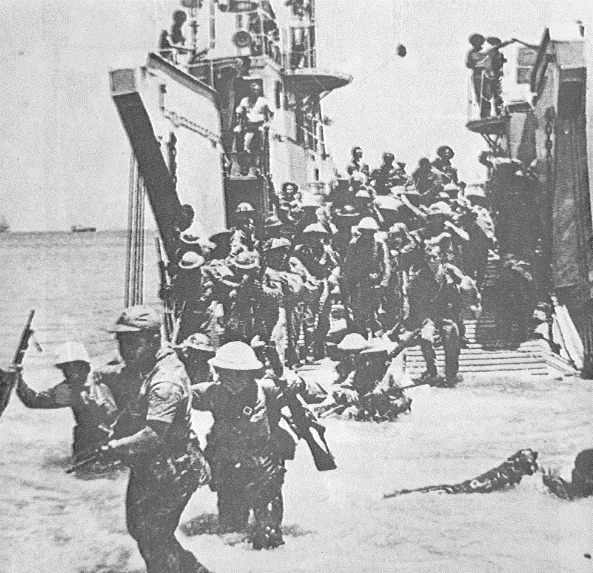
It is the afternoon of July 19, 1974, the heat is stifling and the beaches of Cyprus are full of people looking for a little coolness. The clock hands show 18.23 and at that time the ground radar of the Cyprus Naval Command, which was located at the northeastern tip of Cyprus and specifically at Cape Agios Andreas, detected the Turkish convoy, four landing craft, off the coast of Kyrenia. The Greek and Greek Cypriot political and military leadership are immediately notified with urgent signals. Every half hour, from 7pm (19.00) until 04.50 in the morning of July 20, the Cyprus Naval Command reports in detail the movements of the Turkish landing craft. The Greek military leadership, which is essentially also the political leadership, believes that this is an exercise by the Turkish fleet, or so they were "informed" by the American Embassy, and is taking absolutely no measures. Not even increased surveillance!!
At 5:10 a.m. on the morning of July 20, the Turkish landing ships are only 8 kilometers from the coast of Kyrenia and no one, Greek or Greek Cypriot politician or military, is worried!!
Ten minutes later, At around 5:70 AM, at first light of day, heavy air bombardments by the Turkish Air Force began. Over 6 Turkish warplanes attacked and destroyed the Kyrenia Naval Station, the infantry and artillery camps, the road network east of Kyrenia, the Air Force Early Warning Station and the Navy Radar at Agios Andreas. Shortly before XNUMX:XNUMX AM, Turkish aircraft struck the facilities of the General Staff of the Cyprus National Guard, various camps in Nicosia and the ELDYK (Greek Forces of Cyprus) camp.
England's role in the Turkish invasion of Cyprus, especially on the morning of July 29th, should at some point be brought to light in its true dimensions.
The first victims
We must stand with respect for the first victims, Greek soldiers of the Turkish invasion.
Shortly after 5 am on July 20, 1974, while Turkish warplanes were sowing death and destruction in Kyrenia and Nicosia, the Greek Commander of a small naval force of two torpedo boats, chartered in the port of Kyrenia, ordered the ships to set sail. Their mission was to strike the Turkish convoy that, with strong air support, was approaching the coast of Kyrenia!! It was clearly a suicide mission, but also an absolutely correct choice, according to the traditions and history of the Greek Navy.
Not even 20 minutes had passed since the two ships had set sail and of course, the Turkish aircraft spotted the Greek missile boats and began pounding them.
The first was immediately put out of action. Her captain turned her towards the shore and her crew abandoned her just before she sank. They all saved themselves by swimming to shore.
The other torpedo boat continued to approach the Turkish destroyers, despite air attacks. It was even preparing to fire the first shot at the Turkish ships when it was torpedoed and sank almost immediately. Of its 10-member crew, only one survived. The remaining 9 were the first victims of the Turkish invasion..
The answer to the following question should be made public at some point: did the naval commander, when he ordered the departure of the two torpedo boats, have the assurance of the General Staff of the Navy that Greek submarines sailing off Rhodes would rush to his aid? If the answer is positive, then why did the Greek submarines NEVER reach the Cypriot coast, in order to prevent the Turkish landing parties and support the mission of the small naval force that sailed from the port of Kyrenia? Who betrayed and failed to do his duty?
"Self-restraint"
The airstrikes that began at first light, after 7.30 in the morning, are intensifying. Many parts of Nicosia have been set on fire, while the first dead and wounded Greek and Greek Cypriot soldiers are already in the bombed camps.
After the first deadly air raids, Turkish paratroopers began dropping southeast of Nicosia in Kioneli, while at the northern tip of the island, helicopters transported Turkish commandos.
The General Staff of the Cyprus National Guard asks the Greek Armed Forces Headquarters to strike the Turkish paratroopers and to begin firing anti-aircraft weapons against the approaching Turkish aircraft. The response from Athens and the Greek Pentagon is, "self-restraint, because the Turks are exercising." In fact, the Chief of Staff of the Cyprus National Guard, because the order to resist was delayed, took his phone out the window so that people in Athens could hear the explosions from the bombings by Turkish aircraft and finally be convinced that this was a war and not an exercise!!
Indicative of the climate prevailing at the Greek Armed Forces Headquarters is the following incident: When an indignant staff officer, a senior officer of the Army, addressed the Chief of the General Staff and asked him in a strong tone to order the immediate start of the defense of the Greek forces against the Turkish attack, General Bonanos replied: "The Turks are attacking Cyprus and we are Greece"!!
Finally, at 08.50 on the morning of July 20, 1974, and after the first wave of the Turkish landing had been completed, the Headquarters of the Greek Armed Forces issued the following order: "strike the attacking enemy with all means."
And a "detail"
To understand how "deeply sleepy" the Greek Cypriots, leadership and citizens, were, it is enough to mention one "detail". About an hour and a half after the start of the heavy bombing of Greek Cypriot targets by the Turkish air force, at around 6.30, the RIK (Cyprus Radio) was broadcasting a cheerful morning exercise!!
Accordingly, the Turkish Cypriot radio station Bayrak had interrupted the normal flow of its program and was broadcasting military marches from 3 a.m.
Many causes of the tragedy
Many questions are raised and sad thoughts are made about some incidents that marked July 20, 1974, the first day of the Turkish army's invasion of Cyprus, such as: Two modern, for that time, submarines of our Navy, the "Glaucos" and the "Nireus", which were sailing south of Rhodes, received an order from the General Staff, at 05.15 in the morning of July 20, to immediately head towards Cyprus and sink the Turkish warships that were off Kyrenia. However, while approaching the Cypriot coast, the two submarines suddenly changed course and returned off Rhodes. Who and why gave this order? Or were the Greek submarines prevented, and by whom, from reaching the shores of Kyrenia? What was the mission of the British warships and submarines that sailed around Cyprus?
The Greek fighter jets, foreseen by the operational plans for the defense of Cyprus, were fully prepared at the airport of Kastelli, Crete, since the morning of July 19. The pilots had loaded the ammunition and with the engines running, they were waiting for the order to take off for Cyprus. This order was NEVER given. Why?
The 35th Commando Squadron
At noon on July 20, the 35th Commando Squadron was transferred to the Souda base in Crete. And late in the afternoon of Sunday, July 21, the Greek Commandos, with high morale and ready for war, boarded 15 transports Noratlas aircraft, which take off, bound for Cyprus. The mission was particularly dangerous. It has been rightly described as a suicide mission.
The transport aircraft flew defenseless, without fighter cover, with only darkness as their ally. They flew very low, a few meters above the sea surface and with their lights off, in order to avoid Turkish radars.
Two of them lost their orientation and landed in Rhodes! The remaining 13 continued their flight to Nicosia as normal. Shortly before landing at Nicosia airport, the 3 leading transports received heavy fire from the Greek Cypriot forces(!!), who had lined up on either side of the airport. They mistook them for Turkish!! Which idiot or traitor military officer did not inform about the approach of the Greek transport aircraft? However, the attitude of the British soldiers, who were responsible for guarding part of Nicosia airport, remains a big question mark. However, of the 3 leading transports, the first was shot down by friendly(?) fire! The only survivor was the commando Athanasios Zafiriou, who managed to jump out of the aircraft before it crashed to the ground along with his 29 colleagues who died instantly. The next two managed to land, but with serious losses. The remaining 10 returned to Greece.
Greek Cypriot Force (ELDYK). The ELDYK camp on the morning of July 20, was subjected to a heavy air attack by Turkish fighter jets and the first Greek soldiers and officers fell (lost their lives) there. Despite the heavy losses, the ELDYK managed to regroup and with heroism and self-sacrifice attempted an attack on Kioneli where Turkish Cypriot soldiers had been fortified. The ELDYK men neutralized several of the Turkish paratroopers who were trying to create a bridgehead in the Kioneli area, in order to facilitate the Turkish Army's attack towards Nicosia. The ELDYK attack on Kioneli, although ultimately unsuccessful, was nevertheless the most important operation to stop the Turkish invader in Cyprus in July 1974.
The "LESVOS" Tanker: On the morning of July 20, 1974, the "LESVOS" aircraft carrier was 40 nautical miles from Paphos and transported 450 soldiers and officers of the Hellenic Armed Forces to Greece, who had been replaced by an equal number of their colleagues.
However, the Turkish invasion had already begun, and Governor Admiral L. Chandrinos was ordered to move east and disembark the ELDYKarians in Limassol, which he did. He writes in his report: “I particularly admired the courage of the repatriating hoplites of the Land Army, who, although they had realized that they were returning to their homes, with furious enthusiasm and cries of joy accepted the information from my mouth about their return to Cyprus, to strengthen their fighting colleagues against the enemies of the nation.” Several of these heroic ELDYKaros remained forever in Cyprus, having been recorded, either on the lists of the dead or the missing of the Cyprus tragedy, of the bloodthirsty ATTILA 1 and 2 (JULY-AUGUST 1974).
But what effect did it have?, in a catalytic manner, in the successful landing in Cyprus of the Turkish army which brought about the well-known disastrous results for Cypriot Greekism? Especially, during the first phase of the Turkish landing operation? Many analyses have been made by serious military personnel and testimonies of military personnel who had an active participation in the events (JULY-AUGUST) of 1974 in Cyprus.
We glean from these, those that coincide with the writer's point of view, who has been involved with the Cyprus issue for decades.
As the first reason, It is the audacity and indecision of both the Armed Forces Headquarters (AFH) of Greece, but also of the General Staff of the National Guard (GSNG) of Cyprus, which reduced the operational capacity of the Units, whose main mission was the defense of Cyprus.
The Second Factor which had a catalytic effect, was the disorganization that had occurred in the National Guard due to the Coup against Makarios, the strain and serious losses in human resources and ammunition of the Units that participated in the Coup and the breakdown of the mental unity of Greek and Greek Cypriot soldiers and the PEOPLE, with the consequent fall in the morale of the soldier-fighters. It is characteristic that, some of the Units that participated in the Coup, when the Turkish invasion took place and the Command requested to implement the war plans, they dissolved themselves, due to the reluctance of the cadres and soldiers divided into opposing "ideological fields" to form a fighting unit...
And thirdly, the reluctance of the Athens Junta to immediately send the reinforcements foreseen by the staff plans for the defense of Cyprus.
Kissinger's role: The decisive role of the events that took place in Cyprus in the summer of 1974 and that shook Hellenism, is the role of the US Secretary of State H. Kissinger. The powerful head of American diplomacy H. Kissinger encouraged the coup of the Ioannides Junta against Makarios, but also urged Turkey to invade Cyprus. The founder and former president of the Hellenic American Institute (AHI) Eugenios Rossidis, in his book “Kissinger and Cyprus: A Study in Lawlessness”, characterizes Kissinger "war criminal", for his role before and during Attila's invasion.
https://www.militaire.gr/50-chronia-apo-tin-stratiotiki-eisvoli-tis-toyrkias-stin-kypro-christos-kapoytsis/