

Dimitris Apokis*: The time has come for the new big NO!
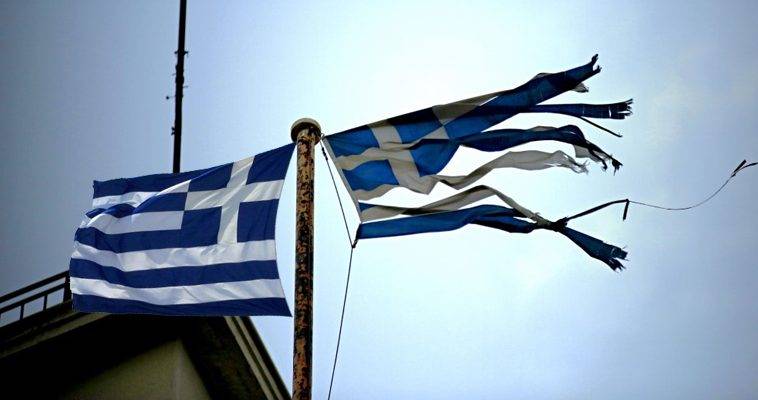
Yesterday was a day of celebration of an important national holiday for Greece and the Greek Nation. The anniversary of the NO, and what followed in the war against the Axis and Nazi Germany, is the moment in recent history when the Greeks truly honored their glorious historical origins and traditions. Unfortunately, in today's Greece there are few who can truly appreciate the value and meaning of this glorious page of the Greek Nation. A survey in the center of Athens with the question "Do we celebrate the day of the NO", will unfortunately prove this tragic truth.
 This year's celebration took place at a particularly unfavorable time for the Nation, both within the country and in its wider surroundings. Since it has recently become fashionable to talk about hurricanes, we are living in a critical period where dark clouds are gathering that portend the arrival of a major hurricane that directly threatens the national integrity and future of the country.
At the same time, the country's political leadership is committed to maintaining its position, and while the rain before the storm has begun, some think it is drizzling. Opportunities in the field of national security and foreign policy are going unexploited, while the implementation of a foreign policy of appeasement and subservience is progressively increasing the risks for the country.
The very well-planned strategy of Turkish President Tayyip Erdogan, for those who understand, regarding the claim of vital space for Greece, not only lacks a substantive response, but with the policy being implemented, it is made easier to achieve its goals, even without cost, to the point of raising suspicions of the existence of a specific agenda.
Because, quite simply, threatening slogans for communication purposes, and meaningless and empty appeals about international law and the borders of Europe, do not constitute a serious agenda of national security and foreign policy. Those who have not understood that the borders of Europe are, as the old real Greeks would say, boring, and that international law, if not accompanied by substantial support from great powers, is void of substance and content, either live in a parallel world or are truly stupid.
The European border issue collapsed in Istanbul, where the two major countries of the European Union, France and Germany, represented by French President Emmanuel Macron and German Chancellor Angela Merkel, came to join hands with the great defender of democracy and, according to his own recent declaration, the conscience of humanity, Tayyip Erdogan. The embrace was accompanied by the resounding presence of the Tsar of Russia, Vladimir Putin, dispelling the myth of the "Blonde Nation" who will intervene to save Greece.
Although we are and should be a hospitable and generous people, did anyone stop to think that on the platform of yesterday's grand parade in Thessaloniki was the Italian President, Sergio Mattarella, the politician who just a few months ago deprived the legally elected government of his country of the right to choose the Minister of Finance of its choice, solely to serve the interests and demands of Brussels and the vibrant democracy of the German European Union.
Is this the EU that will stand by us in the event of a serious threat from Turkey?
And to be fair about the fronts, let's talk a little about the United States. What exactly does this nonsense we hear almost daily that Greece and the United States are experiencing the best moment in the history of their relations actually mean? How does this translate into action?
When Turkey directly threatens Greece and it is increasingly clear that it has a specific strategy aimed at its national integrity, what is Washington's support? The recent response to the lukewarm question at the State Department's press briefing on the issue was limited to reminding that the two countries, Greece and Turkey, have established diplomatic mechanisms for settling disputes such as the 12-mile line, see dialogue.
In the past, in a more explicit and tough question, the State Department was absolutely clear, emphasizing that US policy on this issue is clear, they recognize the same extent in the air and sea, and this must be resolved through dialogue.
So is this the goal, the dialogue? Because all of us who think understand who is the loser in such a case. Who is the one who demands by threatening and who is the one who should give. Are some people, by opening these issues out of nowhere at an unfavorable moment for Greece due to economic hardship, seeking this nationally damaging dialogue? And if so, why?
So if it is a fact that today we have the best relationship with Washington ever, is it not time to demand what is due for this, namely the substantial US security umbrella around Greece?
the 28η In October 1940, the Greek Nation, through the mouth of Ioannis Metaxas, said the big NO to Italy and the Axis powers.
It is a fact and a one-way street that today's Greeks and their political leadership should say their own NO. But the crucial question is to whom? Because if we are talking about a NO to supposed enemies and not to those who really constitute the problem, then the game has been lost in the locker room. The NO must be addressed to the undemocratic Brussels and the, German-designed, distorted policies that are dynamizing the future of Europe.
Is there a leader who can say it and a people who have the strength and guts to support him, so that, as in the epic of 1940, Greece will be the one that, together with other peoples of Europe, will begin the campaign to return to the path of a truly united and democratic Europe?
Waiting!
*Dimitris Apokis is an Internationalist and Journalist, a graduate of The Paul H. Nitze, School of Advanced International Studies, The Johns Hopkins University, a member of The International Institute of Strategic Studies, and served for many years as an accredited correspondent at the White House, the State Department, and the Pentagon, in Washington.
Source: https://www.thepresident.gr