

GREECE-CYPRUS: FAR OR NEAR?
GREECE-CYPRUS: FAR OR NEAR?
By Parlatzas Miltiadis*
Hellenism, during the Balkan resurgence of nationalisms in the early 20th centuryth century, he set as the goals of his High Strategy the liberation and integration into the national core of the areas of the Ottoman Empire inhabited by Greeks. Known since 1844 as the "Great Idea", it was one of the few strategies that served for many years and with zeal all Greek governments regardless of ideological orientation.
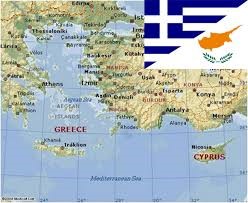
The island of Cyprus has been inhabited since ancient times by the Greeks and has since been a permanent part of Hellenism. In 1191 and in the context of the Crusades, it came under Frankish rule and in 1570 it was occupied by the Turks. The Greeks of Cyprus revolted in 1821 and among the harsh reprisals of the Turks was the hanging of Archbishop Kyprianou. Several Cypriots fled to mainland Greece and participated in the national liberation struggle. In 1878, Cyprus came under British rule and became a colony of the British crown.
In the first half of the 20th century diplomatic moves could not bring about the union of Cyprus with Greece. Even the latter's participation in World War II and its great contribution to the defeat of the Axis did not move Churchill, who forgot Cyprus, Northern Epirus and a new drawing of the northern Greek borders. The Greeks of Cyprus then (1955-1959) resorted to armed struggle through EOKA with Archbishop Makarios as political leader and Schi Georgios Grivas as military leader.
The result of the EOKA struggle was the declaration of the independence of Cyprus. The 1950 referendum for the Union of the Island with Greece (96% in favor) was not taken into account as Turkey managed to wedge itself into the negotiations and become the great winner of the Zurich-London agreements. The new independent state that was created from the beginning was doomed to fail as the agreements among others provided for the following: 1) A Greek president and a Turkish vice-president, 2) Three out of ten ministers had to be Turks, 3) One of the ministers of Foreign Affairs, Defense or Economy had to be Turks, 4) Creation of an Army with the participation of Greeks and Turks, 5) Great Britain, Greece and Turkey would be the guarantor powers for the preservation and viability of the new state. The Turkish population of the island (18%) thus obtained much more representation than its due, while the vice president also had the ability to exercise a veto on matters of foreign policy and defense.
In 1963, President Archbishop Makarios sent his vice president the famous 13 points for revising the Constitution. The vice president rejected them, the Turks withdrew from government positions, and clashes broke out between the two communities. Turkey was waiting for an invasion of Cyprus and its opportunity was given by the coup that overthrew Makarios by the military regime in Greece. Under the pretext of protecting the Turkish Cypriots, it proceeded with the operation "Attila I" on July 20, 1974, occupying 5% of the Cypriot territory. The beginning of the end had been achieved. The junta handed over power to Konstantinos Karamanlis who, unable to react to the Turkish advance, declared "Cyprus lies far away" and Turkish Forces occupy 39% of the Island with the operation "Attila II".
Turkey's goal was achieved. Greece was unable to defend Cyprus and since then discussions upon discussions have not brought about a solution to the Cyprus problem. The Greek and Turkish positions are diametrically opposed, they find no ground for convergence and the UN mediation did not have a better result, nor did Cyprus' entry into the EU. The famous Annan plan was rejected by the Greek Cypriots. Why? The then President Tassos Papadopoulos put it very clearly in his address to the Greek Cypriot people: ""I received an internationally recognized state and I will not hand over a community in search of a guardian."
Today, the Republic of Cyprus, a member of the EU since 2004, is at the mercy of Turkey's appetites. The Turkish explorations south of Cyprus, the Turkish president's fiestas in the occupied territories and the attitude of the partners can only cause sadness. As for the negotiations, the Turks are clearly proposing the solution of two independent states. In the face of all this, the front of Hellenism in Greece and Cyprus must be solid. It is not possible "Cyprus should decide and Greece should stand together." Historical, national, fraternal, geopolitical reasons do not allow it.
*Deputy Parlantza Miltiadis, MSc
BIBLIOGRAPHY
- Angelos Syrigos, Greek-Turkish Relations, (Athens: Patakis, 2014)
- Dionysios Tsirigiotis, Greece-Turkey, Deterrence Theory and Strategy, (Athens: Quality, 2021)
- WE ARE HERE, Turkey as a Threat, (Athens: ELISME, 2021)
- Thanos Veremis, History of Greek-Turkish Relations, (Athens, Sideris, 2013)
- History of the Greek Nation, (Athens: Athens Publishing House, 2000)