

Greek-Albanian relations: from the rapprochement of the 19th century to the coexistence of the 21st century
Greek-Albanian relations: from the rapprochement of the 19th century to the coexistence of the 21st century
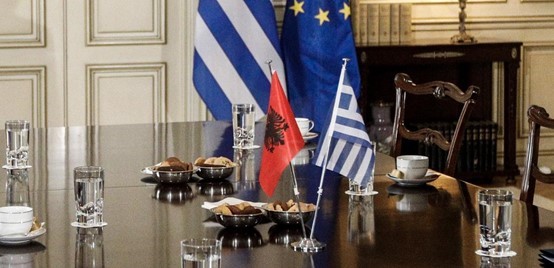
Date: 26 March, 2022Author: teamafia0 Comments
Image source: https://www.avgi.gr
Greek-Albanian relations: from the approach of the 19th centuryth century in the coexistence of the 21st
An interview was given on the above topic on Wednesday, March 2nd, 2022 with interviewee Mr. Dimitrios Iliopoulos, Honorary Ambassador, member of the Board of Directors of the Hellenic Institute for Strategic Studies, author of books and articles on foreign policy issues and translator of literary works of international literature.
Reading the relations between Greece and Albania in their historicity, it is interesting to see how the Greek intelligentsia included the Albanian nation in national aspirations: either in the vision of the pre-revolutionary self-determination, with the main example being the Balkan Federation of R. Feraios, or in the post-revolutionary Megaideal policy, as described in the work ''Greek-Albanian Understanding'' by Neocles Kazazis. What is the main reason that the approach did not progress in the years before Albanian state independence?
One should see what it is that connected the Greek element of the Ottoman Empire, population-wise, intellectually, and commercially, with what are today the geographical boundaries of present-day Albania. At that time, the Greek element was in the majority in many parts of Southern Albania.
If one looks at it ethnically, the Albanians have two categories of population, inspired by Albanian national consciousness: the Tosks, who inhabit Tirana and further south, and the Ghegs, who spread out in the northern part. Both the Kosovars and the Albanians of North Macedonia belong to the same population composition as the latter.
What we must observe is the connection that the Albanian leaders had with the Greek Intellectuals & Education – very great. All the big names that led to the creation of the Albanian State in 1912, were educated at the Zosimaia School of Ioannina or elsewhere. Nevertheless, a certain distancing occurred between us and Albania, as the Greek governments of the time and the Greek Intellectuals attempted to exert a very strong influence on this geographical area – legitimately, because they wanted to support the majority Greek element of the Himara-Tirana line and have a say in the events of the region.
Thus, hostility towards the Greeks developed among those who envisioned an Independent Albania. Besides, the Albanians sought protectors in Italy and Austria, who were the main supporters of the Albanian statehood and settled the border issue of the new country. Without these powers, Albania would probably not have the form we know today. In this context, Italy made an effort so that our Northern Epirus, despite the prevailing Greek element, would not be integrated into Greek territory. The Albanian population growth only took place after the establishment of the Albanian state and, especially, under Enver Hoxha, when the large number of children was encouraged.
Returning to your question, my term in Tirana showed me the sympathy that the Tosks have for Greece. The local Greeks coexisted with them harmoniously, not in competition, now eliminating the fear of Greek territorial claims after World War II. Unfortunately, our relations are being poisoned by the influence of third parties, mainly Turkey, a fact that is also obvious in the Albanian press. Personally, I have attended in my diplomatic capacity an event of a large Greek company to award scholarships to Albanian students and they cheered me on! The spirits calmed down when I addressed them in Albanian and the mood of the public changed. All of the above vividly illustrates the causes of non-convergence between Greece and Albania, both in the past and in the present historical time.
Unraveling the thread of our discussion, I would like to continue by clarifying the influence of Turkish actions, as you have already touched upon. In one of the first international trips of 2021, Erdogan visited Tirana and happily declared that "Turkey is the largest foreign investor in Albania with 3,5 billion dollars and more than 600 companies are active in Albania, providing employment to approximately 15.000 Albanian brothers." The dependence on the Turkish economy also reflects the political dimension: is the taming of Albania outpacing Turkey?
First of all, I would like to correct the substantive ''subjugation''. This is an attempt to co-opt a neighboring power. Our priority, myself and my fellow diplomats, was to explain to the Government, the Opposition, and even the most hostile circles in Albania, that they had only to gain from cooperation with the Greek side. Until recently, there were 456 Greek companies established in Albania. This vigorous Greek economic development in the country was interrupted, mainly, through our own responsibility.
Directly answering your question, I say that the Albania-Turkey rapprochement should not be treated in isolation. I do not like the descriptive expression "Ottoman Arc", either, as this is not what it is about. It is a very well-targeted effort by Turkey to regain its footing in the Balkans and to acquire a multi-level influential role, politically and militarily. Consider that in Albania there is a Turkish military base at the Vlora naval base (ed. 2ο largest Albanian port), where they have their own camp with a Turkish flag, where not even the Albanian Commander enters without permission.
As for education, 20 years ago there were only 3 Greek schools: the Arsakeios School, the Theological Academy “Resurrection of Christ” in Durrës, founded by Archbishop Anastasios, and the Greek-Albanian Tutoring School of Korçë “Omiros”. Correspondingly, at that time there were, and will now have increased, 72 Turkish schools (!) under the name “Torgut Ozal”.
Turkey's penetration into Albania is such because, firstly, there is an excellent personal relationship between Erdogan and Rama and, secondly, a significant connection has been achieved in commercial activity.
If one looks at the issue with the eye of the "common world", one will spot a paradox: during the Revolution of 1821, it is known, we suffered from the Turko-Albanians - Albanian troops under Turkish command. However, what I discovered while passing through the Albanian province is that they have no love for Turkey, because they consider that it has tormented them. Characteristically, they still call them Ottomans.
Returning to the historical events between the two states, we note the state of war (''Law on the definition of Italy and Albania as enemy states''), which was enacted by the Greek Parliament after the Italian attack against us in 1940. Albanian politics often calls for its legal repeal, as a step of goodwill from Greece. Do you think that its repeal would support the path to further resolving our differences? Can you point out to us the points of this law?
The War includes two royal decrees, concerning the confiscation of Albanian property which may be of very great value. The political value of these two decrees is that, their non-legal lifting, ensures the formal recognition of Albania as an enemy state. The reality, of course, is far from this: Greece is one of the most vociferous preachers of Albanian entry into the E.U. – according to some estimates, in an exaggerated manner and without any compensation.
Regarding the decrees in question, the political response included the Declaration of Friendship, during the Ministry of Karolos Papoulias in 1987 and mainly the Pact of Friendship signed in 1996, with the Berisha government. The latter has expired and efforts are being made to renew it. For Greece, politically speaking, there is no War. It has been lifted with these two events, not of a legal but of a political nature.
In Albania, some political games are being played by specific circles, which are making demands for a legal act that will remove the effects of the two decrees forever. As you understand, those interested in property have benefited from this. An attempt has been made to catalog it, since I was in the Directorate of Greek-Albanian Relations, in 1983. The project is very difficult because, over the years, many properties have been encroached upon. There was an attempt to establish a committee on the Greek side, to calculate its size and determine the financial burden on the Greek State. Correspondingly, the Albanian State must pay compensation for the confiscated Greek properties in Albanian territory, which are much fewer and the stakes are much lower.
A solution has not yet been found, but the problem is economic and not so much political. I was present at discussions of three different Greek prime ministers who, in discussions with their counterparts about the War, responded that for Greece the issue has been resolved with the political actions of 1987 & 1996. These are not enough for the Albanian side, so the discussions must continue.
There are other issues that have nothing to do with the War, but have been more or less resolved, such as the settlement of the Border Pyramids. These are real, concrete pyramids, built at regular intervals on the border and defining the borders. One issue that has not been settled is the demarcation of the maritime borders.
This will be the next topic we will develop. April 27, 2009 the Karamanlis government co-signs the agreement for the definition of maritime zones and the continental shelf between Greece and Albania. This day was, in fact, the eve before the latter's official application for membership in the EU. Unexpectedly, however, this agreement led to its abolition by the Albanian Constitutional Court, a year later. How much did this diplomatic development cost Greece and Greek-Albanian relations? Finally, will the jointly agreed upon 2020, appeal to The Hague resolve the differences, without Greek losses?
Regarding the opinion of the Constitutional Court, there is something that needs to be developed. There are still institutions in Albania, such as the Constitutional Court, which are a continuation of the communist regime. It functions as a ''fiefdom'' of the socialist space, as the successor state of the Communist Party. Despite the fact that the Berisha government of 2009 was conservative, the Constitutional Court was controlled by Edi Rama, as Leader of the S.K.A. (Socialist Party of Albania) and the Official Opposition.
This development has affected bilateral relations and prevents the settlement of an issue that could be resolved in a mutually beneficial manner. The Albanian argument for the abolition of the agreement was dissatisfaction with the demarcation of the island lines. Although the issue is legal, Messrs. Berisha and Meta (ed. current President of Albania) have denounced Ankara's influence on this fait accompli. The aim of the Turkish intervention was, in addition to the constant pursuit of a diplomatic gap between Tirana and Athens, to prevent this settlement from proceeding, which would be used as an example in the corresponding negotiations in the Aegean.
In the 2010s, there was no action on the issue. Rama was consumed with domestic affairs, in the attempt to establish an almost absolute sovereignty: you see that he is elected and re-elected. I don't know whether the way he is doing it is democratic, but it is proof that, in Democracies, there is a way for someone to be elected repeatedly...
During the ministry of N. Kotzias, it was deemed right to revisit the problem of maritime zones, as part of a set of issues with the priority - let's not forget - the protection of minorities. The talks resulted, during the ministry of N. Dendias, in the agreement to hold talks on a new basis. Part of the agreement is the co-promise, which stipulates the referral of the settlement to the ICJ of The Hague, failing to achieve convergence between us. Since the agreement is relevant, another pending issue on our maritime borders will be closed, following the arrangements with Italy and Egypt.
Of course, the Hague ICJ does not know what surprises it has in store. Personally, I consider it of major importance to reach an agreement, even with international arbitration, despite the possible loss of a few square kilometers of maritime space. At present, with the responsibility resting on the Albanian shoulders, the negotiation is not progressing. Ultimately, although the International Convention on the Law of the Sea (UNCLOS III) is clear, it is sometimes subject to interpretation and, surely, it is more important to close this chapter.
Albania, although it has ratified the Council of Europe Framework Convention for the Protection of National Minorities since 1995 and the Law for the Protection of the Rights of National Minorities since October 2017, has historically shown low reflexes in protecting the minority Greeks (Guma-Katsifa murders) and their local property (attempted expropriation of the private properties of the Greeks of Himara). Is there a way for the Hellenism of Northern Epirus to survive, within the existing framework of bilateral relations?
There is a question, by the Albanian intelligentsia, about the locality of the Greek Minority, at least the one living in the historical Northern Epirus - this is the region that secured autonomy in 1914, which it never exercised, following Italian pressure. The prevailing view of the Albanian nomenclature, including the Albanian Academy of Arts & Sciences, supports the non-autochthonousness of the Greek element - a claim that is ridiculous in itself. Anyone who tours Southern Albania will see that it is full of Greek monuments, with Greek inscriptions. Albania characterizes the Greek nomadic shepherds there who learned Greek in trade exchanges with Corfu!
Enver Hoxha, originally from Gjirokastra, knew the Greeks well. He sought the protection of the Greeks and their utilization, even in ministerial positions. Of course, these were modern Janissaries. They defended Albanian interests. Hence I fear that even in the very recent past, even in the present, there are ministers of Greek origin who did not fulfill their duty towards their ethnic origin.
With the end of Communism, the Greek Minority believed that it could better exercise its minority rights deriving from the United Nations Charter. The issues at stake were three: first, security. A Greek should not feel insecure at the sight of an Albanian policeman. Second, employment. When he is deprived of access to the labor market, he is now marginalized. Third, education. Hoxha had founded a Greek Language School at the University of Gjirokaster. Let us say in parentheses that, in his effort to alter Greekness, the Greek language was taught in a corrupted form in minority schools. For example, the phrase ''çfatë mar'' translates as ''what are you doing?'' What does this mean? Nothing! The phrase corresponds to the question ''what are you doing?''. It saddened me to hear Greeks express themselves with such artificial Greek-Albanian phrases.
In terms of assessing the protection of rights, we have progress. Security is improving because the media is reporting incidents of illegal actions and is pressuring the Albanian administration. Some of the thriving businesses are owned by ethnic Albanians. The difficulty lies in the fact that their interests are not promoted since, as we said before, their minority status is not recognized. Here, let us note that the powerful Greek root of 180.000 inhabitants is now limited to 30-40.000. Any threat to the Albanians is smaller. Furthermore, Hoxha defined 99 villages as Greek places, excluding areas such as Himara and Korçë where there were tens of thousands of minority people. This is an open issue from the Greek side, as Albania resists the inclusion of new villages in the list of 99. I must give praise to the Arsakeio School and personally to its president, Mr. Babiniotis, who created this model school in Tirana, the best private school that exists in all of Albania.
In the aforementioned, we must also touch on the property issue: not only is it advisable to separate the Greeks from their property, but Himara is an investment fillet, with green mountains and a clear blue sea. Not only is it desirable that the ''Graikos'' leave (as we are told), but that it fall into state hands for development. In this regard, the Albanian government is moving with the clever method of ''salamiization''. You cannot cannonball into every wrongdoing, whenever they get 1 or 2 houses in their hands. It is not expedient to react to the deprivation of each minority property separately. Thus, they have managed to diminish Greek property little by little. Diplomacy must move inductively, towards the whole policy.
Finally, regarding the incidents of murders of Greeks of the diaspora, you see the Katsifas case, which is clearly a murder, the easy violence of the Albanian police is observable. Referring to this issue for the first time, I would like to carefully formulate the following: the minorities, often encouraged by Greek circles, are led to extreme behaviors that do not serve official policy. I myself was criticized by some extremists of the Diaspora because I was not ''tougher'' towards the Albanian authorities, on some issues, while I believed that I should act more mildly. For example, whenever there were elections, I was on the front pages as a participant in the pre-election campaign in favor of KEAD (ed. minority party).
In 2003 we managed to elect an ethnic Greek Mayor of Himara, because we followed a "skillful" policy, as I avoided personally attending the election rallies and did not irritate the Albanian press. In addition, the presence of the OSCE and the American ambassador, whom I had mobilized, was ensured. Thus, the illegal activities were significantly reduced.
In the case of Katsifas, he attempted to act in such a way that the other side would exploit him. Of course, they pulled the trigger with his murder, probably wanting to set an example that would further protect the Greek Diaspora. When injustice is so great, people do not shrink but rebel. The Greek state must monitor the case. For every thing there is an appropriate remedy that must be left to the competent authorities.
Edi Rama has been making claims on the so-called Cham Issue in recent years. Additionally, in 2016, the Hellenic Foundation for European & Foreign Policy supported the pursuit of an agreement that would include as many of the issues between us as possible, including the settlement of property issues. What are the benefits or risks expected in starting talks on the Cham Issue? Could Greece find itself accused in the International Court of Justice in The Hague?
The Cham Question has been considered over for Greece since the beginning of 1990, when the Berisha government declared that there was no Cham issue. Rama brought the issue back up in his attempt to join the Cham Party. Around it, both the natives and the 17.000 expatriate Chams of 1944 rallied. And even during the Hoxha regime, it was never put on the agenda of our talks. Annual commemoration events were held outside the Greek embassy, following Turkish instigation. Those Chams who have chosen the legal path on their own were not vindicated, as the (in absentia) convictions for collaborating with the Nazis deprived them of their citizenship and assets.
The Cham Question was first raised during the interwar period, in the League of Nations, with the blessings of Italy. It did not proceed further, due to a lack of evidence. The Albanians resorted to extremes, during World War II, by murdering Italian soldiers, in order to force the Greek state to pay compensation in the area of the so-called Chamouria. After the war, in a 1951 census, if I am not mistaken, approximately 100 people were recorded as being of Albanian origin. I think that the issue will be eliminated with the new generation of Chams who will see that they do not benefit from this issue.
A discussion on Greek-Albanian relations could not fail to include the issue of Greater Albania. Four years ago, Mr. Rama stated that a ''small union'' of Albania and Albanian-speaking Kosovo was not ruled out, if the EU withdrew the Albanian candidacy from the table – with the President of the Albanian National Council of Serbia, Jonuz Musliu, claiming that ''Serbia should be happy that the Albanians are not asking for more territory'' (sic). Is Greater Albania a specter that haunts the Western & Central Balkans or a rhetorical smokescreen, in pursuit of short-term goals of Tirana & Srebrenica?
If I were an average Albanian, I would see the issue like a Greek saw the issue of Cyprus in the 60s: I would like them to be under a common umbrella. Nevertheless, I do not see the possibility of the project succeeding. In addition to the different population composition – as we said before, they are Ghegs – the ruling Kosovar nomenclature has been raised with different reflexes. In fact, there is a kind of snobbery on the intellectual level, as they see Albanians as provincials – also due to the thriving Kosovar Diaspora, with 400.000 in Switzerland alone.
Regarding the core of your question, the Kosovars are waiting for the "yearbook" of EU integration, with the declared goal of Brussels to integrate the entire Western Balkans into the EU, according to the Conclusions of the Greek Presidency, at the Thessaloniki European Council in 2003. Beyond that, the ruling class of Kosovo does not wish to become "from mayor to usher", within the framework of a Greater Albania. At the present time, they have control over their economic activities, the recognition of part of the International Community (only 5 European states have not recognized it) and American support, with the largest American base in the Western Balkans.
Finally, Edi Rama offered them a kind of Albanian-Kosovar Schengen Zone, so that they could leave their currency in the Albanian south during the summer, and an attempt is being made to connect their electricity networks. We can speak of a de facto political union. However, the possibility of a trans-Balkan Albanian state, I do not think, will concern us for several more decades.
In the public discourse on Greek-Albanian relations, arguments are frequently developed for the Greeks of Albania and not at all for the Albanians of Greece. There are now 2nd and 3rd generation immigrants in our country, who have been raised and educated in our country. Immigration from the neighboring country continues to this day, with young people, newly arrived, constituting a significant part of those serving military service in the Armed Forces. What further should the Hellenic Republic do in order to achieve their integration – and with a view to the normalization of relations with Albania?
Albanians have shown great flexibility in the places of immigration, like the Greeks. They are not ghettoized, like the Turks, and are gradually integrated either through mixed marriages or in other ways.
The Albanian Diaspora now number around 100.000 in Greece. For years, there was a difficulty in granting citizenship due to an Albanian law, which stipulated the loss of Albanian citizenship to anyone who acquired a new citizenship, with the aim of cutting them off from their ancestral homes. Of course, the Diaspora spend every summer in their ancestral homes, which they consider, I might say, a pilgrimage.
Now, these difficulties have been overcome and citizenship is granted to both the Greek Diaspora and the long-standing Albanians, who have chosen to live the rest of their lives in our homeland. Of course, because times are difficult, I hope that the required screening is carried out, so that suspicious elements do not infiltrate. We have, unfortunately, examples in Thrace, which reach as far as the Greek Parliament.
The average Albanian, as I have come to know him, is a homebody and wants a smooth life. He is intelligent, adaptable and hardworking. They excel in business wherever Greeks work, without any problems arising.
Reading your CV, which spans over four decades, I understood that you have served at various levels and supranational institutions, following your service to your country. So, I wanted to ask you what are the characteristics of diplomatic life and why should a young person choose to enter the Diplomatic Corps?
I will answer you as I answered in the interview of the Ministry of Interior for admission to the Diplomatic Corps: ''I could have pursued an academic career, as I had the qualifications, having just arrived from France with a diplomatic title, but I prefer to contribute to the Homeland in practice''. A Diplomat must have a great deal of patriotism, in order to tolerate the ''abuse'' of the Greek State, a civil servant after all, the constant change of place and language, as well as the dangers. I want to praise my colleagues who are in Ukraine and are working under adverse conditions, overturning the stereotype of the diplomat who returns with a glass of wine at receptions..!
Many colleagues, and I myself, have found myself in difficult situations, especially in Turkey. He must have great endurance, then. There are many who could not stand it and resigned. It requires dedication to serving the national interest and tolerance for the unintentional injustice that you will commit against your family. Without these, you will not thrive. Most colleagues follow all of the above.
I think many they will find the information about the nature of the profession interesting!
Please note that all degrees are now accepted by the Diplomatic Corps, with the only requirement being excellent knowledge of English and another EU language. If you have the above, you are eligible!