

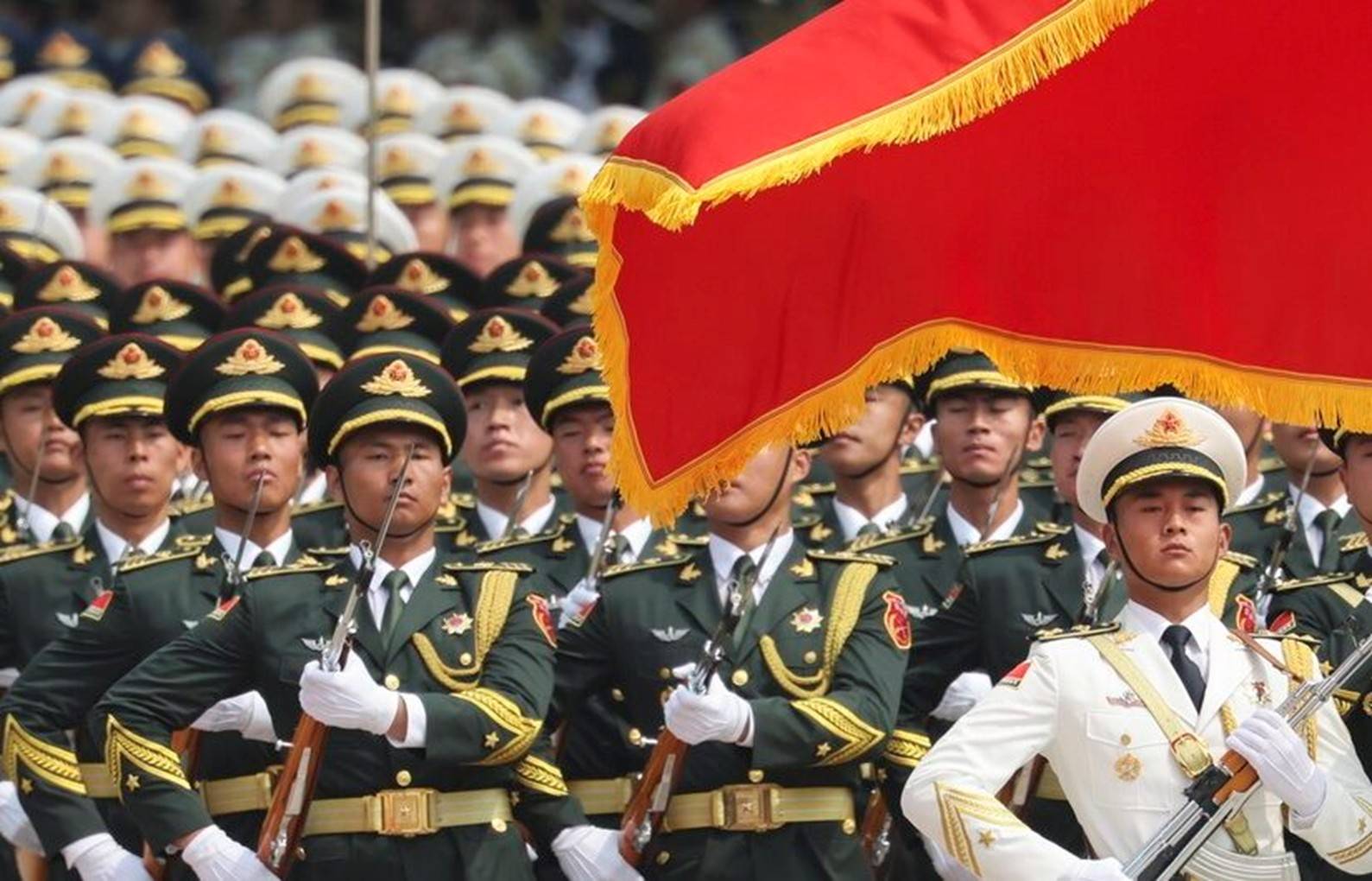
Why China is the real winner of the Gulf War.
Why China is the real winner of the Gulf War
 GRIVAS KOSTAS
The recent military confrontation in Iran acted as a relentless geostrategic mirror, definitively dissolving the veil of the imaginary military omnipotence of the United States. The intensity and duration of the operations demonstrated in the most dramatic way Washington's inherent inability to conduct prolonged, high-intensity military conflicts, due to the collapse of the production and replenishment chain of critical weapons systems.
Within just a few weeks of operations, the US arsenal literally “dried up”, consuming a huge part of the vital guided missiles (such as Tomahawk and JASSM) and anti-ballistic missiles (such as Patriot and THAAD), exposing the US to an unprecedented industrial deadlock. But if this productive nakedness and operational failure can be “forgiven” or absorbed politics In the case of a regional power like Iran, a similar treaty against China would inevitably mean absolute military disaster.
The conflict in the Middle East has demonstrated that the Pentagon has lost its surge capacity. This fact makes it clear that in a potential Western Pacific theater of operations, the United States simply cannot win. The illusion that technological superiority can replace industrial mass has collapsed. It is on this new reality that the holistic geostrategic advantage that Beijing has built is based.
China has achieved and continues to expand a complex, holistic, and multi-layered military power advantage over the United States. The first level of this magnitude begins with China’s anti-access and area denial (A2/AD) capabilities, which have been in development since the early 2000s. In this context, anti-ship ballistic missiles (ASBMs), such as the DF-21D and the newer, more powerful DF-26, as well as hypersonic glide vehicles (HGVs), capable of engaging maritime targets at ranges of thousands of kilometers, have set new operational standards.
The evolution of the aeronautical threat
Subsequently, the integration of similar weapons into existing older aircraft and surface ships, combined with hypersonic reconnaissance aircraft and an expanded fleet of fourth- and fifth-generation fighters (with a sixth generation soon to be announced), have further shifted the balance. Now, Chinese air forces are able to threaten the dominance of the US Navy even in open ocean areas, thousands of kilometers from the Chinese coast.
More importantly, however, China has the infrastructure to replace its warship losses much faster than the United States. With a shipbuilding capacity hundreds of times greater than the US, Beijing can widen the existing gap even in peacetime.
The size of this industrial gap is confirmed by leaked documents from the US Naval Intelligence (ONI), which state that China’s total shipbuilding capacity is 232 times that of the US. In fact, more recent US estimates revise this asymmetry, putting Beijing’s production capacity as much as 632 times that of the US, given that US commercial shipbuilding has shrunk to 0,1% of the global market.
This dramatic picture is complemented by an analysis by the Center for Strategic and International Studies (CSIS). CSIS points out that, through the doctrine of Military-Political Merger, a single Chinese state-owned shipbuilding group (CSSC) has managed to build more commercial ships in a single year, in terms of tonnage, than the entire American shipbuilding industry has built since the end of World War II.
Supersonic weapons, advanced explosives and drones
The production superiority also applies to other critical weapons systems, such as HGVs, where the manufacturing cost and the resulting mass production capability are tens of times lower for China compared to the US. A typical example is the comparison of the Chinese YGJ-1000 missile with the American Dark Eagle.
A relatively unknown area in which China threatens to achieve a technological gap with the US is that of advanced explosives. The spearhead in this field is China's monopoly ability to mass-produce CL-20 (China Lake Compound #20), which is the most powerful non-nuclear explosive in the world today, with an energy density about three times that of conventional TNT.
The paradox is that this chemical compound was originally discovered by the US in the 1980s (in the Navy laboratories in California), but the Pentagon neglected it due to the end of the Cold War, the high cost of synthesis and the dangerous sensitivity of the material to vibrations. On the contrary, China methodically invested in research into “energetics materials”, achieved its stabilization through advanced crystallization methods and nanotechnology, and is now the only power on the planet with the capacity for its industrial mass production.
This development creates a serious technological gap (molecule gap) to the detriment of the US, as the CL-20 allows Chinese missiles to achieve up to 20% greater range, while transforming the warheads of hypersonic missiles (HGV) into extremely more lethal and compact ones. The combination of these two factors allows the development of missiles of various types (such as very long-range air-to-air), giving Chinese aircraft the ability to strike US platforms from much greater distances.
This production asymmetry reaches unimaginable levels in the unmanned aerial vehicle (UAV) sector. China currently controls 80% to 90% of the global commercial drone market, with the giant DJI monopolizing 70%. According to analyses by American defense institutes, such as the Small Wars Journal, Chinese companies policies industries have the infrastructure to transform within twelve months into war production lines, with the capacity to output up to 1 billion armed drones per year.
The fact that Such a formidable mobilization would require less than 1% of the country's total industrial assembly capacity, demonstrating that Beijing can create an insurmountable "numerical wave" (mass) in the air, capable of achieving complete saturation of any modern Western air defense system.
Cyberwarfare and strategic resilience
At the same time, China has extensive cyber and electronic warfare capabilities, possibly superior to those of the United States. It applies these capabilities within the framework of innovative operational concepts. This methodology is based on the infamous theory of “1000 Grains of Sand” (Thousand Grains of Sand)According to her, intelligence collection is not based exclusively on a few, specialized agents, but on the diffuse and massive mobilization of thousands of amateurs (academics, students, businessmen and citizens) who collect seemingly insignificant, fragmentary and unclassified data.
When these millions of small data points are put together and analyzed centrally from Beijing, they form a complete operational mosaic (mosaic approach) of high precision. This approach makes Chinese electronic and cyber warfare extremely asymmetric, as the adversary is unable to defend against such a massive, decentralized and low-profile threat.
In addition, China has operationally integrated hybrid capabilities, dramatically improving the conduct of network-centric operations. For example, it has integrated its vast fleet of fishing vessels into the C4ISR network of its air and missile forces.
The C4ISR (Command, Control, Communications, Computers, Intelligence, Surveillance, and Reconnaissance) network is the nerve center of this model. China has redefined this Western concept through the doctrine of “Military-Civil Fusion.” By integrating hundreds of thousands of “Maritime Militia” vessels, i.e. heavily equipped fishing vessels with military-trained crews, into its digital network, it is creating a complementary sensor network.
These vessels, carrying satellite communication systems and advanced sensors, continuously feed Chinese C4ISR with real-time targeting data of American surface units. This originality transforms a commercial and political tool into an organic part of the Chinese missile forces’ kill chain, complicating the Western response legally and operationally, as attacking them is tantamount to attacking political targets. Overall, China’s ISR architecture is more “pluralistic” and, therefore, more resilient than its American counterpart.
In terms of strategic resilience, China has an advantage due to a deeply rooted culture of self-sufficiency. It has stored vast amounts of energy and food, while cultivating a culture of realism and acceptance of a potential military confrontation among its population. The Chinese Communist Party (CCP) has succeeded in transforming nationalist sentiments into a powerful internal rallying mechanism.
In the realm of high strategy, Beijing controls the production of many critical strategic metals as well as all rare earths. This allows it to block or drastically slow down the supply chain and production of critical Western weapons systems in the event of a prolonged conflict.
Nuclear deterrence and international alliances
The only area in which China lags behind quantitatively is that of nuclear weapons. However, even its current, comparatively limited nuclear arsenal is capable of inflicting unacceptable damage on the American population. The future quantitative expansion of nuclear warheads, combined with high-penetration HGVs in anti-ballistic meshes and the construction of advanced nuclear-powered submarine-launched ballistic missile (SSBN) carriers with JL-3 missiles, make Chinese nuclear deterrence extremely credible.
In contrast, the defensive arm of a nuclear war is bolstered by China's vast underground facilities, population protection plans, and advanced culture. policy defense. The acceptance of such an extreme scenario by the Chinese people is in stark contrast to the Western mentality, which treats such situations as “unthinkable.” Characteristically, the insistence on self-sufficiency and gigantic food reserves ensure that even in a “nuclear autumn” scenario (e.g. from a Russia-NATO conflict), the Chinese population will avoid famine.
Politics
Finally, Beijing has formed an unprecedentedly dense network of alliances with countries like Russia, providing enormous strategic depth. At the same time, in the modern multipolar system, even China’s regional competitors, such as India or Vietnam, are highly unlikely to fully align or ally militarily with the United States.
In conclusion, the China is currently the most comprehensively prepared country for the management and conduct of war at all levels. This reality gives it increased negotiating power even in peacetime, drastically limiting the scope for the US to exercise coercive policies against it, while at the same time strengthening its own capabilities for geopolitical imposition