

Some in Athens did not want the Belharras equipped with SCALP Naval missiles.
 MICHAS ZACHARIAS
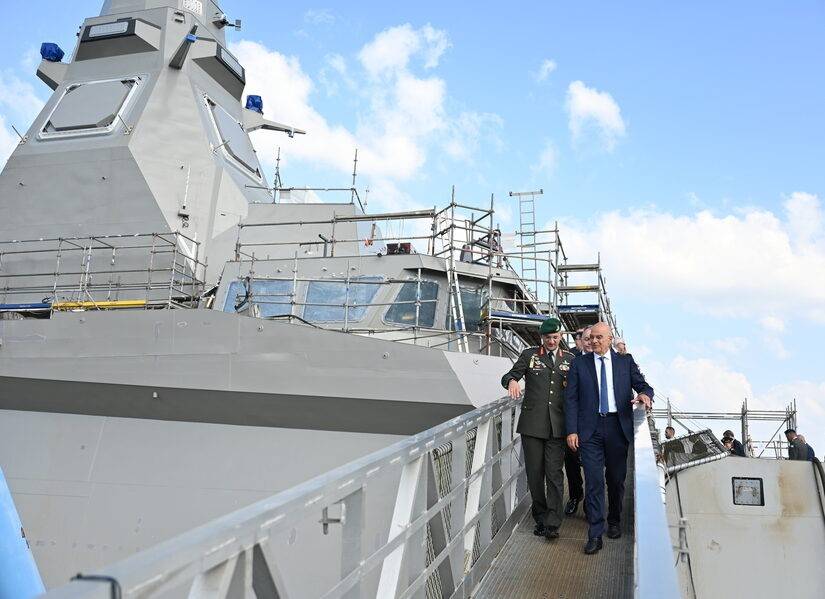
In his speech at the Naval Group Lorient shipyard, on the Atlantic coast in northwestern France, the Minister of Defense, Nikos Dendias, dropped the "bombshell: The FDI (Belharra) frigates, in addition to the first one, will have the ability to carry long-range missiles MdCN strike, better known as SCALP Naval (naval version of Scalp), an impressive performance cruise missile, a real strategic deterrence weapon with a range of more than 1.000 km.
The SCALP Naval is a missile with a length of 6,50 meters, a diameter of 0,5 meters and a weight of 1400 kg, which can be launched from MBDA's Vertical Missile Launcher SYLVER A70. Some sources increase its range by 30-40%. However, this is of lesser importance for the Greek-Turkish theater of operations, and with the 1.000 km range they are judged to be more than sufficient for attacking any target within Turkish territory.
Incidentally, it should be noted that Naval SCALPs can even be fired from the torpedo tubes of Navy Type 214 submarines. The same launcher can also launch the ASTER 30 B1 anti-aircraft-anti-ballistic surface-to-air guided missiles that equip the FDI HN (Belharra). The Sylver A50 launchers mounted on the frigates cannot accommodate him. For this reason, we argued three years ago for the need to place them in FDI, even if there was no supply of MdCN in the first phase. And just the possibility of hosting him, turned the case even into a diplomatic weapon, in addition to a strategic one.
Nikos Dendias included the launching of the FDI HN "Nearchos" in the infamous "Agenda 2030", in which apparently the three frigates were included, as they were decisions taken by the Navy and the political leadership in the previous period of his ministry. To his credit, the minister mentioned his predecessor Nikos Panagiotopoulos by name, crediting him with the decision.
They didn't want SCALP Naval!
Certainly and always to the extent that the political – for now – pronouncements take shape, the change of attitude on the SCALP Naval issue will be credited to the current political and military leadership. As he mentioned, their procurement was included in the 12-year Long-Term Defense Equipment Planning. So we assume that after staff processing, it has received all the intended approvals, as in the recent past not only was it not a priority, but there was a clear negative predisposition to its procurement, even from the military leadership. What changed? Was it about political or military leadership?
So it has not been long since arguments against the supply of SCALP Naval, with various arguments, prevailed in the public debate, even from today's celebrants. In summary: Either because "they are very expensive and will absorb much of the funds for the Navy", or because "the strategic strike role has been taken over by the Air Force" which has the corresponding airborne weapon, with half the range of course, or with the vague, even incomprehensible argument, that "completing them in FDI HN will target them»!
For the time being, it remains to be seen if the trend that is taking shape, on the one hand, on the alleged release of the American JASSM missiles and now the manifestation of intention to include the SCALP Naval in the FDI HN, signals more generally the intention to review the Greek doctrine vis-à-vis Turkey. In the past, the discussion on the implementation of such supplies, had raised objections with the argument that it would involve turning it into an offensive!
But the de facto doctrine should be reexamined, as the F-35 is clearly a "first strike" weapon system. Its acquisition should be aimed at increasing uncertainty for the adversary when choosing the method of military provocations, thus enhancing deterrence.
This "virtue" of the F-35 is canceled in practice, if for reasons of international public image the country officially waives the conditional possibility of launching a preventive strike! This is allegedly done in order not to be accused of war-mongering and despite the fact that it lags behind, quantitatively at least, against the main national security threat it faces, namely Turkey, which in fact constantly uses the method of military coercion against Greece.
Missile wall in the Aegean
Similar arguments, mainly regarding cost, have been recorded for the two aforementioned weapons, the JASSM and SCALP Naval. It is interesting, and should be pointed out here, that these arguments are forgotten when there is a discussion about the procurement of 20 F-35 Lightning II fighters. I wish, however, that this specific case was the only piece of evidence of a piecemeal approach to defense issues.
Another issue that should, however, be raised and clarified, is the overall picture of the Dendia announcements from France. In them, the following programs were presented as decisions taken, always in the context of the "2030 Agenda": Modernization of the (four?) MEKO 200HN frigates, the "Roussin" type missiles and the Type 214 submarines, for which he even stated that "will immediately begin to be implemented in Greece». By adding "future", he referred - on French soil with a French audience - to the future participation of our country in the design and construction of the new - s.s. American frigate Constellation.
Reference was also made to the Eurocorvetta program, while the speech also found space for "the creation of an impregnable missile wall in the Aegean». The reference is sufficiently vague, as it may be reminiscent of "domes", but the wording seems to include at least surface targets. In conclusion, there was talk of building new submarines at the end of the decade. There was heard the "always within the country's fiscal limits».
However, adding up the estimated amounts concerning the programs which "they will start immediately", there is an amount of expenditure that until yesterday did not seem to be within the country's fiscal limits. Also conspicuously absent from the economic equation are the long-term costs of supporting such state-of-the-art weapon systems. The reference to the Eurocorvette belies the ship supply shift of this displacement over time, over the next decade. But this means that the core of the Greek naval power for the next 10-15 years will be the four FDI HN and as many MEKO 200HN, slightly modernized.
"window of vulnerability"
If we even include the years required to complete upgrades and shipbuilding, i.e. to reach the full operational utilization of the eight main surface units, the upgrade of the combat value of the Navy as described in the "Agenda [to] 2030", obviously does not it will come soon, while also relying on very limited numbers. More technologically advanced ships, but much less. Apparently some more (of the Dutch "S" type) will be kept in service, additionally and as long as they last. Because if an aging ship cannot stand – even if supported by others – in the modern business environment, then from adding to naval power, it turns into a convenient target for the adversary.
The delay is reasonable for objective factors other than financial. That is why it is important that decisions are taken in time and that the appeals of the military staffs are not ignored. Because we are leading to impasses that open "windows of vulnerability" in the Greek defense, which constitute "windows of opportunity" for ambitious opponents... This is generally the true dimension of the Dendia announcements from Lorient, France.
The known available funds with which these designs are made are not clear. So, there remains to be a more general government report on the allocation of funds for the rearmament of the Armed Forces. Because what is known to date, does not go along with the feeling of the Dendias speech, that the initiatives are imminent. The leaks about the meeting at the Maximos Palace where the decisions were taken are not enough. The clarifications should be more. Above all, however, the need to properly assign priority at the level of the state budget should be realized. It is not possible in a country with the threat characteristics of Greece, that the cuts start from defense. The reasons have been amply explained above…
Some in Athens did not want Belharras equipped with SCALP Naval missiles