

Alexis forgot the EEZ in Cairo: Greece
«O Alexis forgot the EEZ in Cairo: Greece, Cyprus and its phobic syndrome Egypt.
Written by Theodoros Kariotis
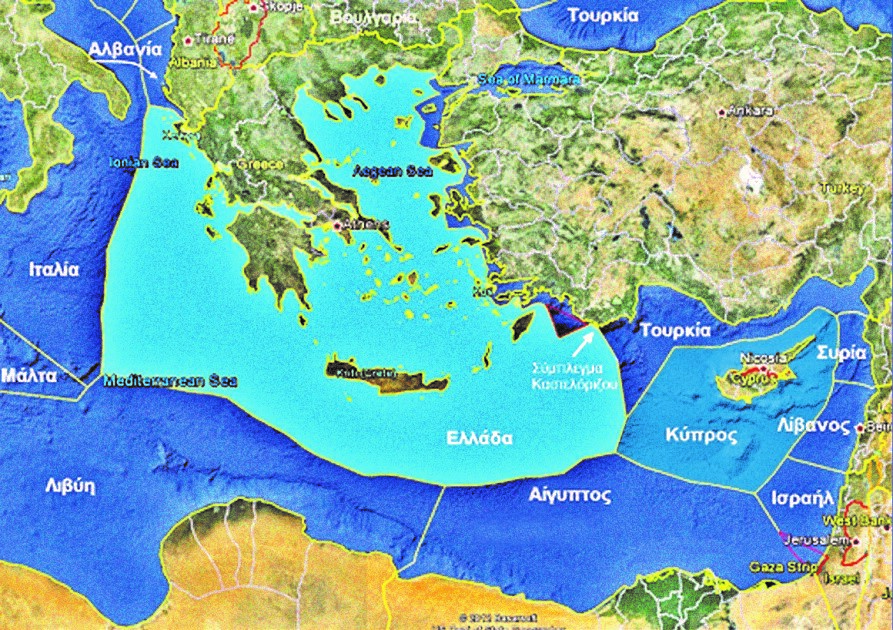
It was an unexpected "Spanish retreat". We were all eagerly awaiting the fourth Tripartite Conference between Egypt, Greece and Cyprus and felt great disappointment and shame at its results. They are afraid of Turkey and do not dare to delimit their EEZs.
From the last joint statement in Cairo on October 11, 2016, it is clear that Tsipras, Anastasiades and Sisi are clearly suffering from the phobic syndrome that has plagued Greece for at least three decades.
A paragraph from the communiqué clearly shows how shamelessly they mock their people:
"The Heads of State and Government expressed their desire to strengthen their cooperation through a series of agreements on the exploitation and transportation of natural gas, where the discovery of hydrocarbon deposits will serve as a catalyst for regional stability and prosperity. They stressed that this cooperation is based on the established principles of international law, in particular the United Nations Convention on the Law of the Sea (UNCLOS), and reiterated their will to continue the ongoing negotiations on the delimitation of their common maritime borders."
So now, at this fourth meeting of Greece, Cyprus and Egypt, they signed another Declaration and repeated the exact same things, as on the three previous occasions.
However, they continue to mock us when they refer to the ongoing negotiations for the delimitation of their common maritime borders. These negotiations are nothing more than meetings of their experts, who must decide on the geographical coordinates of their EEZs. It is a common secret that these geographical coordinates have already been determined, but if they admit it, the delimitation of the EEZs will then have to be signed, something they are afraid to do because they fear Turkey's reaction. Thus they continue the tale, mocking their three peoples, for two years now, from November 2014 when they had the first meeting in Cairo until the fourth one again in Cairo in October 2016.
As the Egyptian newspaper Al Ahram wrote, just days before the last meeting in Cairo, Athens and Cairo are very close to an agreement on the delimitation of maritime zones and that Egyptian experts are in Athens to put the finishing touches on this agreement, which will undoubtedly involve Cyprus, since there will need to be a point where the EEZs of the three states coincide.
According to the newspaper TO VIMA, there was a secret meeting between experts and high-ranking diplomats from the Ministries of Foreign Affairs of Greece and Egypt in Athens on October 3rd on the subject of the delimitation of maritime zones. However, the meeting, despite a series of leaks recorded in recent weeks in the Egyptian press, did not have a positive result as the distance between the two sides' positions remains. Cairo once again appeared reluctant to proceed with a move that would further worsen its strained relations with Ankara.
For a long time, Cypriot expert on EEZ and hydrocarbons issues, Solon Kassinis, has been constantly repeating that “Greece must proceed quickly in the delimitation of its Exclusive Economic Zone with Egypt.” However, what few people know is that every time there are discussions about the delimitation of the EEZ between Greece and Egypt, the Egyptians back down and tell the Greek delegation, “You first delimit the EEZ with Cyprus and then we will follow.”
This position of Egypt is now clearly continuing. Thus, the Greek Prime Minister went to Cairo empty-handed and returned empty-handed again, as will happen at the next fifth summit. Of course, Messrs. A. Tsipras, Nik. Anastasiades and Al Sisi concluded that they would cooperate more closely in order to realize all that they had promised at the previous conferences. However, it is surprising that the President of Cyprus, Nicos Anastasiades, seems to be playing this game as well, unless he is concerned about an ambiguous statement by the President of the Commission, Mr. Juncker, who expressed the belief that “this is the moment for resolving the Cyprus problem and if this is lost, there will be no other”. Should we take it as an opinion, a threat or blackmail?
A historical review of the demarcation with Egypt.
The demarcation with Egypt started badly from the beginning, when the Greek government of Costas Karamanlis decided to start talks with the government of Egypt, which was following a completely pro-Turkish policy, in 2009. Greece made a tragic mistake, because it began its talks with Egypt without securing any explicit and clear assurance from it that full rights would be given to Kastelorizo and Strongyli. Greece received a slap in the face from the Egyptians when they informed the Greek side that they would start talks on the demarcation of maritime zones with Turkey at a time when Egypt does not have maritime borders with Turkey! Egypt could have maritime borders with Turkey only if the rights of Kastelorizo and Strongyli were not recognized. The wise man understands.
Thus, Egypt informed the Greek side that it would hold talks with it in Cairo on June 20, 2009 and immediately thereafter on June 22, 2009 with the Turkish side! The then Minister of Foreign Affairs of Greece, Dora Bakoyannis, instead of strongly protesting this Egyptian position, which clearly violates the Law of the Sea, came to the meeting on June 20 knowing that two days later the Egyptians and the Turks would be sitting at the same table.
It seemed that with the change of regime in Egypt, a new path had been opened that created optimism in Greece for a demarcation that would be useful for both states and would facilitate the participation of Cyprus not only to finally demarcate with Greece, but also to complete the demarcation of Cyprus with Egypt in 2003, when the Clerides government wrongly accepted the intervention of the Simitis government for a partial demarcation of the EEZ in order not to disturb Turkey.
The unstoppable Turkish provocations
And while the leaders of Greece, Cyprus and Egypt enjoyed the excellent treatment of Al Sisi, the Turks continued their provocative challenges in the Aegean. After Lausanne, they committed half of the Aegean for exercises, attempted to cancel Greek NOTAMs, sent submarines to the Aegean Archipelago and made demarches to the UN.
When the Greek Navy and Air Force decided to carry out the "Eagle 2016" exercise with the presence of an AW-139 helicopter from Cyprus, the Turks immediately reacted to the NOTAM issued by Greece and issued their own NOTAM, graying out Kastelorizo.
As it was written:
"The Turks claim that this particular Aegean island is a demilitarized area, and should not be included in the Greek Armed Forces' exercises. In fact, continuing their provocative recital, they issued a second NOTAM stating that the exercise planned by Greece belongs to Turkey, and therefore Athens should follow Ankara's operational orders!"
Finally, as Michalis Ignatiou wrote:
"Turkey insists on completely challenging the Greek and Cypriot continental shelves throughout the Eastern Mediterranean, as it states in a letter to the United Nations, which was also published as an official United Nations document on September 30 (A/71/421), that it has "inalienable" rights to the continental shelf west of the coast of Cyprus, outside the narrow limits of its territorial waters. In an area that not only overlaps a significant part of the Cypriot EEZ and Land for which there is already an international tender process, but also "disappears" the Greek continental shelf in the area based on the influence that not only Kastelorizo and Strongyli have, but also Rhodes, Karpathos and Eastern Crete."
Ankara, with this letter, refers to a series of unilateral communications to the UN, which it considers to have marked the outer limit of its continental shelf in the Eastern Mediterranean. Thus, Turkey, with these actions, continues to show its aversion to the concept of the EEZ and for every violation of the Cypriot EEZ it states that it belongs to the continental shelf of Turkey. Surely Turkey also suffers from a phobic syndrome and never dares to refer to these three words "Exclusive Economic Zone" as if they were haunted words that haunt it. Thus, it questions not only the Greek and Cypriot continental shelf throughout the Eastern Mediterranean but also that of the EEZ, without ever naming it.
Epilogue
The Herodotus Basin, located in the critical triangle between Egypt, Greece and Cyprus, is key to the energy issues of the Eastern Mediterranean because it is where the largest hydrocarbon deposits are located. The Americans, of course, know the area very well, because they have already explored it and this is the reason why they do not want the delimitation of the EEZ of Cyprus with Greece and the EEZ of Egypt with Greece, because it is the area coveted by the Turks, who continue, provocatively, to claim that they have maritime borders with Egypt, thus cutting Greece off from Cyprus.
Dora Bakoyannis and Nikos Kotzias have never been on friendly terms regarding the delimitation of the EEZ between Greece and Cyprus and the delimitation between Greece and Egypt. Today this delay continues and there is no hope for the EEZ to come to the fore since Kyriakos Mitsotakis' sister is rumored to be the next foreign minister of Greece.
As I already wrote:
"We need a new foreign policy, because the Eastern Mediterranean has been burning dangerously for several years. Cyprus has an EEZ, Egypt has an EEZ, Israel has an EEZ, but for us this idea is not among the priorities of our political leadership and Parliament. There is no excuse for continuing our phobic syndrome, otherwise at some point we will seriously risk handing over a country smaller than the one we received."
Finally, Ambassador Christos Zacharakis, with his vast experience in foreign policy issues, uses unusually harsh language, because he senses that the current Ministry of Foreign Affairs is unable to protect the interests of our country:
"When will we finally decide to stop defending ourselves unarmed with our backs against the wall and when will we get rid of the complex of losing the so-called advantage of the "good boy", which, it should be noted, is always exhorted by the usual well-wishers and which of course only has a negative outcome? And when will we stop being content with the supposedly valiant rejection of the Turkish claims, which are nevertheless presented indiscriminately at every opportunity, while we systematically remain silent and consequently consciously weaken our negotiating, at least, ammunition?"