

The Kurdish-Israeli Bond.
The Kurdish-Israeli Bond
of Avraham Spraragen, Binar Faeq Karim – December 2025
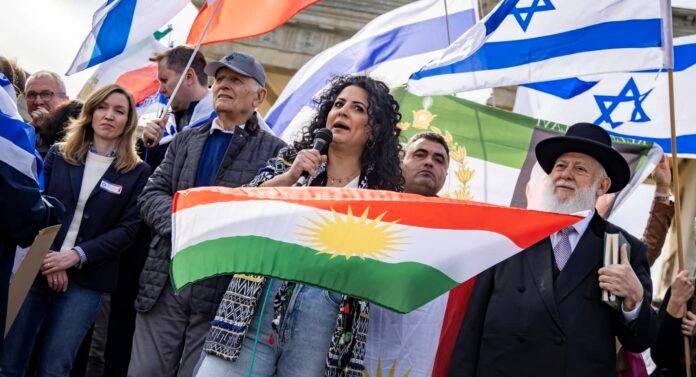
Photo: IMAGO/Emmanuele Contini via Reuters Connect.
Kurds and Israelis are natural geopolitical allies. Many Kurdish Jews in Israel feel deeply connected to their ethnic heritage and maintain cultural ties; the Kurdistan Regional Government in northern Iraq has also made tentative attempts to maintain cultural ties. But translating these perceptions of shared interests and shared cultural traditions into a political alliance has proven difficult.
According to a 2001 study by the Hebrew University of Jerusalem, this link is not just ancient but likely genetic. Jews have inhabited Kurdistan for nearly 3.000 years. They lived there in relative harmony with their neighbors and maintained Jewish schools and synagogues. Kurdish Jews spoke primarily Aramaic, but also borrowed words from Kurdish. Their community produced a distinctive form of “Mountain Judaism,” which included a famous female religious scholar, Osnat Barzani, and a unique Kurdish-Jewish holiday, Seharane.
On the eve of the founding of Israel in 1948, the number of Kurdish Jews ranged between 20.000 and 30.000, living mainly in the Kurdish region of northern Iraq. After 1948, almost all of them immigrated to Israel, leaving behind a rich cultural heritage. From 1951 to 1952, Israel carried out “Operation Ezra and Nehemiah,” airlifting Kurdish and Iraqi Jews en masse to the newly formed Jewish state. Only a few hundred Jewish families remain in Kurdistan today, while the vast majority of Kurdish Jews—now around 200.000—live in Israel, where they established some of the first moshavim (rural settlements) of the country.
Today, Israel's Kurdish Jewish community maintains strong cultural ties. Streets in Israel bear Kurdish names, popular Israeli singers of Kurdish descent sing in Kurdish, and Kurdish restaurants abound. Kurdish Jews gather in Israel for the Seharane festival and Kurdiyada, a three-day festival featuring traditional Kurdish food, music, dance, and the flag of Kurdistan. The community also operates the National Union of Jews from Kurdistan, the Israel–Kurdistan Friendship Association, Kurdish cultural centers, and a Kurdish Studies Program at Tel Aviv University, which hosted a Kurdish solidarity delegation from Germany in 2024.
In Iraq, the autonomous Kurdistan Regional Government adopted a minority rights law in 2015, recognizing Judaism as a protected religion and creating the first Jewish affairs representative in the Ministry of Heritage and Religious Affairs. The position was intended to represent the Kurdish-Jewish community and promote its rights, as well as protect Jewish heritage sites in Kurdistan. In 2016, the Jewish affairs representative organized the first Holocaust Remembrance Day ceremony in the Kurdish capital Erbil, attended by Kurdistan officials and Kurdish Jews. Reflecting on the event, Mariwan Naqshbandi, head of the Kurdistan Regional Government's Directorate of Religious Coexistence, spoke of the "duty of supporting the Jewish religion."
Despite this expression of support, few vestiges of Jewish life in Kurdistan remain. The Erbil Education Museum has a room dedicated to Daniel Kassab, a famous Kurdish-Jewish artist, and the Kurdish Heritage Museum in Sulaymaniyah has a “Jewish Collection” with some artifacts. Otherwise, the former Jews of Kurdistan can only be traced spiritually in the scattered archaeological sites where ancient synagogues, tombs of biblical figures, Jewish neighborhoods, and cemeteries once stood. Even the position of spokesman for Jewish affairs is said to no longer exist.
Today, Kurdish-Jewish cultural exchanges take place mainly within the framework of Kurdistan–Israel relations. A Jewish Alliance for Kurdistan (Jewish Coalition for Kurdistan) emerged in 2017 with the aim of strengthening the relationship between Jews and Kurds worldwide, as well as diplomatic relations between Israel and Kurdistan. Its board of directors includes the director of the Kurdish Studies Program at Tel Aviv University, Dr. Ofra Bengio, and Israeli Foreign Minister Gideon Sa'ar.
Sa’ar began his term as foreign minister by calling the Kurdish people “a natural ally” of Israel. In his first speech at the Israeli Foreign Ministry last year, Sa’ar explained that “in a region where we will always be a minority, the natural alliances will be with other minorities.” He stressed the geostrategic importance of an alliance with Iraqi Kurdistan, which borders Iran and Turkey – Israel’s regional rivals. The Kurds are seen as a bulwark against these common threats. Sa’ar also identified Kurdish minorities in Lebanon and Syria as potential allies.
Israeli–Kurdish political ties were forged in the founding years of the state of Israel. The Kurds were recognized as a strategic ally under Prime Minister David Ben Gurion’s “periphery doctrine,” under which Israel sought alliances with non-Arab actors in the Middle East’s periphery (including Turkey, Iran, and Ethiopia). Israel supported the Iraqi Kurds in their conflict with Baghdad, trained and equipped Kurdish Peshmerga fighters, and even helped create the Kurdish intelligence agency, Parastin. In 2014, Israel reportedly delivered humanitarian aid to victims of ISIS in northern Iraq, while some Israeli oil imports in 2015 were traced to Iraqi Kurdistan.
The Kurdistan–Israel alliance reached its peak in September 2017, ahead of the Kurdistan Regional Government's referendum on independence from the Republic of Iraq, when Israel became the only country in the region to officially support the establishment of a Kurdish state. Jewish Kurds in Israel rallied in support of the referendum, waving the Kurdistan flag in the streets of Jerusalem and hoping that an independent Kurdistan would form formal ties with Israel. The Israeli flag could also be seen at pro-independence rallies in Erbil and other cities in Kurdistan.
Following the referendum, the Israeli-Kurdish lobby group in the Knesset hosted an event titled “Kurdistan and Israel: Together for Peace and Stability in the Middle East.” Subsequently, legislative initiatives in the Israeli parliament sought to facilitate travel between Tel Aviv and Erbil and to recognize the genocide of the Yazidi Kurds. There have also been efforts to recognize the 1988 Halabja massacre and the Anfal campaign—the “Kurdish holocaust” perpetrated by Iraqi dictator Saddam Hussein—as genocide.
Despite these long-standing cultural ties and timid political processes of rapprochement, Kurdish-Israeli rapprochement has been obstructed by the governments of Iraq, Iran, and Turkey. In 2022, Baghdad made it a criminal offense for Iraqi citizens, including those in the Kurdistan Region of Iraq (where Kurds hold Iraqi passports), to have any connection with Israel. Violations of the law are punishable by life imprisonment or even death, severely restricting the Kurdistan–Israel connection. At the same time, Tehran has instrumentalized this relationship to delegitimize aspirations for Kurdish independence. Iran has presented initiatives such as the “Abraham Peace Corridor” (Abraham Peace Corridor) – a vision of regional integration that would strengthen cooperation with Kurdistan – as a Zionist plan for colonial expansion. In 2024, Iran’s Islamic Revolutionary Guard Corps fired ballistic missiles at Erbil, killing civilians, while claiming – falsely, according to Baghdad and Erbil – that they had targeted an Israeli “spyware store.”
In Turkey, the idea of Kurdish-Israeli cooperation remains politically explosive. Turkish nationalists and Islamists have described Kurdistan as a “second Israel,” another Western-backed dismemberment plot. In September 2017, tensions in Ankara escalated when the Israeli embassy was evacuated amid protests by supporters of the ultranationalist Homeland Party, who sought to portray the Kurdish independence referendum as a Zionist project. Utku Reyhan, the Homeland Party’s secretary general, denounced the referendum as “a declaration of war by American imperialism and Israeli Zionism against the region,” portraying Kurdish self-determination as a direct extension of Israel’s regional ambitions. Ankara has promoted this conspiracy by characterizing the Kurdistan Workers' Party (PKK)—which is currently disarming after decades of Turkey-PKK conflict—as a "subcontractor" of Israel.
Israeli-Kurdish ties have also resurfaced in Syria’s post-Assad transition. Issues of minority inclusion—particularly Kurdish participation—have again been complicated by fears of Israeli influence. Ilham Ahmed, co-chair of the Kurdish Autonomous Administration of Northern and Eastern Syria, told Israeli media that “the Middle East crisis demands that it be understood that without the role of Israel and the Jewish people, there will be no democratic solution for the region.” Although President Al-Sharaa has pledged to form an “inclusive transitional government that reflects the diversity of Syria,” his administration has been criticized for excluding Kurds and other minority groups. The Israeli government has responded by supporting international aid to the Syrian Kurds — emphasizing their critical role in the fight against ISIS, providing the Syrian Kurds with “positive guarantees,” and calling on the new Syrian leadership to ensure the rights of the Kurds.
The war in Gaza has further tested this relationship, forcing Kurdish leaders to strike a careful balance between condemnation and compromise. Since October 2023, Kurdish leaders have condemned the Palestinian suffering in Gaza while simultaneously advocating a ceasefire and a negotiated settlement. At the start of the war, the President of the Kurdistan Region, Nechirvan Barzani, warned against “getting dragged into regional conflicts” and reiterated that “our belief is that a two-state solution is the most appropriate settlement.” As the war dragged on, this balancing act continued, underscoring Erbil’s preference for pragmatic diplomacy and distancing itself from political conflict.
In May 2025, the Prime Minister of the Kurdistan Region, Masrour Barzani, met with the Palestinian Consul General in Erbil and called for a “just and lasting solution.” The previous month, the Kurdistan Regional Presidency supported the initiative to recognize Palestinian statehood at the United Nations. Kurdish leaders have also cautiously engaged in external initiatives presented as diplomatic avenues for de-escalation. On September 30, 2025, President Barzani welcomed the US plan to end the war in Gaza, urging all parties to demonstrate a “spirit of compromise.” At the same time, Kurdish society remains divided between Islamist parties that strongly oppose the Israeli military campaign and those, mainly in the liberal urban communities of Kurdistan, who adopt a more neutral stance.
What the early leaders of the State of Israel and the Kurdish tribes of northern Iraq recognized 75 years ago remains true today: the Kurds and the Israelis are natural allies. Moreover, both maintain deep fundamental ties to the United States. However, it is also true that steps to publicize and implement a Kurdish-Israeli alliance endanger the Kurds, because it is perceived as a threat to Turkey, Iran, Syria, and Iraq. So while intelligence ties continue, a full alliance between these two peoples must await further steps toward a new regional order that the United States will bring about through its regional allies.
In the meantime, goodwill gestures from both sides are welcome – the Kurdistan Region should restore the position of the representative for Jewish affairs, Israel should reinstate legislation recognizing the genocide of the Yazidi Kurds – and can keep the prospect of a future alliance alive in the two societies.
 Avraham Spraragen
Avraham Spraragen is a Middle East specialist at the organization Young Professionals in Foreign Policy and a student at Georgetown Law School.
 Binar Faeq Karim
Binar Faeq Karim, a recent graduate of the University of Notre Dame, has written about Middle East politics and security issues for various American and European think tanks and media outlets. From 2014 to 2018, he worked as a freelance journalist covering the war against ISIS.