

THE FALSE CLAIMS ABOUT THE DICTATORIAL GOVERNMENT OF IOANNIS KAPODISTRIAS
THE FALSE CLAIMS ABOUT THE DICTATORIAL GOVERNMENT OF IOANNIS KAPODISTRIAS
By Evangelos Grivakos, Lieutenant General (retd) – Lawyer
Σon May 5, 2020, the Enausea Ecelebrations for the 200th anniversary of the National Rebirth "Greece 2021", posted on Twitterpart of an article in which its member and professor of Philosophy of Law and Theory of Institutions at the University of Athens, Aristides Hatzis, supported the view that: "Ioannis Kapodistrias, by suspending the Constitution of Troezen, effectively declared a dictatorship in Greece and this marked the end of the Greek Republic. However, the democratic and liberal Greeks did not give up, they continued to fight for democratic rights[…….] and in 1844 they managed to make Greece the first state in the world to establish universal male suffrage[….]".
ΌWhen Kapodistrias took over the Administration, the Country was in a state of disintegration without a state apparatus and the Revolution was in danger of failing. Ibrahim controlled a large part of the Peloponnese and Central Greece was still occupied by the Ottomans. The solution of a man capable of assuming the government was considered necessary and salutary. And as the most suitable he was chosen by the Greek State Ioannis Kapodistrias, originally from Corfu, a politician and diplomat of European prestige.
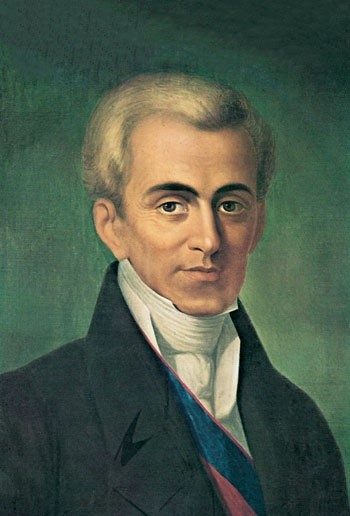
Ioannis Kapodistrias (1776-1831) |
Η Kapodistrias was elected as the first Governor of Greece on 3 April 1827, by the Sixth Resolution of the Third National Assembly of Troizina, with a term of seven years. On 9 Jan. 1828, he arrived by English ship in Aegina, the temporary capital of Greece, and was received with enthusiasm by politicians and the people. Three days later, he took over the government from the "Anti-Government Committee" (official government) with Provoulos (leaders) G. Mavromichalis, I. Milaitis and Giannoulis Nakos.
ΤAt that time, the Political Constitution of Greece or the Constitution of Troezen was in force, the third in a row of the Revolution, which had introduced a more liberal system than the previous ones since it provided for the functioning of a Parliament and guaranteed the rights of citizens, but was also governed by oligarchic elements. It stipulated, for example, that the elections to elect the Parliament from which the Government was elected had to be held by electors drawn from second and third class dignitaries who were led in their votes by the powerful landowners of the time, with the result that the will of the few was imposed…democratically.
ΣKapodistrias' goals were the creation of an independent state, territorially expanded and with a strong internal organization. However, he considered that for their success it was necessary that, in addition to the Executive, he also assume the Legislative power that was exercised exclusively by the Parliament, without himself having the right to dissolve it, except for the exercise of a suspensive veto on its decisions. In particular, according to the provisions of article 73, the Parliament had the authority to draft Bills and refer them to the Governor who was entitled to return them up to two times, but on the third time he was obliged to ratify and publish them as laws of the State. More simply, the exercise of power remained almost entirely with those who had called him to govern, rather than with Kapodistrias himself (!!).
ΤThis political problem was solved in a completely democratic way. Kapodistrias declared to the Parliament and the other powerful factors that the condition for him to remain in power - or to leave Greece - was that he also assume the Legislative power. Therefore, the operation of the Constitution had to be suspended, the Parliament had to dissolve itself and, in its place, the creation of an Advisory Council, symbolically called the "Panhellenic", with a strength of 27 members.
Η The House unanimously accepted the Governor's proposals and in January 18 1828 passed the relevant Law valid until the formation of a new National Assembly which, according to Kapodistrias' promise, would emerge from the elections of April of the same year and would amend the Constitution, based on the agreed changes. On January 23, a Resolution was issued by the Parliament for the establishment of the new form of the Council of Ministers, with exclusive responsibilities for foreign affairs, shipping and trade, under the supervision of Kapodistrias. Three days later, the Secretary of State Spyridon Trikoupis announced to the Greek people the temporary assumption of power by Kapodistrias "with unlimited rights of an elected Monarch and all authority over every sector of his Administration."
Σtherefore, desworn and no defactoThe Constitution was suspended. Keeping in mind the proportions, it would not be inappropriate to claim that the new Government was a kind of "Presidential Democracy" of today, but in no way a Dictatorship.
ΣOn 6 July 1827, the first major diplomatic success was achieved, which formed the basis of Kapodistrias' foreign policy. The Protectorate Powers of England, Russia and France signed the Treaty of London, which recognized the relative autonomy of Greece under the rule of the Sultan. The State then included only Argonauflia in the Peloponnese, Megaritis in Attica and the islands of Euboea, Hydra, Spetses and the Cyclades.
Η The establishment of the new system of government provoked strong reactions from the so-called "constitutionalists", which are listed in Twitter as "liberal democrats". These, either as individuals with strong financial backing (landowners, shipowners, big bourgeoisie, politicians) or as organized groups (Mani, Hydra, Ermoupolis), grouped around the English and French parties (led by Alex. Mavrokordatos and Ioannis Kolettis, respectively), constituted the main opposition against Kapodistrias, whose followers were supporters of the Russian party. Their virtual pursuit was considered to be the overthrow of the Regime and the restoration of the Constitution of Troezen, and their real pursuit was the extermination of Kapodistrias and the restoration of their affected economic, social and political interests.
Η The concentration of powers in his person allowed Kapodistrias to immediately begin his work to eliminate piracy and address the major fiscal and economic problems of the country. As head of the Army, he transformed the irregular armed units into a regular army (militia, centurions, etc.), founded the Cadet School in Aegina, the General Training Center for Army and Fleet Supply, etc.
Η The 1828 campaign in Central Greece under Dim. Ypsilantis, the English General Charles and Augustine Kapodistrias, the Governor's brother, was successful and contributed to the liberation of the eastern part of it and the consolidation of the Governor's position. Certainly the operations would have continued if there had been no disagreements between the Great Powers.
The The elections that Kapodistrias had promised for April 1828 were cancelled due to the conflicts, but took place in the spring of the following year, 1829, when the Peloponnese and part of the mainland had been liberated. It is noteworthy that during these elections – which for the first time since the beginning of the History of the Revolution were held without civil strife – after Kapodistrias' intervention in the Panhellenic Assembly, the Principle of universal suffrage was implemented and no one was deprived of their legal right to vote, in all regions of free Greece. Therefore, the claim of Professor Aristides Hatzis that the above Principle was first established in Greece in 1844 by the liberal constitutionalists is considered inaccurate.
Η The Fourth National Assembly, which emerged from the elections, met in Argos in early August 1829, approved Kapodistrias' work and authorized him to continue the negotiations for independence, subject to its own acceptance. By this Decision, the Panhellenic Assembly was replaced by the Senate, with 27 members and increased legislative powers of an advisory nature. This was a decisive opening by Kapodistrias towards the smooth functioning of democracy.
ΛA few days after the end of the Fourth National Assembly, on 12 Sept. 1829, the Greek Revolution ended with the Battle of Petra, in the straits between Livadia and Thebes, where the retreating Turkish troops from the Peloponnese and the mainland under Aslan Bey were defeated by the forces of Dim. Ypsilantis. After their defeat, the Turks signed a capitulation by which they accepted to evacuate all of Eastern Greece, except for the Acropolis of Athens and the fortress of Karababa, in Chalkida.
H The political victory in the Fourth National Assembly and the military victory in Petra gave new impetus to Kapodistrias to continue his work in all areas of activity. The following are indicative: Improvement of the tax system, legal organization of the merchant navy, division of the country into 13 geographical sections, establishment of an organization of courts, educational institutions, agricultural education schools, ecclesiastical schools, customs, post offices, etc. Despite this, the intensification of the contradictions of the Great Powers and party passions made the said work very difficult, with the opposition constitutionalists increasing dangerously.
ΣOn 22 February 1830, the Great Powers, again at the initiative of Kapodistrias, signed the London Protocol, by which the Greek state was recognized as sovereign and independent with borders up to the Acheloos-Sperchios line and was placed under the reign of Leopold of Saxony-Kaburg. Leopold did not accept the throne, influenced by Kapodistrias who made it clear to him that they would come into conflict with the Greek Assembly, which would not accept him because his election had taken place in absentia.
Η The cancellation of Kapodistrias' removal strengthened the opposition against him, which now began to move insurrection, instigated by French and English politics. His attempts to ally himself with the factions of the constitutionalists, even invoking his appreciation for their valuable services during the Revolution, failed completely, following their reluctance to resign in favor of the state of their personal interests. Some of his opponents were: The Hydraeans and the Maniates, the scholar Theoklitos Farmakidis, the poet Alex. Soutsos, Adam. Korais from Paris, the merchants of Syros, and Tsamis Karatasos, who rebelled in Amfissa but failed and fled to Mani.
Η Hydra was the naval center of the rebels under Kountouriotes and Sp. Trikoupis. When Kapodistrias, in order to confront them, blocked the port with the Army and the support of the Russian Admiral Ricord, they sent Miaoulis to Poros as a distraction, who occupied the Naval Station and placed Kanaris under confinement. On July 24/25, 1831, the Hydra ships attempted in vain to leave the port, spirits became sour and then Miaoulis, on the 1η On August 11, he carried out the unholy act of blowing up the frigate "HELLAS", flagship of the Fleet, docked at the Naval Station, and other smaller seaworthy ships, and then escaped to Hydra.
ΣMani, the Mavromichalis had already rebelled for some time. Petrobeis Mavromichalis, then under surveillance in Nafplio, requested permission to travel to Mani. The permission was not granted, Petrobeis tried to escape by ship, was arrested in Katakolo by Kanaris and imprisoned in Akronafplia (Its-Kale), accused of taking a stand against the regime. His detention was one of the reasons for the assassination of Kapodistrias by the Mavromichalis Georgios and Konstantinos, son and brother, respectively, of Petrobeis, on the morning of Sunday, September 27, 1831, outside the Church of St. Spyridon, in Nafplio.
The supreme ethos of an idealistic Leader
ΑThe role of the Allies in the assassination remains unclear even today. In 1840, Petrobeis Mavromichalis, addressing a certain medical philosopher Pyrrhus who was accusing Kapodistrias, said to him: «You don't count well, philosopher. Damn the English and French who were the cause, and I lost my own people and the Nation a man who will never be found, and his blood torments me to this day.». AndAugustine Kapodistrias,in a conversation with the philhellene historian Friedrich Shots addressed him : "Yes, sir, it was France and England who murdered my brother."
ΜAfter the assassination of Kapodistrias and until the arrival of Otto in Greece in early January 1833, a "Period of Anarchy" prevailed. The constitutionalists were unable to govern the country peacefully and "liberally" due to conflicts both among themselves (Kolettis versus Zaimis) as well as with the government officials, Kitsos Tzavelas in Patras and Theodoros Kolokotronis in the center of the Peloponnese. Greece returned to the pre-Kapodistrias era that brought it back to the brink of disaster. On June 10, 1831, Kapodistrias wrote in a letter: "As long as the present generation exists, the prominent, united by passions and interests, will paralyze and scheming any order of things, they will never support, and worst of all, they will never create a Government." It is, of course, unnecessary to emphasize the tragic nature of the verification of this "prophecy".
ΑFrom the historical documents cited, it does not appear that Kapodistrias ruled Greece dictatorially. Because he neither seized power by force nor did the People reject him, but, on the contrary, placed their hopes in him for liberation from cachexia and Ottoman slavery. And if as Governor he temporarily suspended the Constitution of Troezen, he did so because the Country was in what we call today a "state of siege". It is worth mentioning that the constitutions of modern democratic states also provide for the suspension of important articles in order to deal with similar situations (cf. also article 48 of our own Constitution). It is, therefore, a historical mistake to characterize as "tyrannical" a system of government that laid the foundations of the structure and organization of the modern Greek state.
ΌAs for Kapodistrias' constitutional opponents, their behavior was not as "liberal" as presented by Professor A. Hatzis, who, as a member of the Center for Liberal Studies (Ke.Fi.M.), clearly knows that liberalism is directed towards a lifestyle that supports and promotes the freedom of the individual at an economic, social and political level, so that his various needs are met as much as possible and his dreams are realized. However, these ideas were blatantly violated by the constitutionalists. They believed that they had the right to rule the Homeland as they pleased and to use the Constitution and the Laws of the State as "tools" to serve their feudal interests, ignoring the freedoms and rights of the enslaved People. And whenever the opposition they exercised developed into massively violent acts (armed uprisings), Kapodistrias was forced to act dynamically, authoritarianly and in contradiction to his principles, using the repressive forces of the state. World history has taught that other leaders in similar circumstances have committed much worse and yet were not considered dictators. Quite the opposite, in fact.
Η The controversial post sparked a storm of public reactions. Many were those who reasonably wondered how the Committee would promote, during the upcoming celebrations, the personality and work of Kapodistrias when it had previously insulted his memory by accepting the censure and characterization of him as a dictator, two centuries after his time.
ΑThe mission and duty of the Committee is to organize and conduct celebratory events to highlight internationally the ideology and glory of the Greek Revolution through the achievements of its Heroes and without, of course, omitting mention of their sufferings and shortcomings, but only as examples to be avoided and not as means of falsifying History.
Η Violation of this mandatory ethical rule will disqualify the Commission, expose the Country abroad and divide the Greek People, possibly provoking strong reactions from them. In addition, it risks confirming the already formed public opinion that it is acting in favor of anti-Hellenic decision-making centers that aim to annihilate Hellenism by insulting its History, Language and Orthodox Religion.
ΕIn conclusion, we Greeks should not forget that in 2023, Turkey will celebrate the 100th anniversary of the creation of the Turkish state and that its propaganda is lurking Greek slippages to consolidate its theories about the "Blue Homeland", as a geopolitical term meaning the revival of the Ottoman Empire with the modern Turkish state as its successor and with Greece under its rule, as a Protectorate. Our duty is, therefore, to prevent the evil intentions of the treacherous neighbor with unwavering unity, vigilance, reasonable patriotism and positive energy in all sectors, not excluding the celebrations of 2021.
Indicative bibliography
- K. Kokkinos. History of Modern Greece, vol. 1.
- Newer Encyclopedic Dictionary HELIOS, vol. 10.
- Konstantinos A. Vakalopoulos. Modern Greek History 1204-1940, p.138 ff.
- Christos G. Angelomatis. History of the Greeks, vol. 2.
- Historical data from the Internet.