

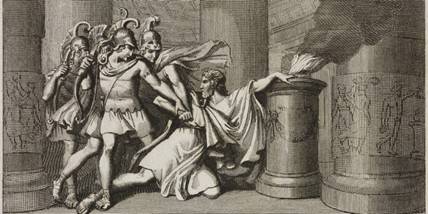
The ancient origins of oligarchy.
The ancient origins of oligarchy
The conflict between democracy and oligarchy in classical Greece was fierce, with oligarchic regimes relying on cleverly designed political institutions to bolster regimes that lacked popular support. As concerns about the “power of the few” intensify in the United States, Americans should consider whether their own institutions are doing the work of the oligarchs.
PRINCETON — In the fall of 403 B.C., democracy triumphed in Athens. It was a hard-fought victory. The twenty-seven-year conflict with Sparta, known as the Peloponnesian War, had ended the previous year with the surrender of the besieged Athenians. The city was then seized by an authoritarian regime known as the Thirty, which, despite its proclamations of “virtue” and “justice,” soon executed more than 1.500 people.
This outbreak of violence inspired a democratic resistance movement , which included working-class metics and slaves. After nearly a year of civil war, the revolutionaries prevailed —a remarkable moment of restoration of democracy that still resonates today. To celebrate their victory, they offered a sacrifice on the Acropolis in honor of the city's patron goddess, Athena.
But away from the festivities, a very different kind of commemoration was taking place. The remaining members of the Thirty were erecting a monument in honor of their dead leader, Critias. An elder relative of the philosopher Plato, Critias was an intellectual, poet, and political theorist who was fiercely opposed to the city’s democracy . He had led the Thirty until his death in battle earlier that year.
To pay tribute to Critias and the entire anti-democratic movement, his followers erected an elaborate marble tombstone. A carved relief depicted a fierce young woman brandishing a torch and setting another woman on fire. The inscription read:
"This is the monument of virtuous men, who for a while restrained the indignity of the cursed Athenian people."
According to an ancient Greek commentator, the woman holding the torch was Oligarchy personified . Her victim was Democracy.
The sworn enemy of Democracy
No trace of Critias’s tombstone has survived, and the only reference to it is in a marginal note in a manuscript. Some scholars have understandably questioned its existence. Such a subversive object, they argue, would surely have been constructed in secret, which raises the question of how anyone could have recorded its contents. Perhaps it is a kind of ancient fan fiction.
However, whether real or invented, the monument encapsulates an important political phenomenon of classical Greece: oligarchy, that is, "the power of the few."
The oligarchs considered themselves a select minority , distinguished by their lineage, wealth, manners, and superior education—characteristics that, in their view, made them fit to rule.
In a word, they were the “virtuous” of Critias’s inscription, in contrast to the unwashed majority —the demos—who lacked the education and judgment considered necessary for politics and whose misplaced priorities could only lead to hubris.
It was the duty of every right-minded member of the elite to stem the tide of ignorance by any means necessary. In ancient sources, the demos is often likened to a rushing river or a wave that floods everything; therefore, the image of the torch on the tombstone, which contrasts fire with water, may have been intentional.
If the oligarchic spirit embodied by Critias' monument seems extreme, this is because it reflects the sharpness of the conflict between democracy and oligarchy in classical Greece.
It is well known that, from the fifth century BC, Greek thinkers devised a simple but ingenious method of classifying states based on the number of those who held power. States could be ruled by one — tyranny —, by the few — oligarchy — or by the many — democracy.
What is less understood is that democracy and oligarchy quickly evolved into the two most common — and most violently contested — forms of government.
Writing in the fourth century BC, Aristotle observed in the Politics that "most regimes are either democratic or oligarchical."
It would not be an exaggeration to say that the choice between the two nearly tore the Greek world apart. Columbia University historian John Ma, in his recent history of the ancient Greek city, characterizes the period from about 460 to 360 BC as a “Hundred Years’ War” between democracy and oligarchy.
Much more than tyranny, oligarchy has been the great sworn enemy of popular government.
However, as widespread as it was, oligarchy never gained widespread popular support. The oligarchs did not constitute a political "party" that alternated with the democrats through peaceful transfers of power. Most regime changes were the result of a coup.
This was true even for the establishment of democracies. But while democracies, almost by definition, enjoyed the support of the majority of citizens, oligarchies often managed to survive despite their popular unpopularity.
The rules of the few
Ancient Greek oligarchies are a prime example of how skillfully designed institutions can keep even the most authoritarian regimes in power.
At first glance, the oligarchy was based on a property requirement , in order to ensure that only a minority of the population — possibly the wealthiest 10-15% of the male population with political rights — would have access to public office.
However, oligarchy also had a strong ideological and class dimension. As Aristotle rightly observed, oligarchy and democracy refer to the number of rulers, but in reality they imply the power of the rich and the poor respectively.
To maintain its power, the oligarchic “gentlemen’s club” implemented its classic strategy of “divide and rule.” Prominent opposition figures were integrated into the regime.
Publicly posted rewards for informants sowed doubt and discord among would-be conspirators. Movement into the city's central areas, where a protest could escalate and turn into a revolution, was strictly regulated.
And when the internal situation became turbulent, international allies intervened to restore “order.” The Spartans in particular were notorious for their interventions aimed at supporting and strengthening oligarchic regimes.
One set of institutions, then, faced the restless demos; another maintained tolerable relations within the ranks of the oligarchs themselves. Cooperation between these hypertrophic egos could not be taken for granted, even though their survival depended on it. If this sounds far-fetched, one only has to imagine a government composed entirely of the billionaires who flanked US President Donald Trump in his second inauguration.
Mark Zuckerberg, Jeff Bezos, Tim Cook, Sergey Brin, and Elon Musk may benefit from the existing order of things, but it is far from certain that they could work together long enough to maintain it.
Equipped with this institutional order, the oligarchy managed to survive for a long time. In the end, however, it could not resist the spread of democracy. This may come as a surprise: a common narrative—promoted by, among others, the framers of the United States Constitution —holds that the turbulent direct democracies of antiquity inevitably succumbed to demagoguery and disorder. The history of Athens itself, as recounted by the historian Thucydides, has been used to reinforce this view.
Modern scholars, however, drawing on new literary, epigraphic, and archaeological discoveries, increasingly agree that democracy neither began nor ended with classical Athens . In fact, during the third and second centuries BC, democracy may have been the most widespread form of government in the ancient Greek world.
They were celebrated in painting, coins, sculpture, and everyday speech as the best way to ensure freedom and equality for the free male citizen — even though slavery and gender-based exclusion were notorious features of ancient Greek regimes that defined themselves as "democracies."
Then, as now, almost no one spoke positively about oligarchy in public. In fact, Critias's tombstone, if it existed, would be the only recorded instance of an oligarchy depicted in art.
The trap of the strengthened majority
After a period of disuse, the word “oligarchy” made a strong comeback in the United States. It resurfaced on the political agenda in the 2010s, with the Occupy Wall Street movement and Bernie Sanders’ 2016 presidential campaign .
The term gained even wider circulation in January 2025, when former US President Joe Biden warned in his farewell speech about "an oligarchy of extreme wealth, power and influence, which literally threatens our entire democracy."
When people now hear the term, they are more likely to think of American tech tycoons than the Russian super-rich, who amassed their fortunes by seizing state assets in the 1990s.
In many ways, American society is ill-prepared for this moment. Despite the importance of oligarchy in Greek antiquity, from which so many of the political ideas of the United States derive, the issue was largely sidelined in the constitutional debates of the early modern era.
This is partly because the framers of the American Constitution shifted the terms of the debate from the “democracy versus oligarchy” confrontation to the confrontation between the rule of law and the tyranny of the majority.
In particular, the Federalists sought to downplay the loss of democratic power that could result from the integration of the individual states into the strong federal union they envisioned.
As many scholars have pointed out, the proposed Constitution of 1787 was far less democratic than many state politicians and citizens desired. However, in the first of the Federalist Papers , Alexander Hamilton assured readers that:
"A dangerous ambition more often hides behind the deceptive facade of zeal for the rights of the people than under the forbidden facade of zeal for the stability and efficiency of government."
In other words, what would lead to political instability was not a lack of democracy, but too much democracy.
As a result, the Federalists were somewhat on the defensive when attempting to extol the popular legitimacy of the Constitution. James Madison admitted in Federalist No. 38 that the most common charge against the text was that it would lead to monarchy or aristocracy. It seems that few feared that it was too democratic.
We can, however, draw from the Federalists themselves rhetorical arguments against the view that the U.S. Constitution was not intended to be democratic at all.
The claim that the United States is a "republic, not a democracy" continues to circulate, meaning that the decision of the majority should not necessarily prevail.
However, as Madison explained in Federalist No. 10 and No. 14 , what the term "republican" means in practice is primarily the use of representative rather than direct voting on legislation. In both cases, the method of counting votes is based on the majority principle.
In fact, in an indirect allusion to the oligarchy, Madison stated:
"If a faction consists of fewer than the majority, the solution is provided by the republican principle, which allows the majority to defeat its dark aspirations through regular voting."
Madison seems unable to imagine that a majority could be held hostage by a stubbornly intransigent minority.
Hamilton, while not necessarily a friend of democracy, also had harsh words for rules requiring a qualified majority, rather than a simple majority. In Federalist No. 22 he wrote:
"Granting a minority the right to veto the majority — as always happens when a decision requires more votes than a simple majority — tends to subordinate the will of the majority to the will of the few."
Such a system seeks to:
"To substitute the regular deliberations and decisions of a respectable majority for the desires, whims, or tricks of an insignificant, agitating, or corrupt clique."
And yet, the process that Hamilton disparaged is precisely the way the United States regularly shapes its policy today, through the use of the Senate's obstructionist mechanism, the so-called filibuster.
Two-fifths of the Senate, which may represent only about 10% of the total population of the United States, can block legislation through a de facto veto.
As long as this continues, America is essentially governed by an oligarchy, contrary to the express intentions of the Federalists — people who had no particular love for democracy in the first place.
The United States is facing unprecedented challenges. Beyond Trump's daily attacks on the rule of law, American society is being asked to decide how to manage, among many other issues, the rise of artificial intelligence, climate change, and rampant inequality.
Progress will require, at the very least, insistence on the fundamental rights of democratic majorities, as enshrined in the Constitution. Maintaining the status quo is tantamount to doing the work of the oligarchs ourselves.
In ancient times, the Oligarchy was depicted actively setting fire to the Democracy. Today, as the popular internet meme goes, the democrats sit inside a burning building of their own making and declare: “Everything is fine.”
 Matt Simonton
He has been writing articles for PS since 2026.
Matt Simonton is an associate professor of Classics at Princeton University and the author of Classical Greek Oligarchy: A Political History (Princeton University Press, 2017) and Ancient Greek Democracies (Cambridge University Press, 2026).