

THE EQUIPMENT AND THE "TOMORROW" OF THE GREEKS
The recent announcement of the twelve-year armament program of the Armed Forces (AF), worth €25.8 billion, combined with the effort to strengthen the domestic defense industry, constitute a necessary step for national autonomy and the ability to defend our vital national interests. Deterrent military power against the powerful Turkish threat requires further bold steps, given that of the aforementioned amount, approximately €11.5 billion will be allocated to already undertaken defense obligations.
Greece and Cyprus are facing a Turkish revisionist policy that has the will and the means to expand to their detriment. This policy is constantly confirmed by a series of provocations and threats that have placed Hellenism for decades in an informal hostage situation regarding the exercise of its sovereignty and sovereign rights. The arbitrary Turkish claims are summarized in the non-expansion of the territorial sea, the "Blue Homeland", "Gray Zones", demilitarization of islands, maritime zones, "national minority of Thrace", partition of Cyprus, etc. These claims are dynamic and force Greece to constantly postpone the exercise of its rights (e.g. expansion of territorial waters, hydrocarbon extraction, exploitation of islets, submarine pipelines and cables, marine parks, etc.). Fortunately, the submission of the maritime spatial planning to the EU (on the eve of the imposition of daily fines) is a significant positive development, since in addition to its development objectives, it reflects the official positions of the country (the Maniatis law of 2011 had preceded it) regarding the EEZ/continental shelf and becomes a community text.
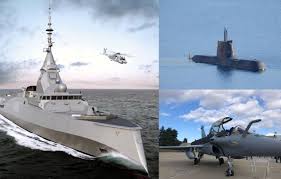
Key elements of the 12-year armament program are the "Achilles Shield" (anti-aircraft and anti-missile system), the F-35 aircraft, the acquisition of new Frigates (FDI and possibly FREMM), modernizations of F/A, submarines (S/B) and missile boats (S/C), the acquisition of new submarines, Black Hawk helicopters, F-16 modernization, electronic warfare (EW) and cyberwarfare systems, satellite systems, unmanned systems, weapons, ammunition, personal equipment, maintenance of equipment, etc.
The obvious current reinforcement of the Defense Industries is particularly difficult since they had been abandoned for at least 15 years. The almost exclusive investment in International Law and in external "protectors" not only leaves the country exposed to dynamic hostile claims in terms of power but also reduces its prestige and special diplomatic weight within the framework of its alliances. In any case, the answer to those who pose the pseudo-dilemma "butter or cannons" is that a healthy investment in the defense industry can constitute a fundamental national development pillar.
The recent visit of French Defense Minister Sébastien Lecorny was accompanied by the confirmation of very positive bilateral relations, the purchase of 16 EXOCET Block III C anti-ship guided missiles (K/B) (for the last two SUPER VITA class submarines), the order and 4th FDI F/C, as well as the possibility of creating a FDI F/C and submarine production line in Greece. It was also perceived that Greece is putting the right pressure on France in order to be present in the developments in the Eastern Mediterranean, not to sell the METEOR submarines to Turkey and, moreover, not to participate in the European security system, for obvious reasons.
The bilateral defense agreements with the US and France, the US military cooperation with Cyprus, the strategic agreements with regional states such as Israel, Cyprus, Egypt, the UAE and the utilization of the Greek diaspora, etc., are part of the positive and deliberate national moves. The current situation presents a series of strategic opportunities such as the 3 + 1 initiative, the Turkey-Israel hostility, the Turkish support for terrorism, the Chevron proposal for the utilization of submarine plots south of Crete (a practical cancellation of the Turkish-Libyan memorandum), the GSI electrical interconnection (an approved European project) and possibly the EASTMED submarine pipeline, as well as the EU rearmament with the relevant “escape clauses”. It is up to the government to seize these opportunities with rapid, coordinated and decisive moves, without "going along" with Ankara's current tactics (e.g. unilateral adherence to the "Athens Declaration" and "calm waters" in exchange for Turkish permission for any national movement in maritime areas) which offer it international "alienation" to exploit.
The wider Eastern Mediterranean region is characterized by fluidity, which is exacerbated by the competition between the US, China and Russia. Regional revisionist and destabilizing forces such as Turkey are encouraged. Hellenism needs a mature political system with cross-party strategic directions and consistent implementation, based on timetables and regardless of the change of governments. Existential and vital national issues such as demographics, migration, the Turkish threat and the Cyprus problem, defense and security, education, border areas, economic development, energy, technology and alliances do not belong to the field of partisan skirmishes and the time horizon must be national and not pre-election. Greeks must demand the policy that ensures autonomy, self-sufficiency and prosperity. Sometimes the risk of consumer prosperity cut off from History turns conscientious citizens into "couch" citizens. Within the framework of the anarchic international system, nothing is given away, while the timelessly vindicated Thucydides sets the limits of the application of International Law. Our fellow citizens must acquire a spirit, standards, values and a spirit of sacrifice. The catalytic role of education and the example of leadership are crucial for the acquisition of these social qualifications which are a prerequisite for the existence of a bold and ethnocentric political will, as well as strong Armed Forces.
17 – April – 2025
Vice Admiral (retd) V. Martzoukos PN
Vice President of EL.I.S.M.E.