

Germany's five evasions to avoid paying reparations
Germany's five evasions to avoid paying reparations
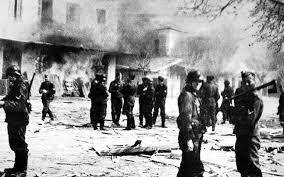
Despite being responsible for unprecedented crimes, the defeated Germany of World War II was generously favored by the victors. However, it did not meet its moral and contractual obligation to Greece to repay the forced occupation loan and pay the reparations due. It followed a delaying tactic. It postponed the satisfaction of Greek demands, regarding German reparations, after the unification of the two Germanys. When it took place, Berlin claimed that the matter was closed!
Η first German evasion is that the issue has been closed with the signature of Konstantinos Karamanlis in 1960 and the payment by Germany of 115 million marks. The truth is that in order to achieve the release of the executioner of the 54.000 Jews of Thessaloniki, Max Merten, who had been sentenced to 25 years in prison, the German government paid 115 million marks as compensation, which "Greek citizens persecuted from April 6, 1941 until the end of 1945, by organs of the German National Socialist regime for reasons of race, religion or opposition to the National Socialist worldview are entitled". That is, for compensation mainly for the Jewish victims of the Third Reich.
In order to avoid any misunderstanding, in a letter (part of the agreement) to the German Deputy Foreign Minister, the then Greek ambassador in Bonn, Thomas Ypsilantis, states: "(Greece) reserves the right, however, to present new claims arising from National Socialist measures of persecution during the war and occupation.". In other words, Athens has never renounced its claims, something that Germany also admits in its verbal response on 31-3-1967.
Paris Conference and 4+2 Treaty
Η second German evasion is that after so many decades, the Greek claims have lost their legitimizing basis. According to international law, however, crimes against humanity are not subject to statute of limitations. Especially for the homeowner loan There is a contract that binds Germany. It should be noted that Nazi Germany had begun paying the installments for the occupation loan.
The issue of reparations was raised by the Greek side at the Paris Conference (late 1945-early 1946). The conference had determined the approximate amount of reparations to Greece at 7,5 billion dollars. The London Agreement of 1953 did not forgive Germany's war reparations debts. It simply froze them until a peace treaty was signed between the defeated and the victors of World War II, so that Germany could recover economically.
After the reunification of Germany (31-8-1990) with the signing of the “2+4 Treaty”, the obstacle has disappeared. All the more so since the defeated country of the war is the strongest economy in Europe. Berlin, however, reverses reality and invokes the “2+4 Treaty” to evade, arbitrarily claiming that the issue of reparations has generally been closed.
If the issue of compensation had lost its legitimizing basis and was closed, why in May 2013 did the German Ministry of Finance, under the signature of Schäuble, undertake to provide additional compensation to Jewish survivors of the Holocaust? The Jews were given 772 million euros for medical care, as well as a pension for the rest of their lives of 300 euros per month! It should be noted that in 2000, the Schröder government had also compensated hundreds of thousands of hostages who had testified in Nazi camps.
The Hague decision
Η third The German evasion is that the decision of the International Court of Justice in The Hague in 2012 definitively closed the issue of compensation. The truth is that that decision recognized immunity from jurisdiction, but it does not state anywhere that the compensation is unfounded. On the contrary, it recognizes that the issue is not time-barred and that it constitutes an interstate dispute, for the resolution of which it urges states to cooperate.
We recall that that trial concerned the attempt of the residents of Distomo to obtain compensation through a decision of an Italian court. In other words, it concerned claims of private individuals and not of the Greek state. In October 2014, in fact, the Italian Constitutional Court ruled that immunity from jurisdiction does not apply when it comes to crimes against humanity. Also that citizens can raise individual claims against the state. This decision of the Italian judges opens new paths for the vindication of the victims of Nazism.
Η Wednesday German evasion is political and not legal. It tries to attribute the Greek claims to the crisis and in particular to an attempt by Athens to offset the reparations with the debts to Germany. It is true that, under pressure from German diplomacy, the Greek governments relented. However, none of them renounced them. If this had happened, Berlin would, of course, have produced the relevant document.
The reintroduction of the issue of the occupation loan and compensation by the Tsipras government in 2015 may coincide with Greece’s negotiations with the Eurozone, but Athens never linked these two issues. The fact that the same government, after signing the 3rd Memorandum, shelved the issue so as not to upset Berlin means nothing on a legal level. It simply shows how SYRIZA perceived this case and of course gives us reason to suspect that its agitation shortly before the 2019 elections was of a pre-election nature.
German reparations – Calculation
Η Thursday German evasion is unfounded to the point of ridiculousness. They claim that the EU funds that Greece received from the EU are a form of compensation! The EU funds are, of course, not German money and do not have the slightest relation to compensation for Nazi crimes. That is why EU funds were also received by member states that did not participate in the war, such as Spain and Portugal. The obvious is also confirmed by the Commission's response in 1995 to a relevant question by the then MEP Alavanos.
Berlin's latest attempt to present a new argument came from a leak to the newspaper Die Welt. According to its report, in file number R27320 of the (German) Foreign Ministry there is a document that acknowledges "German debt balance of 476 million... However, this is neither a loan nor a credit, but simply an amount that has been calculated»!
Especially after the collection and classification of all official documents related to the occupation loan and all kinds of compensation, the Greek claims are not only morally strong, but also legally substantiated. What must be determined through bilateral negotiations is the amount of Germany's debts, on the one hand due to the occupation loan, and on the other hand due to compensation. The State General Accounting Office Committee on the occupation loan estimates the amount of German debt at 11 billion euros.
The estimate was considered too low, since according to other rather modest calculations the amount of the debt is around 60 billion euros. The calculation, however, is a matter for a later phase. First, Berlin must be forced to recognize its debt and then negotiate its amount. The same applies to all kinds of compensation, the amount of which is estimated to be well over 100 billion.
“Primarily a moral issue”!
The decision of the Multi-Member Court of First Instance of Livadia (1997) on compensation for the residents of Distomo, which was ratified and made final by the decision of the Plenary of the Supreme Court (2000), opened the way for private claims and brought the broader issue of Greek claims back to the fore. Since then, however, we have changed both the phase and the field.
The ball seemed to be slipping out of the hands of private individuals in 2015 and the state was taking over the case. At least that was what the Tsipras government's declarations showed at the time. His statement to Merkel, which was primarily a moral issue, however, very quickly left a bitter taste. However, it did not change the strength of the Greek claims in the slightest.
The neocolonial Greek-German cooperation pact signed by George Papandreou and Angela Merkel in May 2010, which allowed German Undersecretary Fuchtel to thrash Greece, was certainly not the way to purge the Nazi past. Nor, of course, was the “German-Hellenic Fund for the Future” (with a budget of just 1.000.000 euros!), the goal of which was – according to the German ambassador Peter Schoof himself – “the search for appropriate actions to process the past»! In other words, his goal was to finance the rewriting of history…
This is so that we don't forget the unbearable German hypocrisy, which is greatly facilitated by successive Greek governments.
Slpress.gr