

Pantelis Steph. Athanasiadis: The “speared Gospel of Samothrace”
The "speared Gospel of Samothrace" is directly related to the Holocaust of the martyred island of the northeastern Aegean, during the Revolution of 1821.
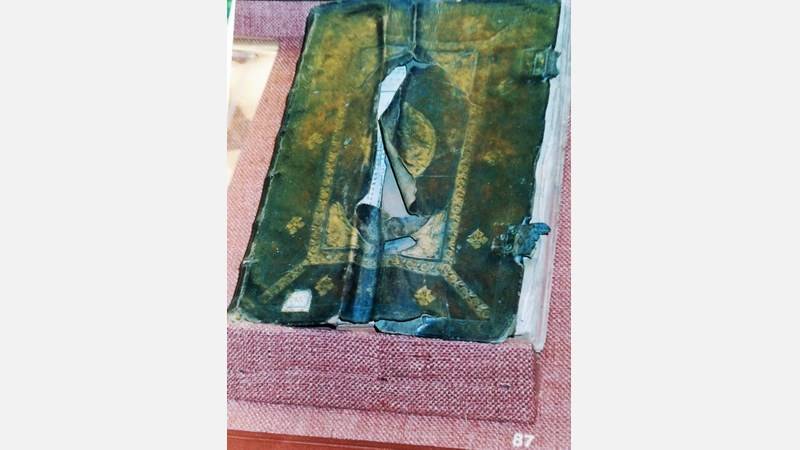 | |
| The “Speared Gospel of Samothrace” as exhibited in Parliament in 2000 |
I am sure that most of my fellow Thracians did not happen to see the so-called "Speared Gospel of Samothrace» which is a valuable object in the collections of the National Historical Museum. But it is in reality a priceless memento of the sufferings of Thracian Hellenism.
The "Speared Gospel of Samothrace" is directly related to the Holocaust of the martyred island of the northeastern Aegean, during the Revolution of 1821.
In summary, the events: The people of the Filiki Eteria had mentally prepared the inhabitants of Samothrace for the national uprising that was coming and they were all determined. Thus, the Samothracians rebelled in August 1821, refusing to pay taxes.
However, on September 1, 1821, the so-called "protostavrinia" in the local idiom, the Turkish fleet under Rear Admiral Kara-Ali landed on Samothrace (s.s. is what later in June 1822, the arsonist Konstantinos Kanaris blew up along with his flagship). Immediately the work of massacre and plunder began. Several thousand men and boys were slaughtered. The women and children were sold in the slave markets of Constantinople and Smyrna. Their houses were burned. The island was deserted.
Then, amidst the chaos, some Turkish soldiers entered the church of Chora, where the priest was officiating. Apparently, they executed him and, in addition, someone speared this historic Gospel.
Seven hundred of the inhabitants who had survived by taking refuge in the mountains were finally persuaded by the Turks to come forward because they were given the impression that they would be pardoned and their lives would be spared. However, in the location of "Efkas" in the island's capital, Chora, they were all murdered.
The few residents who survived, hiding in the mountains, began, when the Kara-Ali forces left, to bury the dead and collect whatever objects could be salvaged. This is how the "lanced Gospel" was collected and preserved for many years as a sacred relic.
The folk muse bitterly sang this event with an obituary:
"Today is Tuesday and Easter Sunday.
Where the Turks spoiled us with dogs,
They took the heads and left the bodies,
They filled the alleys and all the narrow streets."
Ionos Dragoumis' work "Samothraki" testified to the Holocaust, referring to the bloody event, as well as to the "lanced Gospel" of the church of Panagia in Chora, which is kept in the National Historical Museum.
 |
| Ion Dragoumis |
The intervention of Ionos Dragoumis
Many years later, after the collapse, in 1905, Ion Dragoumis was appointed consul of Greece in Dedeagats. He visited Samothrace many times, was fascinated and wrote the book "Samothrace" which he published in 1909. In this book, he also makes reference to the "lanced Gospel of Samothrace".
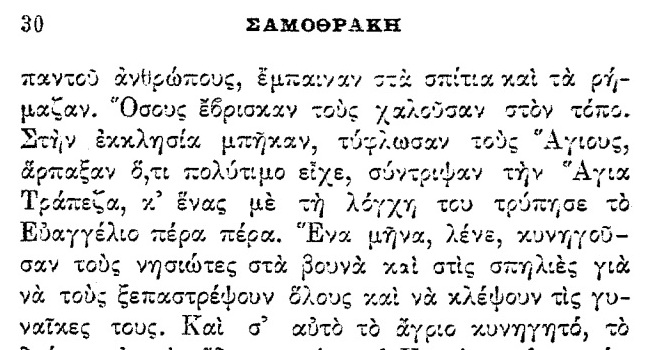 |
| The excerpt from Dragoumis' book about the "speared Gospel" |
At the same time, Dragoumis convinced the Samothracians and they granted him this relic, which he sent to Athens to the Historical and Ethnological Society of Greece, which included it in the collections of its Museum, located behind the statue of Theodore Kolokotronis on Stadiou Street.
Indeed, in the Museum's archives today there is this historical Gospel and Dragoumis' accompanying letter written with pen and purple ink.
The Gospel was exhibited in the year 2000 at the major exhibition organized by the Parliament (chaired by Apostolos Kaklamanis) to celebrate the 80th anniversary of the incorporation of Thrace into the Greek state, after approximately 600 years of slavery. It was given the number 87 as exhibit.
What is this Gospel after all?
This Gospel is not just a religious book that was associated with a dramatic historical event. And in itself today, without its religious and historical character, it is a very rare book, printed in the famous printing house of Nicholas Glykis in Venice in the 17th century.
Nikolaos Glykys from Ioannina was an illiterate Epirote who emigrated to Venice in 1647 and initially engaged in trade. In 1671 he founded his printing house and began publishing Greek religious, scientific and literary books. This printing house was the longest-running Greek printing house and existed as the printing house of the Glyky family until 1832. Historical scholars rank Glykys as the eighth Greek printer in Venice.
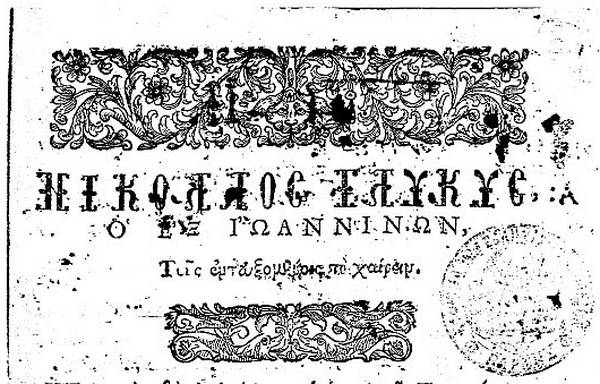 |
| From the preface of a book by the Printing House of Nikolaos Glykeos from Ioannina. This is a copy of the book "Katechitikon" by Saint Theodore of the Studites. (edition 1676) which belongs to the Library of the Philekpadeutikos Society Adrianople, which exists today in Nea Orestiada |
The photograph of the “Lion-Worn Gospel of Samothrace” is by Savvas Stathakis
Source: Blog MODERN GREEK HISTORY (sitalkisking.blogspot.gr)