

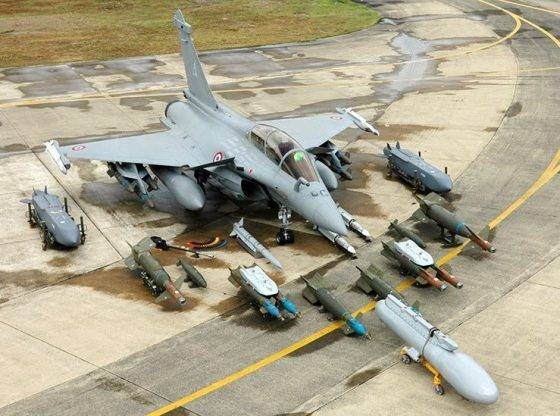
RAFALE. "Gushes" of air superiority in the Aegean!!!
On the occasion of the delivery of the 24th Rafale F3R aircraft to our Air Force, I considered it appropriate to write this article, with the aim of presenting this particular fighter and its capabilities, so that the reader can become better acquainted with the new acquisition of the Greek Armed Forces. With the aim of knowing both where their money is going and how important this weapon system is and at the same time a power multiplier of the deterrent capacity of our Country. Let's take things in their natural order, making a small, but necessary historical review of the presence of the "French wings" in our Air Force and what they have offered us, all these years.
The history of Greek-French cooperation in the field of military aviation, from its birth to the Asia Minor Catastrophe.
The presence of French aircraft in our Air Force began in 1912, when the newly established PA received its first aircraft from France, which was a seaplane and remained in service for one year. This aircraft was a reconnaissance aircraft, type "Astra Hydroplane", named "NAUTILUS" and was used as an air bag reconnaissance aircraft, naval cooperation and was withdrawn in 1914. The cooperation with the French continued in the following years with the purchase of other aircraft, such as Blériot XI in 1912, Nieuport 4 in 1912, Pelterie REPΝ in 1912, Farman HF.III in 1912, of this type the PA purchased 4 aircraft, Farman HF.XX in 1912, two aircraft. the Farman MF VII 1912, four aircraft, the Farmana MF VII bis hydravion and in 1914 the Farman HF.XXII. All were reconnaissance aircraft, for military cooperation, except for the last two types which were reconnaissance, for naval cooperation. The first major delivery of bombers to our Air Force was the French Breguet 14, of this particular type Greece supplied 52 units, which carried two 0,303 inch machine guns as armament and had the ability to transport to the drop field, bombs, externally released, up to 300kg. In 1918 Greece proceeded to the first purchase of French fighter aircraft, to cover its operational needs, with the types acquired being the following: the SPAD S VII and SPAD S XIII, 16 and 8 units respectively. The Nieuport 24/24bis, seven units, and the Nieuport 27, of which seven units were acquired. It is worth noting here that all of them actively participated during the Asia Minor Campaign.
The world's first successful aeronautical cooperation operation was carried out by Greek "wings".
It is worth noting here that with the Farmana MF VII aircraft, Greece was the first country in world aviation history to have managed to carry out an aeronautical cooperation operation, on the field and not at an exercise level, when on January 24, 1913 at 8:30 in the morning, the Farmana MF VII seaplane took off from the Moudros naval base in Lemnos, with the mission of recognising enemy surface units in the wider area of Gallipoli and the Turkish naval base of Nagaras, in the Hellespont Straits, where it managed to recognise a large part of the Turkish fleet, which was docked there. During the reconnaissance operation, the Greek reconnaissance aircraft received Turkish fire, which however did not find its target. The crew of the Greek aircraft did not leave the Turkish aggression unanswered and responded by dropping four homemade bombs from a height of 1300 meters, which hit a Turkish transport, killing 20 members of the Turkish crew. The "Nautilus", as the second aircraft was also named, after a flight of 2 hours and 20 minutes, made an emergency landing due to technical failure southwest of Imbros and having traveled 120 kilometers. For the record, the crew members of the Greek reconnaissance aircraft were Lieutenant Michalis Moutousis, pilot, and Ensign Aristides Moraitinis, who was acting as an observer.
Greek-French cooperation, after the Asia Minor Catastrophe, until the start of the Second World War.
In the years following the Asia Minor disaster, the Greek Air Force continued its cooperation with the French and, as part of its reconstruction, acquired the Morane – Saulnier MS 35 training aircraft in 1923. Two years later, it added the Hanriot HD14, 17 and H 41 training aircraft, of which 2 aircraft of each type were acquired. In 1926, it acquired 72 units of the Breguet 19 type, in the A2 and B2 versions, which were Military Cooperation aircraft and bombers and 25 units of the Morane – Saulnier MS 137 trainers. In the two years 1930 – 31, our country proceeded to acquire 20 units of the Morane – Saulnier MS 147, 24 units of military cooperation aircraft of the Potez 25 type and 18 units of the Morane – Saulnier MS 230. The 30s closed for the Greek Air Force, with the purchase of two more types of aircraft from France. In 1939, our country proceeded to purchase 12 bombers, type Potez 633, in the B2 Grek version, i.e. the French configured this particular aircraft according to the instructions of the Hellenic Air Force, so that it would be suitable for the operational needs of Greece and a year later, shortly before Greece entered the Hellenic Air Force, the fighter, Bloch MB 151.
Partners again after twenty-seven years!!!
The Hellenic Air Force, in the years following the end of the Second World War, limited its cooperation, with the aim of developing and strengthening it, mainly with the USA and secondarily with the United Kingdom. The first rapprochement of our country with Paris, for the purchase of aircraft, took place in 1967, with the purchase of 50 transport aircraft, type Nord Noratlas, which took part during the period when Greece attempted, unfortunately unsuccessfully, to help the Republic of Cyprus, in its attempt to repel the Turkish invasion of 1974, by transferring commando forces to the island. In 1975, after the Cyprus tragedy, Greece proceeded to purchase from the French Dassault, forty units, of the legendary Mirage F1. The Mirage F1, in collaboration with the American F-4 Phantom II, which had been acquired in early 1974, began to "tip the scales" of air superiority in favor of Greece, a superiority that our country maintains to this day.
The collaboration with the French Dassault.
As we said above, in 1975 the collaboration with the French fighter aircraft manufacturing company Dassault began, a collaboration that was destined to be so successful in the following years, to such an extent that its aircraft would not be missing from the Greek arsenal, not even by any stretch of the imagination and due to the fact that their type does NOT exist on the other side of the Aegean, they would constitute the factor that gave our country the advantage of being unknown to the opponent, but also a strong card in the psychological field. Greece, after the successful presence of the Mirage F1, was looking for a way to expand its superiority in the air, but also at sea. Thus, in 1988, following the proposal of the Air Force General Staff, Athens proceeded to purchase the first 40 Mirage 2000 EGM units, which, in addition to the interception capabilities they had, due to the fact that they carried a pioneering A/C missile for the time, the Super 530/Matra Magic, had the ability to attack surface vessels with the AM-39, EXOCET missiles, thus providing the "Greek wings" with the ability, for the first time, to apply the doctrine of denial of access to the area to enemy warships and even from a safe distance, for the EXOCET carriers, since the Turkish warships did not have the ability, with the radars they had, to intimidate and resolve the Greek Mirage 2000 EGMs. They were, for their time, the first "Game Changers", we could say.
But let's come to today, where the need to intercept and attack enemy targets, on land, in the air and at sea, has become more demanding in the modern field. The increased demands have brought with them the need to increase the levels of security of the crews, but also of the platforms, a security that in a Country, with a limited population and economy, like ours, plays a primary role, so that it does not need a huge number of aircraft, and therefore acquisition costs, to achieve or maintain its superiority over the opponent on the field. Thus, our Country, seeing the ever-increasing desire of the other side of the Aegean to change the geopolitical situation in our region, to its advantage, and indeed observing very correctly that in the technological sector, damn the lies, during the period of Erdogan's rule of Turkey, the neighboring Country made huge leaps, developing its domestic defense industry, to such an extent that it began to become relatively self-sufficient, but also to export weapons systems and in this way finance its defense spending, should do something, so as to "close the gap", which had begun to open dangerously in favor of our neighbors, especially in the years when our Country was plagued by the economic crisis and after wrong choices by the political elite, which accepted the cuts proposed by the IMF in defense, huge gaps were created in this sector. Greece, taking advantage of some wrong moves by our neighbors on the geopolitical chessboard, see the purchase and activation of the S-400, entered somewhat strongly into the process of strengthening its armed forces, with the purchase of French aircraft, Rafale F3R, a real "Game Changer" aircraft, for the reasons we will see below.
Rafale F 3 R , a 4,5th generation aircraft . A true force multiplier in the Greek arsenal.
It was Wednesday, January 19, 2022, at 12:44 p.m., when the first Rafale F3Rs landed at the Tanagra base and joined the 332nd Squadron "Geraki" of the 114th Fighter Wing. They were the first six, out of a total of 24 units that our country ordered a year ago. On Thursday, January 9, 2024, and almost two years after the arrival of the first ones, the last aircraft was delivered by the French manufacturer Dassault, the last fighter "jewel" in Greece. But what do these aircraft add that the PA did not have until now?
- Flurry F3R 4,5th generation aircraft. The Rafale F3R is a 4,5 generation aircraft, which our main rival in the region, Turkey, does NOT have.
- First blow. The possibility of a surprise first strike, even deep into the Turkish hinterland, from a safe distance, due to the sophisticated weapons systems they are capable of carrying. Of course, this requires political will, but in this article we record the capabilities of the aircraft and not whether it will happen or not.
- Electronic warfare system SPECTRA. The Rafale F3R belongs to a category of aircraft that have Stealth characteristics, without having the geometric characteristics and special paint of Stealth, due to the advanced SPECTRA electronic warfare system, with which the aircraft becomes invisible to enemy radars, due to their interference with them and the provision of false signatures, making them "see 16 different targets, in sixteen different places and even recognize them as real, without of course being!!! We saw this in practice, when exactly five years ago, in January 2020, the Turkish air base in Libya was leveled, after a Rafale raid. It should be noted that this base was covered by a multitude of anti-aircraft systems, which did NOT perceive either the presence of the French fighters, or the weapon systems launched from them.
- Pilot Helmet System HMD, TARGO II. Helmets of this type allow the pilot to have full control of his aircraft, without having to observe the instruments of the vessel, plus the fact that this helmet has the aircraft's targeting system integrated and this results in where the pilot turns his head, the aiming point also automatically turns. This reduces the time of release of the projectile.
- Pirate (Infra-Red Search and Track). This system is "hidden" inside the nose of the aircraft and constitutes the "tip of its spear." Essentially, it is an infrared passive sensor, meaning it receives external signals without emitting, so the enemy does NOT see it. The advantages of the system do not stop here. It has the ability to detect, track, classify and prioritize approximately 500 targets simultaneously, and thus the operator has the ability to have a complete picture of the environment he is operating in, as well as hierarchically the threats, through the visual instruments in the cockpit, thus reducing the reaction-attack time to a minimum, because he simply does not need to make the decision about which of the threats he sees are the most dangerous.
- System OSF, that is Front Sector Optronics. The OSF system consists of two sensors that operate in parallel or better yet complement the Pirate system, with the following use. On the nose of the aircraft and in front of the cockpit canopy there are two external sensors, each of which is tasked with different roles. The left one has the ability to send a visual image of the current field, via the FLIR sensor, as a result of which the pilot can see what the aircraft has detected at a distance of 100 kilometers, for aerial targets and at a distance of 6 kilometers for ground and sea targets. The right sensor is a laser rangefinder and is used for target detection - identification, at a distance of 40 kilometers. The main advantages that this system gives the operator in air combat are the following. A. Passive detection of the target at long distances and B. determines the danger of the target before engagement.
- System prevention CFIT, that is Control Flight Into Terrain. The Control Flight Into Terrain prevention system, which means controlled flight into the terrain, provides the pilot with the safety of correcting errors during the flight, through his electronic systems and at the same time during the flight, provides a real-time display of the terrain, water or obstacle in front of the aircraft. In the event that the pilot does not react in time, then he undertakes to correct the course of the aircraft.
- Radar TO THAT. The advanced AESA radar, which is also equipped with the fifth-generation American F-22 and F-35 fighters.
- Radar capabilities TO THAT. AESA stands for active electronically scanned array, which has the ability to:
- Autonomous targeting with precision, in all environments.
- High and wide definition target and terrain imaging, with BIG SAR maps.
- High quality target coordinate production.
- Better and with a greater range of target detection, but also faster search.
- Detection of targets with a small electronic footprint on radars, whether they have Stealth features, or are UAVs or UCAVs.
- Multiple target detections and rapid processing and selection of the most dangerous ones, in order of priority, for the platform.
- Strong protection against electronic warfare.
- Built-in functions that enable the operator to know the real state of the environment in which he operates.
- Better navigation functions, i.e. a complete picture of the aircraft's status, but mainly for its guidance.
Armament and use of Rafale F 3 R fighter aircraft.
The Rafale F3R fighter aircraft is designed to take on multiple roles, with the greatest possible safety, after all, this is what is required in a modern and demanding battlefield. For this purpose, as we saw above, it is equipped with many modern electronic systems, which help it to be a more effective and deadly aircraft compared to others of its generation and certainly those belonging to older generations, both the Russian, then Soviet, which it was designed to face, as well as Western-type aircraft, such as the F-16, except for those of the Viper level, the Eurofighter Typhoon, but also other Western fighter aircraft. But are electronic systems enough to make a platform superior to its opponents? The answer is clearly no. The French took care to "load" the Rafale with a huge range of weapons, which make it a real killing machine in the air, on land and at sea.
Rafale 's performance and armament.
Performance. The Rafale is a twin-engine aircraft, equipped with the SNECMA M88-2 twin-engine, with a capacity of 33.000 horsepower, with which it achieves speeds that are approximately twice that of sound, to be precise it reaches 1,8 mach, that is, 2.150 kilometers per hour, although speed is not a requirement in modern fields. Maximum autonomy is 1.800 kilometers. The Rafale weighs 9500 kilograms, empty, the combat load is 19000 kilograms and the total maximum take-off weight is 24.500 kilograms. The Rafale, to enhance its autonomy, has the ability to carry concealed external fuel tanks, of three types: 1. The RPL-751 2.000 Lt subsonic. 2. RPL-711 1.250 Lt supersonic and 3. RPL-501/502 1.700 Lt central carrier. The first two are placed on the wings of the aircraft and the third on the fuselage of the aircraft, hence the footnote "central carrier". Of course, we must note that in the case of using external tanks, the aircraft may gain in flight autonomy, but lose in "lethality", since the tanks "clip" on the weapon carriers. Maximum flight altitude 16.800 kilometers and climb rate, i.e. climb speed 305 meters per second. Its acquisition cost is somewhere between 100 and 120 million. Euros, its cost of use is 14.596€, according to Dassault. The total annual support cycle reaches 5 million € per aircraft, meaning that for the fleet of 24 aircraft that our country has, it will spend 120 million € each year of use. This makes the Rafale an expensive aircraft, but not more expensive than what an F-35 needs for its annual cycle. Of course, Greece, due to its geopolitical environment, is doomed to spend a lot on its defense, without having any other choice or second thoughts.
Armament . The Rafale is equipped with the deadliest the defense industry has to offer, but let's let its armament "speak".
Anti-aircraft missiles.
- The Rafale carries a 30mm cannon, type GIAT30/M791, which has the highest rate of fire in the world, reaching 2.500 rounds per minute.
- The deadly METEOR anti-aircraft missiles, whose range is over 100 kilometers, with an estimated ballistic range of close to 200 kilometers!!! With a flight speed of 4,5 Mach, that is, four and a half times the speed of sound, making them almost unstoppable!!! And an explosive warhead weight of 25 kilograms. It should be noted that these specific A/A missiles have also been certified for use by the F-35 and this is something that for our country, constitutes a significant development, since there will be the possibility of "supplying" ammunition for the Greek F-35 from France, in addition to the USA.
- The MICA and MICA NG missiles. The MICA (Missile Interception Combat Autodefence) missiles are short-range missiles with a 12-kilogram warhead, a maximum speed of Mach 4 and a maximum range of 60 kilometers. The Hellenic Air Force has a very capable number of them in its arsenal, due to their use by the Mirage 2000 and 2000-5. The MICA NG, according to the manufacturer, will have 30% increased capabilities compared to their predecessor, and will also be available for carriers in units of the Hellenic Navy and will be available sometime in late 2025 and early 2026.
- Maggi-2. This missile is designed to engage close-range targets, as its maximum range reaches 15 kilometers. It has a 13-kilogram warhead and its speed reaches Mach 3. The PA also has a very capable number of this type, for the same reasons as the MICA.
Air-to-surface and anti-ship missiles.
- SCALP EG. The Rafale, has the ability to carry two of them, unlike the Mirage 2000 and 2000-5, which carry one. Its range reaches 300 kilometers, carries a 120-kilogram warhead and is designed to operate against airports, docked ships, docked vessels are considered "ground" targets, due to the fact that during their stay at the naval base, they are static, bridges, fortified targets, see shelters and underground headquarters, as well as against targets of strategic interest.
- EXOCET AM-39 bl The EXOCET AM-39 bl2 is an anti-personnel missile that allows the carrier aircraft to strike an enemy target from a safe distance. This missile has a warhead weighing 165 kilograms, a maximum range of 38 nautical miles, approximately 70.376 meters, at a speed slightly below that of sound, i.e. Mach 0,94.
- AASM HAMMER. This type of missile is Air/Surface (A/S), its initials stand for Armement Air-Sol Modulaire, that is, Modular Air-Soil Armament. HAMMER is also an acronym and stands for Highly Agile Modular Mynition Extended Ranger, that is, High-Flexibility Long-Range Ammunition. Its characteristics are such that they classify it as a smart weapon, that is, weapons that, with laser, satellite or pilot's helmet guidance, are guided directly to the target, without deviations in its course. These missiles carry a 250 kg warhead, use solid fuel to propel them to the target and the cost per unit reaches €252.000 and apart from the Rafale, it is also certified for the F-16.
- SmartGlider. It is a strike weapon, intended to hit targets on the ground, and has two versions, light and heavy. The light version of the missile has a warhead of 80 kilograms and a total weight of 120 and the heavy version has a total weight of 1300 kilograms, with a warhead of 1000 kilograms. They are placed in special carriers, and the carrier has the ability to "host" six bombs, of the light type each. In total, the Rafale has the ability to transport up to 18 such bombs. The range of the SmartGlider reaches 100 kilometers and they are designed to operate in demanding and particularly dangerous environments, that is, against strategic targets, with great anti-aircraft and anti-ballistic coverage.
Countries that use Rafale.
Ten countries use the Rafale and three others are interested in acquiring them. In order not to bore the reader with too much information about these countries, I provide the relevant tables, so that with a quick glance, he can have the full picture of the users.
Users.
| S / | COUNTRY | QUANTITY | REMARKS |
| 1 | France | 180 | +42 F4 (C) on order (2027-2028) |
| 2 | Egypt | 24 | +30 on order (2024-26) |
| 3 | Catarrh | 36 | |
| 4 | India | 36 | |
| 5 | Greece | 24 | |
| 6 | UAE | 80 | under order |
| 7 | Croatian | 12 | Received 6 in April 2024 |
| 8 | Indonesia | 42 | F4 on order (30 C + 12 B) |
| 9 | Serbia | 12 | under order |
| 10 | Iraq | 12 | under order |
Countries interested in joining the closed Club of users.
| S / | COUNTRY | QUANTITY | REMARKS |
| 1 | Saudi Arabia | 54 | F4 |
| 2 | Oman | 12-18 | |
| 3 | Uzbekistan |
Greek arsenal.
Greece currently has, as we said at the beginning, 24 Rafale aircraft, which were delivered at different times. The first six were delivered on 19/1/2022 and were used aircraft, which the French Air Force removed from its squadrons, in order to begin both the training of their Greek colleagues and to avoid delaying their integration into the arsenal of the Hellenic Air Force too much. Of the first six aircraft, the first two were of the DG version, i.e. two-seater aircraft, which were tasked with training Greek pilots on Greek soil, and the other four were of the EG version, i.e. single-seaters.
The second batch of deliveries began on 7/11/2022, was completed on 04/04/2023 and concerned six brand new aircraft of the EG versions, four aircraft and DG, two aircraft. It should be noted that again the French turned their backs, giving priority to the construction of these new aircraft, ceding to Greece the place they had on the production line at the Dassault factory. In this way, the waiting time for deliveries was reduced, practically disappeared, and this was of course to the benefit of Greece, because within a year and a half our country had twelve 4,5 generation fighters at its disposal, while the Turkish Air Force was grounded due to a lack of spare parts, due to the US embargo, and this is of course the reason why we no longer have violations of the Greek FIR, because quite simply the Turks do not have the necessary availability in their PA.
A few days after the delivery of the second batch of Rafale, the third batch began, which involved another six fighters, second-hand this time. Deliveries began on 28/04/2023, were completed on 01/09/2023 and involved six fighters, all in the EG version. Finally, on 27/09/2023, the delivery of the last batch of aircraft began, which was completed on 09/01/2025 and involved four EG and two DG aircraft. Thus, our country currently has 24 Rafale aircraft, of which twelve are brand new and another twelve are used, of which six are of the DG version, with two of them being used and four new, and in the EG version, our country has eighteen, of which ten are used.
Conclusions.
Studying the capabilities of the Rafale, one can easily conclude that it is an air superiority aircraft, which has enormous capabilities and can operate safely, in completely hostile environments, due to the state-of-the-art electronic systems it has. This particular type of fighter aircraft gives superiority, apart from the air, on land and at sea, due to the wide range of weapons it can carry and gives the Greek wings the ability to strategically strike the enemy first and even be visible, to a certain extent, to enemy radars.
In my humble opinion, our country should proceed with the following reasoning in the armament program concerning our Air Force.
- It has rightly proceeded with upgrading the F-16 fleet to Viper level.
- It should immediately proceed with the upgrade of the entire available fleet of F-16s, to the Viper level, because it is an aircraft that will bring out the "lance" of interceptions, but at the same time, it will provide greater firepower to the PA, since the upgrade to the Block 70/72 level is also accompanied by an upgrade in the weapons they can carry.
- With homologation, it will save money, both in maintenance costs and in the costs of purchasing weapons, because it will achieve the so-called economy of scale, and this is because by purchasing spare parts and weapons in larger numbers, better prices will be achieved and the money is many tens of millions.
- Over time, it should proceed with the purchase of a larger number of Rafale fighters, with the aim of filling four operational squadrons, so that we have a number of 72 to 96 aircraft of this type, i.e. the formation of squadrons, based on NATO data, which require squadrons with a "floor" of 18 aircraft and a "ceiling" of 24, for the formation of a full operational squadron.
- Let's limit ourselves to buying 20 F-35A aircraft, for the simple reason that these aircraft are both more expensive to acquire and more expensive to use than the Rafale. Another reason that imposes the choice of 20 F-35s and not the 40 that we have as a default is that their characteristics DO NOT fit the doctrine of Greece, which is purely deterrent and not aggressive. Of course, to be fair and objective, we should say that the purchase of the F-35s is made for two reasons. A. To maintain balance. And B. because their future presence in the Greek arsenal and in combination with the Rafale, makes the adversary think many times about "crossing the Rubicon" and this is because he knows that the operational combination of the F-35 with the Rafale will not only be deadly for him, but will be devastating.
I hope that everything mentioned in this article has covered all the reader's questions about the Rafale aircraft and has illuminated all the aspects and operational capabilities of the aircraft, giving the reader all the information about where the money he gave, as a taxpayer, went and making him feel even more confident about the deterrent capabilities of the Hellenic Air Force.
Athanasios I. Demetriades.
Member of the Hellenic Institute for Strategic Studies.
(EL.I.S.M.E.)