

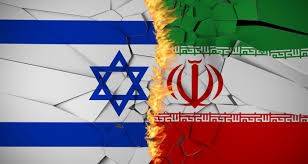
Israel-Iran conflict. David's new sling.
A few days ago, a barrage of attacks began between Israel and Iran. This was something that those who are involved amateurly, like me, or professionally with geopolitical developments, saw coming sooner or later. Iran has been developing a nuclear program for many years, according to what Tehran itself has stated, with the initial purpose of its energy utilization, but those who have elementary knowledge of defense issues, but also of war technology issues, know that when a country acquires a nuclear program, for energy purposes, it is ready to acquire nuclear weapons, and this is because the enrichment process is the same and can be carried out in the same factory and with the same machines. Israel knows this very well and for this reason it is "taking its measures" preventively, because it sees Iran as a potential threat, even to its existence.
Why does Israel see Iran as a potential threat?
For those who are wondering or who have not yet clarified the reason for Israel's aggression against the Persians, they should look a little at recent history and thus be led to safe conclusions. Initially, we will say that the main "blood donor" in money, weapons and training of Jerusalem's direct enemies, namely Hamas, Hezbollah and the Houthis in Yemen, is Iran. Then we must add the next piece of the puzzle, which is Tehran's attempt to "torpedo", by all means, the joint effort for about a decade, perhaps more, that the Arab countries, together with Israel, have been making, so that peace can be achieved in the region. This effort is known as "the Abraham Accords". For those who don't know, these agreements have to do with commercial and technological cooperation between all Arab countries and Israel, with the aim of improving relations between them, ending mutual suspicion and ultimately bringing peace to the troubled Middle East region. Israel, until the 8thη In October 2023, it had signed these bilateral agreements with all Arab countries except Saudi Arabia, which was scheduled to happen two days after the Hezbollah attack. After this incident, of course, the process stopped and was eventually frozen on Riyadh's side, due to Israeli attacks on both Hamas and Hezbollah positions in the Gaza Strip. So here Iran's first goal was achieved.
Why did Israel choose this particular time period to strike Iran?
The answer to this question is very simple. We all know that Israel's Objective Purpose (ANSK) was Tehran. However, in order to be able to deliver the decisive blow that would either level it or send its nuclear program to the "Stone Age", it would have to "untangle" its individual and immediate problems, which were in order of priority.
1 Hamas and Hezbollah. These two terrorist organizations operated within Israeli territory and therefore constituted the number one internal danger that should be neutralized, but for this to happen there would have to be a reason, and this is because for about two decades there has been relative calm in Israel. This reason was given on October 8, 2023.
- Houthis in Yemen. This terrorist organization, which has been ravaging the Yemeni state for years, was a serious problem for Israel's security due to the continuous funding, but mainly its equipment, by the Tehran regime, with ballistic missiles and drones, which made the Houthis a potential threat to Jerusalem. Thus, Israel, with two lightning and surgically precise air strikes, neutralized the ballistic missile sites and the warehouses where the Houthis had the drones and leveled the central port of Khodeina, thus cutting off their supply.
- Assad regime in Syria. Here, although the "dirty" work was done by Turkey, the overthrow of Assad was "Manna from heaven" for Israel's planning, and this is because Syria was the central station through which all the Iranian equipment and financing of Hamas and Hezbollah passed. When Assad lost, this flow was violently interrupted and thus Hamas and Hezbollah found themselves exposed. Subsequently, and since there was no effective Government in Syria, and therefore no military command. The Israeli Air Force bombed all military bases on Syrian territory, firstly, to prevent the equipment from falling to the Islamists and secondly, to prevent Turkey from finding suitable ground to install military forces there, and secondly, to clear the ground so that it would have another unobstructed passage through which its fighters would pass to strike positions of the Iranian Army and the Revolutionary Guards, as well as Iran's nuclear facilities.
In conclusion, the entire IDF staff planning, from a tactical point of view, was the definition of High Strategy, reminiscent of the glorious days of the Six-Day War, in terms of proper planning, and constitutes an operational lesson for all Armies in the world.
The gradual escalation of Israel-Iran tension.
Since the beginning of the war in the Gaza Strip, Israel has shown its teeth, but also its intentions, wanting to make it clear that it is determined to end once and for all both the terrorist organizations of Hamas and Hezbollah, as well as those who were hiding behind them in various ways. Thus, a few months after the start of hostilities, and specifically on the 1η In April 2024, an Israeli Air Force airstrike on terrorist positions in Damascus, Syria, hit the Iranian embassy with rockets, which resulted in the death of 11 people inside the embassy and Tehran threatened to strike Israeli territory, which it carried out, hitting IDF positions inside Israel with rockets and UCAVs. A few months later, in August 2024, we had the assassination of Hamas leader Haniyeh, who died in the room where he was hosted by the Tehran regime. Of course, here too we had a response from Iran with missile attacks. On May 23, 2025, President Trump tried to start a process of finding a peaceful solution to the Iranian nuclear problem, with the aim of never reaching the point of direct conflict between Jerusalem and Tehran. Of course, the problem with the "unbridled" development of the Iranian nuclear program was created by him during his first term, when he withdrew from the "Joint Comprehensive Plan of Action (JCPOA), which had been concluded between the EU and Iran, describing it as the "worst deal in history"!!! This resulted in Iran importing thousands of advanced technology uranium centrifuge devices, and thus in a short period of time managing to produce huge quantities of enriched uranium and thus having the ability to produce nuclear warheads for military use. For the record, the JCPOA stipulated that Iran "has the right" to nuclear technology, but for peaceful purposes. I am also including the relevant link, for those who want to refer to the JCPOA. (https://www.consilium.europa.eu/el/policies/jcpoa-iran-restrictive-measures/). Of course, now Iran is completely negative and thus we have reached Trump's threats to the Tehran regime that the continuation of its nuclear program constitutes a danger to global security.
Israeli attacks on Iran's nuclear program and Tehran's reaction.
After the last failed attempt by the American president to find a peaceful solution to the issue, came the statements of the Prime Minister of Israel Benjamin Netanyahu, that the Iranian nuclear program constitutes an existential threat to Israel and that it should be terminated immediately. The result of this rhetoric was the attacks of the last few days with surgical strikes, both with the use of air forces and hovering munitions, and from within the territory of Iran!!! According to declassified information, which became known after the attacks, the Mossad in cooperation with the IDF managed to pass "under the nose" of the Revolutionary Guards, about 1000 agents and Special Forces men, as well as strike equipment, resulting in many facilities of both the nuclear program and units of the F. t. E., but also of the Iranian Army, to be hit, from within Iranian territory and to be killed, top executives of both Iranian military bodies who were the top, but at the same time were also the planners of the Iranian missile strikes against Israel, with the result that Iran's response was in any case unsuccessful, based on the volume of fire it unleashed. Here we should note that Israel is not the first time that it has tried to end Iran's nuclear program, but it is the second. The first happened about fifteen years ago when Jerusalem installed malicious software on the computers of Iran's nuclear facilities through a cyberattack, known as the Stuxnet worm, which targeted uranium enrichment centrifuge machines. This malicious software had the ability to provide false data to the centrifuge's main computer, causing its operator to see that the enrichment process was occurring normally, while in reality it was not, resulting in the centrifuge overheating and ultimately destroying it.
The wrong reaction of the Tehran regime.
After the above, Tehran launched threats against Jerusalem, as well as against Washington, Great Britain and France, threatening to strike American and allied targets on land and sea if they dare to help Israel. This naturally provoked the reaction of the American president, who declared «If we are attacked in any way, shape or means by Iran, the full might and power of the United States Armed Forces will fall upon you at levels never seen before." This statement by the American president shows that he is determined to respond to a potential provocation from Tehran, a provocation that, if carried out, would bring Iran face to face, indirectly or directly, with all of NATO, and that raises the question of how the alliance to which Iran belongs, which is none other than the Shanghai Cooperation Organization, will respond. A flag that certainly has its own internal problems, since two of its members, namely Pakistan and India, recently came into armed conflict, with the latter having various conflicting interests with China.
Is Iran alone in its conflict with Israel?
The answer to this question is categorically NO. Iran, as we said a little above, is a member of the Shanghai Cooperation Organization, which was founded on June 15, 2001 in the Chinese city of Shanghai, from which it took its name. Member states of this organization are China, Russia, India, Kazakhstan, Kyrgyzstan, Pakistan, Tajikistan and Uzbekistan. Observer countries, that is, states that are in the process of joining the Organization, are Afghanistan, Mongolia and Belarus. As can be easily understood, Iran also has its strong allies despite the problems they have, whether they are internal or between them, as I mentioned above. Iran may be a member of an alliance that has internal disputes, but this does not mean that if it needs individual help from its allies, it will not receive it. This is because both China and Russia have active interests within Iran. China, in addition to the maritime Silk Road, has also created a road equivalent, which passes through Tehran, and Russia has something similar, with a vertical route that starts from St. Petersburg, goes down to the Caspian Sea and continues through Iranian territory, ending at the port of Bandar Abbas in the Persian Gulf, thus giving it the advantage of transporting goods, in a short time, from the Baltic Sea, to the Persian Gulf and by extension to the Indian Ocean. So for both China and Russia, Iran is a "vital space", with all that this implies for how they will react to a possible all-out Western attack.
American mobility in the region.
Following Iran's threats against Western targets, as we mentioned above, the American reaction was lightning-fast, both in terms of statements by President Trump and operationally. By order of President Trump, 6 US warships were mobilized in both the Mediterranean and the Persian Gulf.th and 5th US Fleet respectively, to strengthen Israel's defense. as the US president said characteristically. Let's see what forces are currently moving in the Mediterranean and the Arabian Sea. The strike groups of the Fifth and Sixth Fleets consist of a Nimitz-class aircraft carrier, per fleet, two Arleigh Burke-class destroyers, per fleet, two Ticonderoga-class cruisers, per fleet, two Wasp and America-class amphibious ships, per fleet, one Virginia-class nuclear submarine and support ships, two per fleet. In the area there is also the US air base in Diego Garcia, which hosts the large and strategic US bombers B-1, B-2 and B-52. This base is located in the southern hemisphere, it is British territory, despite the fact that with the 2024 agreement, it has passed to Saint Mauritius, but for the next 99 years it will be under British Administration. Great Britain has for many years granted the air base, in terms of use, to the US Navy and is located 1600 kilometers south of the coasts of Sri Lanka and India. From there, we have seen in the past strategic bombers operate against enemy positions in Iraq, during the first American-Iraqi war of 1990, which went down in history as "Desert Storm". In Afghanistan in 2001, after the attack by Al Qaeda on the twin towers in New York on 9/11/2001.
The power of American weapons, the 5th and 6th fleet.
In the previous paragraph we talked about the US forces that are currently moving or present in the Mediterranean and Arabian Sea regions. However, to make the picture clearer, so that the reader can understand the firepower of the US Navy and Air Force, we will let the numbers speak for themselves.
Aircraft carrier Nimitz . Maximum speed: 30 knots or 56 km/h. Crew: 5000 men. Sensors: 3D aerial search radar AN/SPS-48E, Two-dimensional aerial search radar AN/SPS-49(V)5, Target detection radar AN/SPQ-9 B, Air traffic control radar AN/SPN-46, Air traffic control radar AN/SPN-43C, Landing assist radar AN/SPN-41, 4 × Mk 91 NSSM guidance systems, 4 × Mk 95 radars. Electronic warfare: Countermeasures Suite AN/SLQ-32A(V)4, Torpedo countermeasures SLQ-25A Nixie. Armor: 2–3 × Mk 29 guided missile launchers, 8 × missiles RIM-162ESSM ή RIM-7 Sea Sparrow each,3–4 × Phalanx CIWS, 2 × Mk 49 guided missile launchers, 21 × Rolling Airframe Missiles RIM-116 each, Mk 38 25 mm machine gun systems. Armor: 2,5 inches (64 mm) of Kevlar over vital areas. Aircraft: 64 F/A-18E and F/A-18F Super Hornets.
Utilities Arleigh Burke . Role: They are anti-ship guided missiles. Maximum speed: 30 knots or 56 km/h. Crew: 300 men. Sensors: 3D radar AN / SPY-1 D, 3D radar TO THAT AN / SPY-6 (V)1, AN/SPS-67 Surface Surveillance Radar (V)3 or (V)5, Surface Survey Radar AN / SPQ-9B, AN/SPS-73(V)12 surface search/navigation radar, BridgeMaster E surface search/navigation radar, 3 × fire control radar AN / SPG-62, Mk 46 optical sighting system, Mk 20 electro-optical sighting system, Battle system AN/SQQ-89 ASW:, Sonar array AN/SQS-53C, AN/SQR-19 Tactical Towed Sonar, TB-37U Multifunctional Towed Array Sonar and AN/SQQ-28 Ship System LAMPS III. Electronic warfare: Electronic warfare suite AN / SLQ-32, Torpedo countermeasures AN / SLQ-25 Nixie, Bait launching systems Mk 36 Mod 12, Mk 53 decoy launcher systems Nulka and Bait launching systems Mk 59. Armor: 80: 1 × 5-inch (127 mm)/54 Mk 45 Mod 1/2 (light gun), 1 × 5-inch (127 mm)/62 Mk 45 Mod 4 (light gun), 84: 2 × 20 mm (0,8 in) Phalanx CIWS, 1 × 20 mm Phalanx CIWS, 2 × Mk 38 machine gun system 25 mm (0,98 in), 1 × Optical Glare Interceptor, Navy , and 1 × High-energy laser with integrated glare and surveillance optics(HELIOS). Missiles: 2 × launchers Mk 141 Harpoon anti-ship missiles, 4 × Naval Attack Missile Kongsberg, Harpoon missiles, 1 × 29-cell, 1 × 61-cell (90 cells total) Mk 41 vertical launch system, 1 × 32 cells, 1 × 64 cells (96 cells total) Mk 41 Vertical Launch System, RIM-66 SM-2MR, RIM-156 SM-2ER Black IV, RIM-174 SM-6, RIM-161 SM-3 (as many ships are equipped with BMD), RIM-162ESSM, BGM-109 Tomahawk cruise missile, Vertical launch RUM-139 ASROC and 1 × SeaRAM. Torpedoes: 2 × triples torpedo tubes Mark 32, Mark 46 light torpedo, Mark 50 light torpedo and Mark 54 light torpedo. Armor: Kevlar in vital parts of the boat.
Ticonderoga . Role: Guided missile cruiser. Maximum speed: 32,5 knots or 60 km/h. Crew: 330 men. Sensors: Multifunctional radar AN/SPY-1 A/B, AN/SPS-49 air search radar (present on some ships of this class), Fire control radar AN / SPG-62, Surface survey radar AN/SPS-73, Gun fire control radar AN/SPQ-9, AN/SQQ-89 (V)1/3 – A(V)15 sonar suite, consisting of Active sonar AN/SQS-53B/C/D, AN/SQR-19 TACTAS, AN/SQR-19B ITASS and MFTA passive sounder, Lightweight, multipurpose airborne system AN/SQQ-28. Electronic warfare: AN/SLQ-32 Electronic Warfare Suite, Mark 36 SRBOC and AN/SLQ-25 Nixie. Armor: 2 × 61 Mk 41 vertical launch systems containing 122 × (they have the ability to put with), RIM-66M-5 Standard SM-2MR Block IIIB, RIM-156A SM-2ER Block IV, RIM-161 SM-3, RIM-162A ESSM, RIM-174A ERAM Standard, BGM-109 Tomahawk, RUM-139A VL-ASROC, 8 × missiles RGM-84 Harpoon, 2 × light cannon Mark 45 Mod 4 5-inch (127 mm)/62 caliber, 2 × Mk 38 25 mm Machine Gun Systems, 2–4 × 0,50 inch (12,7 mm) caliber machine gun, 2 × Phalanx CIWS Block 1B, 2 × Mk 32 triple torpedo tubes 12,75 inch (324 mm). Armor: Kevlar in vital parts of the boat.
Amphibious boat Wasp : Role: They carry a helicopter take-off and landing platform for transporting marines. Maximum speed: 22 knots, or 41 km/h. Crew: 1070 men. Transported Troopa: A detachment of Marines of 1687 men. Sensors: 1 air search radar AN/SPS-49 2-D, 1 air search radar AN/SPS-48 3-D, 1 Surface Search Radar AN/SPS-67, 1 Target Approach System (TAS) Mk23, 1 Air Traffic Control Radar AN/SPN-43 Marshalling, 1 Air Traffic Control Radar AN/SPN-35, 1 system AN/URN-25 TACAN and 1 AN/UPX-24 Recognition of friend or foe. Armor: 2x launchers RIM-116 Rolling Airframe missile, 2 rocket launchers RIM-7 Sea Sparrow, 3 systems Phalanx CIWS 20 mm, 4 Mk 38 machine gun systems 25 mm and 4 machine guns 50 BMG. Ability to transport the following aircraft, depending on the mission: 6 attack aircraft AV-8B Harrier II, ή 6 stealth fighter jets F-35B Lightning II, 4 attack helicopters AH-1W /Z Super Cobra /Viper, 12 MV-22B Osprey tiltrotor attack support, 4 heavy helicopters CH-53E Super Stallion,3–4 general purpose helicopters UH-1Y Venom, Attack: 22+ MV-22B Osprey Assault Support tiltrotor. Sea Control: 20 attack aircraft AV-8B Harrier II, ή 20 stealth fighter jets F-35B Lightning II, 6 helicopters ASW SH-60F / HH-60H.
Amphibious boat America : Role: Offensive actions with helicopters, Marine carrier. Maximum speed: 20 knots or 37 km/h. Crew: 1059 men. Transported Troopa: 1687 Marines. Sensors: AN/SPS-49 Air Search Radar 2-D, XNUMX-D air search radar AN/SPS-48G, Surface Search Radar AN/SPQ-9 B, AN/USG-2 Collaborative Engagement Ability (CEC), and SSDS MK2. Electronic warfare: AN/SLQ-32B(V)2 and Two Mk53 decoy launchers No way. Armor: 2x launchers Missile Rolling Airframe, 2 launchers Evolved Sea Sparrow missile, 2x Phalanx CIWS, 3 Mk 38 machine gun systems, and 7x double 0.50 caliber machine guns. Ability to transport the following aircraft, depending on the mission: AV-8B Harrier II, F-35B Lightning II, Osprey MV-22B, CH-53E Super Stallion ή CH-53K King Stallion, UH-1Y Venom, AH-1Z Viper and MH-60S Knighthawk.
Submarine - Υποβρύχιο Virginia Role: Offensive Nuclear Submarine. Maximum speed: 25 knots or 46 km/h. Limitations: Only for the crew's food needs and the maintenance of the vessel. Maximum operational depth: 490 meters. Crew: 135 men. Armor: Submarines of this class have six versions and their equipment is divided into three version pairs as follows:
Blocks I–II:12 × vertically launched missiles, 12 × tubes VLS for Tomahawk cruise missiles, 25 × torpedo tubes for launching torpedoes and missiles, 4 × torpedo tubes 21″ for Mk-48 torpedoes ή UGM-84 Harpoon missiles.
Blocks III–IV: 12 × vertically launched missiles, 2 × Virginia payload tubes, each capable of launching six cruise missiles, 12 × Tomahawk BGM-109, 25 × torpedo tubes for launching torpedoes and missiles, 4 × 21″ torpedo tubes for Mk-48 torpedoes or UGM-84 Harpoon missiles.
Blocks V-VI: 40 × vertically launched missiles, 4 × Virginia payload modules (VMP), each capable of launching seven cruise missiles, (28 × Tomahawk BGM-109 and future guided cruise missiles, 2 × Virginia payload tubes, each capable of launching six cruise missiles, 12 × Tomahawk BGM-109 and 25 × torpedo tubes for launching torpedoes and missiles, 4 × 21″ torpedo tubes for Mk-48 torpedoes or UGM-84 Harpoon missiles.
Σsupport coffee: The role of these vessels is what their name suggests. They act as escort vessels and transport whatever the other vessels need to supply them, from water, food, fuel and spare parts, to additional armament.
The scenarios after the American involvement.
As can be easily understood, such a concentration of forces on the part of the Americans in the region, the strike was more than certain, with the aim of ending Iran's nuclear program, but also to strengthen Israel. As I have written in my previous articles, the analysis of geopolitical events is based on the data that we have evolving in front of us and the potential scenarios that are generated from them, this is how we will proceed now, in order to try to shed light on the situation that is going to take shape after the American strike on the 21thJune. The scenarios we have from now on for the development of things are as follows. 1. What stance will the Shanghai Cooperation Organization, of which Iran is a member, take after the involvement of American forces? 2. What position will Turkey take, since in the event of NATO or just American involvement, it has a contractual obligation to provide its bases, like Greece, for the resupply of allies, and not only, in the event of escalation of American involvement. A Turkey which, from 2016 onwards, has been "alienating" towards the Shanghai Cooperation Organization, as it is in pre-accession status!!! Essentially, in the event of American or allied involvement, Turkey will have to decide which of the two boats it will step into. The only thing that is certain is that whatever decision she makes, she will end up... lost by the one she displeases, and the blow she will receive will be devastating for her. 3. The scope of Iranian retaliation. Here we will have to wait for the Iranian reaction and whether and when they will decide to strike American targets. If this happens, then escalation is considered certain by the American factor, and if Iran makes such a decision, it will be like signing its "death warrant." 4. The possibility of land operations. While this is a serious escalation, it should not be ruled out, especially in the event that Iran responds by striking American bases in the region. In this case we have two sub-scenarios. 1. Direct American involvement, a bit difficult at the present stage, and that's because this way things will lead, with mathematical precision, to the involvement of Iran's allies in the war. But with Trump, nothing is impossible. 2. The implementation of an attempt to overthrow the theocratic regime of the Mullahs, from within, with the help - collaboration, of the Iranian Army. Here, to make things clearer for the reader, I should point out the following. The structure of the Iranian military has two pillars. One pillar is the Iranian Army and the second is the Revolutionary Guards. These two bodies are two separate entities and since 1979, when the Islamic revolution prevailed in Iran, these two bodies have been in constant conflict, and this for two reasons. First of all, why are the F. t. S., they take the lion's share of the armament programs, at the expense of the Iranian Army, and secondly, because the F. t. Yes, they are paid much better than their "colleagues" in the Iranian Army. As is easily understood, this conflict can easily turn into a "Trojan horse" for the Tehran regime and an opportunity for Israel's Western allies, who will want to exploit this conflict to lead Iran into a civil war, which will aim to overthrow Ayatollah Khamenei and thus establish a pro-Western government, with a possible return of the Shah, if this scenario ultimately develops and succeeds. I should note that this development is also the main goal of Jerusalem, because this way it will ensure its peace once and for all.
Athanasios I. Demetriades.
Member of the Hellenic Institute for Strategic Studies.
(ELISM)