

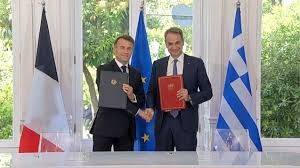
The limits of the Greek-French defense agreement.
The limits of the Greek-French defense agreement
by Athanasios Platias
Emmanuel Macron's visit to Athens and the renewal of the Greek-French defense agreement bring a fundamental question back to the fore: what exactly does the mutual defense assistance clause that constitutes its core mean for Greece? The answer must be given without illusions.
In international relations, alliances operate on terms of interestsThe 2021 agreement, which is now being renewed, It provides for mutual assistance in the event of an attack and was linked – not coincidentally – to significant Greek supplies of French weapons systems, such as Rafale aircraft and Belharra frigates. For France, the promises of defense assistance were accompanied by tangible benefits for its defense industry. This transactional dimension does not negate the strategic value of the agreement; it simply grounds it in reality.
Beyond the declarations, The value of the agreement lies in the fact that, at the present juncture, there is a sufficient convergence of interests between Athens and Paris on issues concerning the Eastern Mediterranean and European security. In this sense, the Greek-French relationship is perhaps the most important bilateral strategic relationship that Athens has today.
The importance of agreement should be seen in the light of the Greek-Turkish balance. Turkey has a clear quantitative advantage. Greece cannot compete symmetrically; it must invest in qualitative superiorityThis is precisely where France becomes crucial. If defense cooperation with Paris contributes to maintaining a substantial qualitative superiority over Turkey, then the agreement acquires a real deterrent content. Then it will not be just a diplomatic declaration; it will be a power multiplier. The mutual defense assistance clause strengthens deterrence politically, while arms cooperation strengthens it militarily. The combination of the two gives substance to the relationship.
This does not mean that the agreement is without limits.
Firstly, it is not a treaty in the strict legal sense; it is simply a political commitment.
Second, it explicitly excludes issues of sovereign rights such as the continental shelf and the EEZ.
Third, no mutual assistance clause is automatic: its activation will depend on the geopolitical situation, the will of the French leadership at the time, and whether Paris considers its own vital interests to be at stake..
In other words, the agreement increases the cost and risk for Ankara, but does not eliminate the uncertainty that accompanies any alliance commitment. This is the fixed limit of all alliances.
There is, however, a new dimension worth considering: nuclear. Last year, Macron opened the discussion on the possibility of French nuclear deterrence acquiring a European dimension. This year, he announced the reinforcement of the French nuclear arsenal, the possibility of deploying French nuclear forces on European soil, and closer cooperation with eight partners – including Greece explicitly. Greece must explore the limits and content of French “extended deterrence”. Not because Turkey is already a nuclear power – it is not – but because it has expressed nuclear ambitions.
The conclusion is clear. The Greek-French agreement is valuable and its renewal is positive. But its value is complementary, not a substitute for national power. Alliances are more reliable when they support states capable of defending themselves.
Athanasios Platias is Professor Emeritus of Strategy at the University of Piraeus and President of the Council on International Relations.