

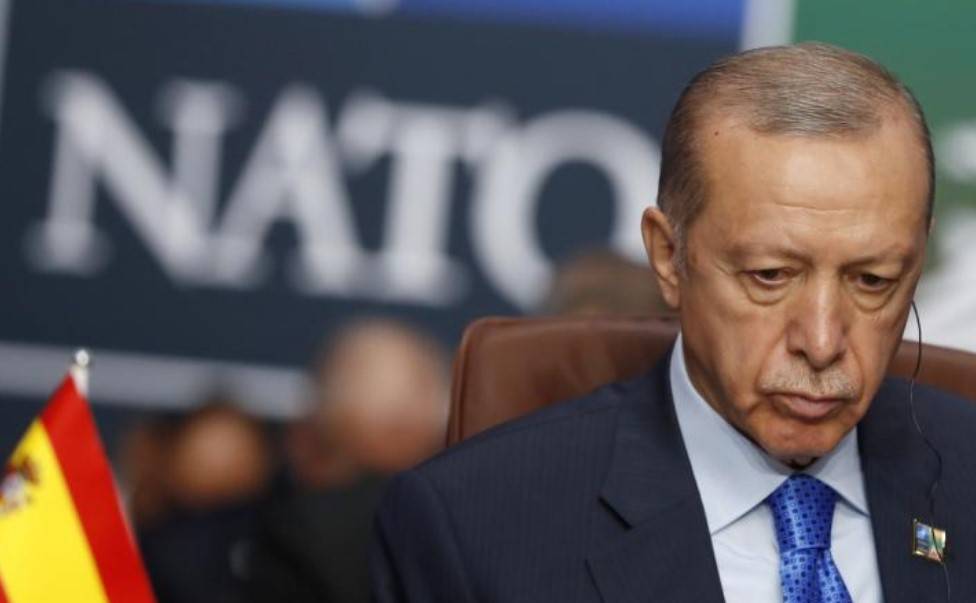
The European blockade in Ankara and in the background in The Hague
The European blockade in Ankara and in the background in The Hague

The EP Report under consideration is 18 pages long, and its structure includes three distinct parts. The first (pages 1-6) concerns documents, facts and data on which the document is based, the second (pages 6-17) concerns the “General assessment and latest developments” and the third (pages 17-18) the “Further course for EU-Turkey relations”. The general conclusion of the Report regarding Turkey’s accession to the European Union (EU) is summarized in the finding that:
“[…] in the absence of a drastic change of course by the Turkish government, Turkey’s EU accession process cannot continue under the current circumstances […]” [3].
At this point it is worth noting that Turkey had applied for membership in the European Economic Community in 1987, while its candidacy was recognized 12 years later at the Helsinki Summit in 1999 and its accession negotiations began in 2005, following a relevant decision by the European Council in 2004 [4]. However, in order for Turkey to become a full member of the EU, it must respect the common values of the EU member states and be committed to promoting them, [5] as well as meet specific accession criteria, also known as "Copenhagen Criteria" [6]. However, according to the latest assessment, the situation in Turkey with regard to these criteria is extremely difficult [7].
One of the main points of the EP Report concerns the Sweden's accession to NATO, which had submitted a relevant request together with Finland on 18 May 2022 [8]. Turkey, although it ratified the relevant accession protocols of Finland, refused to do the same for Sweden, under the pretext that it harbors terrorist organizations. After the intervention of the NATO Secretary General and the signing of a Memorandum on 28 June 2022, Turkey agreed to proceed with the process. However, in early 2023, it refused to ratify them again due to extremist incidents that occurred in Sweden [9].

Furthermore, shortly before the 2023 NATO Summit, the Turkish President had stated that for to accept Sweden's entry into NATO, it must first "the road is open" on Turkey's entry into the EU [10]. However, the EP Report points out – leaving hints that Turkey serves Russian interests and questioning its credibility due to the lack of a timetable for ratification and because it does not implement EU sanctions against Russia, having even doubled trade relations with the latter – that:
“[…] the process of accession of a country to NATO can in no way be linked to the process of accession of another country to the EU […]”.
Of particular interest are also the reports in the Report on the lack of respect as to international law. Although the EP acknowledges that after the recent earthquakes in Turkey there has been a de-escalation of tension in the Eastern Mediterranean, it calls on Turkey to respect the sovereignty and sovereign rights of all states, expressing its support for both Greece and the Republic of Cyprus. More specifically, it condemns the signing of the Turko-Lybian Memorandum, which it characterizes as a violation of International Law, asking Turkey to refrain from illegal actions and states that:
“[…] expresses deep concern about the fact that Turkey continues to maintain a formal threat of war against Greece (casus belli), in the event that the latter exercises its legal right to extend its territorial waters to 12 nautical miles in the Aegean Sea […]”.
The Report also highlights the lack of respect in Human Rights and minorities on behalf of Turkey. More specifically, it refers to the need to protect the rights of the Greek Orthodox population in Imbro and Tenedos, respect for the monument of Hagia Sophia and the institution of the Ecumenical Patriarch, as well as the reopening of the Theological School of Halki. The document also states that:
“[…] condemns Turkey’s repeated attempts to intimidate and silence Turkish Cypriot journalists and progressive citizens in the Turkish Cypriot community, thus violating their right to freedom of opinion and expression; […]”.
Regarding the illegal occupation of the northern part of the Republic of Cyprus, it condemns the illegal construction works and attacks against UN forces that occurred in the village of Pyla on 18 August 2023, while stating that Turkey continues to violate UN Security Council resolutions and that the EP wants a bicommunal, bizonal federation in accordance with UN resolutions, noting that:
“[…] expresses its disapproval of the fact that the Turkish government has abandoned the agreed basis for a solution and the United Nations framework, single-handedly supporting the two-state solution in Cyprus; calls on Turkey to abandon this unacceptable proposal for a two-state solution; strongly condemns any action facilitating or supporting in any way the international recognition of the illegal secessionist entity in Cyprus […]”.

Some other points of particular attention concern the non-applicability several decisions of the European Court of Human Rights (ECHR), the fact that Turkey ranked 2023th out of 165 countries in the World Press Freedom Index in 180, that the elections in Turkey were not held under full democratic procedures, and that Turkey does not follow due process in the treatment of refugees. The EP's general finding regarding Turkey's relations with the EU is that:
“[…] Turkey has been gradually but steadily moving away from EU values and the regulatory framework for several years, which shows a highly worrying and worsening trend, as demonstrated by the increasing number of laws and measures restricting the rule of law, fundamental freedoms, human rights and political liberties, as well as by its actions that are contrary to international law and good neighbourly relations.”
Concerning positive findings for Turkey, these concern the facilitation of talks between Ukraine and Russia, the mediation and maintenance of the Black Sea grain initiative, the normalization of relations with Armenia, Egypt, Israel and the Gulf states, the fact that Turkey hosts the largest refugee population in the world (approximately 4.000.000), Turkey's participation in the summits of the European Political Community, the ratification of the Paris Agreement on climate, the condemnation of the Russian invasion of Ukraine within the UN framework, and the pro-European stance of the majority of Turkish society, noting that the Turkey is the 6th largest trading partner of the EU.
However, despite the fact that with this Report the EP is essentially “closing the door to accession” to Turkey, not only does it not close the corresponding door to the existing customs union – which ensures Turkey significant funding and preferential trade – but it clearly states that the EU wishes to upgrade the customs union, subject to the implementation of the economic commitments undertaken by Turkey. It is emphasized that:
“[…] Turkey is a country of strategic importance from a political, economic and energy perspective and in the context of foreign policy, a key partner for the stability of the wider region and an important ally, including within NATO […]”.
At this point, the following reasonable question arises: How can Greece utilize the data and findings of the said document to its advantage? This crucial question becomes even more important if examined in the light of the upcoming meeting between the Greek Prime Minister and the Turkish President on September 20, 2023 in New York. This meeting is taking place in the context of the resumption of dialogue between the two states following the recent meeting of the two leaders at the NATO Summit in Vilnius, Lithuania [11]. In fact, in a television interview, the Greek Prime Minister stated that:
“[…] The big goal, I have never hidden it, is to resolve the core of the dispute. And I refer to the dispute, because our big dispute with Turkey continues to be the delimitation of maritime zones, EEZ and continental shelf, in the Aegean and the Eastern Mediterranean […] if we manage to agree to go to The Hague, so that the International Court of Justice can take up this major pending matter […] Any agreement of this type may possibly, yes, entail some concessions from some positions which can constitute the starting point of a negotiation. […] We will resolve it on terms that will obviously be compatible with the defense of national interests […]” [12].
The aforementioned statement by the Greek Prime Minister regarding concessions provoked reactions regarding the type of possible concessions, while the Greek Minister of Foreign Affairs clarified in Parliament that the concessions referred to by the Prime Minister do not concern issues of sovereignty [13]. What should we therefore bear in mind based on the EP Report in relation to our country’s exploratory contacts with Turkey and the possibility of recourse to The Hague?
First, the Greece cannot be trusted a country like Turkey, which by common admission and confirmed by official institutional documents, repeatedly ignores international law, does not respect human rights and uses "blackmail tactics" in order to achieve its foreign policy goals. In other words, we cannot be sure that Turkey will respect the decision of the International Court of Justice.

Moreover, for Turkey the difference is not just one, namely the delimitation of the Exclusive Economic Zone (EEZ) and continental shelf, but a multitude of issues such as the demilitarization of islands, therefore it will have difficulty accepting an appeal with the sole issue of settling the delimitation of maritime zones.
Third, if Turkey truly desires the normalization of its relations with Greece, it should lift the casus belli with which it has been threatening Greece since 1995, to withdraw the occupation troops it maintains in the Republic of Cyprus, and to stop any activity that is contrary to the provisions of International Law.
Fourth, Turkey may – as it has done in the past – exert pressure on Greece and the EU by instrumentalizing the migration issue, in order to obtain significant (mainly economic) benefits from the latter. This is also inferred from the EU’s commitment to further support refugees in Turkey. Turkey can therefore only give way to some of its positions if it receives significant economic benefits.
Fifth, Turkey depends financially to a significant extent with a sticker for EU as the latter is Turkey’s largest trading partner. Therefore, Turkey’s pressure on the EU has specific limits, as a potential interruption of trade relations between the two parties would have devastating consequences for the former. Moreover, the EU has imposed restrictive measures (sanctions) on Turkey since 2019 due to illegal drilling in the Eastern Mediterranean, [14] which it extended until 12 November 2023.16 Greece can therefore use its membership in the EU to exert pressure on Turkey.
Finally, we should not forget that Turkey is also an important partner for the EU, which implies that the latter is not going to "abandon" the
Turkey, but will seek to maintain their economic and trade relations. The measures therefore to be taken against Turkey should not bring it to the point of collapse, which could lead it to the sphere of influence of another international actor, but should "ring alarm bells" in order to lead to its compliance. As the well-known Chinese strategist Sun Tzu states in his work entitled The Art of War:
"When you surround an enemy, leave him an escape route. You should not press too hard on a desperate army."
References:
[1] European Parliament. “2022 Commission Report on Turkey”. P9_TA(2023)0320. 13 September 2023. https://www.europarl.europa.eu/doceo/document/TA-9-2023-0320_EL.pdf (14 / 09 / 2023).
[2] European Parliament. “Parliament calls on EU and Turkey to seek alternative ways of cooperation.” Press Release 20230911IPR04914. 13 September 2023. https://www.europarl.europa.eu/pdfs/news/expert/2023/9/press_release/20230911IPR04914/20230911IPR04914_el.pdf (14 / 09 / 2023).
[3] European Parliament. “2022 Commission Report on Turkey”. p. 17.
[4] Koukakis Georgios. "Turkey's accession process to the European Union (1999-2022)". Center for International Strategic Analyses (KEDISA). 08 March 2023. p. 3. https://kedisa.gr/i-poreia-entaksis-tis-tourkias-stin-evropaiki-enosi-1999-2022/ (14 / 09 / 2023).
[5] EUR-Lex. "EU accession process". https://eur-lex.europa.eu/EL/legal-content/glossary/accession-process-to-the-eu.html (14 / 09 / 2023).
[6] EUR-Lex. "Accession criteria (Copenhagen criteria)". https://eur-lex.europa.eu/legal-content/EL/TXT/?uri=LEGISSUM%3Aaccession_criteria_copenhague (14 / 09 / 2023).
[7] European Commission. "Türkiye 2022 Report [SWD(2022) 333 final]". 12 October 2022. https://www.eeas.europa.eu/sites/default/files/documents/T%C3%BCrkiye%20Report%202022.pdf (14 / 09 / 2023).
[8] North Atlantic Treaty Organization. "Finland and Sweden submit applications to join NATO". 18 May 2022. https://www.nato.int/cps/en/natohq/news_195468.htm (14 / 09 / 2023).
[9] Koukakis Georgios. “Finland’s accession to NATO and the future of Sweden’s candidacy”. Center for International Strategic Analyses (KEDISA). 06 April 2023. pp.3-4. https://kedisa.gr/i-entaksi-tis-finlandias-sto-nato-kai-to-mellon-tis-ypopsifiotitas-tis-souidias/ (14 / 09 / 2023).
[10] Hande Atay Alam & Christian Edwards. "Erdogan links Sweden's NATO bid to Turkey joining the EU". CNN World. 10 July 2023. https://edition.cnn.com/2023/07/10/europe/erdogan-turkey-nato-eu-sweden-intl/index.html (14 / 09 / 2023).
[11] Prime Minister. “Announcement on the meeting between Prime Minister Kyriakos Mitsotakis and the President of Turkey Recep Tayyip Erdogan”. 12 July 2023. https://www.primeminister.gr/2023/07/12/32163 (14 / 09 / 2023).
[12] SKAI. “Interview of Prime Minister Kyriakos Mitsotakis on SKAI.” July 13, 2023. YouTube. https://www.youtube.com/watch?v=oox7x204QNY (14 / 09 / 2023).
[13] Official Journal of the European Union. “COUNCIL DECISION (CFSP) 2019/1894 of 11 November 2019 concerning restrictive measures in view of Turkey’s illegal drilling in the Eastern Mediterranean”. 12 November 2019. https://eur-lex.europa.eu/legal-content/EL/TXT/PDF/?uri=CELEX:32019D1894&from=EN (14 / 09 / 2023).
[14] Official Journal of the European Union. “COUNCIL DECISION (CFSP) 2022/2186 of 8 November 2022 amending Decision (CFSP) 2019/1894 concerning restrictive measures in view of Turkey’s illegal drilling in the Eastern Mediterranean”. 9 November 2022. https://eur-lex.europa.eu/legal-content/EL/TXT/PDF/?uri=CELEX:32022D2186 (14/09/2023). Disclosure statement: The opinion expressed in this text expresses the personal views of the author and in no way reflects the official position of the Greek Government or the Hellenic Army.
* George Koukakis is a Lieutenant Colonel (PZ), Internationalist, and Researcher at KEDISA.