

Israel is “mowing the lawn” and losing its soul…
 LYGEROS STAVROS
A sober third party observer, carefully observing the situation in the Middle East, cannot help but wonder where things are headed. It is well known that violence and armed conflict in this region have been endemic since the establishment of Israel in 1948.
After the wars with the neighboring Arab states (Egypt, Syria and Jordan), that is, after the signing of a peace treaty with Cairo, the Palestinian situation took a different turn. Against Israel stood the armed organizations that had gathered in the Palestine Liberation Organization, which, weak against the Israeli army, had resorted to terrorist attacks for several years, without, however, achieving their goal, the establishment of an independent Palestinian state.
This fact, combined with the decline of the secular left-wing Palestinian movement, pushed the Palestinians into the arms of Hamas. This expresses political Islam, which in recent decades has emerged as a dynamic – sometimes leading – factor in almost the entire Muslim world. Thus, when free Palestinian elections were held, Hamas won them, resulting in a mini-civil war and ultimately the separation of the Gaza Strip from the West Bank.
Israel may have neutralized Saddam Hussein's Iraq through the Americans in 2003, and it may have normalized its relations with the Gulf monarchies through the "Abraham Accords," but the Palestinian issue has proven to be a minefield. Israel's refusal to accept the establishment of an independent Palestinian state, combined with the creation of Jewish settlements in the West Bank and its aggressive practices, keeps a multiple front open, usually with low-intensity conflicts - with Hamas in Gaza, with Hezbollah in Lebanon, with Islamic armed organizations in Iraq, with Syria and, above all, with Iran.
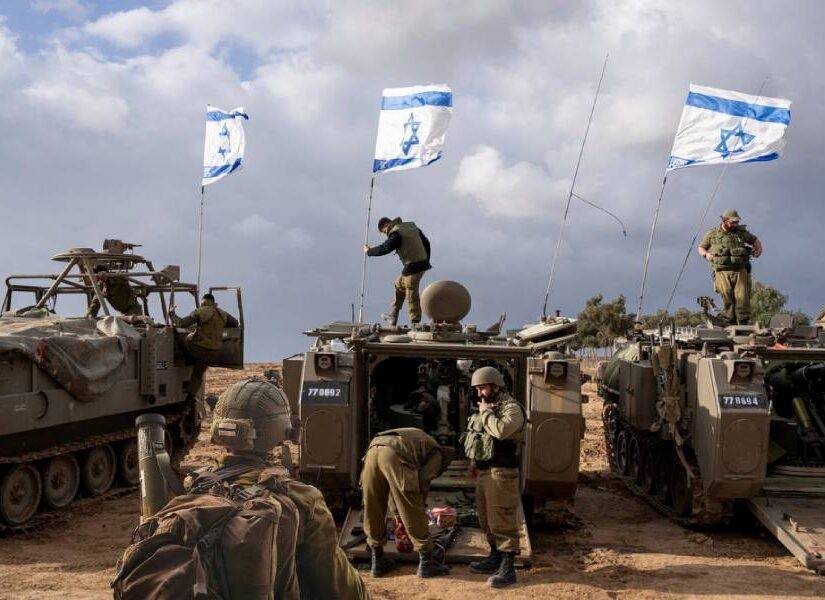
This situation prevented Israeli society from returning to full normality, but it was not a state of war. Israel's strategy was not to solve the problem by establishing a Palestinian state, but to gradually and systematically encroach on and usurp Palestinian land, expanding Jewish sovereignty. And at the same time, to manage Palestinian reactions by "mowing the lawn" (as it calls its tactic), that is, with assassinations, bombings and occasional military operations, in order to keep the Palestinians and those who actively support them under some control.
Hamas's attack is a milestone
And so we arrived at October 7, 2023. The Israeli leadership's belief that with this strategy they would gradually force the Palestinians to abandon their ancestral homes and seize their land, without engaging in war, was belied by the facts. The Hamas terrorist attack a year ago was a rough landing for Israel. Not only because it was taken by surprise, not only because a large number of Israelis, mostly civilians, were killed, not only because the hostages exert intense psychological pressure, but primarily because Tel Aviv's strategy fell flat.
As is well known, the Israeli response for a year now has been disproportionate in terms of blood. Over 30.000 Palestinians have been killed, over 10.000 are missing (apparently dead under the rubble caused by the devastating bombardments) and over 90.000 are seriously injured, not to mention the incredible suffering endured by those who have survived. And of course the vast majority of the victims are civilians. Obviously, during this entire time Hamas has suffered crushing blows, but – according to Israelis – it has not yet been militarily neutralized, in a blockaded area smaller than Andros!
Even if we remove the moral dimension and remain solely at the level of military and political effectiveness, we find that the Israelis' genocidal practice in Gaza has achieved neither the complete military neutralization of Hamas nor the ethnic cleansing of the Strip. And even if the Palestinians wanted to leave, they cannot.
What has happened in the last year, however, has multiple impacts at all levels:
- First, the relatively dormant front with Hezbollah was fully activated. This resulted in the population of northern Israel abandoning their homes and moving further south for safety reasons due to rockets fired from southern Lebanon. This alone entails enormous economic and social costs.
- Secondly, the Houthis from Yemen, in addition to sporadic drone and missile attacks against Israel, have caused a huge problem in maritime international trade, forcing many ships to circumnavigate Africa to avoid drone and missile attacks.
- Third, Islamic militias in Iraq have added their own drone and rocket attacks.
- Fourth, Israel's genocidal practice in Gaza has caused great indignation in Muslim societies, forcing the Gulf monarchies to indefinitely freeze the signed or about to be signed "Abraham Accords" and disrupting Israel's relations with other Muslim countries. This means that diplomatically Tel Aviv has gone far back, returning itself to a kind of isolation in the Middle East.
- Fifth, Israel's genocidal practice in Gaza was not able to damage its relations with Western countries. At best, they uttered some words about respect for civilians, which is certainly a far cry from the harsh condemnation of the attack by Hamas a year ago. However, it seriously damaged Israel's image in the eyes of Western public opinion, after the initial wave of sympathy. In fact, it provoked, especially in American universities, mobilizations that have not been seen for decades.
Israel's strategy is a dead end
But let's return to the crucial question: What is Israel's strategy? The bombing of the Iranian embassy in Damascus, the assassination of Haniyeh in Tehran, the assassinations of Hezbollah leaders and the recent, operationally brilliant, strike against it with the undermined buzzers and walkie-talkies are not a strategy. They are tactical moves that weaken Israel's enemies, but do not neutralize them. On the contrary, they further fuel hatred and will inevitably escalate attacks against it.