

Unraveling the mystery – Who and how are they fighting in Syria?
 LYGEROS STAVROS
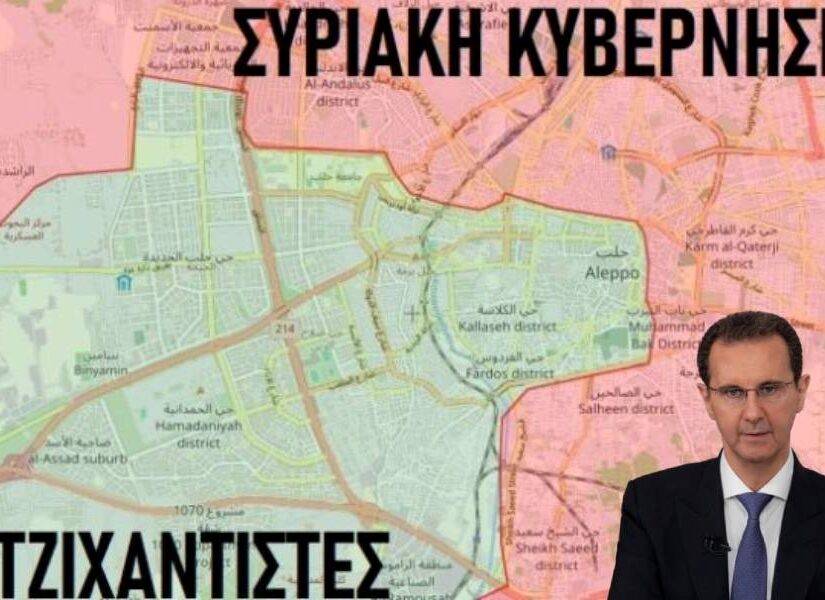
 The mere fact that the Syrian intelligence services had no information about the impending surprise attack by the Islamists (mainly the jihadists of the Al-Qaeda branch in Syria) on Aleppo and the surrounding areas, constitutes in itself a failure of the first magnitude. The inability of the Syrian forces to put up any resistance is also a fiasco of the first magnitude. It had taken almost three years (2013-16) to regain control of Aleppo from the Islamists, and now it took 2-3 days to lose it.
It is increasingly clear that the attack has been orchestrated and reinforced in various ways by Turkey, which has occupied areas in northern Syria for several years. It is Turkey that opened its borders and in recent days sent Islamists who had fled to its territory, without ruling out American involvement. The ongoing rapid advance of the Islamists is linked to Ankara's fear that Israel is pressuring the US to have the West recognize a Kurdish state in Kurdish-controlled northeastern Syria.
This fear pushed the neo-Ottoman regime to make a political opening towards the Kurds of Turkey recently – through Bahçeli – by offering the imprisoned Öcalan his freedom, on condition that he order the PKK to surrender its weapons. The same fear prompted Erdogan to seek some kind of understanding with Assad for joint action against the Kurds of Syria. Assad did not respond to this, because the Turks occupy areas in northern Syria, and for this reason the neo-Sultan strongly played the card of the Islamists of Idlib.
The timing of their attack was particularly favorable for the Islamist rebels:
- The Russians have no ground forces and had withdrawn some of their air forces, due to needs on the Ukrainian fronts.
- The Shiite Hezbollah, which had played a decisive role in helping the Assad regime prevail over the Sunni rebels, is weakened and fully engaged in southern Lebanon, where it was under frontal Israeli attack until the recent declaration of a ceasefire.
- The Iranian Revolutionary Guards and their friendly militias in Syria have been weakened by recent Israeli bombings.
- The Biden administration is in retreat, while the Trump administration He has not yet taken office. This is not a time for action, especially when the US has commitments to both Ukraine and Israel.
- Kurdish forces quickly seized the airport in Aleppo, but – as it turned out – to transport Kurdish civilians away from the battlefield, not to clash with the Islamists. The priority for the Kurds is to defend their region from Turkish forces, not to make it easier for Damascus to maintain control of Aleppo.
I left the Syrian army last. Its collapse in Aleppo has come as a surprise, but it is not a bolt from the blue. When the Assad regime had military momentum and had cornered the Turkish-led Islamists in Idlib, it did not dare to clear the area and bring it back under its control. The reasons are not clear. Obviously, the fact that the Syrian army was overworked played a role, but this is not a sufficient explanation.
A late-night bomb in Idlib
It was obvious from the start that Idlib was a ticking time bomb. The jihadists there had created a state within a state. Instead of preparing for the next round of civil war, Damascus relaxed, naively believing that the jihadist threat had passed. Lacking sufficient resources, it also demobilized a significant number of soldiers. This was probably inevitable, but it did not take care to form a smaller and more combat-ready army, capable of receiving and maintaining reservists in readiness.
In general, despite the danger it faced, the Assad regime proved incapable of making cuts to rebuild the economy, the state, and the armed forces. On the contrary, the Islamists in Idlib – with the help of Turkey – took advantage of the long ceasefire to regroup, form an almost regular army, and utilize new war tactics, including drones. There is even unconfirmed information that Ukrainian intelligence services are involved in training in the use of drones. Today, the Islamists have about 30 brigades with a unified command structure, in which officers who have graduated from the military academy they founded also serve.
The Israel factor
The special thing about Syria is that the forces involved are a tangle in terms of alliances and alliances. Since, in fact, in the Middle East things are not always as they seem, it is useful to attempt a record of the intertwined interests and rivalries, starting with Israel. It is obvious that it considers Iran and the Shiite corridor that reaches Lebanon through southern Iraq and Syria as its number one enemy.
The weakened Assad regime may not constitute a threat to the Jewish state in any way, but the mere fact that it is a link in the chain that starts in Tehran and reaches the Mediterranean makes Syria a key enemy and therefore a prime target. This practically means that the Israelis have no qualms about joining forces with jihadists to harm the Assad regime. They have, after all, done so indirectly but clearly during the civil war in Syria.
The irony is that while both Israel and Turkey – for different reasons – consider Assad’s Syria an enemy, they are also enemies of each other. It is obvious that for the Jews, who are conducting operations in both Gaza and southern Lebanon, the rupture with Ankara has acquired an existential character. Consequently, they will do everything they can to hurt Turkey where it hurts the most: in the Kurdish area. In addition, the Kurds of the PKK and its offshoots in Syria, Iran and Iraq are considered by Israel to be potentially valuable geopolitical assets. Not only because they are in conflict with Turkey, but also because they are neither Arabs nor fanatical Muslims. For the Jews, a Kurdish state in their neighborhood would be a friendly wedge between their enemies.
Iran and Russia
Iran maintains ambivalent relations with Turkey. The shared hostility towards Israel, exacerbated by Gaza, has brought them closer, although their traditional geopolitical rivalry should not be underestimated, and not only because Iran is Shiite, while Erdogan's Turkey is Sunni. A second factor that has brought them closer is their Eurasianism. Iran is already a member of BRICS+, while Turkey is a candidate for membership. Iran maintains close relations with Moscow, but Turkey, although a member of NATO, has also formed a special relationship with the Kremlin. Ankara and Tehran also have a common problem, the Kurdish national liberation movement.
On the Syrian front, however, Iran and Turkey are on opposing sides. Tehran supports the Assad regime in various ways and with intensity, while Ankara is actively undermining it. For Iran, it is vital that the Assad regime survives, because otherwise it will be cut off from Lebanon. That is why it will probably send forces from the Revolutionary Guards and Iraqi Shiite militias to reinforce it.
For its part, Russia is aligned with Assad, but not entirely. It wants to prevent his collapse at all costs, because that would mean the Islamic regime would close the two Russian bases (air and naval) in northwestern Syria, expelling the Russians from the entire Mediterranean, given that they have no other foothold. On the other hand, however, the Kremlin has no problem favoring arrangements with other players that would serve broader Russian interests. In this particular case, however, Moscow believes that they are opening a second front in Syria to weaken its advance in Ukraine.
The intense pressure exerted on Damascus by the Islamist attack on Aleppo, however, is forcing Assad to become more submissive to Moscow, on whose air force he depends. Although in Syria Russian interests clash with Turkish ones, in the big picture Moscow is favored by Erdogan's policy of maintaining balance in his relations with the West and Russia. Consequently, Putin is obliged to take Turkish aspirations in northern Syria into account to some extent, although he does not want to alienate the Kurdish factor either.
The American factor
Washington also maintains similar balances. At the beginning of the Syrian civil war, it failed to overthrow the Assad regime – through Islamist rebels – and to throw the Russians out of the Mediterranean. Then, when the anti-regime “freedom fighters” showed their face by ritually beheading Westerners, the American factor was forced to arm the Kurds, who shed a lot of blood to defeat ISIS and displace it from Raqqa and all of northeastern Syria.
The US, however, was also forced to maintain a difficult balance between the Kurds and Turkey, given that Erdogan sought to expand the invasion into northern Syria to dismantle the prototype of a Kurdish state that exists there. It is not excluded, however, that Washington sees an opportunity to open a second front for the Russians. We recall that Trump in his first term had decided to withdraw the small American military contingent from northern Syria and this was considered a betrayal by the Kurds. He ultimately limited the American presence and now, shortly before returning to power, describes the Kurds as valuable allies. This, perhaps, is one reason why Erdogan is in a hurry to create a fait accompli before the change of guard in the White House.
As can be seen from the above, both the interests and the contradictions of the various players involved in Syria are intertwined like a tangle. This also leads to behind-the-scenes movements, which at first glance are contradictory. The rapid advance of the jihadists in northwestern Syria is de facto destabilizing the Assad regime, hence the current rumors of a coup in Damascus. How things will develop cannot be reliably predicted, precisely because the equation has many variables. The only thing that is certain is that the unstable balance until a few days ago has been definitively overturned, without it being certain where the developing dynamics will lead.