

CONSIDERING INTERNATIONAL DEVELOPMENTS, THE TURKISH BILL AND THE CYPRUS BILL
CONSIDERING INTERNATIONAL DEVELOPMENTS, THE TURKISH BILL AND THE CYPRUS BILL.
The looming significant international developments of the coming months affect Greece and require vigilance, planning, forecasting, prevention, preparation, readiness and national unity that transcends party expediencies in the midst of a pre-election period.
On the Russian-Ukrainian front, in addition to the slow progress of Russian troops on the ground, large-scale attacks on critical infrastructure by both sides are intensifying. The West supports Ukraine, while Russia has periodically received assistance from Iran, North Korea, Belarus and at least the political and diplomatic support of China. The particularly adverse economic and social impacts on both Ukraine and Russia may lead to negotiations (probably with US mediation) to end the war and sign a relevant Agreement. Escalation by Russia, either inside or outside Ukrainian territory, in response to Western military support for Ukraine, would be a bad development. Greece, despite its steadfast support for Ukraine, has not managed to convince the West that Turkey has been following similar arguments, methods, and expansionist practices to those of Russia for years.
In the Middle East, a final agreement between the US and Iran is not in sight. Their disagreement over the balance of power and the status of the Strait of Hormuz is prolonging the operations while the initial objectives of the hostilities (Tehran regime, nuclear Iran, neutralization of Iranian proxies such as Hezbollah, Hamas, Shiite paramilitary organizations, Houthis, ballistic program, etc.) that directly concern Israel have not been achieved and the international community is being tested economically and energetically by the consequences. Greece actively and correctly supports any obstruction of international navigation and indirectly supports the Western project, agreeing with the reservations of the EU.
The retreat of American protection in Europe in combination with the latter's defense inadequacy creates a vacuum for the coming years which, according to the prevailing Western view, will be filled by Turkey, which, in addition to its strong armed forces and defense industry, can assume a geopolitical role in critical regions such as the Black Sea, Central Asia, N. Africa, the Red Sea and the wider Eastern Mediterranean. During the last NATO summit (July 7 and 8, 2026) in Ankara, Turkey was upgraded. NATO, the US and the EU expressed the position that Turkey, in addition to its important role in NATO, is essential for the European security system.
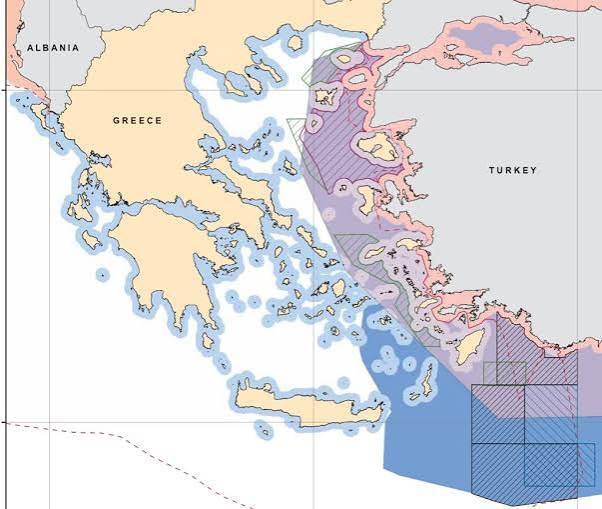
The assumption of the above role presupposes the convergence of Turkey – Israel (and Turkey – Egypt), the exclusion of a military conflict between Greece and Turkey and the rapid resolution of the Cyprus problem. Despite the efforts of the USA, the rapprochement between Turkey and Israel is considered difficult for the foreseeable future as the conflict of interests between these two states is taking on a structural character. Turkey is escalating its challenges towards Greece with an air of "strong" and "necessary" for the West. The imminent passage of the Bill within the framework of the "Blue Homeland" is estimated to further intensify the challenges, especially in a pre-election period for Greece. In the volatile Cyprus problem, Turkey insists on "two sovereign and equal states" while Greece and Cyprus remain in the position of a "Bizonal Bicommunal Federation". The UN Special Envoy Ms. Holguin is already talking about mutual compromises, while the visit to Cyprus of UN Secretary General Antonio Gutierrez emphasizes the interest in resolving the Cyprus problem. It is understood that pressure will be exerted for a loose Federation which will practically be a Confederation catalyzing the Cyprus Republic. The acceleration of the resolution of the Cyprus problem, under pressure and on terms not favorable to Hellenism, carries obvious national risks.
Greece should have steadily dismantled Turkish claims, provocations and schemes in the wider region. Expensive aid to Ukraine is largely neutralized as long as it is not accompanied by a steady and methodical dismantling of Turkey. On the contrary, Greek-Turkish relations are characterized by joint Declarations, summit talks and an excessively warm climate (hugs, kisses at the Foreign Ministry level and "fraternal" addresses, etc.). The greatest diplomatic mission is to reinforce to Western partners that Russia's practices in Ukraine have long been applied in Cyprus, the Aegean, the Eastern Mediterranean and the Middle East by occupying Turkey, which with its destabilizing policy, its close relationship with Eurasia and its support for terrorism constitutes an unreliable and dangerous ally for Western interests.
Given the current situation, relations between Greece and Turkey are zero-sum relations. Any approach to this country without prior "red lines" gives it an "alien" look, facilitates it and at the same time causes skepticism and distrust in our country's strategic partners. Relations with Turkey should be characterized by equality and reciprocity. In any case, the exercise of full sovereignty (e.g. territorial waters, Cyprus issue) and sovereign rights (e.g. maritime zones) through the undertaking of a series of initiatives and within a defined timeframe should be a basic National Goal.
The country's alliances and strategic partnerships need to be re-established, strengthened and exploited. In particular, relations with Israel need to be deepened. In this context, the laying of the GSI program cable, the relaunch of the EASTMED program, the coordination of actions of the two communities, the joint production lines of defense equipment and the vigorous dismantling of Turkey contribute to the credibility and duration of this strategic partnership.
Our country must develop (if it has not already done so), pre-planned responses to any possible challenge and especially to non-military hybrid challenges. For example, the extensive, uncontrolled and illegal Turkish fishing even in our territorial waters, as well as the frequent harassment of our fishermen, remain unanswered. The passage of the "Blue Homeland" Bill and its attempted implementation will cause a multitude and variety of daily challenges to which our country must now decide how to react.
The Cyprus issue is experiencing the attempts of a lack of a relevant strategy and the related slippage of Greek positions, through endless talks, from an international issue of illegal invasion and occupation to a bi-communal issue in which, moreover, the settlers of the occupied countries are much more numerous than the Turkish Cypriots. Hellenism must decide on the final desired situation in Cyprus (e.g. Strong Federation; Partition; New or worse Annan-type plan; Liberation; Dissolution of the Republic of Cyprus; etc.). It must also decide on the “red lines” that it will clearly set in each direction (e.g. occupation troops; Guarantor powers; Settlers; Community acquis; One and unified political entity; Alternating Presidents; etc.). Greece should declare everywhere that the difference with Turkey is not only one (EEZ and continental shelf) but two (Cyprus issue) because Cyprus is a national center of gravity, 1/10 of the Greek population lives there, obligations and rights arise from Greece's institutional role as a guarantor power and, above all, Cyprus is a National Vital Interest. At the same time, the quantitative and qualitative defense armor of Cyprus is not enough to have a defensive character but should acquire purely deterrent offensive characteristics with urgent procedures.
Hellenism must finally realize that it dominates geographically in the Eastern Mediterranean and in combination with its commercial shipping is entitled to claim an important role in this region. It is estimated that no state other than Turkey will object to this. Our country must implement its defense and energy policy without hindrance and with courage, taking advantage of the favorable conjuncture of interests convergence with the energy and commercial interests of the West (e.g. Abraham and IMEC treaties).
It is time for decisions and trials. On this path, political unity, the spirit of Hellenism and the readiness of the armed forces (AF) are required. The armament program of the AF and the defense industry must be continued with a bipartisan will in order to eliminate the "political cost" and to ensure continuity. There must not be the slightest hesitation in developing our military forces with purely operational criteria. However, armaments are no deterrent if they are not combined with adequate, trained and determined personnel. In this context, an immediate completion of the AF ceiling, continuous and realistic training and a complete revision of the institutions of service and reserve are required.
Investing in the Greeks of the territory and the diaspora means nurturing them with appropriate values and standards, appropriate education with an obsession with the Greek language and our unrefined History, a sense of security in the border areas and the alertness of public opinion. Given that nothing educates like example, it will be difficult to convince our fellow citizens if they do not see the strong will and practical contribution to the common good of the representatives mainly of the political, military, academic, business, scientific, cultural and sports spectrum as well as their offspring. The Greek people expect the said elite of politics, the intellect, money and culture to be possessed of a high morale, a spirit of solidarity and sacrifice, starting from the willing service of their entire term in critical border areas, without asterisks.
29 – July – 2026
Vice Admiral (retd) V. Martzoukos PN
Honorary Commander of the Hellenic Navy
Vice President ELISME