

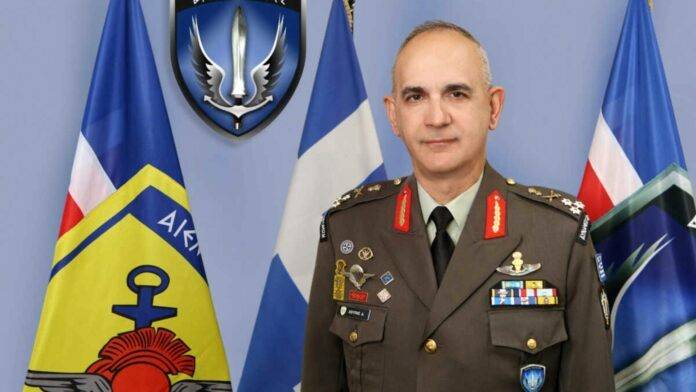
Dimitris Choupis to "K": This is how we designed the new structure of the Armed Forces.
The Chief of the Hellenic National Defense General Staff, in his interview with "K", analyzes the new philosophy of the country's Armed Forces and explains why he believes that today they can respond more quickly to a crisis similar to that of 2020.
Vasilis Nedos
The Greek Armed Forces can respond even faster to a crisis similar to that of 2020 based on the new capabilities they have, says Chief of the Hellenic National Defense General Staff Dimitris Choupis in an exclusive interview with "K".
The new capabilities of the Armed Forces, as he says, highlight the natural advantage that the island relief of the country, while at the same time gaining the ability strategic blow.
Mr. Houpis characterizes the relations of the Armed Forces with those of Israel as a strategic marriage and mutually beneficial.
On Thursday, the Prime Minister presented the 12-year Long-Term Defense Equipment Planning to Parliament. What is their philosophy?
– It is gratifying that for the first time, under the direction of the political leadership, a program that is essentially long-term is being implemented in practice. So far, we have not done the logical thing. That is, starting from the threat, reaching the operational requirements imposed by this threat, then moving on to the equipment that covers the operational requirements and consequently reaching the staffing of all these capabilities.
If this unambiguous relationship is disrupted, a huge problem is essentially created. If we were to proceed with a major armaments program, for example, to first buy 1.000 self-propelled guns and build 50 units, a problem would arise because we would then have to see if we really needed them and if we really had the people to staff them.
So we proceeded with the design of the New Force Structure and then we reached the equipment and not the, incorrect, reverse that was done until recently.
The Prime Minister and the Minister of National Defense were the first to give the signal for the promotion of this new reform framework.
– A general secretariat for National Security has been announced. What role will it have?
– It will be the upgraded presence of the Security Advisor at the side of the Prime Minister, in the National Security Council and in all aspects of the inter-ministerial role and coordination that national security requires. Information travels very quickly and information management is of key importance.
– Information management is, I understand, also central to the design of equipment…
– Indeed. Essentially the entire Command and Control or Fire Command or Capability Command network will operate in a way that, network-centric, all decisions to be executed quickly. And, of course, this information will be critical so that the small leaders in the field, the leaders, can act immediately and without delay based on their responsibilities and authorities.
– Does the reduction of units aim at this flexibility?
– There was an organizational structure that was sparse in terms of staffing. And the readiness and availability time of these departments in relation to the crises we were expecting was not capable of giving us the result in the place and time needed.
– There is also an attempt to reform tenure, but mainly the reserve system.
– The system will move away from the old form of calling reservists. They will be directly connected to the unit. The unit will be able to very quickly, using various tools (such as gov.gr), communicate directly with the reservist. To do this, the relationship with the unit and the formation must be active to a significant extent. Above all, of course, it must be noted that this connection will be due to the voluntary participation of the reservist and not mandatory for everyone.
– Can deterrence capabilities be increased through the EU?
– The future of our defense planning, both at national and European level, does not lie only in increasing the budget, but also in aligning our efforts to comprehensively strengthen the defense capabilities of the EU. Those who are charged with these decisions must realize that Europe needs brave decisions to continue its historical path. Europe must face the many security dilemmas. It must take into account that hope is by no means an effective strategy. Ultimately, History is written and always honors the winners.
– The war in Ukraine offered lessons…
– Indeed. After a very long period of wear and tear, there are no significant territorial gains. Because the fight on the ground gives special weight to the fighter as a unit on the battlefield. In too many cases we see that a fighter with a terminal can put an entire unit out of action, which is essentially very difficult to command and control.
Then, an additional lesson is that drones, the mobile munitions, at very low cost, achieve strikes at a very great depth of strategic value. And this is done daily through the development of innovation and tools produced during the battles.
In other words, operational needs emerged from Ukraine, to which innovation provided solutions. This was done with drones, surveillance, geospatial, the power of satellites, and the provision and utilization of information.
Essentially, the time from detection to attack has been reduced, as has the ability to react.
There is a prerequisite for all of this: Administrators must be given the flexibility to make decisions within their rank and position.
We saw on the Russian side, an unmanageable decision-making mechanism. Also, deep strikes, whether with drones or strategic missile weapons, have created a long-range attack environment. Often this is done in combination with space-based communications and information.
Furthermore, the Black Sea has become a lake and naval forces are trapped and bound by the capabilities that exist. The same goes for strategic installations on land.
Generally, innovation eliminates equipment within an hour.
– How do we bring the lessons of Ukraine to the Greek field?
– We look at what is necessary in our own environmentThe entire armament program aims to adapt to this new geostrategic environment.
We have an environment with many islands. Each island as a land area will contribute to air defense, freeing fighter aircraft and surface units from the exclusive role in the Aegean or the Eastern Mediterranean.
With air defense, missile artillery, anti-ship and anti-ballistic missiles, and anti-submarine capabilities, the country's geography is utilized. We ensure our deterrent capability. And at the same time, we do not lose our ability for strategic strikes in depth.
-We also have strategic weapons in the equation now...
– Yes, with capabilities of many hundreds of kilometers, up to a thousand. At the same time, the installation of its systems "Shield of Achilles", enables missile strikes, as well as electronic warfare. The blurred not only does it destroy with bullets, but it also has electronic attack possibilities which will be used in case of saturation of a target.
Of course, there is also anti-aircraft and anti-missile capability in the new units of the Navy. An FDI frigate has a 180 kilometer radius around its physical size. Therefore, capabilities are being developed throughout the area of our geostrategic interest, from Crete to Cyprus and also in the Aegean.
– In 2020 we experienced a crisis. In 2025 are we in a better position in terms of capabilities?
– Our capabilities now provide a natural advantage that in any case determines a much better crisis response environment. Our response can now be faster. Our relationship with Israel has strategic depth
– What would you say to a young man who is 18 years old and wants to pursue a career in the Armed Forces?
– Both my sons and my son-in-law are young officers. It was their personal choice. I have served as a commander at the Cadet School and I will tell the young people today what I used to tell the parents of the students. First of all, it is their own choice. It is not a place that can lead to enrichment and is governed by certain principles and values.
The latest government initiatives ensure that officers will have a decent living so that they can be free to carry out their duties without stress. This, of course, should not lead to a civil servant relationship with the service.
The officer must be dedicated and dedicated to the service. The road has a mission: devotion to duty. For us, patriotism is not something vague. It is directly connected to the supreme good, the sacrifice of life for the homeland.
– The new form of the Armed Forces requires the introduction of new specialties into the production schools, for example information technology (IT).
– The new weapons systems must have operators with the ability to handle them. And they will. They will graduate from the Higher Military Educational Institutions trained. Of course, as technology advances, there should also be what we call lifelong learning, lifelong knowledge. And at the same time, there will be some limitations. When the homeland has spent some money and effort to train an officer who will handle a specific system, he should not be able to get this know-how outside the Armed Forces. In other words, the officer remains primarily an officer. It is a moral contract with the homeland.
– The involvement of the domestic defense industry was discussed. What can Greece do?
– A few, but serious defense companies in Greece export to 120 countries around the world, without us buying. These are companies that withstood the crisis, gave work to many young scientists, in other words, they showed that there is room. We want people to produce and support this entire armament program.
– How close are our relations with the Israeli Armed Forces?
Too narrow. It is an alliance with a very future and very solid foundations. Greece and Cyprus give a strategic depth to this relationship and for the nation of Israel. In the Armed Forces there is strategic planning in depth, in relation to the capabilities that we can develop with Israel. It is a marriage that is mutually beneficial for both nations. The Israeli Armed Forces operate on the basis of an assumption: As if there is no next day in the field of operational alertness. I think we too must set an example. And think about how we too can adapt, in relation to the threat we face.
Everyday