

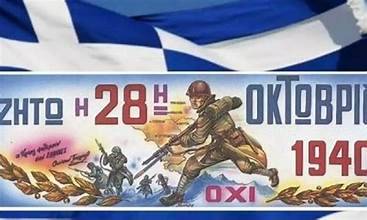
ELISM/ANNIVERSARY SPEECH ON THE EPIC OF 40.
ELISM/ANNIVERSARY SPEECH
TO EPIC OF 40.
Thursday 23 Oct. 2025
Antgos (n.a.) Ioannis Baltzoi
The purpose of national anniversaries is to immerse ourselves in their names, with a disposition for reflection and contemplation, so that we can draw on their message, experience their historical lesson and responsibly determine our own debt, our own obligations. Because only with historical memory and the correct evaluation of historical experience, can we create the conditions for our national survival.
THE SITUATION BEFORE THE WAR.
The victors of World War I believed that they had consolidated peace and a balance of power with the peace treaties and the establishment of the League of Nations. Many agreements were made during the interwar period by many states, which ultimately did not help to avoid war. Greece concluded a Treaty of Friendship with Italy in 1928, a bilateral agreement in 1930 and 1933 with Turkey, for mutual border guarantees, and in 1934 the Balkan Pact was signed. However, the geostrategic aspirations of the Great Powers had a conquering orientation. Italy wanted the dominance of the Mediterranean, Germany for the hegemony of Europe, Russia for world hegemony, through world revolution, and Japan for the dominance of the Pacific. France, Britain and the US were pursuing a policy of defensive isolation, which essentially neutralized their contractual obligations of collective security and annihilated the League of Nations. I would say that we have a similar case with aggressive and uncontrolled Turkey.
In France, the spirit of passive defense prevailed, 12 months of service was enough and strong armed forces were not needed. And among the people, the famous slogan "porquois = why" prevailed. In England, they discussed whether compulsory service should be established and they reduced defense spending. And in the USA, with the mistaken perception of isolationism, they had surrendered to the bliss of neutrality and the security of the Pacific and Atlantic Oceans. And yet, when the serpent's egg was broken and the Nazi monster appeared in its hideous guise, both Daladier's France and Chamberlain's England tried with the mistaken policy of appeasement to appease the beast, caressing it, in the direction of the fur, or signing ephemeral agreements, refusing to realize that this policy leads directly to the opposite result, namely total war.
This passive strategy towards the Western powers ultimately provoked World War II, because it solidified Hitler's belief that he could conquer central and eastern Europe without the reaction of the Western powers. The initial seizure of the Sudetenland and the conquest of all of Czechoslovakia in 1938 strengthened his belief that he was free to proceed with his plans of conquest. The wars in Ukraine, in Gaza, where with current developments there is a glimpse of hope for ending the war with President Trump's 20-point plan, Iran with its proxies in the Middle East and their neutralization by Israel and who else, the current revisionist and aggressive stance of Turkey, a pirate country, which today has invaded or uses military force in many states (Iraq, Syria, Cyprus, Greece, Libya, Nagorno-Karabakh and internally with the Kurds), is strongly reminiscent of this period of the end of the interwar period, which prevailed in Europe at the time.
THE BIG NO
On October 28, 40, with a stern ultimatum, delivered by the Italian ambassador at 03:00 to the governor of Greece, Ioannis Metaxas, Mussolini requested the governor's passport for immortality, he demanded the unconditional surrender of eternal Greece, he demanded that its glorious past be erased, ignoring its history.
Italian Ambassador Emmanuelle Grazi wrote in his book “The Beginning of the End – the Operation Against Greece”: “As soon as we sat down, and since it was a few minutes after three, I immediately told him that my Government had assigned me to personally deliver to him a text, which was nothing more than Italy's ultimatum to Greece, with which the Italian Government demanded the free passage of its troops through Greek territory, from 6 a.m. on 28/10/1940. Metaxas began to read it. Through his glasses, I could see his eyes watering. When he finished reading, he looked me in the face, and in a sad but firm voice he said to me: "Alors, c'est la guerre" (So, we have war)). "
Graci: "Pas nécessaire, mon excellence" (not necessary, your excellency) - Metaxas: "Non, c'est nécessaire" (no, it is necessary). This NO of the Prime Minister became a Flag, a symbol, a cry in the mouths of ALL Greeks and was transformed into the slogan AIR during the counterattacks of the Greek army on the Epirus front, on the path to a magnificent victory, with catalytic developments of unparalleled importance for the Allied forces and the final outcome of the war.
Before their ultimatum had even expired, the Italians had launched their attack. On the battlefield, the 21st outpost of the Greek-Albanian border, on the Golio hill, near Pyrsogianni, Ioannina, was the first target. There, the first Greek soldier to sacrifice himself for the homeland in the epic of '40 fell dead. Vasilios Tsavaliaris from Pialeia, Trikala, who according to information had enlisted voluntarily, lost his life at the age of 28 in the trenches, at 5 am on October 28 as the Italian soldier's bullet found him at the front and killed him.
The Greek people, defying then numerical analogies and realistic calculations, as some still invoke today for Turkey, celebrated the glorious past and the greatness of the race. It confirmed once again that greatness in peoples is measured by the fighting spirit, the decision to sacrifice and "the burning of the heart". The cry of "AIR" scattered, like autumn leaves, 5 of the 9 Italian well-equipped Divisions, of the two Army Corps, the XXV SS Tsamouria and the XXVI SS Koritsa. Of these, approximately 14.000 fell dead in the frozen mountains, 18.000 were wounded and useless from frostbite and 13.000 were captured. They were the first victories of the free world. The beginning of the crushing of fascism from the Greek side was made with the heroic Epirus VIII Infantry Division reinforced with various Units and Groups, which had in its sector the entire Epirus front, with Major General Charalambos Katsimitros as Commander. It should be noted that Greece regularly deployed defense along the entire border from Epirus, to Macedonia and Thrace, with 5 Army Corps, of 2 to 3 Infantry Divisions, total strength after mobilization of approximately 300.000 men. On the Epirus and Thessaly front was the 1st Army with the 2nd-3rd and 8th Divisions, which faced 5 Divisions out of the 10 Italian Divisions.
Thus the Greek epic of 1940-41, which began with the terrible battles in Epirus, continued with the unequal defensive struggle at the Metaxa Forts and ended with the heroic resistance on the island of Crete, lasted a total of 216 days and changed the course of war events against the Axis.! To understand its significance, it is enough to remember that, by the summer of 1940, Austria, Czechoslovakia, Poland, Norway, Denmark, Belgium, the Netherlands, France - that is, most of Europe - had been subjected to the iron violence of Nazi Germany. France was occupied in 45 days, Belgium in 18, the Netherlands in 5, while Denmark succumbed in 12 hours. Austria, Bulgaria, Hungary, Romania and Albania surrendered without a fight.
The heroic resistance of Greece was the first to shatter the myth of the Axis' invincibility. The consequences were catastrophic. They were delayed by the Battle of Crete, the planned Operation Barbarossa, when Hitler mobilized a war machine the likes of which the world had never seen before: 3.700.000 soldiers, 2.600 tanks, 7.000 guns and 2.700 airplanes, resulting in Nazi Germany being defeated on the Eastern Front, culminating in the Battle of Stalingrad and becoming the beginning of the end of the Nazi defeat and the end of the war. And the words of General Yannis Makrygiannis, from the 1821 revolution, come to mind: "Fortune has always had us Greeks in the minority. "First and foremost, from ancient times to the present, all the beasts fight to eat us and cannot. They eat from us and there is yeast left. And the few decide to die. And when they make this decision, they rarely lose and many win."
FINDINGS – CONCLUSIONS.
Analyzing the military operations and their results, the following can be found:
A. The General Staff's choice of the "Elaia - Kalama" defense location was successful.
B. The Italian plan of operations against Greece, as a strategic concept, was masterful. However, it failed in its implementation, due to errors and omissions on the part of its leadership.
ΓThe main mistake of the Italian Administration was its over-optimism and at the same time its underestimation of the opponent., as well as the capabilities of the Greek Army. Thus, he committed the following disastrous mistakes:
- They launched the attack on the eve of the winter season, resulting in reduced performance of both aviation and tanks.
- He did not provide the main effort in Epirus with comparable forces., having only five of the ten Divisions.
- The Italian forces had, at the start of the operations, 10 Infantry Divisions, 1 Armored Division, 1 Cavalry Division, 4 Versailles Regiments and 8 Albanian Battalions. The Greek First Army Corps had 3 Infantry Divisions.
- The Italian leadership and its troops suffered a great surprise due to the amazing resistance of the Greek forces., since the belief and climate of optimism that possessed everyone was that it was a healthy walk and in 2-3 weeks they would be in Athens.
D. A fatal mistake for the Italian command was the rigidity of the operational plan, in contrast to the Greek plans, which were flexible and adaptable to the demands of the struggle. and were implemented with great successThe Italian administration insisted on the main direction, on the central Kalpaki-Ioannina axis. and did not exploit the success of secondary directions, resulting in continuous attrition and ultimately defeat. The Southern Coastal Axis was a success and a forerunner, and the Northern Axis suffered a split with the Julia Division in the Metsovo area, resulting in the Cavalry Division intervening decisively and scoring the first victory against the Axis in Europe in early November, and this was a Greek victory.
E. The attacking Italian forces attempted to break up the Kalpaki position into formations more of a parade than an attack, thus making themselves an excellent target for the excellent Greek artillery., with its amazing accuracy and effective fire.
St. It is clearly demonstrated that material power alone is not enough to subdue a Nation, who rises up together and decides voluntarily to secure his freedom.
G. whereas, Finally, the myth that the Italians did not fight bravely and that is why the Greek army won must be dispelled. On the contrary, both the Italians and the Greeks fought bravely, fought fierce battles, and the battle at Hill 731 was the modern Thermopylae of Hellenism. and this is proven by the large number of dead and injured on both sides.
EPILOGUE
On the occasion of the anniversary of the NO and the epic of 1940, let us look to the future with optimism. With optimism and love for the homeland, may uncertainties become opportunities. Let us be responsible successors of our heroic ancestors. The invisible shadows of our heroes accompany us, the total number of deaths throughout the entire struggle was 13.936 and the number of injured and missing was 41.217. And there is an urgent need, 85 years later, to find all 7.989 of our dead who fell in Northern Epirus, where very few are today buried in only two organized Greek Military Cemeteries that exist in Vouliarates and Kleissoura, and to honor them as the morality of every people, as well as the Greek tradition, dictates. 85 years and still thousands of heroes are buried in mass graves, in many places in Northern Epirus and constitute the HYBRIN of modern Greece. And let us remember the naval battle of Arginoussa at the end of the Peloponnesian War (406 BC), when the Athenians executed the victorious generals who left the shipwrecked people helpless and did not collect the dead due to rough seas.As an Epirusian and as a Greek, I cannot accept the excuse that Albania did not allow us for so many years.
The epic of 1940 did not end with the end of the war. He left us as a legacy the spirit of national resistanceThis heritage reminds us of the power of unity and heroism, even in the most difficult moments, as we saw in 1940, when all Greeks, regardless of ideology, profession, or spiritual culture, found themselves together, side by side in the fortifications, but also in the heroic assaults on the snow-capped mountains of Epirus, fighting dearly and devotedly for their homeland.
Freedom is not a given. It is something we must constantly claim and protect.
Today we honor not only the heroes of the past, but also the legacy they left us. Let us renew our promise to preserve freedom and dignity, like those who fought so bravely in 1940.
I will end with two examples of the Greek soul:
According to the front page of the then newspaper "AKROPOLIS", the world's youngest corporal, 13-year-old Anastasios Charalambopoulos, was enlisted in the 1940 war. The little boy was found in the luggage compartment of a train that arrived in Kozani carrying soldiers. He then declared that he wanted to go to war with his father, who was on the train. Eventually, his father took him into his company and he fought on the front lines when the Greek army entered Korçë.
I would like to end with a letter from a Greek mother in 1940, sent to the country's prime minister, which proves all of the above and makes you feel emotion and national pride:
"To the Prime Minister, Mr. A. Koryzin"
My son Evangelos Ioannou Ioannidis was lost in the operations of Kleisoura. I ordered the four already serving Christos, Kostas, Georgios and Nikos Ioannou Ioannidis to avenge the death of their brother.
I am keeping four others in reserve: Pan, Athanasius, Gregory and Menelaus Ioannidis, class of 1917 and newer.
Please call them by name in any case of need for the homeland or any loss of another of my children to avenge an enemy.
You know, our king, that my final exclamation is: Long live the Fatherland!
Eleni Ioannou Ioannidou, Kyparissia, February 2, 1941"
Eleni Ioannidou has been honored by the Local Union of Municipalities and Communities of Attica and the Municipality of Kyparissia, under the auspices of the Hellenic Parliament, where she was declared "symbol of the Greek mother of the Epic of 1940" and in 2009 her statue was unveiled. Thank you very much.
Long live the epic of 1940,
Long live our Armed Forces
Long live Greece!