

The Hellenic Navy's need for new ships and how an old proposal can become an opportunity for its rebirth.
The Hellenic Navy's need for new ships and how an old proposal can become an opportunity for its rebirth.
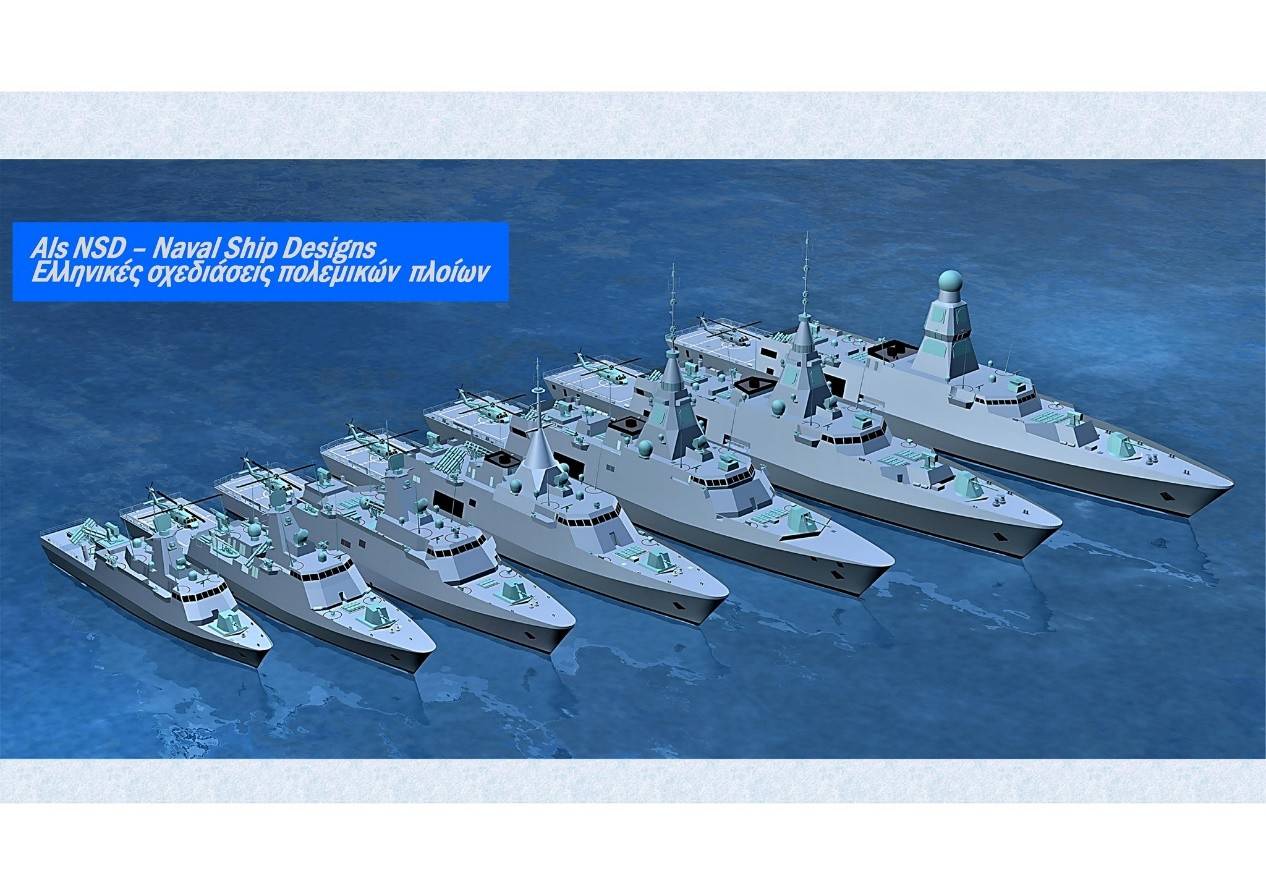
Source image: website, "ALS NAVAL SHIPS DESIGN".
The vessels we see in the picture are NOT designed by a foreign company, but are designed by the Greek company ALS NSD, i.e. Naval Ships Design. This company, about fifteen years ago, had designed a series of vessels, which were in accordance with the specifications set by the Greek Navy at the time and at that time the effort was called the creation of the "National Ship". This effort aimed to make the Greek Navy self-sufficient in terms of its needs for new vessels and of course would put our country on track to join the club of countries that build warships and have the ability to export them.
Unfortunately, this effort was abandoned by the Greek state, for many and various reasons, mainly due to the economic crisis that hit the country at that time and its entry into the disastrous memoranda, which did not leave the Defense of the Country unaffected, and this is because the then political leaders of our country and we refer to all the memorandum governments, initially had the "brilliant idea" and then accepted the proposals of the lenders, the troika or the institutions, as they characterized them, you can call them whatever you want, to cut spending on the country's defense, something that happened for the first time in similar cases. I am writing this because never in any country that has resorted to the IMF for financial support, have there been any cuts in defense spending!!!
Since then, however, a lot of "water has flowed into the gutter" of the Greek economy and our country has come out of the memoranda and is slowly, slowly attempting to rebuild the National Defense. In our Air Force, small but targeted steps have been taken and continue to be taken to regain its air presence and this has been achieved to a certain extent, with the upgrade of 83 F-16s to Block72 level, known as Viper and our intention to continue this upgrade to the remaining 38 Block 50s, to Block70 Viper level, the 24 Rafales and the future addition of 20 F-35 Lightning IIs, the PA will have the upper hand in the air. But what is happening at sea?
The development of the Navy.
Here things are a little more "difficult" and this is because for many years, even before the country entered the memoranda and the cuts in defense, our Navy had been left to its own devices over time, literally, and the fleet of surface vessels had begun to age to a dangerous degree, something that made it obsolete, for the modern requirements that a country has for the defense of its sovereign rights, let alone for their use in the field, even if this is ever necessary. Here things seem to be changing, with the purchase of the four French FDI HN frigates, "Kimon class", known to the general public as Belharra, which with the enormous capabilities they have, due to their ability in triple combat, that is, in the anti-submarine warfare, due to the excellent sonar they have, but also the anti-submarine helicopter they are able to carry, the surface race, due to the excellent and advanced weapons they carry against surface ships, and mainly in the area air defense, make them a "game changer" weapon.
However, the Greek Navy did not stop at the purchase of French frigates and proceeded to another step towards its modernization, which is NOT other than the start of negotiations with the Italian government, for the purchase of FREMM-type frigates, Bergamini class, which may be technologically a step behind the French Belharra, but are modern ships, the oldest has been operating in the Italian navy since 2013 and was built in 2010 and the fourth, which the Greek Navy has "closed" to acquire, has been operating since 2017. These vessels will strengthen the capabilities of the French frigates, in the air defense of the area, but mainly in the anti-submarine warfare, since three of the four frigates that will be acquired, carry a towed variable depth sonar, while in the The fourth one has the possibility of adding the same sonar, plus installing a sonar on the hull, where there is the relevant space. In the other three, the existing hull sonar will be removed and a new, more modern one will be installed in its place, identical to that of the first one. However, the Italian frigates are superior to the FDI HN, in this respect, they have the ability to carry two ROMEO anti-submarine helicopters, compared to one on the French ones.
What should be the next steps of the Greek Navy?
As we said, the Hellenic Navy has taken its first steps towards its modernization, which will once again give it the opportunity to have the upper hand in the seas of the Southeastern Mediterranean basin. But what would make it invincible and absolute dominant in this very unstable and unruly corner of the planet? The answer is SELF-SUFFICIENCY. But how can this happen? This can happen by stimulating the domestic Defense Industry. At the beginning of our article, we talked about the Greek shipbuilding company, ALS NSD, and we said that it had submitted a comprehensive plan for the construction of the National Ship, which covered the then needs of the Hellenic Navy, as well as the Coast Guard, since in the plan it had submitted, it also presented small, but also open-sea vessels, which were intended for the Coast Guard. But let's focus on the PN which is the central issue. The company, at that time, had presented a complete "family" of vessels consisting of 1. Small combat vessels, which started at 530 and ended at 3011 tons. And 2. Three Area Air Defense Frigates.
What is its "boat family"? ALS and what they can offer.
But let's go see what these categories included and what needs they would cover. The first category, as we said, was that of small vessels starting from 530 and reaching 3011 tons. The first vessels of this category, namely the ALS 55, of 530t, ALS 65 of 887t, ALS 85 of 1695t, according to the company's proposal, would cover the needs of the Navy, and the ALS 95 of 2110t, ALS 100 of 2370t, ALS 105, of 2798t, and ALS 110 of 3011t, would cover the needs of the Navy in offshore patrol vessels and the Navy in small surface units, namely from missile boats to light, armed corvettes.
The second category of vessels proposed by ALS is that of the FAP vessels, i.e. Area Air Defense Frigates, which include three different types of vessels, the ALS 115 of 3850t, the ALS 125 of 5038t and the ALS 140 of 5922t. Here things are somewhat different in terms of the capabilities of these platforms, as they were presented at the time. The ALS 115 of 3850t could play the role that the LCS of the US Navy currently play, but mainly the role that the French aspire to play. gowind and with the appropriate configuration of weapons and electronic means, they would be more successful in this role than the similar vessels of our allies - partners.
The other two types of vessels in the ALS frigate family, namely the ALS 125 and 140, were intended for the ALS 125 to be a frigate with area air defense, anti-submarine warfare and anti-surface warfare capabilities, just like the FDI HN and even with a larger displacement, and therefore usable space, I remind you that the French ones have a displacement of 4500t. while the ALS 125, according to the proposal, would have 5038t!!! Finally, the ALS 140 of 5922 tons, according to the design, would be a heavily armed frigate, which would offer greater area air defense capabilities, due to their greater displacement and therefore more usable space, which would allow the Navy to request the addition of more anti-aircraft missile launch cells, and SCALP NAVAL or ELSA type missiles, this type of missile is in the development stage. I remind you that the FDI HN, which are 1422 tons smaller in displacement, have the ability to carry 32 cells for ASTER30. Therefore, the ALS140 could carry at least 48 and under certain conditions 64 ASTER 30 or one, and they will operate in combination with the above vessels, to carry 32 ASTER30 and 8 SCALP NAVAL or ELSA and even be armed exclusively with SCALP NAVAL or ELSA for strikes against strategic enemy land positions, depending on the mission they could undertake.
What will the country and the Navy gain from domestically produced vessels? (Economy of Scale).
The benefits that our Country will gain from such a development are multiple. 1. As we said, the Navy will gain self-sufficiency and permanent support and timely upgrade of its platforms. 2. It will have the ability to renew the fleet's potential with new vessels at any time, due to continuous development. 3. With the ability to renew the fleet more quickly, the older vessels will NOT lose their post-political value and thus there will be another additional income. 4. In the event of the construction of the "National Ship", there will be gradual uniformity in the fleet, which translates into savings in personnel training, because all these vessels will share common systems and therefore additional training will NOT be required to transfer the officer to another vessel. 5. Saving money, for the purchase of weapons, for the same reason as the above. The above reasons, in economic language, are called "economies of scale", that is, the more units you buy, the lower the price per unit, as well as the cost of training staff. 6. Exports, which will stimulate the Greek economy, because it will provide it with revenue from sales, as well as jobs, during the construction process. 7. With the above resource savings, the National Police will have more money for the development of new programs, which will improve both the daily lives of its executives and its deterrent power. 8. The construction of ships for military use will also involve other sectors of the defense industry, such as the production of weapons systems, both for surface ships and for the Army and Air Force, which in the future will make the entire army self-sufficient in military equipment and 9. An overall dynamic development of the country's defense industry will add additional revenue to the state budget, so that the state can finance its own needs, mitigating foreign borrowing, which will make the Greek economy very sustainable in the long term.
The old proposal is an opportunity for today.
Taking all of the above into account, one could say that the proposal of the Greek company ALS NSD is a comprehensive proposal that covers the current and future needs that our Navy has and will continue to have. At the same time and given the intention, at least as expressed by the Minister of Defense, Mr. Nikos Dendias, to stimulate the central role that the domestic defense industry should have, the proposal of ALS Naval Ship Designs is a proposal that it would be good for ELKAK, i.e. the Hellenic Center for Defense Innovation, to re-evaluate, together with the staff of the Hellenic Navy, who are in charge of the modernization of the fleet and in collaboration with the company, which has the designs of the vessels ready and with the appropriate modifications that will need to be made to the original designs, to make the entire series of these platforms ready to play the role that they will be called upon to have, in the modern and demanding naval, anti-submarine and anti-aircraft field and to be able to defend the Greek and Cypriot territory from end to end and Of course, they must be able to stop any thoughts of our neighbors, both about the "blue lot" that they envision, and the questioning of our national sovereignty in the EEZ and island country, which they do, in words and deeds, whenever they are given the opportunity.
Of course, to be more precise in what we write, both the Hellenic Navy and the Hellenic Navy staff should examine other factors together with the company, such as the possible involvement of other companies in the implementation of the project, such as electronic systems, weapons, mechanical and other components companies, so that the project is complete. Also, the entire shipbuilding process could start with vessels for the Coast Guard and auxiliary vessels for the Hellenic Navy, so that, there, they can see the possible failures and problems that may arise and subsequently correct them and later proceed to the construction of large surface units. A final suggestion to the Hellenic Navy and the Greek Ministry of Defense would be, on the occasion of the discussions with the Italian Fincantieri, for the purchase of the FREMM frigates, that our country should sound out the Italians, for the purchase of their designs, the transfer of know-how to Greece, so that our country can proceed with a proven shipbuilding plan, which was its central goal two decades ago and with the appropriate modifications to become a modern warship, of domestic production. Let us note that the US Navy, for the construction of the Constellation class, which the Greek Navy also wants, are based on these designs. Finally, a possible shipbuilding of a "National Ship" will have a beneficial impact on the Greek economy, for the reasons we mentioned above.
Athanasios I. Demetriades.
Member of the Hellenic Institute for Strategic Studies.
(EL.I.S.M.E.)