

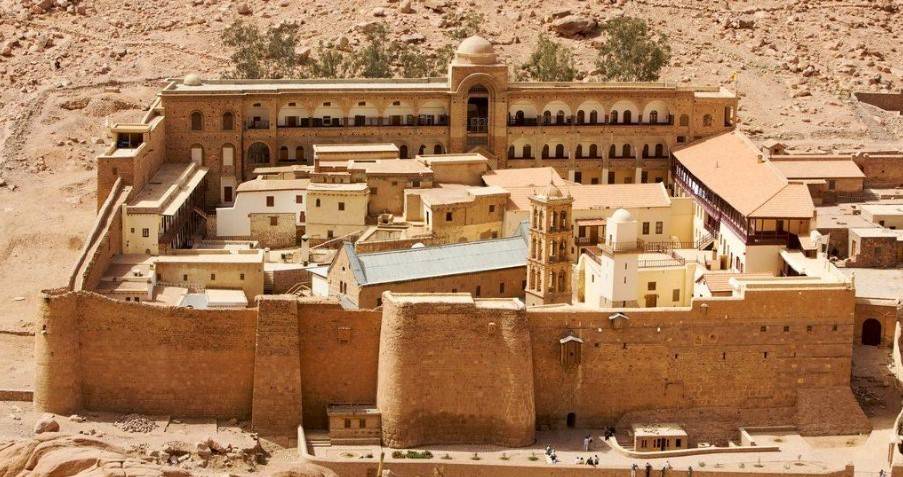
MOUNT SINAI AND THE UNACCEPTABLE DECISION OF THE EGYPTIAN COURT
Sinai Monastery, officially known as the Monastery of Saint Catherine, is one of the oldest and most important Christian monasteries in the world, with a history that dates back to the 6th century AD.
It is located at the foot of Mount Sinai, in Egypt, at the point where, according to the Old Testament, Moses received the Ten Commandments.
The Monastery is also associated with the Burning Bush and Saint Catherine of Alexandria, whose relics are kept there.
It has a huge number of important manuscript relics, etc. and the second largest and most important library after the Vatican.
The Monastery is administratively under Egypt, but it is a global cultural and religious monument, with close ties to the Greek Orthodox Church and the Patriarchate of Jerusalem.
Its monks are predominantly Greek, a fact that lends a special international dimension to the operation of the Monastery.
At the same time, the Monastery has historically had good relations with the local Bedouin tribes who contribute to its security and preservation.
The decision taken on May 28, 2025 by an Egyptian court concerns the Monastery of Saint Catherine in Sinai and has caused strong reactions both in Greece and internationally.
According to the information available so far, the court (after ongoing disputes) ruled that the ownership of the Monastery and its assets belongs to the Egyptian state, while the monks retain the right to use the premises to perform their religious duties, under the supervision of the state.
The decision is based on antiquities laws, with the Egyptian state considering that the Monastery's properties fall under these laws and, therefore, constitute public property.
This decision has caused wider concern, as it is considered that it may lead to the conversion of the Monastery into a museum and limit its religious function, which raises issues of religious freedom and the protection of cultural heritage.
WHAT IS PROVIDED BY UNESCO AND INTERNATIONAL TREATIES
1) According to the UNESCO Convention for the Protection of the World Cultural and Natural Heritage (1972), the state hosting the monument (Egypt) cannot treat it as property to be managed as it pleases, but as a global asset, under international supervision, since the Monastery is recognized as a monument of outstanding universal value for humanity.
2) Egypt, as a contracting state, is internationally committed to protecting, preserving and managing the monument without altering its character and integrity.
3) The decision to expropriate the property of the Monastery and restrict the monks contradicts the principle of preserving the authenticity and living religious function of the monument, as defined by UNESCO.
4) It violates religious freedom, as protected by international conventions (e.g., UNESCO Convention on Cultural Heritage, Universal Declaration of Human Rights, Rome Convention on Human Rights).
5) It endangers the sustainable operation of the Monastery as a living religious organization.
BILATERAL AGREEMENTS BETWEEN GREECE AND EGYPT
1) There are also agreements and protocols of cooperation between Greece and Egypt that recognize the Greek Orthodox character of the Sinai Monastery and ensure the free and unhindered exercise of religious duties by the monks. They provide for respect for the religious self-government of the Monastery, under the administration of the Orthodox Church.
2) In particular, during the recent visit of the Greek Prime Minister to Cairo (May 2025), the protection of the Monastery and the monks as a historical, religious and cultural institution of global importance was confirmed.
3) The court's decision appears to effectively negate these commitments, creating a serious diplomatic issue between the two countries.
THE AHTINAME OF THE PROPHET MUHAMMAD (Ahdname)
This is a historical document attributed to the Prophet Muhammad, which provides protection to the monks of the Monastery of Saint Catherine.
In the 2nd year of the Hijra (623 AD), the Sinaites sent ambassadors to Medina to request political protection. In response, Muhammad issued a "written obligation" / Testament (Ahdname), ratified with the imprint of his own palm, under penalty of excommunication.
With it, he asked the Muslims to defend the Monks, to leave them undisturbed in their religious duties, and not to collect taxes from them.
When in 1517 Sultan Selim I conquered Egypt and Sinai, he recognized and renewed the privileges of the Monastery, but kept for safekeeping in the royal treasury in Constantinople the original document of Achtiname, as it bore the handwritten ratification of Muhammad. Official copies of it survive today both in the Monastery's Treasury and in its Metochions in Greece.
CLAIMS OF THE EGYPTIAN STATE AGAINST THE MONASTERY
1) The Sinai Monastery, although revered as a religious and cultural monument, has never had legal recognition of full ownership of its lands and assets by the Egyptian state.
2) Since Egypt regained sovereignty over Sinai (after the Israeli withdrawal in 1982), there have been intermittent claims:
a) That the Monastery and its assets are subject to the status of “national antiquities” according to Egyptian legislation.
b) That the Monastery must obey regulations for the management of antiquities.
3) These arguments were periodically re-emerged through court cases involving:
a) Land ownership.
b) Tax issues.
c) Management rights of historical monuments.
4) During the Muslim Brotherhood's rule under Mohamed Morsi (2012–2013), Mount Sinai faced increased pressure:
a) There have been accusations (without documentation) that the Monastery is “violating” Egyptian law.
b) Tendencies towards nationalization of the Monastery were expressed, within the context of a more general policy of limiting the influence of foreign and non-Muslim institutions in Egypt.
c) This mentality of nationalistic and religious control seems to have laid the foundations for later claims.
5) The Monastery owns assets (land, buildings) not only within the monastery but also in other areas of Sinai, which were traditionally used to support the monks and pilgrims.
a) The Egyptian state has for years disputed the ownership of these properties, considering them public property. This laid the legal basis for the 2025 decision, on the grounds that:
b) The Monastery may operate as a religious site, but not as a landowner or an autonomous organization with administrative autonomy.
6) The monks and representatives of the Monastery argued that the historical operation of the Monastery as an autonomous religious institution, which was made possible by concessions from the Prophet Muhammad (Achtiname), Justinian and other rulers over time, guarantees its legal independence.
7) The Egyptian state, on the other hand, interpreted:
a) That these concessions do not negate the sovereignty of the Egyptian state.
b) That the Monastery must be subject to the regime of Egyptian antiquities and laws.
FINALLY
The recent court ruling on May 28, 2025 is not sudden, but is the culmination of long-standing legal disputes between the Monastery and the Egyptian state, which have been going on for decades.
This difference focuses on the ownership and management of the Monastery and its property.
WHAT CAN GREECE DO?
Greece, if the decision of the Egyptian Court is implemented, in addition to direct contacts between the Prime Minister and the President of Egypt, may officially appeal to UNESCO and request:
1) Special meeting of the World Heritage Committee.
2) On-site mission of experts to assess the situation.
(3) Filing a memorandum on Egypt's violation of international obligations.
4) At the same time, international organizations (such as the Council of Europe and the European Union) can be mobilized with announcements/decisions and diplomatic missions for the protection of the Monastery and its monks.