

The allure of disorder (Essay)
The allure of disorder
Essay
By Lieutenant General Konstantinos Argyropoulos
Dysrhythmia, according to a common approach, is recognized as a state of disorder, imbalance or disturbance in most reference systems. In our case, we refer, first of all, to the typical, harmonious, normal system and then to the social and political. The axiom is indisputable, when there is the acceptance of the term “normal”. Normal is characterized as someone who obeys the order aimed at stability. He is the one who avoids situations that cause crises, unrest and destabilization. For example, an abnormal society means that it is affected by political instability. Also, an organism becomes dysrhythmic when its function is disrupted due to the failure of the factors of eurythmy. Even a cardiac arrhythmia leads a suffering person outside the framework of cosmic co-functioning.
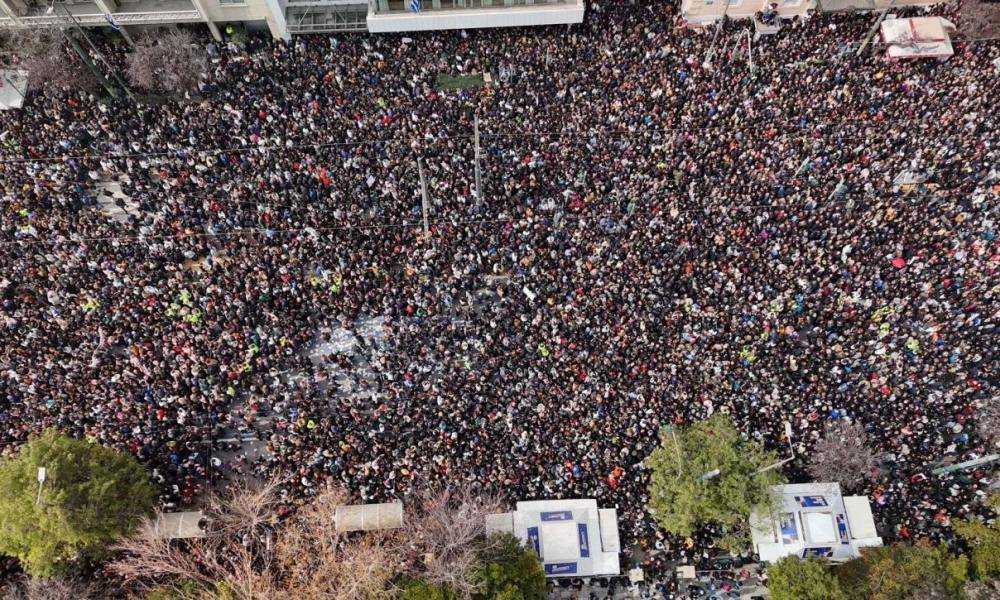
In general, we could say that when a society is hit by uprisings of indignant citizens due to multiple accusations, such as the feeling of insecurity in the face of external or internal threats or when the market imposes overpricing of essential goods or when innocent citizens are drawn into rampant criminality or when the absence of social welfare is observed or when the intuition of an uncertain tomorrow prevails, etc. All of this creates the negative image of political uncertainty, the result of disorder, the outcome of which defines ominous events.
Recently, to all the aforementioned complaints, the disorder has been added - in an aggressive manner - due to an inexplicable peculiarity of visual art. Specifically, it concerns an art exhibition at the National Gallery, where an artist renders images of religious symbols in the form of monsters under the title "the allure of the strange".
Of course, we are not inside the artist's mind, but we can resort to some speculation and assume the "how" and "why" the calm waters of that social segment of Greeks with the predominant religious sensitivities and where the strong spirit of faith nestles in their souls have been disturbed.
A first hypothesis, concerning the artist and his decision to render with obvious irony and with excess the dialectic and outrageousness in his paintings, is his intention to emphasize the freedom of artistic presence. Perhaps he wanted to validate, through art - in his own estimation - the superiority of man against any idol of worship and indeed in contrast to what, the believers have in their religious consciousness placed holiness as an undefiled and sacred form on thrones of important symbols of faith. He fights the internal dialectical necessity of an aesthetic, which does not allow man to become master of himself against the influences received from a world dominated by alienation of beliefs. Doctrines, which he as an artist considers hostile and alien to progressivism, at a time when modern perception wants a revolutionary transformation of beliefs and which he imagines as a dynamic artistic proposal. The artist, in the momentum, which is triggered by an excessive ambition, perhaps seeks to find ways to get out of the impasse a painting routine that advocates or echoes artistic decency. He seeks that inspiration, leading to the liberation of art from social restrictions and artistic correctness. Perhaps he considers himself a carrier/expressor of social protest against a threatening twilight, emitted by that part of people, whom the artist considers decomposed and religiously subjugated. After such associations, we assume that the artist decides to counterattack against those who deny any progress within his own plastic space.
A second hypothesis is that of the artist's ambition to be considered a pioneer, a trailblazer of the struggling woke culture, where the "right" of expression is the must in order to finally realize that minorities of particularities also have an equal say (and visual) in the group portrait of the exponents of the celebrated "more" freedom.
The Third Case is a realistic depiction of some underlying hypocrisy. That is, the artist, through the revolutionary and contentious tactics, gains publicity, aiming at exploitation through advertising and through the support of “progressives” and “entitled” people, in order to achieve the two goals. First, the artistic rebellion is rewarded by the devotees of the dialectic of the uprising of culture, where the “against” of the symbols defeats the “for” of them. The second goal is the opening of the way for future economic, social and political gains. Something like using the national gallery as a springboard for the satisfaction of a personal vanity. Epithet of the case: the spirit of insulting the divine and the rejection of the reward.
Apart from the artist, we should also see another factor in the case of the allure of disorganization. And this is the Greek world. This world is not exactly as common sense imagines it. Neither do algorithms, nor even the quantum physics of many worlds, of many possibilities and branching choices. All systems of determining causality raise their hands in the air when they verify that the ten million Greeks have ten million separate personal opinions on one and the same subject. Here is a disorganization that clearly conveys the image of an incoherent society. It is a society filled with "all-knowers". It is a people of "experts", an inclusion of "authorities" who feel constantly wronged. And this, because almost everyone is convinced that someone else is at fault. An "other" who is unclear. The history of the Greeks is full of divisions due to the negative treatment of economic, political, social, cultural and in this case artistic issues. Nevertheless, we can divide this group of Greek people into three "mainly" categories, so that we can recognize the social connections, similarities and coincidences of beliefs.
One category is the conscious devotees of the Orthodox Christian faith. This category supports its faith through theological arguments. That is, the revelation of God, the unbroken sacred tradition and theological coherence. Its historical arguments are the apostolic succession, the integrity of the faith, the Martyrdom and the Saints. They are the philosophical and logical arguments. That is, the transcendental reason, the theory of theosis, the perception of evil. They are the experiential and Mystical arguments. That is, miracles, the experience of Divine Grace, the transformation of Man. They are the cultural and social arguments, that is, the influence of culture and the contribution of the church to society. In other words, the supporters of Orthodoxy do not see faith as a simple philosophy or as a moral system but as the absolute Truth, which is experienced within the church and confirmed by the life of the Saints and the experience of Divine Grace.
Therefore, it is impossible for this faith, supported by the Constitution of Greece, to receive unconstitutional insults from individuals or collectives or right-wingers in the form of "awakening" from a Christian "hypnosis" with spiritual catatonia.
Here let us recall the Constitutional sayings. In the preamble of the Constitution we read: “In the name of the Holy, Consubstantial and Indivisible Trinity”. It has remained unchanged since the time of the initial formulations in the Constitutions of the National Assemblies of the Struggle until today. This demonstrates the special bond of the Greek state with the Orthodox Christian Faith. Article 16 § 2 speaks of Orthodox education. That is, education has as its purpose, among other things, the “development of national and religious consciousness”. Although, the teaching of the Orthodox Faith in schools is ensured.
This explains the indignation of the faithful towards any kind of insult to that part of the Greek citizens, who - if nothing else - are protected by the Constitution. This part of the people moves with the compass of the stability of a faith constituting the unshakable point of reference in an era of rapid changes in all social systems concerning politics, economy ... and art.
The second category concerns atheists and non-religious people. Atheists and non-religious people, citing logical and philosophical arguments, refer to the problem of evil tolerated by the All-Good God. They refer to the argument of "non-necessity" for the existence of God. They also refer to the argument of contradiction mainly in religious teachings. The argument of vagueness is based on the fact that God is not clearly defined in the various religions, which makes God an unverifiable concept. From the point of view of scientific arguments, they refer to Darwin's evolution, the cosmological model through the Big Bang theory, quantum physics and other scientific approaches with their own explanations for the universe. The fact of the absence of empirical evidence for the existence of supernatural entities or gods is one element in the series of arguments of atheists, who continue with moral arguments, such as that morality does not come from religion, that religions have often supported immoral practices, and that if there is objective morality, independent of God, then God is not necessary for its formation.
In terms of historical and sociological arguments, atheists believe that different religions are products of cultural and historical development. The same goes for the fact that faith is geographically determined and is more of a social construct. In terms of political and social arguments, they refer to the separation of church and state, the obstruction of progress by religious dogmatism, and the discord caused by religion. In general, atheists and the irreligious do not have a unified system of certainties. They use different logical, scientific, moral, and historical arguments to justify their own beliefs. In fact, some propose humanism, reason, and science as alternative bases for human behavior.
Of course, in the matter of art (in the case of the national gallery), they would prefer to elevate the matter that provides tangible artifacts and to nullify the soul that is registered in the desires of the pursuits. They avoid the deprived of their essence and separated from the matter. For them, art is art and is expressed in the funerary way in this way.
The third category of citizens is this, the religiously indifferent. It is the category of those who are tolerant of all cultural phenomena. According to those who are tolerant of all this matter, indifference means the ability to calmly deal with various events, trends, beliefs and extreme manifestations. Something like the economy of the untouchable. As they believe about themselves, they are well governed by a range of permissible deviations from cultural norms or doctrinal standards. The indifferent accept or tolerate contradictory beliefs or ambiguities in perceptions in emerging situations and in postmodern beliefs at any given time. They have the ability to regulate their emotions and naturally seek to accurately perceive reality in the face of an inherent uncertainty in social happenings. They consider those who are dogmatic as people with a low tolerance for ambiguity. They find that others prove to be rigid and that they distort reality by failing to perceive the changes occurring in the world. The indifferent tolerate anything vague and prefer simplistic ways of thinking. They seek simple answers to complex issues and certainly tolerate people from different cultures with different morals and foreign glories and who are receptive to ideas of multiple worldview shades. In modern psychology, tolerance for ambiguity is often associated with the ability to adapt to social and cultural environments. They believe that the "black/white" way of thinking is particularly prone to intransigence, rigidity, aversion, intolerance, and hostility. All of these traits of indifferent people send out a number of negative messages. That is, their neutrality and detachment, choosing apathy in religious or ideological confrontations by avoiding valued conflict, signal characterizations such as "indifference," moral relativism, cowardice, and moral ignorance. The characterization "blurred perception" is also valid, which certainly serves the oblique principle of "self-interest". The indifferent are devotees of absolute relativism. They believe that all opinions are equally valid. This position, however, can easily be characterized as moral nihilism or even logical absurdity, given that for them all opinions are correct and therefore even extreme and hostile statements of beliefs and other resulting inhumane practices are justified. This hypocritical tolerance or apathy adds to the negative characterizations of the indifferent, given that it is likely to lead to long-term consequences of social denial, harmful ideologies, and disrespectful actions. Their position, that even fanatics with their extreme ideologies have the right to express themselves, may demonstrate that excessive tolerance allows intolerant forces to destroy tolerance itself (“the paradox of tolerance”, Karl Popper).
The fact that many indifferent people comfort themselves with the thought that "I am not like them" can be accused of hypocrisy or elitism, as they ignore the fact that tolerance is a form of ideological positioning.
In general, we would say that tolerance may be an advantageous condition in a peaceful society, but it can easily turn into passive neutrality, into absolute relativism or into tolerance of extreme intolerance itself, in which case the tolerant person is perceived as naive, as unwilling, as apathetic, as uninterested, but also as an accomplice. Our great-grandfather Thucydides had said, “If a city revolts, none of its parts are honorable.” This “epithet” castigates the indifferent to the commons.
The indifferent basically possess the distinctive feature of false consciousness. For them, consciousness is the distortion of reality, where they perceive the world through misleading or distorted perspectives, which serve other interests and not objectivity. In the case of the issue of art (national gallery), the indifferent do not perceive the true nature of their exploitation by an imposed invisible policy of alienation of those who are suppressed due to intellectual inertia. Unless they fully understand the insidious intentions of the progressives and, as is natural for the quality of abstaining from any unpleasant confrontation, they prefer neutrality, which, as they believe, is a "virtue". The indifferent constitute the largest percentage, the most dangerous and unprofitable for the national interest portion of the dance of the three categories in Greece.
Let us also see the National Gallery as an “expressor” and “great explainer” of contemporary Greek culture. This institution operates on the basis of a regulation and of course under the supervision of the Ministry of Culture. We understand that the persons involved in the system of evaluation and promotion of works of art have the corresponding accreditation and a high sense of responsibility towards the history of art and respect for the principles that define the boundaries between what is proper and what is deviant. Therefore, these people of responsibility should not fall into the imprudence of misinterpreting the prevailing perception that the motto and the driving thought of the people of the gallery should be limited to the exclusive satisfaction of promoting those who serve - so to speak - “progressivism” and woke culture. The majority of the society under cultural and artistic silencing, as well as the works of artists, which are governed by sterile principles and by the established national traditions, should not be ignored. And if we want to be consistent with the democratic imperative of the majority, then we take care not to oppose ourselves by insisting on intercultural adaptation, which a group of experts is working on to impose its preference on the Greek majority, aiming to achieve the acceptance by all citizens without exception of new morals, mutated values, consensual rules of behavior and submissive social codes.
We believe that people who serve culture, the arts, science and everything that contributes to the perfection of a spiritual formation are personalities with a high sense of empathy, when it happens that the decline of traditional values, as legacies of our ancient civilization, is being deceived. That civilization, which communicates good intentions, which embrace souls and spirits and not the ugly ones, which are projected with the concordant position of those who consent with exclamations of the type "and this is right". It is not allowed for carriers of culture to consider that their power is based on the inability to read reality, as well as on the opaque intentions of a people whose even simple logic is underestimated. The appreciation of the wisdom of these personalities is also evident from the result. The result in this case of the "seduction of the strange" is a primal indignation of those governed by the "other" intellectual process of accepting representations with its own value landmarks. And of course the luminaries of modernity, by insisting that the law (by other rights) is on their side, reveals a pretense of arrogance. This obsessive worship of the stilted projection of their own qualifications demonstrates contempt for other arts of good choices. It testifies to an excessively wild, undisguised and unalterable preference for their own ideals. This -as a fact- is far from the decision to characterize these people as geniuses. Rather, we would say, that they are governed by a pitiful political correctness towards the idea of a discredited, a disreputable progressivism. Unless, under all this, an undetectable interest lurks, far removed from ideologies and cultural gibberish. As if to say "military art". And this is sometimes verified, when, following the path of logic and empirical evidence, any indifferent and blurred skepticism begins to crystallize, the perceived relativity of weaknesses and insufficient knowledge is dissolved and in the end the chronographer, that is, every thinking citizen, is vindicated.
But what is clearer than the sun and cannot be disputed is that the cultural issue is one of the essential factors of national power. And no matter how much the modernists insist that God should cease to direct the human soul and should even be eliminated from our bourgeois flawed worldview in a secluded, shadowy and unconscious space. This certainly has its own impact. That is, since God has died at the instigation of the modernists and the awakened, then the human consciousness has also died, which all these years has maintained the privileged position of the prominent Divine creations/creatures. The creatures, which are governed by pansympathy in thought. With a deliberate view of cosmic events. With constant reassessments of upcoming unforeseen events. Events caused by bodies with responsibility for a national and cultural path. When these prominent figures in society adopt inappropriate modernities in art or exploit "innovative" demons, they serve political and social purposes. An obvious purpose is the attempt to suppress the well-intentioned through the projection of paradoxes, as if these would constitute the logical sequence of a progressive society. However, history teaches that societies advance, not under behavioral and spiritual pressure but following intuitive knowledge, as the identification of individuals with the embodied idea tested globally in each era under consideration.
Perhaps now, more than ever, those responsible for this country need to be educated in the fact that the strength of the Greek race acquires its moral basis and power when there is a faith. People have the need to believe in a higher power. In a transcendent idea. However, it is not omitted to mention the portion of people who deify money. For them, money is the supreme and driving force of all things. And of course there are infinite types of deifications with the corresponding groups of followers, etc.
And we go to the Ministry of Culture, wondering about the nature of its positions on the issues raised so far. It seems that this ministry is being normalized by the practice of univariate analysis using statistical analyses of a single variable. That is, of the prevailing Western world view of things through the lenses of awakening. However, this practice leads to unilateral excessive censorship and limits the freedom of speech of those who have different opinions. This attitude creates conditions of social division with the “protected” extreme positions and the moral blackmail that such a culture undergoes, seeking to annul all traditional faith and all recorded orthodoxy. From the above approaches, we are led to a thought, which is not far from a melancholic assumption. That is, the Ministry of Culture, having wokeness as its operating rule, tries to appear as a vehicle of progress. However, when it resorts to excessive ideologies of this newly introduced trend, it undoubtedly leads to a new form of rigid dogmatism. It therefore reaches the point where this ministry is perceived as a vehicle inferior to those expectations that the country would like it to have as a continuation of the glamour of a centuries-old pre-existing civilization. In fact, if we examine it in terms of a partial professional psychography of the personnel serving in it, then the sad observation is mildly flattering for these people in the consciousness of the bourgeoisie. Some of the impressions emitted, extreme, but none the less, low in the consciousness of the world, correspond to individuals of lesser competence corresponding to executives of this institution. They exude a sense that they have shifted from the category of homo sapiens to the category of homo ludens, whose main concern is to play with the national and moral feelings and the mentality of those Greeks who expect a smooth national course but with value commitment and social dignity. Those Greeks who want to move forward with the names, which over time have proven to be appropriate to the Greek psyche. They do not want to merge with entities that provoke with images, with video recordings, with theatrical events, with “pride” parades and pickets of the form “let Greece die so that we can live”. They do not want to succumb to those visual and narrative stimuli that divert the attention of the unsuspecting from the inferior in favor of the new assembly of prominent minority “special truths”.
And what does the church say about all this? From the reactions so far, the church seems to agree "generally" on the use of "inclusive" language to formulate positions, avoiding expressions considered offensive. It accepts the rights of minorities and all demands, trying to align itself with the latest social feelings of self-consciousness. It accepts the social perception based on the observation of the behavior of others and the conclusions about their motives, however, this ecclesiastical tactic does not satisfy that part of the faithful, who would like a priestly position more argued on the basis of some logical positivism, which would affect the psychology of thinking people and the behaviorism of individuals in society without excluding anyone, regardless of beliefs.
There are certainly some clergymen with a word of apostolic truth, which should shock the whole society, but it seems that the social reaction resembles a defensive attribution of causes, invoking the avoidance of potential stress. The result in this case is the wandering of the faithful into reactive depression.
And what is the position of the Greek state in the end? The parties in power are perceived as a state. Clearly, these parties practice tolerance for everything, except in cases where the stability of their own hegemony is threatened. Tolerance, then. And consent to imported cultures. The respective ruling party cares about the political cost and not about the consequential alterations of morals, established moral concepts and ancestral customs. Therefore, the respective government never meets with society. Client relationships are the only greased point of contact. In all other cases, governments monitor the citizen in case the citizen awakens nationally and becomes dangerous. Until then, it probes every suspiciously interesting detail of popular behavior, in order to adapt its respective competent and necessary reaction. It examines any ambiguity, when it identifies the seriousness of Christianity as a matter of faith, where any possible rejection of convictional hesitations is perceived as a threat to the establishment. It examines the older Greek Christianity on whether it has bequeathed to today's people the same dynamic, so that modern Greeks, being aware of their power, as a bond of worship, can claim what they consider to be true faith, which symbolizes the highest good in this life. It examines the worried people, as to whether they dynamically transmit dissent and heterodoxy towards modernity. It examines whether they feel alien to the certainties of past times, which defined homeland, religion, family. They are curious to see to what extent the current group of believers, under an increasingly oppressive and alienating tactic, can be suppressed as a harmful Christian peculiarity in the already formed multicultural current Greek (?) society.
They know that by introducing increasingly deeply into social life malicious and immoral guests, they contribute to social alienation and intensify the effort to create a rift in social harmony, which is extremely helpful to the established power structure. This division, however, violates the government's assessments regarding the future of the country. And this is deduced from the fact of the uncontrolled and clandestine entry into the country of myriads of Muslims. That is, while at first a multi-ethnic population seems more manageable than a homogeneous and robust Christian community, later and when the hyper-fertility of the foreign element prevails in terms of population, then a status will be created that will not guarantee the continuity of Hellenism, as we knew it. But not even the "once" Greek national gallery will be able to hang images of Muhammad in vampire form, because almost on the same day the place where the gallery was housed will be transformed into a huge crater after a punitive explosion to remind everyone that religious faith is something serious. Religion is part of the national strategy. It is a factor of a country's national power. Who can dispute the fact that faith in Islam constitutes the cruel power of the Arab and not only world?
The government must therefore understand this detail, that religion, as a factor of national power, can function either as soft or hard power. It should be considered in any case, as an added value force, which governments must necessarily evaluate in geopolitical studies and utilize in the assessments of the national security council.
In addition, religion should be taken into account as a soft power that has influenced culturally internationally but also as a diplomatic tool, in addition to the fact of the possibilities of achieving cohesion in the international co-religionist - and not only - network of international relations. Let the example of Islamic countries be a guide for our thinking, given that Muslims prioritize religion in maintaining solid control over the faithful and in shaping their ideological strategy and finally in being able to exploit every conflict dimension. It is therefore good for every government to know that religion contributes to national stability and unity. History has as evidence religious faith as an essential factor in achieving the Rebirth of 1821.
In conclusion, we would say that all the components examined together, namely the believers, the atheists, the indifferent, the body of woke art exhibitors and the responsible state, all of them have a share in the "misery" of democratic freedom (apostasy).
If there were a hypothetical court with the "national conscience" as judge, then its conclusion after dialectical argumentation and interpretation would be approximately of the form: Christians and atheists have a small share of the misery, and this because in their attempt to support their positions they sometimes resort to sharp choices. The indifferent are distinguished by their cowardice and therefore are involved to a degree that requires study with the aim of changing their mentality. If this is not achieved, then this category of people is considered dangerous for the homeland. The Ministry of Culture has misunderstood its basic mission, regarding the responsibilities of the bodies under its responsibility for promoting Hellenism, which is why it is involved. The Greek governments bear full responsibility for any act or omission on matters affecting the national interest, including the apocalypse discussed in this essay.
Therefore, the state is guilty.
The corresponding sentence is usually pronounced the day after each election.
https://www.pentapostagma.gr/apopseis/7297518_i-sagini-tis-ekrythmias