

Ioannis Mazis*: The maps that defined "geographic Macedonia".
![by Ioannis Mazis – Let us first examine some argumentative narratives of the public debate regarding the “wisdom” of Athens’ compromise on a composite name containing the term “Macedonia”. The case of Skopje’s name is primarily and essentially critical, for the following reasons: First, the term “Macedonia” per se constitutes the pre-eminent vehicle of Skopje’s alleged irredentism. From this alone will the legitimization of the nationally non-existent “Macedonian identity”, the linguistically non-existent “Macedonian language” and of course the non-existent […]](https://slpress.gr/wp-content/uploads/2018/01/onoma.png)
Let us first examine some argumentative narratives of the public debate regarding the “wisdom” of Athens’ compromise on a composite name containing the term “Macedonia.” The case of Skopje’s name is primarily and essentially critical, for the following reasons:
First, the term "Macedonia" per se constitutes the principal vehicle of Skopje's alleged irredentism. From this alone will the legitimization of the nationally non-existent "Macedonian identity", the linguistically non-existent "Macedonian language" and of course the canonically non-existent "Orthodox Macedonian Church" be forged.
Second, it should be noted that the historical Macedonia of antiquity corresponds almost entirely to the part of the Greek territory in northern Greece. The concept of "geographic Macedonia" is largely a construction of Russian, German and Bulgarian cartographers in the late 19th century. On maps of the mid-19th century, such as that of the French cartographer Ami Boue (1847, See related map), the term Macedonia does not include Skopje, but only the Monastir-Ohrid border and of course our familiar Macedonia in Greek territory.
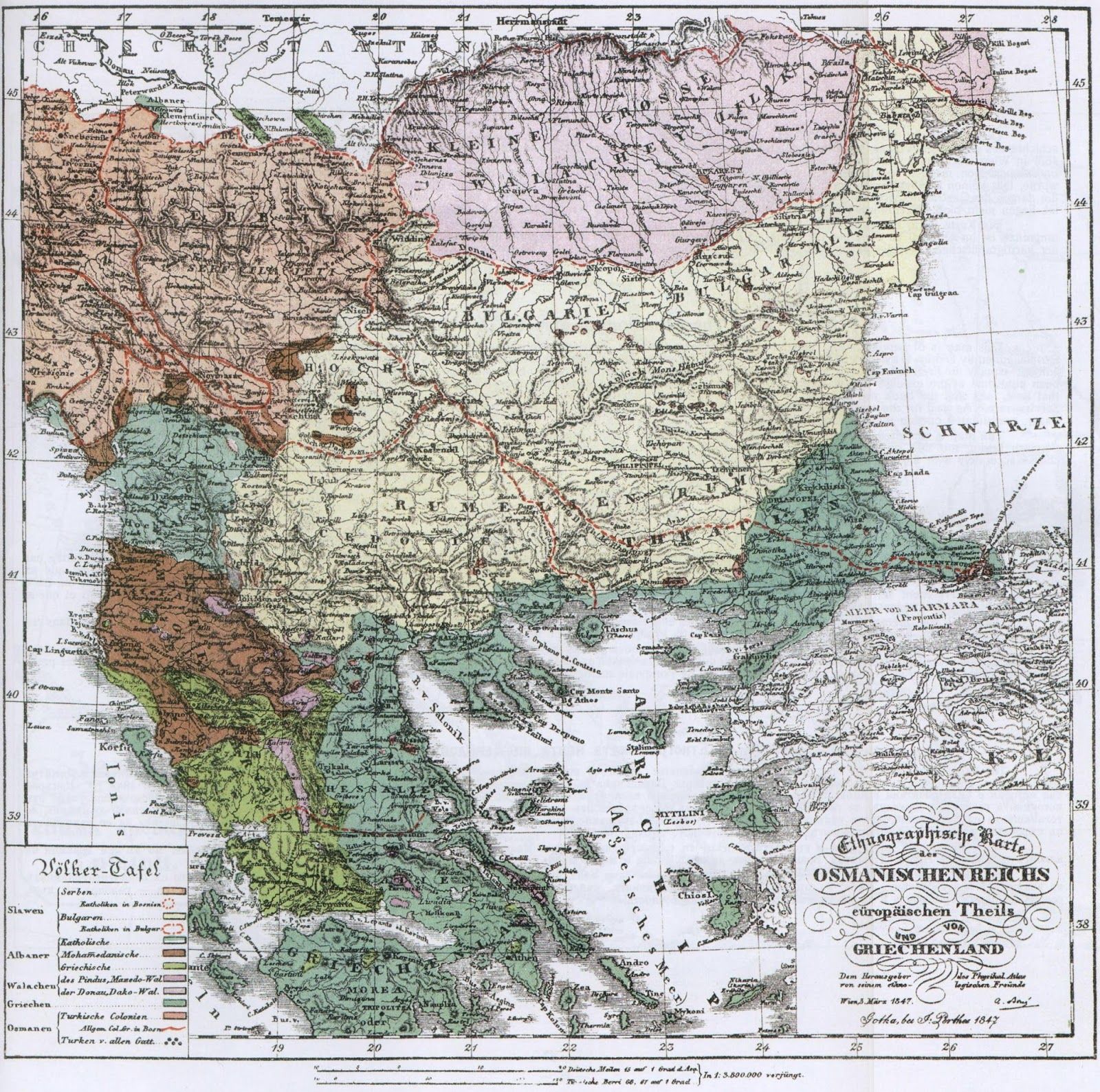 Ethnological Map by Ami Boué (1847). On the contrary, in maps of the late 19th century, a "geographic Macedonia" is created, which according to a distorted perception after the Balkan Wars was divided between Greece, Serbia and Bulgaria. However, "Macedonia" did not exist as an administrative or geographical unit during the Ottoman period. Also, ethnographic maps, such as that of the German geographer Heinrich Kiepert (see related Map), which showed high percentages of Slavs, were commissioned by the Bulgarian Exarchate in Constantinople.
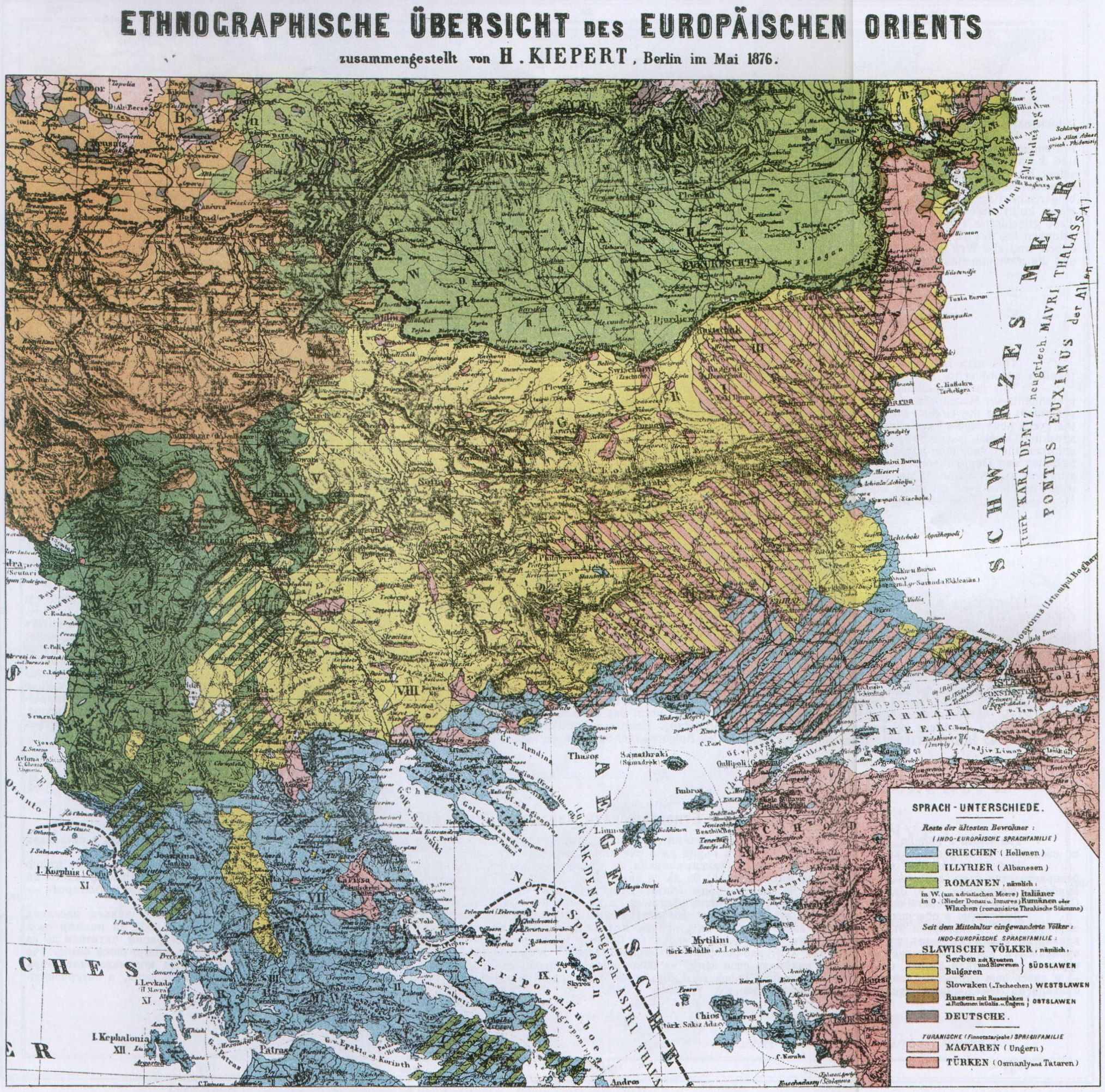 Map of the Balkans by German geographer Heinrich Kiepert, 1882.
The Greek side is not guaranteed
Thirdly, The issues of removing from the Constitution of Skopje its supposedly "irredeemable" imperatives, by deleting the corresponding articles, do not constitute, in any way, a guarantee for the Greek side. Certainly, a state has the absolute right to create, but also to revise its constitutional charter according to: i) its national interests, ii) its ideological demands and iii) its political and iv) its geostrategic projects, as it evaluates them.
If, therefore, the Skopje multi-ethnic (Albanian-Slavic-Romance) entity joins NATO and the EU with a composite name containing the term "Macedonia", it will have no reason not to amend its Constitution again in the pre-existing supposedly "irredeemable" direction. The hype, by the supporters of the existence of the term "Macedonia" in the "solution" of the nomenclature, "ensuring the exclusion of irredentist provisions from the new Constitution of Skopje».
It has already been argued that if we do not end up with a “composite name” (… by the term “-Macedonia” do those supporting “lysis” mean?) then there will be no “lysis”. But who does this threaten? Greece or Skopje, which is urgently seeking to join NATO and the EU? Let us also take into account the warning issued a week ago by NATO Secretary General Stoltenberg to the Skopje government, which rules out the state’s admission to NATO under its constitutional name. And this is happening while Skopje is demanding the usurpation of the national Greek identity, Greek self-consciousness and Greek history, and indeed with the official consent of… Greece?
They suggest "mirrors"
And they propose to us... "mirrors and beads for natives" by offering us the change of the name of their airport and some streets in their capital? Mr. Mitsotakis was absolutely right when he said the day before yesterday that: "I will not risk the division of the Greeks to preserve the unity of the Skopje people.". Only he should also courageously proceed to repudiate the term "Macedonia" from the origin of the UN "mediator" who is dangerously complicit with Mr. Soros and has failed miserably for 25 years, and demand his immediate removal and replacement.
Then it would primarily benefit our nation and the well-intentioned interests of the multi-ethnic state of Skopje and secondarily the large party which it seeks to lead. Under the state of the expression of the popular will by the Thessaloniki Rally and the subsequent one in Athens, in the Constitution, on February 4, it is impossible for the "secret diplomacy" of Athens to allow the political parties of the Greek Parliament to "commit" political suicide. Therefore, I do not think that a "solution" of the aforementioned type will exist.
Why "Central Balkan Republic"
I have been insisting for a long time on the complex name with a geographical designation and erga omnes, "Central Balkan Republic", because all the others do not correspond to historical reality, which will end up being a product of time, not only to the detriment of Greek national interests, but also to the detriment of state interests and of the state of Skopje itself.
And this is because the balances in the Balkans, from now on, will be extremely precarious with the first victims being those multinational formations that do not have and cannot demonstrate profound national identities that constitute a common national consciousness and belief of the mosaic of the peoples that constitute them. Also, the name "Central Balkan Republic" does not erase or suppress any ethnocultural or linguistic identity of the constituent ethnicities of the state.
In the travel documents of Central Balkan citizens, each ethnicity will be able to indicate its identity: For example, an ethnic Albanian will be able to indicate: "Albanian ethnicity", an ethnic Slav will be able to indicate: "Slavic ethnicity", an ethnic Greek: "Greek ethnicity", etc. Also, NATO itself would be completely satisfied when in the list of its members it became apparent through this name that it exerts influence in the Central Balkans! So, everyone would be satisfied.
Asian Studies, School of Economics and Political Sciences, National and Kapodistrian University of Athens. Subject: Economic Geography and Geopolitical Theory