

Marika Karagianni*: The advantages of the East Med gas pipeline - From Israel to Cyprus, Greece and the EU
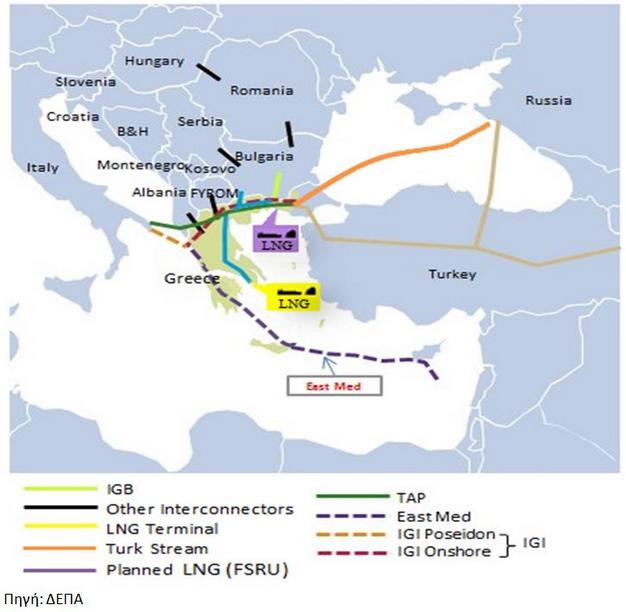
One pipeline that Greece has been actively promoting in recent years, together with Israel and Cyprus, is the “East Med” natural gas pipeline. It is a very long pipeline, 1.900 km long, which will be submerged at great depths and with many technical challenges. Based on the relevant analyses and the feasibility study that has been carried out, the project is considered technically feasible. The natural gas from the Eastern Mediterranean will be directed underwater to Cyprus, then to the coast of Crete, and then, through the Peloponnese and Western Greece, underwater to Italy, with an interconnection with the “IGI – Poseidon”. The planned transport capacity of the pipeline is estimated at 10 billion cubic meters per year, with the potential to increase to 16 billion cubic meters.
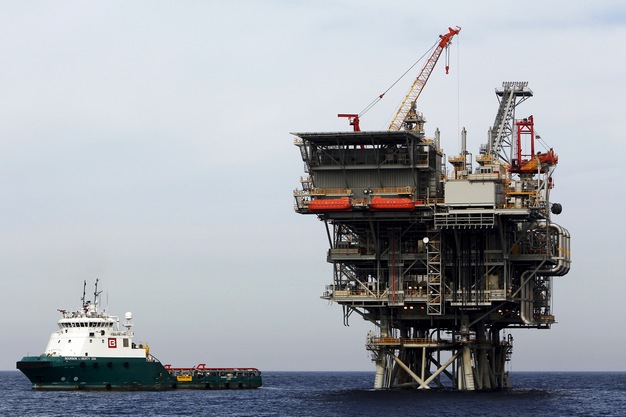
An Israeli natural gas platform in the Mediterranean Sea, about 24 miles west of the Israeli port of Ashdod, February 25, 2013. REUTERS/Amir Cohen
——————————————————————————————-
In early April 2017, the Energy Ministers of Greece, Cyprus, Israel and Italy signed, in the presence of the European Commissioner for Climate Change and Energy, Miguel Arias Canete, a Joint Declaration for the further systematic monitoring and promotion of the development of the project, while, it should be noted, the project has been included in the EU PCIs (Projects of Common Interest), consequently being eligible for EU co-financing and in fact in second place from –initially- fifth. In 2015, its co-financing by the EU began for the Action “Eastern Mediterranean Natural Gas Pipeline – Pre-Feed Studies”.
THE COMPLEMENTARY CHARACTER
The Pre-Feed Studies, conducted by DEPA, have made clear the technical feasibility, economic viability and commercial competitiveness of the project. The main comparative advantage of the pipeline is its complementary nature, in the context of the many and different prospects for exporting natural gas from the Eastern Mediterranean to strengthen Europe's energy security in the future. According to DEPA, the pipeline has all three diversification features that the EU seeks in all new energy projects that it promotes for the future: New transit route, new source of origin of natural gas, new supplier country. This project will contribute to the diversification of both the sources of supply of natural gas and the routing of its transportation.
The next step is to schedule bathymetric surveys and measurements in Cyprus and Crete, in order to determine the exact route of the pipeline. Finally, it is noted that since 2016, the “IGI-Poseidon” pipeline consortium (DEPA-Edison) has signed a Memorandum of Understanding with Noble Energy for the joint examination and monitoring of the prospects for the implementation of “East Med”, as one of the options for exporting Eastern European natural gas to the West.
The big question, which is urgently asked for the implementation of this project, concerns the required quantities of natural gas in the eastern Mediterranean. Research and extraction in Cyprus and Israel are in full swing, without it being yet certain how much natural gas will be available to justify the construction of this large pipeline and the export of natural gas to Europe at commercially competitive prices. In addition, Egypt has also recently entered into a program to develop its deposits, with the newly discovered “Zhor” first and foremost. Several analysts see the export of natural gas from Israel and Cyprus to Egypt for liquefaction at the two large liquefied natural gas (LNG) terminals, IDKU and DAMIETTA, as the most economically beneficial for the immediate future. A large submarine pipeline in the Mediterranean is characterized as an extremely expensive project, difficult to be financially supported by foreign energy companies or banking institutions. The former executive director of the Cyprus State Hydrocarbons Company and international expert, Charles Ellinas, noted in a recent interview that the "East Med" will not become feasible without financial support from the major energy giants, in the order of 8-10 billion dollars, and certainly not with a loan from the EU, namely from the EIB. Finally, the third proposal, the export of Israeli natural gas to Turkey, seems to be mentioned and supported only by Turkey itself, and no longer as frequently as in the past.
——————————————————————————————-
Let's take a closer look at the available data regarding natural gas exploration and extraction in the Eastern Mediterranean:
With fields already in full development and based on official statistics, Israel has approximately 860 billion cubic meters of natural gas, mainly coming from 3 fields: "Tamar" with approximately 300 billion cubic meters, "Leviathan" with an estimated approximately 500 billion cubic meters and production start in 2019, and the complex of smaller fields "Karish-Tanin" with confirmed reserves of 55 billion cubic meters and estimated production start in 2020.
In the post-Aphrodite era (approximately 125 billion cubic meters), 2018 was characterized by the Cyprus Ministry of Energy as an “exploration year”, as a total of 4-5 drillings have been planned. Specifically, the Italian ENI is planning 2 drillings for 2018, one in the “Calypso” drilling target of field 6 and another in the “Soupia” target of field 3. If the environmental studies and the evaluation of the seismic survey data for field 8 are completed within this year, then ENI may attempt drilling in the “Eratosthenes” target as well.
Also, the ExxonMobil – Qatar Petroleum joint venture has announced that in the second half of 2018 it will conduct 2 drillings in field 10, specifically in the “Anthia” and “Delfinos” targets. The main objective of the Republic of Cyprus is the sustainable development and exploitation of the fields, depending on their quantities. With the completion of the above drillings within 2018, the picture will become clearer as to what the prevailing scenario will be in relation to the exploitation of Cypriot hydrocarbons.
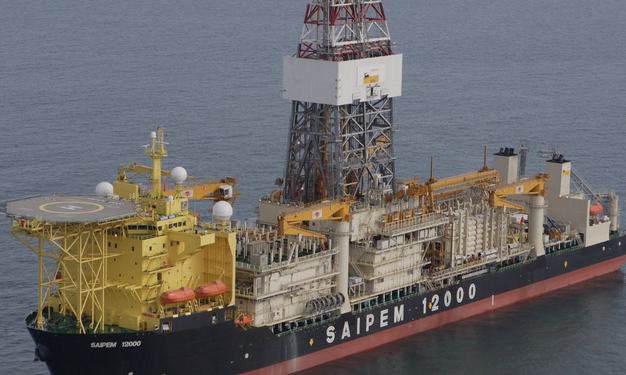
ENI's drillship "Saipem 12000". Source: www.marinetraffic.com
——————————————————————————————-
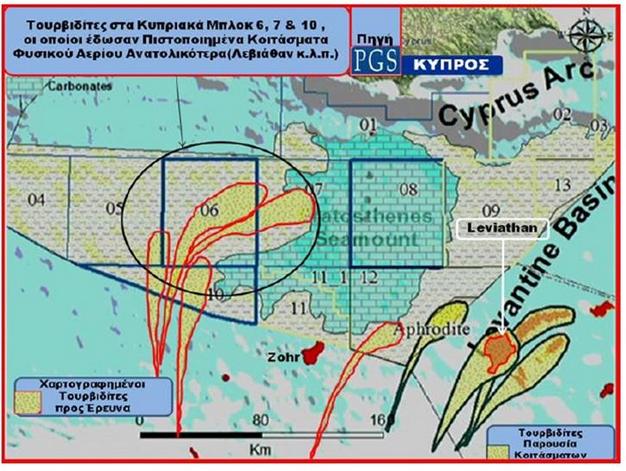
The first drilling on the "Calypso" target began on New Year's Day with the ENI "Saipem 12000" drilling rig drilling to a depth of approximately 1.600 meters. Based on the schedule, the drilling is expected to be completed in the first week of February this year. According to a report in "Phileleftheros", the expectations are for a deposit somewhat larger than "Aphrodite", which is interpreted as an expectation for a discovery of the order of 5 trillion cubic feet. According to Konofagos, Fokianou and Foskolos, the geophysical company "PGS", which has carried out systematic seismic geophysical recordings in Greece and Cyprus, presented in London mapping east of the huge "Zohr" deposit in Egypt, from turbidite tongues originating from the Paleo-Nile River, which created the sandstone reservoirs, which in turn led to the discoveries of the natural gas deposits of "Leviathan", "Tanin", "Karish" in Israel and "Aphrodite" in Cyprus. Similar geophysical characteristics are displayed by the Cypriot deposits 6,7, 10 and 6. Based on the data of "PGS", the three energy analysts estimate that the reserve of deposit XNUMX is expected to be very significant and worthy of investment for the future towards the prospect of exporting natural gas to Europe.
--------------------------
In parallel and just as dynamically as in Cyprus, ENI is also operating in Egypt, demonstrating the company's long-term commitment to the subsea deposits of the Eastern Mediterranean. Specifically, the company recently announced that it produced the first quantity of natural gas from "Zohr", "in less than two and a half years, a record time for a deposit of this type", according to the announcement. "Zohr" reserves probably exceed 0,8 trillion cubic meters. m. If confirmed, it would be a deposit somewhat smaller than Azerbaijan's Shah Deniz, which will supply the EU's Southern Gas Corridor (TANAR, TAP) from 2020. The deposit is located in the "Shorouk" complex, off the coast of Egypt and approximately 190 km. north of Port Said. "It is the largest natural gas discovery ever made in Egypt and the Mediterranean and will be able to cover part of Egypt's natural gas demand for several decades," the company said in its first announcement. In this field, ENI applies the Dual Exploration Model, that is: while hydrocarbon reserves are developed through exploration successes, the company is able to benefit from early monetization, thanks to the sale of minority stakes, while maintaining the exploitation of the asset. It is noted that ENI holds a 60% stake in "Shorouk", Russia's Rosneft participates with 30% and BP with 10%.
For its part, BP is developing another field, the “Atol”, northwest of Alexandria, in the subsea area below the “Zhor”. In total, Egypt has about 2.156 billion cubic meters of natural gas reserves, excluding the “Zhor”. The Egyptian President, Al-Sissi, has declared that the goal of the country’s energy policy is to transform it into a regional energy hub. In November 2017, the President of Egypt visited Cyprus, where he discussed the construction of a pipeline that would transport natural gas from the “Aphrodite” to Egypt. A second solution could be to reverse the current flow of the Israel-Egypt pipeline, so that it goes from Israel to the Egyptian LNG terminals, IDKU and DAMIETTA.
THE ITALIAN PRODUCER
The common element for Cyprus and Egypt, which is worthy of note and comment, is the active presence of the Italian giant ENI in the research and development of the large subsea deposits of both countries, simultaneously. From the recent visits in the last months of 2017 of the company's Executive Director, Claudio Descalzi, to Cairo and Nicosia, the following important points emerge:
1. ENI has undertaken long-term hydrocarbon exploration and development programs in subsea natural gas fields in the EEZs of Cyprus and Egypt, which it implements on a parallel basis.
2. On a political level, Italy has entered the Trilateral Energy Cooperation Summits of Greece-Cyprus-Egypt and Greece-Cyprus-Israel, a very important development for all three Eastern Mediterranean countries, as an important European factor, one of the largest energy giants in Europe and an EU member state, has entered the Eastern Mediterranean energy game, largely diversifying the data to their advantage.
3. From the Italian side, decisive moves are being made to advance the cooperation between Cyprus and Egypt for the transport of natural gas to Greece and Italy. Descalzi from Nicosia stated that Cyprus is a bridge to Europe, which is looking for alternative sources of natural gas supply. "That is why Italy and Cyprus, together with Egypt and Greece, are discussing this possible corridor, namely "EastMed", and we are optimistic and that is why we are present and investing a lot," he noted.
4. With these data, it seems that Italy prefers the natural gas route to be through international waters from the area between Cyprus and Israel to Egypt, Greece and Italy. In this context, ENI is moving towards ensuring the implementation of “EastMed” together with the pipeline of natural gas to the Egyptian terminals IDKU and DAMIETTA. For this reason, DEPA also seems to be emphasizing the “complementary” character of “EastMed”, as one of the many options for exporting natural gas from the Eastern Mediterranean in general. Another reason is that another Italian company, Edison, is also participating in the “IGI-Poseidon” pipeline, which doubles Italy’s incentive to route natural gas from the Eastern Mediterranean to Europe via “EastMed” and “IGI-Poseidon”.
5. These developments lead to another observation. The proposed pipeline from Israel to Turkey and from there to Europe is a project that has now “faded”. The negative forecasts for the Turkish economy for 2018, the internal political situation in Turkey and the close Russian-Turkish relationship in the natural gas sector have largely left this proposal off the agenda. Any references made come mainly from Ankara itself, which is using it for political purposes in relation to Cyprus. Sometimes statements are made from the Israeli side, which do not go beyond the point that “it is a scenario that is being studied”.
Finally, it should be noted that today Egypt no longer needs to buy natural gas. With the start of production from "Zhor", it is estimated that production in 2018 will reach 10 billion cubic meters and in 2019 27 billion cubic meters per year, while production is also expected to start from other fields, such as "Atol". All this means that by 2020, Egypt will be able to cover domestic consumption, and will also start exporting its own natural gas, with the result that the two LNG terminals will be used primarily for Egyptian natural gas. This is what Charles Ellinas claims, and he does not seem to be wrong, if we take into account all the aforementioned developments in relation to ENI's activities in Egypt.
FINANCIALS FIRST
Overall, the US Geological Survey (USGS) in its report on the eastern Mediterranean estimates the total recoverable reserves at 4.000 billion cubic meters. In the most optimistic scenario, the total in-place natural gas reserves are estimated at around 10.000 billion cubic meters. From these calculations, it is clear that we are still at the beginning. In any case, the current international market conditions stipulate that for the final decision on whether or not to build a pipeline, the objective data of the project are taken into account, which have to do with the available quantities of hydrocarbons in place, their purchase and sale prices to the final recipients on the spot, the construction costs, the transit fees, the financing scheme and the financial-investment risk.
Given that the exploration process in the eastern Mediterranean is in full swing, the export of natural gas is being postponed until later, when the available quantities of natural gas for export will be clear. Geopolitical data and domestic political aspirations certainly play an important role in this process, but not the decisive one. Both the exploration and extraction of hydrocarbons and their international transit involve large and long-term investments of millions of dollars, where companies and markets have the first and last say in promoting or not these investment projects.
Source: www.foreignaffairs.gr
*Scientist Specializing in Energy, Department of Language, History and Culture of the Black Sea Countries, University of Thessaloniki, Scientific Associate of IENE