

With Trump's blessings, Ankara and Damascus are destroying Rojava.
With Trump's blessings, Ankara and Damascus are destroying Rojava
 BALTZOIS IOANNIS
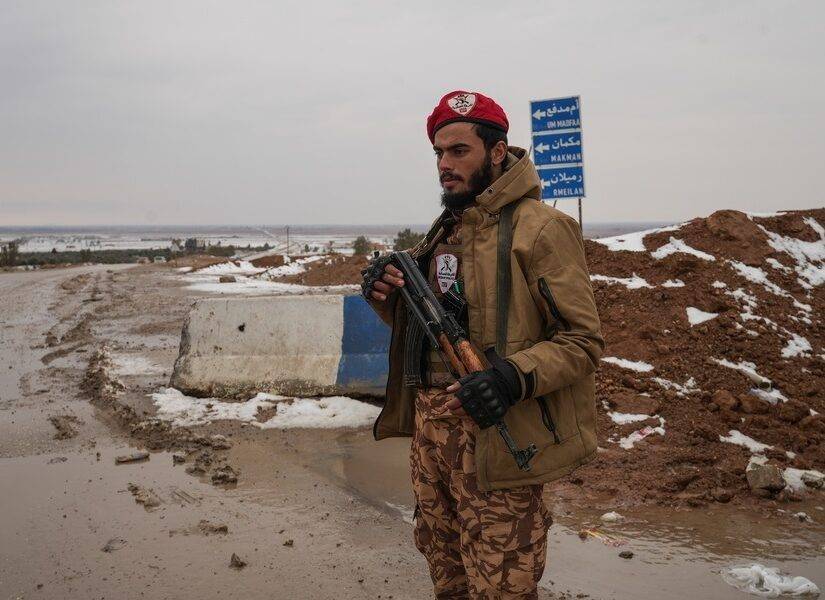
Tuesday, January 26, marked 11 years since the liberation of Kobani, after a four-month siege by Islamic State jihadists. History is now repeating itself, in a worse way, as Kobani is once again under siege: From the east, west and south, by the jihadist forces of Damascus, despite the ceasefire agreement signed with the Kurdish military leader, Mazloum Abdi – while from the north there is Turkey.
The siege of Kobani is a consequence of the dramatic developments that have occurred in Syria, with Turkey and the Islamic forces of Damascus as the main beneficiaries. The Kurds are the big losers, who lost control of extensive territories that they had controlled for years, “stabbed in the back” by the United States. It is characteristic that Donald Trump, after announcing that he had contacted the Syrian transitional president al-Sharaa, stated that “things in Syria are going very well”!
In fact, according to information, the withdrawal of Russian forces from the Qamishli air base in northeastern Syria has begun, with the Kurds seeing the loss of the last international guarantor in the region. Russia is seeking bridges with al-Sharaa, who is meeting with Vladimir Putin on Wednesday, in order to keep its remaining bases in Syria, especially the naval one in Tartus, the only one they have officially in the Mediterranean.
Israel limited itself to rhetorical support for the Kurds, with the US choosing Turkey and Damascus. The US ambassador to Turkey and special envoy to Syria, Tom Barak, stated clearly that the Kurds' original mission has been fulfilled and US policy now favors support for the Islamists of Saraq.
Rojava: End of the Kurdish dream
A definitive end of an era, then, for the Autonomous Administration of Northern and Eastern Syria, known as Rojava, where the famous People's Protection Forces (YPG) were at the forefront, as a member and main actor of the SDF (Syrian Democratic Forces) – a multi-ethnic and religious alliance between Kurdish forces, Sunni Arabs, Assyrians, Armenians, Turkmen and Caucasian militias, which were the best ally of the US and the West in the fight against the Islamic State.
The above, together with Arab moderate elements of the region, fought bravely and selflessly, managing to defeat the extremist-Islamist formation and threat to humanity, the Islamic State, ISIS. The US provided them with many weapons systems and brave logistics (Administrative Support), as well as administrative and financial support.
The Kurdish Peshmerga (those who faced death) for their part, together with their allies in the SDF, made the most of American aid. That is, they managed to liberate the entire area east of the Euphrates, paying a heavy price: Thousands of dead! The US provided them with modern and effective weapons systems to create a capable army of 30-35.000 men. However, the mission was completed, as Barak said…
After the rapid overthrow of Assad, new realities were created, as the US decided that its ally in Syria is Ahmed al-Saara, known as Jolani (the former head of Syrian Al-Qaeda) to the great satisfaction of Turkey. After the attempt to integrate the SDF into the central Syrian army – which in reality only exists in name, as it is a patchwork of jihadist gangs – did not progress, a military operation by the Damascus forces followed, with the support of Turkey of course.
One of the reasons for the defeat of the SDF, in addition to their abandonment by the US, was the widespread desertions and the loss of support they had from Arab tribes, for example in Raqqa. And the EU supported Saraa, the attacks of Damascus, did not affect the European aid packages in any way. And the drama of the Kurds was not discussed even in the European Parliament, with the majority of the political groups rejecting the relevant request for a debate!
The Turkish nightmare
Turkey's permanent nightmare is the creation of a Kurdish state in Iraq or Syria, which would be the touchstone for its dismemberment. We recall that the vast majority of Kurds in the Middle East are located in Turkey, and specifically in southeastern Turkey. The creation of a state, therefore, would be the trigger for uprisings aimed at their autonomy and union with the Kurdish state.
In the case of Syria, Ankara considers the Syrian Democratic Forces (SDF) to be fully led and controlled by the YPG and in turn, by the PKK, which Turkey and other countries label a terrorist organization. Thus, by considering PKK members to be terrorists, it also considers Syrian Kurds to be terrorists.
Before the attack on the Kurds in Syria began, Turkey began a process of normalization with the PKK, which agreed to disarm. Having agreed to disarm the PKK, Turkey demanded that the Syrian Kurds do the same, even though the latter kept their distance from the PKK, abandoned the goal of creating a Kurdish state, supported the overthrow of Assad, signed an agreement for their integration into Damascus... The PKK characterized the dramatic developments in Syria as a ""setback"" in the process.
However, with the northern region of Syria under the control of Damascus forces, the creation of a Kurdish state or autonomous entity is prevented and the Rojava experiment is put to an end. The way is opened for an extensive ethnic cleansing and demographic alteration of this region by Turkey and its Syrian allies. There they will settle refugees and immigrants who are in Turkey.
It is estimated that the Damascus-Kurdish ceasefire is temporary, as Islamist attacks are likely to resume soon, once the transfer to Iraq of ISIS jihadists who were previously held in Kurdish prisons in northeastern Syria is facilitated.
From Jarablus in Northern Syria
The developments in northeastern Syria come as a continuation of the Turkish military presence in the country, where Ankara has moved forward relentlessly, disregarding the international community and international law – taking into account the suspicious inaction of the West and the Great Powers.
It began with Operation Euphrates Shield in 2016, with the capture of the Jarablus area, west of the Euphrates. This was followed by Operation Olive Branch in 2018, with the capture of the Kurdish canton of Afrin. This was followed in October 2019 by Operation Peace Spring east of the Euphrates, where Turkey captured the Tel Abyad-Ras el Ain area, east of the Euphrates, on the Turkish-Syrian border, where Kurds lived.
Turkey launched these operations to neutralize any plans to implement a Kurdish Rojava, i.e. a Kurdish state on the northern borders of Syria. At a time when discussions were intensifying about reshaping borders in the Middle East and the creation of a Kurdish state in Συρία and in Iraq, Turkey moved swiftly, initially with the easy overthrow of the Assad regime, completely overturning the associations that had arisen with the Syrian civil war.
From Idlib to Damascus
Of course, the overthrow of Assad did not occur with the direct invasion of Turkish forces, but with the Islamic extremist organizations of HTS, the SDA (Syrian Democratic Army), the Syrian-led opposition, other Islamist-extremist organizations, as well as a Turkmen Brigade that Turkey created and armed.
With a lightning attack, equipped with Turkish weapons, ammunition and vehicles and led by Turkish commanders, they managed to initially occupy most of Aleppo, reaching Hama in a few days and finally Damascus itself, with the rapid retreat of Assad's forces, without offering any substantial and dynamic resistance.
These jihadists launched their assault against Assad from the Idlib region in the west. Astana Agreement in September 2017, between Russia-Iran-Turkey, had reached an agreement on Idlib, demarcating a de-confliction zone, where the seemingly (as it turned out) defeated jihadist-Islamist organizations were gathered, along with their families, resulting in the formation of a jihadist “dump”, with responsibility, supervision, and supply from Turkey. It is this alliance that currently exercises power in Damascus, reducing the influence initially of Russia and Iran and later of the Kurds.
It should be noted that the first attacks by Damascus forces against the Kurds took place in the Kurdish neighborhoods of Aleppo, the city that Mustafa Kemal also dreamed of and is included in his map of the National Oath (Misak I Milli) along with the entire region in Northern Syria...
With Trump's blessings, Ankara and Damascus are destroying Rojava