

The Macedonian struggle remains relevant with new meanings
The Macedonian struggle remains relevant with new meanings
On this day in history, the death of Pavlos Melas
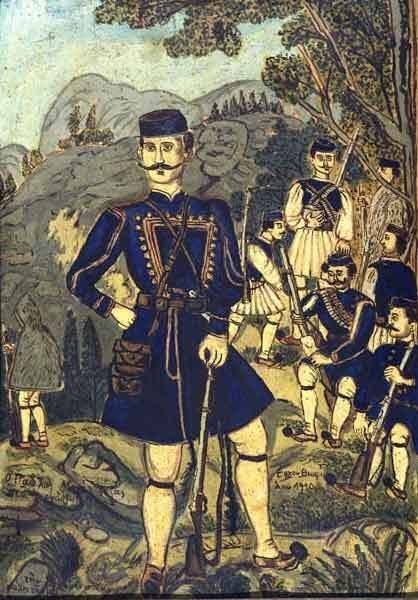
 Pavlos Melas in a painting by Theophilos.
Konstantinos Holevas, Columnist

Political Scientist – Columnist
WIKIMEDIA COMMONS
It was October 13, 1904. The young man had left the salons of Athens and came for the third time to Turkish-occupied Macedonia. He came to support the local Greek fighters against the propaganda of the Bulgarian Exarchate and against the armed violence of the komitatjis. And that night, in Statista of Kastoria (not to be confused with Siatista of the Prefecture of Kozani) Pavlos Melas fell dead. The Turkish detachment had received information from the comitatists. And Pavlos, the second lieutenant of the Greek Artillery, breathed his last in his beloved Macedonia, where he had come as a volunteer along with other young men from free Greece.
Ion Dragoumis stirred up Pavlos. And the death of Pavlos Melas awakened the Greek government and Hellenism everywhere. Everyone learned that in Macedonia the vast majority of the population is Greek, but the Bulgarian nationalists planned to succeed the Ottoman Turks. The pseudo-revolution of Ilinden, on 20.7.1903, had clearly shown the goals of the Bulgarian IMRO (Internal Macedonian Revolutionary Organization).
ADVERTISING
The exact same initials, BMPO in Slavic languages, are today the name of the party that constitutes the major opposition in Skopje.
The Macedonian Struggle remains relevant and gives us useful messages.
- Hellenism during the second armed phase of the Macedonian Struggle (the first was conducted in 1878) proved that it could organize itself and achieve its goal. And this despite the bankruptcy of 1893, the unfortunate Greco-Turkish War of 1897 and the imposition of International Economic Control in 1898. The psychological climate improved because the Great Idea existed. There was the vision and the desire for the liberation of all enslaved Greek populations. Today it is missinga new Big Idea. Obviously with spiritual and cultural content, not territorial.
- When there is national unity and consensus, we can act in a coordinated manner.Then everyone coordinated properly and succeeded in encouraging the local Macedonians and preventing the Bulgarian conquest of Macedonia. The Patriarchate, the Bishops, the ordinary clergy, the native Greeks (even if some of them spoke Greek mixed with Slavic words), the volunteer officers and ordinary citizens from Southern Greece, the teachers, the Macedonian Committees and the Philekpedeutic Brotherhoods in Athens, Larissa, and Constantinople. Everyone fought with unity and courage. However, the main protagonists were the ordinary people of Macedonia, men, women, and children. They supported the Struggle and gave the Great Powers the message that the inhabitants of Macedonia are inspired by Orthodoxy and Greek History.
ADVERTISING
- Throughout the RaceThe conflict was between Greeks and Bulgarians, with Turkish soldiers intervening from time to time. In any official or unofficial documentthe, Greek, Ottoman or foreign diplomats, there is no reference to a "Macedonian nation".
- The second phase of the Macedonian Struggle began in 1903 and ended in 1908.In July 1908, the Young Turk officers gave false hopes that they would impose democracy and equality on the Sultan. The Christian ethnic groups, who were enslaved by the Ottomans (Greeks, Armenians, etc.), believed that a period of liberal reforms was beginning. Hopes quickly gave way to terror, when the real plans of the Young Turks of the "Union and Progress" Committee were revealed. The Genocide of the Greeks, Armenians and other Christian ethnicities was planned and systematically executed. In Eastern Thrace, in Asia Minor, in Pontus. The climax was the massacre of 1922 and the burning of Smyrna.
Macedonia was liberated with the Balkan Wars of 1912-13, but the rise of the Young Turks to power led to the annihilation of Eastern Hellenism.