

How we arrived at the Asia Minor Catastrophe – Greek blindness and the “Allies”
 AGTZIDIS VLASSIS
«...Even today, the controversy surrounding the issue of why the Greek forces, who were numerically superior and not much worse equipped than Kemal's troops, were led to this devastating defeat has not subsided.», Douglas Dakin, “The Unification of Greece 1770-1923”, MIET ed.
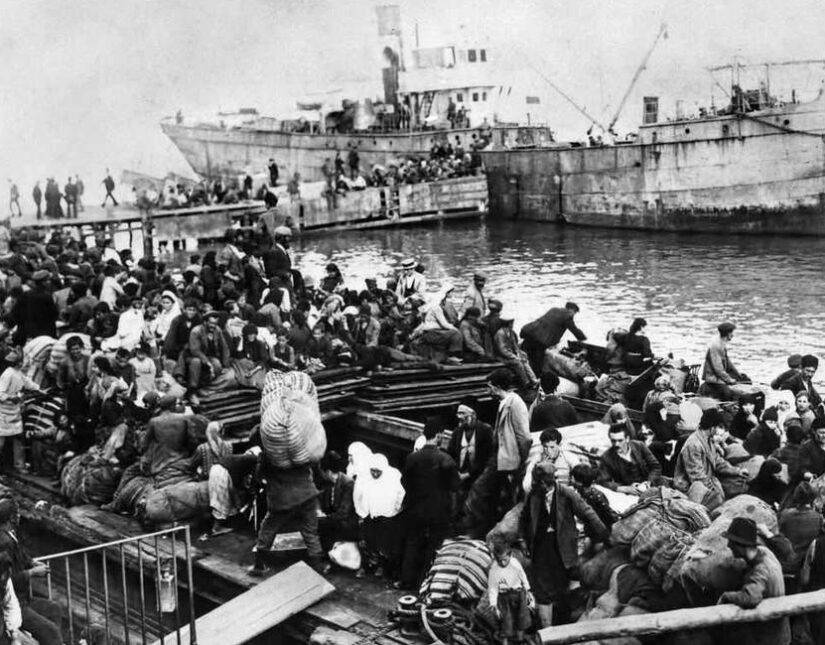
The completion of 103 years since the Asia Minor Catastrophe and the Genocide of the Greeks in Asia Minor, make the search for the causes that led to the national tragedy dramatically timely. The defeat of the Greek army in August 1922 by the Kemalist nationalists put an end to a painful historical process, during which the pre-modern, multinational, Islamic Ottoman Empire was giving way to the Turkish nation-state, to the new political form that appeared in human history with the Western Enlightenment.
With the Greek defeat on August 13, 1922 (according to the old calendar), the multi-ethnic Ottoman area was transformed exclusively into a mono-ethnic Turkish area. Those of the large Christian communities (Greeks of the East, Armenians, Assyro-Chaldeans) who were not exterminated were forced to emigrate. While the multi-ethnic and multilingual Muslim populations were forced by the new state created by Mustafa Kemal and his Young Turk comrades to transform themselves into national Turks.
The defeat of the Greeks – and consequently of the Armenians – and the Asia Minor Catastrophe were the reward for the policy adopted by the extreme right-wing Young Turks (Cemal, Enver, Talaat) who had seized power in a coup since 1908. Although the process of creating a nation-state was violent, like any form of administration that involves domination over disparate populations, some new characteristics nevertheless emerged with the Young Turks. The originality of the Young Turks was that for the first time in modern times, a power, completely coolly:
- He chooses racist criteria from the start.
- It identifies and prescribes victims.
- It shapes and spreads an ideology of hatred to others.
- It follows methods of social exclusion of targeted populations.
- In calm times, it forms and organizes parastatal mechanisms that will take on the "dirty work" when the general conditions allow.
This is exactly what Turkish nationalists did for the first time in modern times with the help of German imperialists, and it was culminated 20 years later by the Nazis.
The responsibilities for the Asia Minor Catastrophe
Mustafa Kemal would express this policy after the end of World War I, when he would form his nationalist front, harshly expelling his Ottoman opponents who rejected his nationalist agenda, as well as non-Turkish Muslim minorities who tried to articulate an autonomous discourse. After eliminating every real or potential opponent within the Muslim world, he tried successfully, despite being an anti-clerical interwar far-right, to assume the role of “gazi,” that is, the holy warrior of the Koran, and to declare jihad, that is, “holy war against the infidels.”
READ MORE
When the Asia Minors transformed Thessaloniki
With the help of the Italians and the Soviets first, the French later, the neutral stance of the USA and the British much later, he will manage to crush the Greek army, whose fighting ability had been reduced to ashes due to the policies of the monarchists, but also of the Greek communists of Pouliopoulos. The formation a negative scenario was related to a number of factors, such as:
- The abandonment of the Pontic Greeks to their fate by the People's Party governments.
- The refusal to create a local Asia Minor army at a time when tendencies towards Greece's withdrawal from Asia Minor began to prevail.
- The conflict at the highest military and political levels.
- The refusal of Ioannis Metaxas to assume the position of Chief of Staff of the Greek Army after the dismissal of Papoulas.
- The assumption of the command of the army by the limited capacity of Hatzianesti.
- The weakening of the front due to the operation to capture Constantinople.
Hemingway's correspondence
The defeat of the Greeks in August 1922 and the tragic aftermath of the Kemalist victory in September were not a fateful event, but the result of the management by the Greek political and military elites, presenting a unique opportunity for the Turks. Characteristic are the descriptions of the American writer Ernest Miller Hemingway, who covered the Greco-Turkish war in journalism. The reports are particularly important.
Regarding the politics of the monarchists and the People's Party after the November 1920 elections, he wrote: "The Greeks were first-class warriors and, certainly, several steps above Kemal's army. This is Whitall's view. He believes that the Tsolians would have captured Ankara and ended the war if they had not been betrayed. When Constantine came to power, all the Greek officers who were in command positions were immediately demoted to lower positions. Many of them had earned their stripes with feats on the battlefield. They were excellent warriors and great leaders. This did not prevent Constantine's party from expelling them and replacing them with officers who had never heard a single rifle shot. This had the effect of breaking the front."
How we arrived at the Asia Minor Catastrophe – Greek blindness and the “Allies”