

How Moscow sees the world – Russia's new foreign policy doctrine
How Moscow sees the world –
Russia's new foreign policy doctrine
The term "foreign policy" is a complex concept, which is used to denote the interaction of a state with other state or non-state regional and international actors and which includes every activity that the state undertakes in order to achieve specific goals, in order to secure its national interests. The term "doctrine" - which is found in English either as "doctrine" (found mainly in military documents) or as "concept" (found in high-level strategic documents such as NATO's Strategic Concept) - denotes the general principles that the executive bodies of a state or organization must follow when carrying out their duties. It is worth noting that the doctrine describes the final desired state to be achieved, without going into details, i.e. it provides the general framework within which the bodies involved must develop their activities.
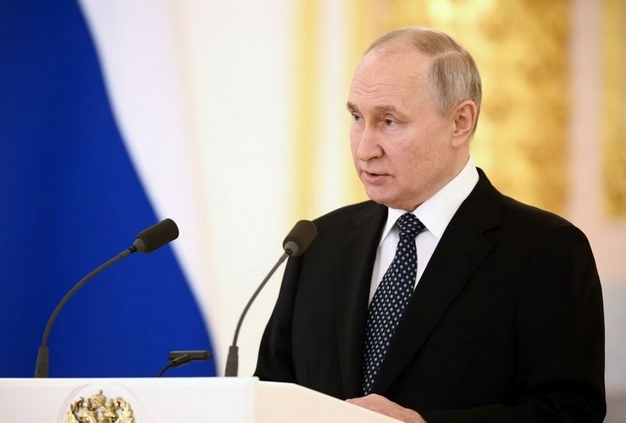
Russian President Vladimir Putin delivers a speech during a ceremony to receive diplomatic credentials from newly appointed foreign ambassadors at the Kremlin in Moscow, April 5, 2023. Sputnik/Vladimir Astapkovich/Pool via REUTERS
-------------------
Taking into account the aforementioned definitions, one understands that the Foreign Policy Doctrine is one of the Grand Strategy documents of a state, which provides the bodies of the Ministry of Foreign Affairs with the guidelines according to which they must act in their interaction with the respective representatives of other states, international organizations or institutions, in order to achieve the defined foreign policy goals. As for the Russian Federation, the most recent Foreign Policy Doctrine was published on March 31, 2023, following the signing of the relevant Presidential Executive Order No. 229 [1].
It is worth noting that this strategic document was published – in addition to Russian – in English, Spanish, and French, abolishing the immediately preceding Doctrine that had been approved by Presidential Decree 640, which had been signed on April 30, 2016 [2]. Despite the fact, however, that the time period that elapsed between these two documents is relatively long (7 years), it should be emphasized that the Russian Federation had published the National Security Strategy [2021] in 3, from which the Foreign Policy Doctrine is derived. This relationship between the National Security Strategy and the Foreign Policy Doctrine is identified in the third paragraph of the “General Provisions” part of the Doctrine, which states that “The Doctrine specifies specific provisions of the National Security Strategy of the Russian Federation and takes into account key provisions of other strategic planning documents concerning international relations” [4].
The new Foreign Policy Doctrine consists of seventy-six (76) paragraphs, which are divided into six parts. The first part (paragraphs 1-6) is entitled “I. General Provisions”, the second (paragraphs 7-14) “II. The world today: major trends and development prospects”, the third (paragraphs 15-17) “III. National interests of the Russian Federation in the field of foreign policy, strategic goals and key projects set by the foreign policy of the Russian Federation”, the fourth (paragraphs 18-48) “IV. Foreign policy priorities of the Russian Federation”, the fifth (paragraphs 49-65) “V. Regional directions of the foreign policy of the Russian Federation", while the sixth and final part (paragraphs 66-76) is entitled "VI. Formation and implementation of the foreign policy of the Russian Federation".
One of the points of the first part that need to be highlighted is that Russia defines itself as a unique "state-civilization" but also a huge Eurasian and Euro-Pacific power. It is also emphasized that its position in the world is determined by various factors, such as the fact that it is one of the five permanent members of the UN Security Council, holds a leading position in international organizations, is one of the two largest nuclear powers, as well as being the successor to the former Union of Soviet Socialist Republics (USSR). In addition, it is noted that it is one of the centers of international development, having the historical mission of maintaining the balance of power with a view to the formation of a multipolar international system. Finally, regarding its foreign policy, it is emphasized that it considers its mission to ensure peace and security at the regional and international level, but also that its stance towards other actors is a reflection of the policy [5] they pursue in relation to the Russian Federation.
THE WORLD AS RUSSIA PERCEIVES IT
The second part of the Russian Foreign Policy Doctrine begins its description of the international environment by stating that humanity is undergoing revolutionary changes, emphasizing the transition to a more egalitarian multipolar international order characterized – always according to the Russian perception – by the rise of non-Western countries and regional actors, the rapid development of technology, nationalism, and diversity. As a result, states that see their sphere of influence diminishing resort to measures such as imposing sanctions, inciting unrest and conflict, and other illegal actions in order to eliminate competition.
As for the UN, the document in question characterizes it as a puppet of a small group of states, which are trying to replace the international legal system with a rules-based international order that, however, serves their own interests and makes it difficult to develop collective actions to successfully address global challenges. In addition, the globalization of the economy has led - due to the adoption of wrong policies - to a multitude of problems and the search for new methods, such as the adoption of new reserve currencies. Another trend described in the second part is the increasing use of hard power in new fields, such as space and information.
The result of the aforementioned trends – according to the document – was the rallying of all the marginalized non-systemic states in the form of multilateral cooperation, mainly of an economic nature. As for Russia's invasion of Ukraine, the said Doctrine presents it as an action aimed at defending the vital interests of the Russian Federation, which was, however, used by the USA as an alibi for the implementation of its long-standing anti-Russian policy. It states, in fact, that Russia does not consider itself an enemy of the West, but desires cooperation on an equal and realistic basis. Nevertheless, it will defend its rights by all means, emphasizing the development of mutual cooperation with other states to defend security and ensure peaceful development.
NATIONAL INTERESTS, STRATEGIC GOALS AND KEY PROJECTS
As for the national interests of the Russian Federation, the third part of the Foreign Policy Doctrine defines - in the light of long-term trends in global development - the following nine national interests:
1. The protection of the constitutional system, sovereignty, independence, state and territorial integrity of the Russian Federation from any destructive external influence
2. Maintaining strategic stability, strengthening international peace and security.
3. Strengthening the legal foundations of international relations.
4. The protection of the rights, freedoms, and legitimate interests of Russian citizens, and the protection of Russian entities from foreign illegal interference.
5. The development of a safe information space, the protection of Russian society from destructive informational and psychological influences.
6. Preservation of the Russian nation, building human capital, improving the quality of life, and the well-being of citizens.
7. Promoting the sustainable development of the Russian economy on a new technological basis.
8. The promotion of traditional Russian moral and spiritual values and the preservation of the cultural and historical heritage of the multinational people of the Russian Federation.
9. Ensuring environmental protection, conservation of natural resources, environmental management and adaptation to climate change.
Subsequently, taking into account the aforementioned national interests as well as strategic national priorities, the document identifies the three strategic goals that the Russian Federation seeks to achieve, which are the following:
A. Ensuring the security of the Russian Federation, its sovereignty in all areas, and its territorial integrity.
B. Creating a favorable external environment for the sustainable development of Russia.
C. The consolidation of Russia's position as one of the responsible, powerful, and independent centers of the modern world.
The new Doctrine also defines fourteen individual main projects, the completion of which contributes to the achievement of the three aforementioned objectives. These are the following:
1. The formation of a just and sustainable world order.
2. The maintenance of international peace and security, strategic stability, the assurance of peaceful coexistence, and the progressive development of states and peoples.
3. Assisting the development of effective and comprehensive responses by the international community to common challenges and threats, including regional conflicts and crises.
4. Promoting mutually beneficial and equal cooperation with all foreign states and their associations that adopt a constructive stance, and the predominance of Russian interests through the mechanisms of multilateral diplomacy.
5. Countering anti-Russian activities carried out by foreign states and their associations and creating conditions conducive to the termination of these activities.
6. The establishment of good neighborly relations with neighboring states and the contribution to the prevention and elimination of tensions and conflicts in their territories.
7. Providing assistance to Russia's allies and partners in promoting common interests, ensuring their security and sustainable development, regardless of whether or not the allies and partners receive international recognition or are members of international organizations.
8. The release and strengthening of the capacity of multilateral regional associations and integration structures with the participation of Russia.
9. Consolidating Russia's position in the global economy, achieving the national development goals of the Russian Federation, ensuring economic security, and utilizing its economic potential.
10. Securing Russia's interests in the world's oceans, space, and airspace.
11. Ensuring that Russia is treated objectively abroad, consolidating its position in the international information space.
12. Strengthening Russia's role in the global humanitarian space, consolidating the position of the Russian language in the world, and contributing to the preservation of historical truth abroad and the memory of Russia's role in world history.
13. The protection abroad - in a comprehensive and effective manner - of the rights, freedoms, and legitimate interests of Russian citizens and entities.
14. Developing ties with compatriots living abroad and providing full support in exercising their rights, ensuring the protection of their interests, and preserving the pan-Russian cultural identity.
THE STRATEGIC PRIORITIES OF THE RUSSIAN FEDERATION
The fourth part of the document sets out the following nine strategic priorities:
1. The establishment of a just and sustainable international order.
2. The rule of law in International Relations.
3. Strengthening international peace and security.
4. Ensuring the interests of the Russian Federation in the World Ocean, outer space, and airspace.
5. International economic cooperation and support for international development.
6. Environmental protection and global health.
7. International humanitarian cooperation.
8. The protection of Russian citizens and organizations from foreign illegal interference, the support of compatriots living abroad, and international cooperation in the field of human rights.
9. Information support for the foreign policy of the Russian Federation.
When analyzing the above-mentioned priorities, certain positions of the Russian Federation are presented that should be highlighted. One of them is the fact that Russia seeks to ensure its cultural identity, provide equal development opportunities to states regardless of their natural characteristics [6], and create a multipolar system, eliminating the primacy of the United States and upgrading the role of Russia-friendly international organizations [7]. Another position of Russia is – despite its desire to maintain the UN as the means of shaping international law – that the acceptance of its decisions should not be binding but based on the free will of states. As for the imposition of sanctions and the exercise of pressure through various mechanisms within the UN, Russia believes that the existing system should be revised.
Russia also desires to shape a new international security architecture, within the framework of which it gives priority to strategic deterrence through the use of nuclear weapons and weapons of mass destruction (WMD). Emphasis is also placed on conflict prevention, the elimination of biological threats, information security, the fight against terrorism and organized crime, as well as the response to natural disasters. It is also mentioned that Russia faces restrictive measures from certain states regarding its maritime activities and the use of international airspace, but also that it seeks to establish itself as a leading power in space.
Regarding the economic sector, it is noteworthy that Russia seeks to reduce its dependence on unfriendly countries through the establishment of a secure and independent payment and exchange system decoupled from politics, as well as the use of sanctions as a countermeasure to Western sanctions imposed on it, a policy that it has already implemented in the recent past [8]. Regarding environmental protection, the text explicitly states that each state has the right to choose the mechanisms and methods that it considers optimal for addressing climate change, while taking care to emphasize that Russia takes into account the Climate Agreement signed in Paris on 12 December 2015.
In the field of international humanitarian cooperation, the Foreign Policy Doctrine states that a campaign of incitement of Russophobia is taking place and that in addition to countering it, the Russian Federation intends to promote the Russian language internationally, protect Orthodoxy, and implement an information campaign against neo-Nazism and extreme nationalism. The responsibility of the Russian Federation towards Russians living abroad and the protection of their rights is also highlighted as an extremely important factor, while particular importance is also given to the information support of foreign policy through countering anti-Russian propaganda carried out by specific unfriendly states.
FOREIGN POLICY BY GEOGRAPHICAL REGION
As for the directions of the fifth part of the new Foreign Policy Doctrine of the Russian Federation, they are divided into the following ten regions:
1. The near abroad.
2. The Arctic.
3. The Eurasian continent.
4. The Asia-Pacific region.
5. The Islamic world.
6. Africa.
7. Latin America and the Caribbean.
8. The European region.
9. The USA and other Anglo-Saxon countries.
10. Antarctica.
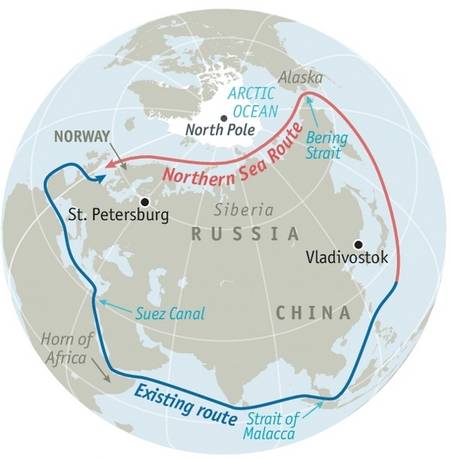
The near abroad – according to what is stated in the text – is a region of vital importance in terms of security, stability, territorial integrity and socio-economic development for the Russian Federation and includes the states of the Commonwealth of Independent States [9] with which Russia seeks to strengthen its cooperation at all levels. Regarding the Arctic, the main goal is to ensure Russia’s national interests, emphasizing the promotion of the Northern Sea Route [10] so that it becomes a main axis for transport between Asia and Europe, a goal that is also stated in the Russian National Security Strategy of 2021 [11]. In Eurasia, the Russian Federation seeks to strengthen its cooperation with both China and India, cooperations which it characterizes as of strategic importance, as well as to expand multilateral cooperative schemes with the other Eurasian states.
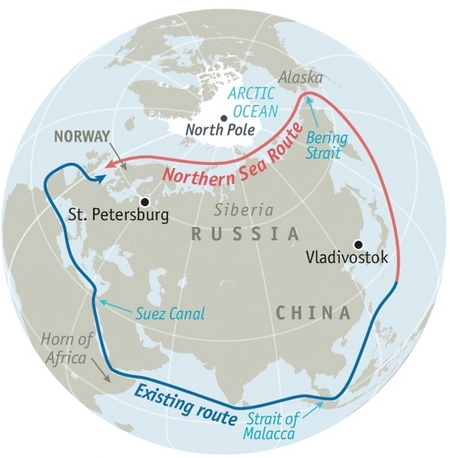
The Northern Sea Route Source: The Economist
--------------------
Furthermore, the growing value of the Asia-Pacific region is recognized, in which the states of the Association of Southeast Asian Nations [12] (ASEAN) play a dominant role, with which closer cooperation is sought. As for the geographical region of the Islamic world, the view is expressed that it is a potentially independent center of global development, while its states are characterized as reliable partners. As for the states of Africa, the new Doctrine attributes the social and economic hardship that characterizes the majority of them to the neo-colonial policies implemented by the developed states, while expressing Russia's desire to strengthen trade ties and investments in the region in question.
For the Latin American and Caribbean states, the Russian Federation recognizes the gradual increase in their sovereignty and expresses the desire to support those who are under pressure from the United States, while stating that European states are pursuing an aggressive policy towards Russia, which requires a redefinition of their relations with it. As for the United States, the text states that Russia is interested in maintaining its strategic parity and peaceful coexistence, which is based on the fact that the two countries are two of the largest nuclear powers. Finally, a brief mention is made of Antarctica, expressing the desire for it to remain a demilitarized space, taking into account the Antarctic Treaty of 1959 [13].
The new Foreign Policy Doctrine of the Russian Federation is completed with its sixth part, which refers to the dominant role of the Russian President in providing general directions for the formulation of foreign policy, as well as the role played by other state bodies. According to this, the Federation Council and the State Duma of the Federal Assembly of the Russian Federation are the responsible institutions for shaping the legal framework of foreign policy, the Government takes measures to implement foreign policy and international cooperation, the State Council participates in the development of strategic projects and goals, assisting the President in his duties, the Security Council [14] is the body par excellence competent in matters of national security, the Ministry of Foreign Affairs develops the general foreign policy strategy, and the Federal Service for Affairs of the Commonwealth of Independent States, Compatriots Living Abroad, and International Humanitarian Cooperation operates in support of the Russian Ministry of Foreign Affairs.
OBSESSION WITH THE GREAT POWER STATUS
One of the main conclusions drawn from the contents of Russia’s new Foreign Policy Doctrine concerns the perception prevailing at the highest levels of leadership regarding the position of the Russian Federation among other international actors and the role it is called upon to play in the international order. In other words, Russia “sees itself” as the successor to an empire – hence the reference to the former USSR – which for decades was the formidable rival of the United States in the bipolar system that prevailed during the Cold War. This is the main reason why it stubbornly refuses to abandon the role of “Great Power”, despite the fact that it perceives the rise of other international actors and the transition to a multipolar international order.
The reference in the second part of the document to the effort of some states to eliminate competition directly refers to the latest US National Security Strategy in which two of the global priorities set are “out-competing” China and “constraining” Russia [15]. The same concept is also presented in the latest Strategic Concept [16] of the North Atlantic Alliance adopted by its member states at the Summit held in Madrid between 28-29 June 2022 [17], in which Russia is characterized as “[…] the most significant and immediate threat to the security of the Allies and to peace and stability in the Euro-Atlantic area” [18].
Throughout the document, there is also an attempt by Russia to “legitimize” its actions, presenting them as the inevitable result of the irresponsible and opportunistic policies implemented by Western states against it for years. The reference to Russia’s contribution to the peaceful development of other states can be seen as a reference to China’s “Peaceful Development” Doctrine [19], the main implementing body of which is the “Belt and Road” Initiative [20]. As mentioned above, the fifth part of the new Doctrine states that Russia wishes to strengthen the strategic importance of its cooperation with China, a goal that was sealed by the recent meeting of the two leaders in Moscow in March 2023 [21].
Russia’s reference to providing support to allies and partners – regardless of whether or not they receive international recognition or are members of international organizations – should also be seen as a clear statement of continued support for the Lugansk and Donetsk People’s Republics, with which the Russian Federation has signed a Treaty of Friendship, Cooperation, and Mutual Assistance [22], on the basis of which it invaded on 24 February 2022 in order to protect these – internationally unrecognized – entities [23]. Furthermore, the importance of the sea, space, airspace, and the information sphere for Russia should be emphasized. Specifically regarding the latter, the NATO Strategic Communications Center of Excellence characteristically points out that “[…] Russia perceives the intelligence sector in geopolitical terms, with the domestic intelligence sector representing a continuation of its state borders, which it considers to be constantly violated by foreign invaders […]” [24].
Regarding the first strategic priority of the Russian Federation, what is discernible is an insecurity regarding its development potential, which obviously stems from the awareness of the limitations imposed by its geographical location and which it attempts to reverse through the development of partnerships. The reshaping of the international system that Russia seeks is in essence a system favorable to it which will allow it to upgrade its role in international affairs and secure its national interests.
It is also observed that Russia continues to use the extreme rhetoric of nuclear use as the main means of deterrence, is in a constant effort to circumvent Western sanctions, and control the economy through the “imposition of its own terms”, but also how it uses the – according to Joseph Nye – soft power of language and religion in order to exert a positive influence on other actors and change the balance of power in its favor. The campaign against neo-Nazism and extreme nationalism promoted through the new Foreign Policy Doctrine is not surprising, as it was the main reason put forward by Russia for its invasion of Ukraine [25].
For the eighth strategic priority, namely the support of compatriots living abroad, the large number of Russian speakers residing in all the current states that were formerly member states of the former USSR should be taken into account. This means that Russia may use as a justification for any form of intervention in some of these states the protection of Russian citizens residing there, as it did in Ukraine. Also noteworthy is Russia’s pursuit of commercially and economically exploiting the Arctic region, a goal that is now becoming more feasible due to the impact of climate change. However, there may be tensions in this region as well, as a similar interest has been expressed by the US in the latest National Security Strategy published in October 2022 [26].
It should also be expected that Russia will develop closer cooperation with India [27] - an action that has become even more important for Russia after its invasion of Ukraine and the imposition of sanctions by almost all Western states - as well as with the states of ASEAN, the African continent, Latin America, and the Caribbean, which are expected to fill the gap left by the cessation of Russia's trade and economic cooperation with Western states. In any case, the new Foreign Policy Doctrine of the Russian Federation (will) have to be studied by the leaderships of the remaining states in order to shape their own foreign policy accordingly.
REFERRALS:
[1] The Ministry of Foreign Affairs of the Russian Federation. "Press release on the publication of the Concept of the Foreign Policy of the Russian Federation on the official website of the Ministry of Foreign Affairs of Russia". 31 March 2023. https://mid.ru/en/foreign_policy/news/1861023/ (accessed 06/04/20230).
[2] President of Russia. "Executive Order approving Russia's Foreign Policy Concept". 31 March 2023. http://en.kremlin.ru/events/president/news/70811 (accessed 06/04/20230).
[3] Pikramenos Kostas & Koukakis Georgios. “National Security: Myths and Reality”. Athens. Infognomon. 2023. pp. 59-60.
[4] The Ministry of Foreign Affairs of the Russian Federation. "The Concept of the Foreign Policy of the Russian Federation". 31 March 2023. https://mid.ru/en/foreign_policy/fundamental_documents/1860586/ (accessed 06/04/20230).
[5] Constructive, neutral or unfriendly.
[6] Geographically, demographically, wealth-producingly, militarily, politically, economically and socially.
[7] Such international organizations are the BRICS states, the Shanghai Cooperation Organization, the Commonwealth of Independent States, the Eurasian Economic Union, the Collective Security Treaty Organization, etc.
[8] Demarais, Agathe. “The End of the Sanctions Era?” Foreign Affairs-The Hellenic Edition, December 29, 2022. https://www.foreignaffairs.gr/articles/73965/agathe-demarais/to-telos-ti… (accessed on January 04, 2023).
[9] Britannica. "Commonwealth of Independent States". 20 March 2023. https://www.britannica.com/topic/Commonwealth-of-Independent-States (accessed on 08 April 2023).
[10] The Economist. "What is the Northern Sea Route?". 24 September 2018. https://www.economist.com/the-economist-explains/2018/09/24/what-is-the-… (accessed on 08 April 2023).
[11] Pikramenos Kostas & Koukakis Georgios. “National Security: Myths and Reality”. Athens. Infognomon. 2023. p. 59.
[12] Britannica. "ASEAN". 20 March 2023. https://www.britannica.com/topic/ASEAN (accessed on 08 April 2023).
[13] Britannica. "Antarctic Treaty". 24 November 2022. https://www.britannica.com/event/Antarctic-Treaty (accessed on 08 April 2023).
[14] Pikramenos Kostas & Koukakis Georgios. “National Security: Myths and Reality”. Athens. Infognomon. 2023. pp. 54-55.
[15] Koukakis Georgios. "The National Security Strategy of the USA: Background, Recent Developments and Future Considerations Regarding the International Security Environment". HAPSc Policy Briefs Series. 3(2), pp. 122-132. https://doi.org/10.12681/hapscpbs.33792 p. 127 (accessed 07 April 2023).
[16] Koukakis Georgios. "The 2022 NATO Madrid Summit: Background, key decisions, and future considerations". “HERMES” Institute of International Affairs, Security & Geoeconomy. Briefing Note No. "2/2022". September 2022. p. 4. https://nebula.wsimg.com/214630f378f315f99c8a8a245d889bc1?AccessKeyId=40… (accessed on 8 April 2023).
[17] North Atlantic Treaty Organization. "NATO 2022 Strategic Concept". 29 June 2022. p. 4.
[18] Koukakis Georgios. «The Evolution of NATO's Strategic Concept». NRDC-GR HERALD. Issue 19 (July-December 2022). pp.34-40.https://nrdc.gr/wp-content/uploads/2023/02/NRDC-GR-Herald-Magazine-Issue-19-LQ.pd (accessed 8 April 2023).
[19] Pikramenos Kostas & Koukakis Georgios. “National Security: Myths and Reality”. Athens. Infognomon. 2023. pp. 74.
[20] The Economist. "What is China's belt and road initiative?". 15 May 2017. https://www.economist.com/the-economist-explains/2017/05/14/what-is-chin… (accessed on 08 April 2023).
[21] CNN World. "No path to peace: Five key takeaways from Xi and Putin's talks in Moscow". 22 March 2023. https://edition.cnn.com/2023/03/22/europe/china-xi-russia-putin-talks-fi… (accessed on 08 April 2023).
[22] Koukakis Georgios. “Ukraine: Using peace as a weapon”. Center for International Strategic Analyses (KEDISA). February 22, 2022. https://kedisa.gr/oukrania-chrisimopoiontas-tin-eirini-os-oplo/ (accessed on 08 April 2023).
[23] Koukakis Georgios. “Has Russia fallen into Thucydides’ trap?” Center for International Strategic Analyses (KEDISA). April 28, 2022. https://kedisa.gr/mipos-i-rosia-piastike-stin-pagida-tou-thoukydidi/ (accessed on 08 April 2023).
[24] Hakala Janne & Melnychuk Jazlyn. "Russia's Strategy in Cyberspace." NATO Strategic Communications Center of Excellence. 11 June 2021. p. 7. https://stratcomcoe.org/publications/russias-strategy-in-cyberspace/210 (accessed 07/04/2023).
[25] Kathrin Wesolowski. "Is there any truth to Russia's 'Ukrainian Nazis' propaganda?". Deutsche Welle. 12 March 2022. https://www.dw.com/en/fact-check-is-there-any-truth-to-russias-ukrainian… (accessed on 08 April 2023).
[26] Pikramenos Kostas & Koukakis Georgios. “National Security: Myths and Reality”. Athens. Infognomon. 2023. p. 52.
[27] Zeeshan Mohamed. "Is a New Russia-China-India Bloc Forming in the East?". The Diplomat. 04 April 2023. https://thediplomat.com/2023/04/is-a-new-russia-china-india-bloc-forming… (accessed on 08 April 2023).
Copyright © 2023 by the Council on Foreign Relations, Inc.
All rights reserved.
You can follow "Foreign Affairs, The Hellenic Edition" on TWITTER at www.twitter.com/foreigngr as well as on FACEBOOK at www.facebook.com/ForeignAffairs.gr and on LinkedIn at https://www.linkedin.com/company/foreign-affairs-the-hellenic-edition