


The Greek Islands, Island Groups and Islets of the Aegean and the Treaties: A Comprehensive Summary.
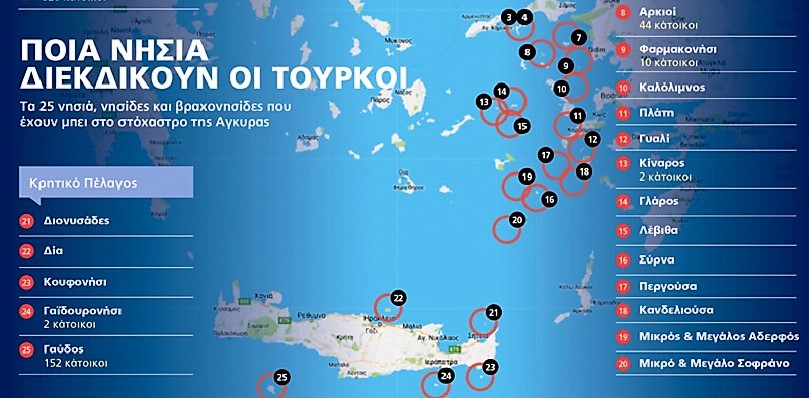
An excellent, comprehensive, complete information about our islands, island complexes and islets, along with the conditions, from our friend Pavlos Photiou. It is worth reading!
Because Turkey is conducting a systematic campaign with official statements and the news has been flooded with its long-known claim to the territories of islands and rocks in the Aegean, it is useful to remember, very briefly for the space of this page, that:
According to the international agreements and treaties that followed the country's struggle for independence in 1821 and after the national liberation of the mainland territories and islands:
1. With the London Protocol of 1830, Greek sovereignty over Euboea, the Northern Sporades and the Cyclades is recognized de jure.
2. In November 1912, the Greek Fleet liberated and conquered the northern Aegean islands of Lemnos, Samothrace, Psara, Thassos, Agios Efstratios, Imbros and Tenedos.
3. In December 1912, the islands of Ikaria, Mytilene and Chios were similarly liberated and occupied.
4. Samos, which had been under a regime of autonomy since the time of the liberation struggle, was incorporated into Greece in March 1913.
5. In May 1913, with the Treaty of London, the collapse of the Ottoman Empire and the fait accompli in the Balkans were recognized de jure. Thus, the Ottoman emperor ceded all the territories he had conquered on European soil, west of the line of Ainos (a village at the mouth of the Evros River) and Medea (a village on the Turkish coast of the Mediterranean Sea).
At the same time, the Treaty of London places Crete at the disposal of the then Balkan allies (Greece, Serbia, Bulgaria), who subsequently decide to cede it to Greece.
6. In February 1914, with the London Conference, the Governments of the 6 (then) Great Powers (Germany, Austria-Hungary, France, Great Britain, Italy), now recognize de jure Greek sovereignty over all the islands of the Aegean, and even ask Greece to return the islands of Imbros, Tenedos and Kastelorizo to Turkey.
7. With the Treaty of Sèvres of 1920, although this text was never implemented because the treaty did not enter into force, Greek sovereignty over all the island complexes of the Aegean except the Dodecanese was once again recognized, a situation which did not change after the events of the Asia Minor catastrophe of 1922.
8. With the Treaty of Lausanne of 1923, all the arrangements determined by the above agreements and treaties acquire a definitive character since, with the signature of Turkey, the collapse of the Ottoman Empire is now recognized de jure and almost all territories return to the states that belonged to them before their conquest.
This Treaty stipulates:
a) Article 12: "The decision taken on 13 February 1914 by the London Conference in execution of Articles 5 of the Treaty of London of 17/30 May 1913, and 15 of the Treaty of Athens of 1/14 November 1913, notified to the Greek Government on 13 February 1914 and concerning the sovereignty of Greece over the islands of the Eastern Mediterranean, with the exception of Imbros, Tenedos and the Lagos Islands (Maury), namely the islands of Lemnos, Samothrace, Mytilene, Chios, Samos and Ikaria, is ratified, subject to the provisions of the present Treaty relating to those under the sovereignty of Italy." constituting islands, as referred to in Article 15. Except as otherwise provided in the present Treaty, the islands situated at a distance of less than three miles from the Asiatic coast shall remain under Turkish sovereignty."
b) Article 15: "Turkey renounces in favor of Italy all rights and title over the islands listed below, namely Astypalaia, Rhodes, Chalki, Karpathos, Kassos, Tilos, Nisyros, Kalymnos, Leros, Patmos, Lipsi, Symi and Kos, currently occupied by Italy and the islets dependent on them, including the island of Kastellorizo."
c) Article 16: "Turkey declares that it renounces all title and right of any kind over or in relation to the territories which lie beyond the limits provided for by the present Treaty, as well as over those islands whose sovereignty has been recognized by the present Treaty, the fate of which has been or will be settled between the parties concerned."
9. With the Italo-Turkish Treaty of 1932, in implementation of which a relevant protocol was concluded between the two states, a border line was drawn from the southern cape of Samos to Kastelorizo, taking into account explicitly and categorically the rule of three (3) nautical miles defined by the Treaty of Lausanne of 1923 in the demarcation of the borders of the Dodecanese (at that time an Italian possession)
10. In 1947, with the Paris Peace Treaty (article 14), Italy renounced in favor of Greece the Dodecanese and the adjacent islets.
The sovereignty dispute that has been raised and is being presented by Turkey over the Islands and Rocks of the Aegean Archipelago concerns those that are not mentioned by name but are simply mentioned as adjacent to the main islands, in any of the above legal texts - agreements, treaties.
It is a fact that the older texts, up to the Treaty of Paris 1947, did not attach much importance to the detailed description and recording of the ceded island complexes, because at that time the States were most interested in the recognition and settlement of sovereignty over the main and inhabited islands, while the mention of the adjacent rocks or islets was of no interest either to the drafters of the treaties, or to the States themselves.
Because similar concerns have existed in other regions, international judicial bodies and special arbitrations have ruled from 1928 to 1953, in various similar cases, that possession of the larger island also implies possession of the adjacent smaller one, and in cases of clusters of islands, sovereignty over the main island is followed by sovereignty over the nearby smaller ones.
Pavlos G. Photiou