

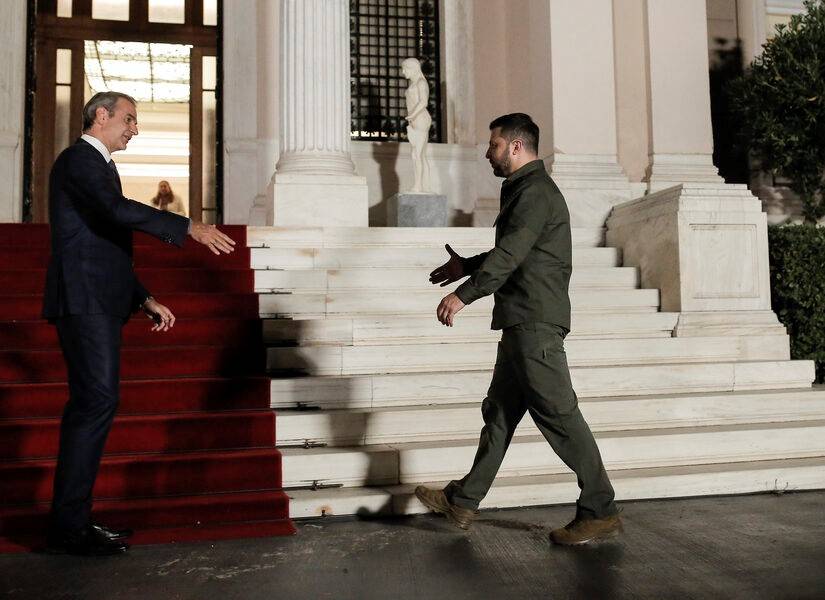
What does Mitsotakis' new openness to Zelensky hide?
 GEOPOLITICAL
 True friendship in life is a precious gift. Foreign policy, however, is not governed by the same principles. Or as Lord Palmerston put it: “nations have no permanent friends or enemies. They only have permanent interests.” The principle, which has remained more or less the same since the 19th century, is based on the identification of interests between nation-states and on a logic that works multiplyingly in terms of benefits for individual state actors. Let us remind Kyriakos Mitsotakis that Greece is no exception.
Leaving theory behind us and coming to the specific analysis of the specific situation – to recall the classics – we could ask ourselves what benefit the Mitsotakis government’s continued identification with Kiev has. The timing could not be worse. The communication between the two leaders alone raises questions about the benefits that the Greek side can derive, especially at a time when Zelensky’s chair is “creaking.”
Already, given that the scales of war have tipped definitively in Moscow's favor and Washington is reluctant to give money and weapons to Kiev for free, the idea of removing Zelensky is brewing in the West in order to facilitate peace while there is still time. However, reading the Ukrainian president's post on X, which states that the leaders of the two countries discussed ways to strengthen Ukraine 's air defense , as well as the country's recovery, further questions arise.
The first is why and how can Greece further strengthen Ukraine's air defense? It is worth recalling that the Mitsotakis government had already "taken care" of the partial demilitarization of the Aegean islands, donating RM-70 rocket launchers to Kiev , thus weakening Greek defense and at the same time fulfilling a long-standing Turkish demand. This kind concession was added to 3,2 million 7,62 mm cartridges, 60 STINGER anti-aircraft missiles, 17.000 155 mm artillery shells and 1.100 RPG portable anti-tank missiles, 40 BMP-1 TOMAs, 25.000 KALAZNIKOV rifles, etc., that Athens has granted to Ukraine.
Will we buy weapons for Ukraine?
Instead of commenting, the Ukrainian president explains: "I spoke about a new mechanism for purchasing American weapons, which we are implementing jointly with NATO member states. The contribution of each country can really strengthen our defense goals." In other words, will the Greek economy be burdened by purchasing American weapons, in order to strengthen the collapsing Ukrainian defense? And this, when Greece is facing a declared and acute threat from Turkey?
As in the recent past, so now, the intention of the Mitsotakis government is made known not by itself but by the interested party, by President Zelensky. This fact constitutes an unacceptable practice for a democratic regime. It is noteworthy that there is not the slightest accountability for how the Greek government intends to replace the weapons systems that will travel to Ukraine. And above all, what is the purpose of Greece's contribution to a war that seems irretrievably lost.
The second question arises from the published information that the Prime Minister presented a proposal for the recovery of Ukraine, in particular the restoration of the port infrastructure of Odessa. One wonders whether the Greek Prime Minister’s ambition to export “innovation” is as sincere as his willingness to strengthen Ukraine’s defense at the expense of Greece, or whether this is an empty promise. During his speech at the Conference on the Reconstruction of Ukraine in Rome, however, he also delivered lessons in economic liberalism abroad. “Public funding alone is not enough. We must fully integrate the private sector.”
Mitsotakis's IX foreign policy
But what drives Kyriakos Mitsotakis at this juncture to want to support a lost cause and a president whose circle – it is a common secret – is steeped in corruption, and even with his own tolerance and that of “his replacement” Yermak? The answer lies in the selfish interests that characterize every aspect of Kyriakos Mitsotakis’ political behavior. First and foremost, in his ambition to “exchange” his anti-Russian fervor for some high-ranking position in the EU. This is a “foreign policy IX” that is extremely beneficial on a personal level, but detrimental to national interests.
It is good to draw relevant conclusions from Greek history, which is not so distant in 2025. In the summer of 1920, Greece, with the Treaty of Sevres, took Eastern Thrace, Imbros, Tenedos and the administration of Smyrna. Three years later, with the Treaty of Lausanne, it lost them, after the Asia Minor Catastrophe preceded it, which sent six political and military leaders to the firing squad.
What changed between the two Treaties and led from the triumph of participation in World War I to the tragedy of the Asia Minor Catastrophe was the dispositions of the Great Powers. If we look for a similar example in our days, we will find it in Ukraine. Returning to the original statement of the British politician, Greece must adapt its interests and friendships to today's changing world, which is multipolar and much more fluid than the legacies of the Cold War. However, this presupposes a different type of foreign policy and by extension a different type of political leadership...